
Please watch my interview with Elizabeth Lo to get a deep dive into her new film “Mistress Dispeller”
Making a documentary following a cheating husband, an angry wife, and the husband’s girlfriend in real time seems implausible. What couple would allow cameras into their private drama? Why would the mistress agree? (Watch at 44:30) Especially in China, where privacy around family matters is paramount.
Enter Elizabeth Lo’s new film, Mistress Dispeller, where she got access to follow an aggrieved Chinese wife, Mrs. Li, who hires a “mistress dispeller” to break up her husband’s affair. Mistress dispellers are an emerging profession in China, and their jobs are to break up affairs and then to reunite married couples. (Watch at 22:00 for more on this)
The mistress dispeller Mrs. Li hires, Wang Zhenxi (Teacher Wang), turns out to be a brilliant operator—part therapist, part master manipulator—who we watch turn liars back into lovers all while healing (or at least smoothing over) the souls of all involved.
While this all sounds too good to be true, it might just be.
The film reveals how Teacher Wang’s methods lead to a moment of catharsis in the film that was hard for me, and many viewers, to square. In fact, in test screenings, so many people thought the film was fiction that Lo added text cards at the front and back stating the film is nonfiction. (16:28)
But as I have since learned from closely watching the film and talking to Liz about it, my discomfort with the way the characters “acted” belied my own cultural bias and expectations about how human behavior.
In China, divorce is never really an option. Instead, in a society that prizes the common good over individual happiness, the way the participants behave in the film looks forced because, in a way, it is. And that's the point. They are behaving in a way that serves them culturally and socially, even if it isn't true to what their inner experience might be. If you watch the film closely, the interplay between brief glimpses of their unguarded thoughts and actions contrasted with their very appropriate ones makes us think about how we all 'behave' versus how we actually feel on the inside. We are all actors in our own lives, trying to survive (and thrive!) amidst the rules and expectations of our cultures. (37:10)
Indeed, Lo shared that audiences in different part of the globe react to the film differently.
“Oftentimes audiences will be baffled by the husband’s choice to stay and the wife’s choice to stay. Whereas when I’ve shown the film in Asia, it’s sort of a given that this is how it would unfold. And I think that maybe has to do with Asia being a more collectivist culture in which people sacrifice personal desires for a perceived greater good. Whereas in the West, in a more individualistic culture, the pursuit of your own personal happiness is paramount, even if it comes at the expense of others. That cultural difference has come into play in how people interpret the film.”
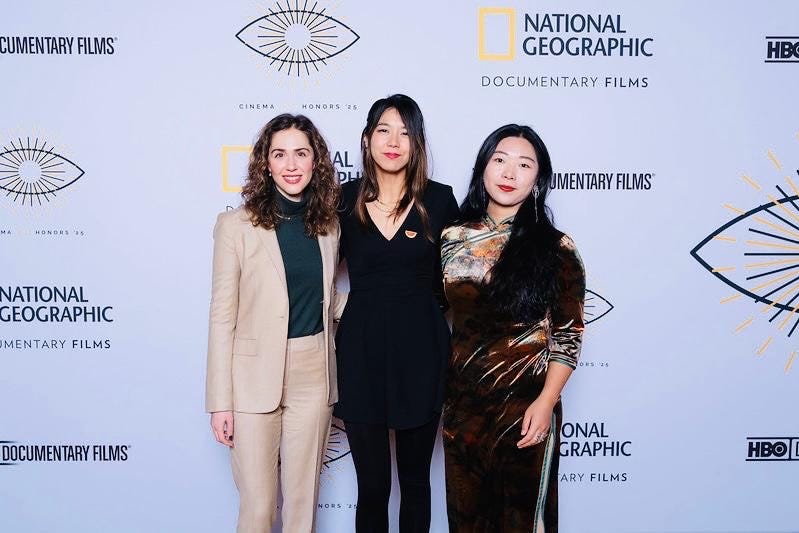
Lo is a citizen of Hong Kong who has spent much of her professional life in the United States. We met in 2015 when she submitted her short Hotel 22 about an all night Silicon Valley bus line to The New York Times Op-Docs. (Watch our chat from the start to hear about how the short launched her career.) She has now made films in the U.S., Turkey, and this movie is her first film set in China. “I really wanted to show audiences this side of China, a portrait of domestic life, and also for me to get to know this culture and country that was both foreign to me, but also close to my roots.”
The film ends up being both universal and a very uniquely Chinese picture of modern love. As the story shifts our sympathies between husband, wife and mistress it takes audiences through a story that is both captivating to watch but also not as it seems at first blush.
My favorite story in our interview is when Lo explains how she gained the trust of the subjects in the film—twice. It’s not a pat narrative, but in short she both got their permission at the start, and then once again at the end because of the ethical considerations of documenting such an series of intimate betrayals on the part of all involved.
The ‘truth’ is always shifting, and it’s up the a filmmaker to make sure her nonfiction film captures the truth in the most honest way possible.
Watch Mistress Dispeller on your favorite digital rental platform and watch to see if it wins an Oscar nomination in the coming weeks.
P.S.
Elizabeth Lo told her own story of love and heartbreak to Modern Love. It’s a wonderful, intimate tale about her own love life and how Teacher Wang changed it.
There is a well known quote from Picasso that says "Art is a lie that tells the truth." Here is the whole quote in it’s shinning glory…
“We all know that Art is not truth. Art is a lie that makes us realize truth, at least the truth that is given us to understand. The artist must know the manner whereby to convince others of the truthfulness of his lies... I would like to know if anyone has ever seen a natural work of art. Nature and art, being two different things, cannot be the same thing. Through art we express our conception of what nature is not.”
— Picasso approved this statement made in Spanish to Marius de Zayas, before it was translated and published as Picasso Speaks in The Arts. New York, May 1923.
My podcasts episode of the week is from “Who’s Afraid of Realism? A Close Readings podcast from the London Review of Books” on ‘Madame Bovary’ by Gustave Flaubert. The discussion of whether or not the ‘real’ gets in the way of the truth is as pertinent as ever.
Comments
Nothing yet. Say the first thing.
Sign in to join the conversation.