
Today I spoke to Sara Khaki and Mohammadreza Eyni, the co-directors (who are also married to each other) of Cutting Through Rocks. The film premiered at the 2025 Sundance Film Festival, where it won the World Cinema Grand Jury Prize for Documentary, and is now the first Iranian documentary ever nominated for an Oscar. Even so, unsurprisingly the film does not have U.S. distribution.
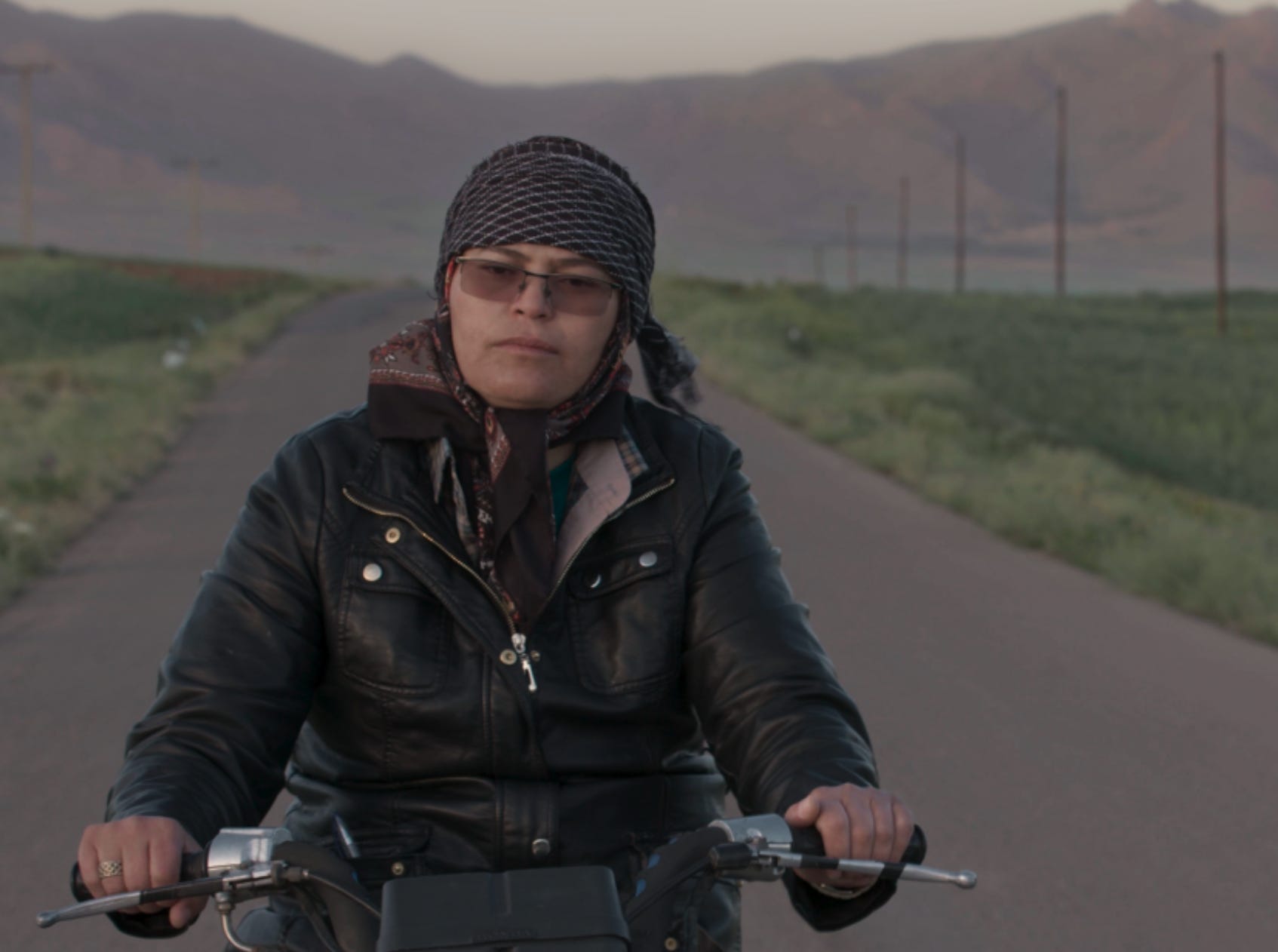
We watch as she drills the heavy frame into place with her bare hands, then maneuvers a giant log to force it into alignment. Most people, male or female, could not complete such a task solo. In the next scenes, we watch her negotiate a fierce family dispute, fighting to protect her sisters’ inheritance from their brothers’ attempts to claim it. And then we find out she is going to run for office in her traditionally male-controlled village, and is the first woman to ever even try to do so. She is beyond impressive. She is tireless and fearless.
But ultimately this isn’t a film about hard work paying off. Shahverdi’s ability to succeed has nothing to do with her work ethic but her ability to imagine a different world than the one she sees in front of her. Without that vision, no amount of sweat equity will change anything.
And that idea of imagination is also what drove director Sara Khaki to spend seven years making the film.
Khaki, who was born in Tehran and has spent much her life in the United States, came up with the idea for the film after searching for stories about women claiming their power in Iran.
“In my family, in my extended family, there were always women who really paved the way and cleared the path for the next generation, for their siblings.” When she learned of Shahverdi she knew she had found her subject. She brought in Mohammadreza Eyni, who is from the same region of Iran as Shahverdi, to co-direct. It was a partnership that was essential, since neither director alone could have gained access to villagers of the opposite gender.
As Eyni told me, “If you want to understand what is happening now in the streets of Tehran, one of the stories that can give you a better understanding — I can say — is watching Cutting Through Rocks.”
Khaki put it this way: “As filmmakers and storytellers, we find a responsibility to dedicate our lives and have enough patience to try to tell stories that go beyond the headline news. Sometimes what we hear as Iranians, what we hear from the US and vice versa, really just ends up on the headline news and we don’t get to have the privilege of connecting on a human level. And movies, stories, and cinema is really the only true connector on a human level.”
Watch the full conversation above.
Thank you Penny Lane, Joel Drazner – No Point B!, Sasha Santiago, and the other fabulous people for tuning into my live video with Mohammadreza Eyni and Sara Khaki!
P.S.
There is so much to unpack about the news that Paramount will buy Warner Bros/Discovery for Hollywood. But the part that I find the most unsettling is what it means for the fate of CNN. From the most read newsletter Status:
“At this stage, CNN staffers have every reason to be worried about the future. What is unfolding is plain as day. Trump, who has despised CNN more than any other institution throughout his political career, wants to neuter the network. He wants to break it. And that is precisely why his administration did everything it could to tilt the scales against Netflix and in Ellison’s favor.”
I rewatched American Beauty on a recent flight. It holds up. Yes, it sexualizes a teenage girl in a totally inappropriate way but it also confronts and redeems that depiction in a way that feels realistically human without being too tidy. And the dysfunction of every character is a good reminder that American life was already a total mess long before social media and AI came along.
This American Life’s episode on “Kid Logic” made me think about how disinformation campaigns really work. Our brains don’t like to be misled so it’s easier to keep believing in the tooth fairy than to admit when you have been duped at any age.
Need a break? Keith McNally’s memoir I Regret Everything— the story of how he went from washing dishes to owning New York institutions like Odeon, Pastis, and Balthazar — is a genuine romp. McNally is surprisingly perceptive about his own life, owning his shortcomings while somehow still coming across as a sweet man doing his best despite being, by his own admission, a bit of a mess. I listened to the audiobook, read by actor Richard E. Grant, whose flourishes make it even more enjoyable — highly recommended.

Available for iOS and Android
Comments
Nothing yet. Say the first thing.
Sign in to join the conversation.