
Komal Sri-Kumar has been advising multinational and sovereign funds for the past 17 years as head of Sri-Kumar Global Strategies, a macroeconomic consulting firm in Santa Monica, and prior to that since 1990 working at the likes of TCW, Trust Company of the West, and Drexel Burnham Lambert, among others.
So when a bond market selloff hits the U.S. and financial markets around the world, and the U.S. Treasury secretary jumps into the fray announcing that he is expanding a U.S. government bond repurchase program — which dates back to the Clinton Administration — it’s time to ask what is going on here? And when Kevin Warsh is about to deliver his first speech on Federal Reserve policy in Jackson Hole next week at the Kansas City Fed’s annual conference, who better to turn to than someone who has ridden fixed income waves through many financial rough waters?
Sri-Kumar is quick to dismiss Scott Bessent’s decision to expand the President Clinton-era bond repurchase program, the announcment of which was enough to quickly push U.S. treasury bond yields down by about 10 basis points from their recent highs.
”I call it a Band-Aid. Does a Band-Aid work? Sure. If a person is hurt and you put a Band-Aid on top of it, it protects the the damage for a couple of days, but it doesn’t cure it — the same way here,” he says. “What he is doing brought the interest rates down. It may bring the yield down even further over the next couple of days, but eventually the markets are going to see that this is just an intervention.”
So what does matter to markets and to the U.S. economy? Sri-Kumar sees a big divide in the past few weeks between the U.S. stock market which has rallied since the Fed’s July policy meeting where the Fed did not raise interest rates and the U.S. bond market has seen yields rise. He sees Warsh’s high profile speech where he opens the Federal Reserve Bank of Kansas City’s annual conference as a potential game changer.
“There is very little he can do to reassure <markets> but he has to try. And let me tell you why the speech is so critical. If he comes up again, and as he did in his first two meetings... every time the answer was, I have to bring inflation down. It’s a very big problem, but I’m not going to tell you how I’m going to bring down inflation... If he repeats that mantra on Friday, the market, the bond market is going to take a dive.” Bottom line? “He has to say very clearly, not only I am concerned about inflation…In addition to that, I’m going to actually increase interest rates because the alternative... that he has been talking about shrinking the balance sheet…that won’t work if you shrink the balance sheet as an anti-inflation device that causes some kind of a financial accident.” Sri-Kumar also casts his critical eye on Secretary Bessent’s move to use a Federal Reserve repo facility to help Japanese officials intervene to support their beleagured yen. ”
Spoiler alert: What does it do to inflation?
”I guess the Secretary doesn’t care because he badly wants the yen to be supported so that they don’t sell U.S. treasuries. But meanwhile the fundamentals are left to take care of themselves, ” Sri-Kumar says. “The Fed balance sheet is increasing. Now what needs to happen here is for the Treasury not to interfere with the Fed, that this is clearly Treasury trying to dominate over the Fed.
U.S. response is to be a facilitator 00:21:55:18
They don’t. Instead, they are trying to depend upon intervention in the market to support the yen, which is weakened phenomenally since the beginning of 2026. What does the United States Treasury do? Instead of advising the Japanese to increase interest rates and take care of your own household yourself? They intervene and say, we cannot allow you to sell US treasuries to support your currency.
Treasury repo plan undermines Warsh balance sheet objective 00:22:27:14
That will raise interest rates for US consumers. So I’m going to say that let’s have the fed intervene and start to repurchase facility, which is known by its acronym as FIMA. The new policy that Scott Beasant is asking the Fed to pursue. What does that mean? The Fed wants to reduce the balance sheet. This new repurchase facility will expand the Fed’s balance sheet.
Fed and Treasury are at odds/Is Fed independence at stake? 00:22:57:12
What does it do to inflation? I guess the Secretary doesn’t care because he badly wants the yen to be supported so that they don’t sell U.S. treasuries. But meanwhile the fundamentals are left to take care of themselves. Inflation is unaffected. The Fed balance sheet is increasing. Now what needs to happen here is for the Treasury not to interfere with the Fed, that this is clearly Treasury trying to dominate over the Fed. The Fed’s independence, which we have cherished for 75 years, may be lost if Kevin Warsh listens to Bessent. And rather than fashion monetary policy to combat inflation, he is going to actually use it for currency intervention and supporting the Secretary’s policies.
Share Kathleen Hays Presents: Central Bank Central
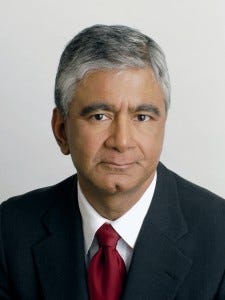
Dr. Komal S. Sri-Kumar is President of the Santa Monica, California based Sri-Kumar Global St rategies, Inc., a macroeconomic consulting firm he formed in January 2013 to advise multinational firms and sovereign wealth funds on global risk and opportunities. Prior to founding the firm, Sri worked at the Los Angeles-based Trust Company of the West (TCW) from 1990 to 2012, serving for the last several years as the firm’s Chief Global Strategist.
He was the Chairman of TCW’s Comprehensive Asset Allocation Committee from 1997 to 2015. The Four-Morningstar rated TCW Conservative Asset Allocation Fund that he was a manager of (TGPCX) was rated “Category King” by the Wall Street Journal for performance as of September 30, 2015. The fund was ranked First among 365 similar funds.
Before his work at TCW, Sri was Senior Vice President at the Beverly Hills-based Drexel Burnham Lambert, and Executive Vice President of DBL Americas, specializing in country risk analysis.
He is a Senior Fellow at the Milken Institute, and was a member of the Columbia University Graduate School of Arts and Sciences Alumni Board. He is a member of the Economic Club of New York. His articles and interviews have been published in the Financial Times, Wall Street Journal and the New York Times. He is often interviewed on CNBC, Bloomberg Radio and TV, and Fox Business. Sri is a contributor to Bloomberg View on global macro issues and their impact on markets (www.bloombergview.com).
Sri holds an M.A. in Economics from the Delhi School of Economics, and M.Phil and Ph.D. degrees from Columbia University. His doctoral dissertation at Columbia University was supervised by Robert Mundell, Nobel Laureate in Economics (1999).
Comments
Nothing yet. Say the first thing.
Sign in to join the conversation.