
Hello friends,
This one is coming to you a little later than I had originally planned, but I wanted to write something to mark the publication of The Moonstone, my adaptation of Wilkie Collins’s classic detective novel, for Walker Books’ Abridged Classics series. It came out at the beginning of July, complete with this wonderfully mysterious cover illustrated by George Ermos. I’ve had this song stuck in my head ever since.
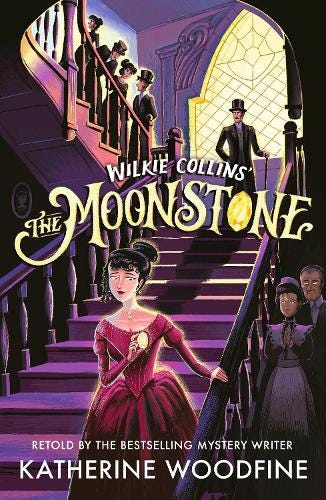
Published in 1868 (originally serialised in Charles Dickens’s magazine All the Year Round), Wilkie Collins’s The Moonstone is often credited as being the first detective novel written in English. TS Eliot famously called it ‘the first and greatest of English detective novels’ and Dorothy L Sayers herself describes it as ‘probably the very finest detective novel ever written’. It’s long been a favourite of mine (my second book The Jewelled Moth is very much a tribute) so I was thrilled to have the opportunity to adapt it for Walker. Their Abridged Classics series already includes a selection of classic books adapted by contemporary authors, including Frankenstein by Lucy Strange, and Jane Eyre by our brilliant newly-crowned Children’s Laureate, Patrice Lawrence — check them all out here.
Here’s a bit more about my take on The Moonstone, which you can order from Waterstones, Bookshop.org.uk or from your favourite independent bookshop.
“Whatever happens in your house, robbery or murder, you must have your breakfast.”
The Moonstone, a priceless yellow diamond, is looted from an Indian temple by a murderous British colonel. Years later, it is given to young heiress Rachel Verinder as an eighteenth birthday present ... but seems to only bring danger and misfortune. On the night of Rachel’s birthday, the gem is stolen once again and no one is above suspicion. Soon the eccentric Sergeant Cuff is on the case with the help of Rachel’s suitor, Franklin Blake. As they attempt to solve this puzzling crime, they are hindered by uncooperative witnesses, red herrings and a dark secret that could compromise the entire investigation...
The very first detective story, abridged for today’s young readers by a beloved mystery writer.
We all know by now how much joy I take in adapting or retelling a classic (see also Anne of Green Gables and Pride & Prejudice) and I’ve already mentioned here the huge amount of fun I had abridging this enormous doorstopper of a Victorian novel for young readers. It was such a pleasure to dive deep into the research, and to have the chance to explore the text to a forensic level of detail.
However this was certainly far from a straightforward task! The original text is several hundred pages long, and the story is complex, with all manner of twists and cliffhangers. As far as possible given the constraints, I wanted to do justice to the plot and to each of the different narrators who helps to tell the story, as well as to honour the style, atmosphere and language of the original. I also had to figure out how to present some of the elements of the story that might be most difficult to understand for a contemporary middle-grade audience, whether it was Victorian opium-eating or the intricacies of the 19th century legal system. (At one point a proctor pops up in the story and I have to admit I have very little clue what a proctor actually does, and I’m pretty sure a 9-year old reader won’t either). My thanks must go to editor Emma Lidbury and team at Walker for being thoughtful and patient, particularly when indulging me about all the parts I simply couldn’t bear to leave out (Betteredge’s burst buzzard - iykyk).
I am particularly grateful to sensitivity reader Sraddha whose careful feedback was crucial when thinking about how to navigate issues of race, religion, colonialism and Empire. The Moonstone is full of tricky contradictions: it is obvious that Collins was critical of much of what he observed in Victorian society, and indeed of the British Empire — after all the story begins when the ‘wicked Colonel’ loots a sacred gem from an Indian temple, and the echoes of this act of colonial violence are seen repeated through the story. Yet there’s no doubt that the book remains deeply problematic in all sorts of ways. I was very glad to have the opportunity to contextualise some of this for today’s young readers in a supporting introduction.
I know not everyone is keen on this kind of shortened version of classic literature for children, but personally I’m a fan. I remember reading quite a few classics in Ladybird form first and foremost; and I think these kinds of books can act as a meaningful entry point into literature for young readers, offering an initial way in, which can help build confidence to read and enjoy the original books in due course. With this in mind, I’ve also put together this list of great abridged versions of classic novels for children (these are faithful retellings or adaptations, rather than a more comprehensive reimagining of the original story, or indeed a continuation. There are lots of great examples of all of these too, so perhaps I need to do a separate book list to cover them all!)
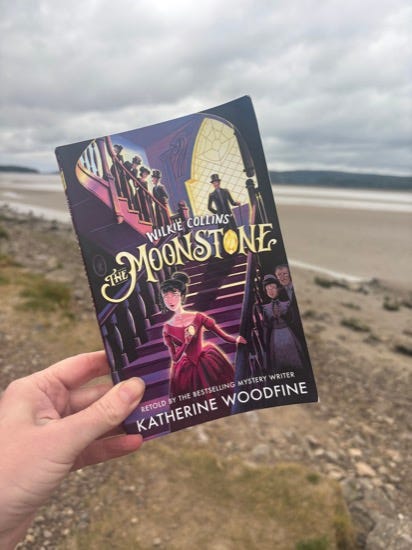
To celebrate the book’s publication, we headed to the beach. One of the things I have always loved about The Moonstone is that much of it is set in the North of England — specifically in Yorkshire, although the landscape of the Verinder country estate reminds me very much of the countryside close to me in Lancashire. The ‘Shivering Sands’, one of the most important locations in the story, always makes me think of my own local landscape of Morecambe Bay which is beautiful but wild and treacherous. Here’s how it’s described in the new book:
Between two spits of rock lies the most unpleasant quicksand. At the turn of the tide, it seems to shiver and tremble, giving it the name of the Shivering Sand.
Like the Shivering Sands, Morecambe Bay is renowned for being extremely dangerous. (As the fishermen say in The Moonstone: ‘What the sands take, the sands keep forever.’) You only have to walk along the beaches or coastal paths to see all sorts of dire warning signs about tides and quicksands.
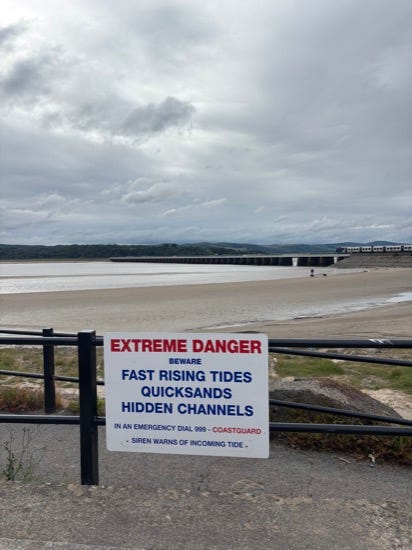
It is possible to actually cross the sands on foot, going from one side of the Bay to the other, but only if you are accompanied by an expert — specifically the royally-appointed King's Guide to the Sands — a position currently held by Michael Wilson. This role has existed since 1548; prior to that, I understand that the monks of Furness Abbey and Cartmel Priory were in charge of the guiding.
From the 1780s to at least the 1850s there was also a horse-drawn coach service that went over the sands, running six days a week, with a ‘sober and careful driver’, promising an ‘expeditious’ crossing. The changing position of the river channels and gullies meant that the safest route to travel often fluctuated, and the timetable was dependent on the tides.
Later in the 19th century (and indeed today!) it became possible to cross the Bay by train. But walking out onto the sands alone remains so dangerous that the local police sent out this rather terrifying email to local residents at the beginning of this summer, followed by detailed instructions on what to do in the event of getting stuck. It popped into my inbox under the headline: ‘Stuck in Sinking Sand/Mud? DON’T PANIC!’
Remember - “Quicksand/mud is a fate reserved for traitors, betrayers, the treacherous and other villains who have escaped, fled or otherwise gotten beyond the reach of human punishment.” But if you do somehow manage to find yourself in this predicament, the primary thing to do is stay calm… If you want to free yourself without waiting for rescue or for the sand to liquefy again, then research showed that just to release one foot, you would need to provide a force of 100,000 newtons – the equivalent of the strength to lift a medium-sized car.
With that in mind obviously I’m not venturing too far out onto this local version of the ‘Shivering Sands’ anytime soon — at least not unless I have the King’s Guide with me. But I was happy to be on the safety of the shore to celebrate The Moonstone. It was not a particularly nice day (surprisingly, given that most of July was non-stop heatwave) but the grey light did give an appropriately mysterious atmosphere. One of my favourite characters from the book, loyal house steward Gabriel Betteredge, would probably have suggested that we toast it with a glass of grog — but failing that, fish & chips from the local chip shop did the job nicely,
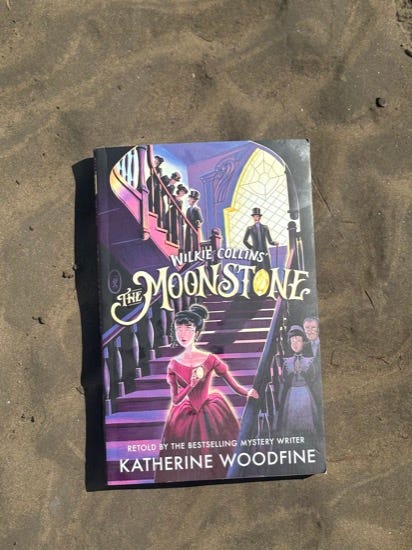
I do find myself wondering if Wilkie Collins actually might have taken some inspiration from Morecambe Bay when he was devising the setting of The Moonstone. He’d certainly visited the area — it’s documented in a book he co-wrote with Charles Dickens, The Lazy Tour of Two Idle Apprentices which fictionalises a trip the two writers took together in 1857. It includes a chapter set in my home-town of Lancaster, in which they take rooms in the Kings Arms Hotel, where the Dickens character has a supernatural experience relating to nearby Lancaster Castle. Unconvinced, the Collins character attributes this to the effects of the ‘bride-cake’ (i.e. wedding cake - a rich fruit cake with almond paste and icing) that is served at the hotel after dinner. (The whole book is an entertaining read: I particularly enjoyed the scenes where the Collins character injures himself when unwillingly hiking up a Lake District mountain and has to be carried back down by the Dickens character - shades of The Other Bennet Sister?!) So perhaps it’s not too much of a stretch to imagine he might have put a little bit of Morecambe Bay into his Shivering Sands, when he came to write The Moonstone a decade later.
The following week, I marked The Moonstone with some school events at Morley Academy near Leeds and Boston Spa Academy, as part of the Gorse Literary Festival. I talked about the book with students from Years 7-9 and also ran some fun creative writing workshops.
In the same week, I went along to the Branford Boase Award to celebrate all of our amazing shortlist and the overall winners Asli Jensen and Shalini Vallepur, as well as the young winners of the Henrietta Branford Writing Competition. What a huge pleasure it has been to be one of the judges for this brilliant and very special prize this year! If you’re in need of some summer reading, I can heartily recommend all the books on our shortlist.
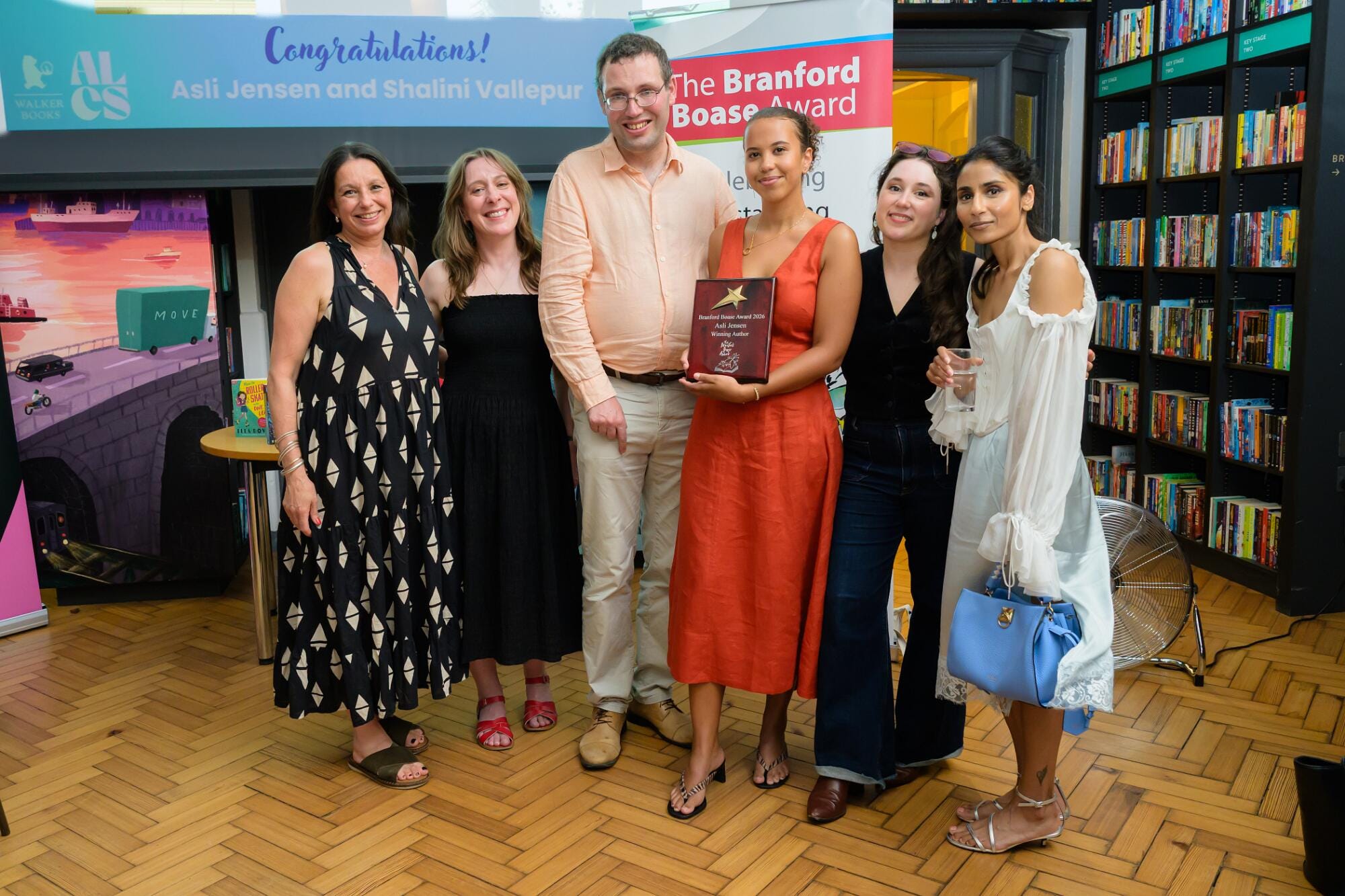
And if you’re interested in finding out more about what it’s like judging a book prize like this one, I wrote this for PaperBound magazine about my experience of being a judge for the Award.
I haven’t done one of these in ages, but to mark the publication of The Moonstone, I thought I’d give away a signed and dedicated copy.
If you want to enter, all you have to do is drop me an email here by 12 noon (GMT) on Sunday 16th August with the subject ‘Newsletter Competition’. (Please note that the competition is open to those in the UK only, because of postage costs.) One winner will be chosen at random from all the entries.
Now I’m signing off for the rest of the summer. I’ve got some fun trips planned and an extremely tempting pile of books lined up to read.
I’ll be back here in September, but until then, you can keep up with (sporadic) news on Instagram, see books I’ve recommended, or find information on my website katherinewoodfine.co.uk — and, of course, you can always contact me here.
Happy reading!
Katherine x
Comments
Nothing yet. Say the first thing.
Sign in to join the conversation.