

One piece of advice that I give to parents is to wait at least until 16 to give a kid a smartphone. According to author and psychology professor Dr. Jean Twenge, getting a smartphone should be on par with getting a driver’s license in terms of the level of maturity required to operate one.
Like cars, smartphones are powerful tools that can cause harm, both deliberate and inadvertent, to the owner of the phone and to others. By waiting an extra few years, you reduce the likelihood of making online mistakes that cannot be deleted or undone. The potential for harm is higher at a younger age, as kids lack the self-control and self-awareness to make judicious decisions and to restrain themselves from responding emotionally.
There are other benefits to waiting. A 2023 study conducted by Sapien Labs found that the older a child is when they receive their first smartphone, the better their long-term mental health outcomes. The difference was most pronounced for females. From the study:
The percentage of females experiencing mental health challenges decreased from 74% for those who received their first smartphone at age 6, to 46% for those who received it at age 18. For males, the percentage declined from 42% at age 6 to 36% at age 18… The relationship between mental well-being at age 18-24 and age of first smartphone acquisition remained significant, even in those with no traumatic or adverse childhood experience.
Another reason to tie smartphone ownership to getting a driver’s license is that it incentivizes a teen to go through the challenging process of learning to drive and passing the necessary tests. This gives them a useful life skill and grants them greater independence and mobility, which is an important feature of getting kids off screens and out into the real world. Teens must be able to go places and do things, if they’re expected to entertain themselves in analog ways; and if they can drive to meet friends, they will be more incentivized to have in-person meetups than online ones.
Finally, waiting till 16 to get a smartphone deters a child from signing up for social media. Of course, a profile can be created on a computer, but it’s less convenient than accessing it on a phone app. This is an example of the kind of physical “friction” that disincentivizes certain behaviours for the best.
Delaying smartphone ownership doesn’t mean your child can’t talk to their friends. There are all sorts of workarounds to allow communication without giving them access to everything on the Internet and giving the entire Internet access to them. You can use a land line in your home; provide them with a basic or flip phone, possibly a watch, that allows texts and call with limited numbers (if you’re in the US, check out dumbwireless.com for lots of options); or send and receive iMessages from a desktop computer. None of these workarounds is as convenient as a smartphone, but they’re much safer.
Related Post: Analog Revival
When your child does receive their first smartphone at 16 or later, it should not be a free-for-all. Like a driver’s license, there must be graduated levels of responsibility that are earned and attained as competency is proven over time.
My oldest son got his first smartphone several months after his 16th birthday, well into grade 11. I would’ve liked to wait longer, but (a) we don’t have any decent basic phone options in our rural area of Canada, and (b) he’s moving abroad in a few months’ time for a full year of study, and for practical purposes, it felt like the right time to ease him into smartphone ownership.
His father and I drafted a contract that outlines clear expectations for use and consequences for misuse. In a departure from how I used to think about smartphone ownership for teens, I now maintain that parents should own the phone, as opposed to the child paying for it. That way, it’s easier to insist that having access to a smartphone is a privilege, not a right, and that it can be taken away at any point. We parents know the password (it’s written on a chalkboard in the kitchen, so he can change it anytime as long as he updates it there), and we do periodic spot checks without forewarning. This is not snooping, because he knows it happens. Plus, as a sticky note on my office wall says, “Parenting matters more than privacy.”
There are additional rules: He cannot take the phone into his room overnight, and he cannot take the phone to school. This last rule might surprise some parents, but I think it’s the most effective way to ensure that he stays focused on class (minus all the distractions from his friends’ phones), since Ontario schools make no effort to separate students physically from their devices, e.g., using locked magnetic pouches or other lockers that limit all access between 9am and 3pm. Yes, it means I can’t reach him during the day, but that’s an opportunity for him to have some independence, and I can always call the office in a pinch, relying on the standard communication protocols that have always existed.
It’s been nearly six months, and the arrangement continues to work well. There have been no violations. I make a point of checking my son’s phone several times a week, usually when it’s charging in the kitchen at night. He asked permission to install WhatsApp, which we granted. When he travels overnight for sports competitions or exchange orientation and training, he’s allowed to take his phone. These rules might sound draconian, but he doesn’t challenge them; he is just relieved finally to have a phone of his own.
I’ll share the contract here with readers. I think there’s value in the formality of it, and the rather solemn act of reviewing it, signing it, and then keeping copies for reference. It indicates to the child that this not something to be taken lightly, and that they have to prove themselves continually to retain access.
One final point is that it’s perfectly acceptable to walk back tech that was introduced prematurely. If you regret giving your child a smartphone too soon, there’s no reason why you can’t change your mind. As the parent, you are allowed to tell your child that you made a mistake and that you’re no longer comfortable with them having access to a device that’s proven to be harmful to their mental well-being. You can swap out a smartphone for a basic phone at any point. They won’t like it, of course, but our job as parents is not to please our children; we must strike a balance between protection and preparation—and delaying smartphone ownership till 16 is a straightforward way to do that.
The smartphone is the property of [parents’ names] and may be confiscated at any point at their sole and absolute discretion.
1. [Child] must ensure that parents are made aware of the password to the phone.
2. [Parents] can and will perform periodic spontaneous reviews of activity on the phone.
3. The smartphone shall not be kept in [child’s] bedroom overnight.
4. The smartphone shall not be in [child’s] possession during meals.
5. Social media apps such as Instagram, TikTok, Snapchat, and Facebook shall not be installed on phones belonging to children younger than 16 years of age. Requests for other apps may be made and will be considered for approval by [parents] on a case-by-case basis.
6. The smartphone will not be used or accessed while there are other people in the room, unless for a specific productive or necessary purpose.
a. Examples of productive or necessary purposes include, but are not limited to, receiving or making phone calls and looking up urgent information.
b. If the phone must be accessed while others are in the immediate vicinity, and if its use disrupts a conversation in any way, then [the child] must excuse himself and/or ask if it is acceptable to do so.
7. The smartphone shall not be used in any way that is harmful to another person. It cannot be used to watch content that is vapid, violent, demeaning, pornographic, or otherwise damaging.
8. The smartphone shall not be taken into [the child’s] school building or any space in which [the child’s] classes occur.
9. Violation of any of the above will constitute a breach of this agreement and will be considered grounds for confiscation of the smartphone and/or cancellation of any connection plans for the smartphone.
Feel free to reuse this contract for your own families. I am interested to hear how others have handled the onset of smartphone ownership with their own kids, so feel free to share in the comments below.
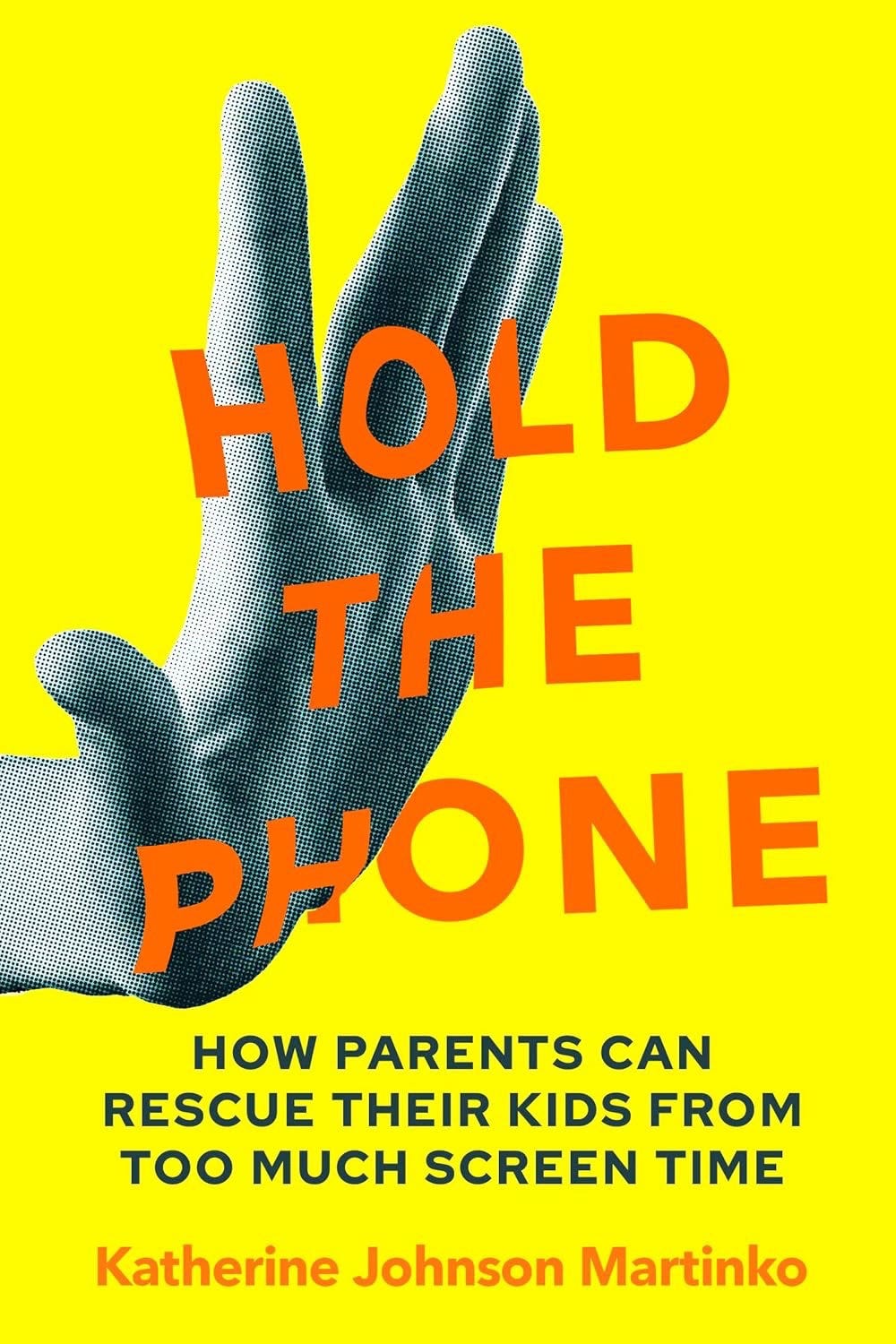
I am thrilled to announce the upcoming launch of my second book, Hold the Phone: How Parents Can Rescue Their Kids From Too Much Screen Time, coming fall 2026 from New Society Publishers. The cover has been released, and the book is now available for pre-order on Amazon (US site, Canadian site. It’s absolutely thrilling to see it out there already. I am fiercely proud of this book, which is packed with research, anecdotes, and practical advice, much of which has been informed by the 60+ talks I’ve given across North America over the past year and a half.
No posts
Comments
Nothing yet. Say the first thing.
Sign in to join the conversation.