

“People will come to adore the technologies that undo their capacities to think.” This line, uttered by the inimitable Neil Postman, is printed at the beginning of Dr. Jared Cooney-Horvath’s 2025 book, The Digital Delusion: How Classroom Technology Harms Our Kids’ Learning—and How to Help Them Thrive Again. The line gives me shivers because it sounds so hauntingly dystopian, this notion that we would surrender our cognitive power—the very essence of what it is to be human—to shiny new technologies that seem fun and convenient to use.
It sounds insane, and yet that’s exactly what we are seeing in our own lives, a sort of pathological attachment to devices and practices that were nonexistent two decades ago but now seem critical for survival. We Google the answers to every question, use AI to draft messages and summarize articles, rely on GPS for navigation. Forget about brains! If tech can do the task, let it! We opt for ease over an opportunity to flex our cognitive muscles. We are alarmingly unconcerned about letting them atrophy.
It is one thing for adults to make this choice for themselves, but it’s an egregious abdication of responsibility to do it on behalf of children. In fact, I’d even go so far as to say it’s an act of deprivation and of profound neglect, to allow children’s education—which establishes a crucial cognitive foundation for the rest of their lives—to be handed off to digital tools.
Cooney-Horvath is a teacher and neuroscientist who has spent decades studying how kids learn, and he is deeply concerned about how the widespread adoption of educational technology, a.k.a. “EdTech”, in the classroom has not only failed to improve children’s academic performance but made it worse. For the first time in human history, he writes, “our children are less cognitively capable than we were at their age.” Children of Gen Z (born 1997-2012) score worse on literacy, numeracy, creativity, and general IQ than their parents did at the same age; and the early data from Gen Alpha (born after 2012) suggests that the decline is only accelerating. This is horrifying and should be cause for full-blown revolt.
While parenting and home life have a profound impact on child development, school plays a major role and should not be overlooked. It is where kids spend most of their days, which adds up to a lot of hours. School is where they first forge relationships with influential adults who are not their parents. It’s where they practice important social interactions with peers. It’s where the seeds of motivation, a love for learning, and the desire to pursue excellence are planted. When those early years are squandered, they cannot be recouped, and kids miss out, remaining at a disadvantage forever.
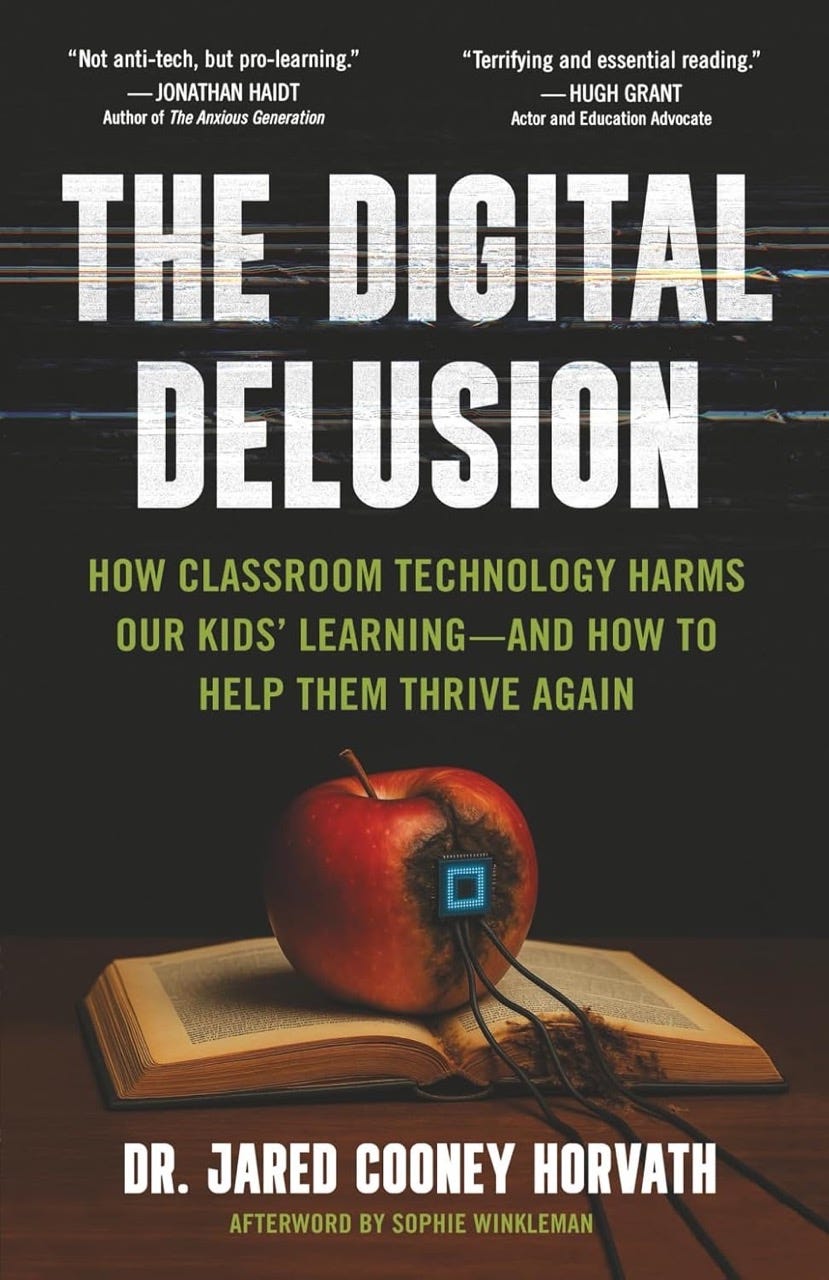
Cooney-Horvath presents clear, abundant data to build a strong argument. He explains that the $400-billion EdTech mega-industry is built on a series of myths, including the idea that education is broken (it’s not perfect, but it was never broken—if anything, the influx of digital tools broke schools); that multimedia enhances learning (except that entertainment and learning are not the same thing); and that students learn best on their own (wrong, because without expert guidance, students often waste time by mistaking activity for progress).
He sets out numerous examples of standardized test scores in decline, including PISA (the Program for International Student Assessment), TIMSS (the Trends in International Mathematics and Science Study), and PIRLS (the Progress in International Reading Literacy Study). PISA is the world’s largest standardized test. It found that the more time students spend on screens at school, the more their scores fall. On average, students who used computers for more than six hours a day scored 66 points lower than those who didn’t use them at all; the drop was even steeper among wealthy OECD countries.
Navigating these studies can feel confusing to non-researchers, so I appreciated Cooney-Horvath’s explanation of why EdTech’s results are so contentious. At first glance, meta-analyses make EdTech look OK, but he points out that there is no consistent baseline against which EdTech is measured, e.g., direct instruction by a teacher or student-led learning, both of which have significantly positive effect sizes and thus cannot be zero, as a reference point. Most researchers agree that meaningful educational gains are somewhere between +0.40 and +0.50, but EdTech only reaches +0.29 across meta-analyses of 21,000+ studies, so it’s well below that benchmark. The only two places where EdTech appears to benefit students is with adaptive tutoring systems and interventions for learning disorders.
My favourite part might be when Cooney-Horvath challenges the all-too-common justifications that we hear from proponents of EdTech. Statements like “EdTech has so much potential” are frankly absurd, when you think that potential refers to what could be, not what is grounded in evidence. Ask for data; if they can’t provide it, then it’s merely a sales pitch, which doesn’t belong in the classroom.
Same goes for “We need more time.” Computers have been making inroads into education since 1977, when the first meta-analyses were done. How many more decades do we need to figure out how to use them effectively in teaching kids? “No child’s education should be put on hold so EdTech can have one more decade to get it right,” Cooney-Horvath writes.
As for arguing that “digital devices are ubiquitous and aren’t going anywhere,” just because something is common does not mean it should be the conduit through which every subject is taught. What’s ubiquitous outside school does not need to be ubiquitous within it.
What about kids needing digital skills to succeed professionally? I get this question a lot after talks, and I always say that the skills that will set our children up for greater success are the ones that set them apart from the machines, the ones that emphasize their humanity. Cooney-Horvath offers a useful rule of thumb: “Teach someone how to use a tool, and they’ll be able to use that tool. Teach someone how to think, and they’ll be able to use any tool.”
The list goes on. All are useful rebuttals with which to familiarize oneself for future debates with school administrators—because that’s where it leads, does it not? The book moves into practical territory, suggesting all sorts of changes that can be made by parents (at home), by students themselves, by teachers and principals, to resist the digital deluge. His advice is smart, simple, and incremental. Schools, he says, should “start young” and “start small.”
Here are a few of his ideas.
Parents can start by doing a detailed tech audit, implementing tech-free weekends, banning AI from the house (especially for elementary schoolwork), and buying a printer (a brilliant proposal I haven’t heard before). Students can adjust their study habits, choosing paper over screen whenever possible and using a timer to carve out blocks of time for focused work. Teachers should be guided by the following motto when assessing tech use: “Is it deliberate? Is it time-bound? Is it justified?”
Administrators should take a year to stabilize and assess the situation, pausing all new tech adoption, performing a detailed tech audit, and conducting a cost-benefit analysis. Then the tech-reduction journey should begin, by demanding data, isolating tech to a lab or cart, formalizing opt-outs for families, giving teachers a no-tech veto, and “recentering” the teacher in the classroom—recognizing the power of that personal relationship with students. Finally, schools should bring in bell-to-bell smartphone bans, tech-free days, an annual “analog” week; they should cap device use time and make long-form reading a core value.
It sounds like a tall order—to excise embedded superfluous tech from schools—but Cooney-Horvath’s prescription is calm, convincing, and inspiring. He conveys a sense of urgency without inducing panic or guilt, and offers so many varied solutions that it feels manageable, even exciting, to tackle the issue. I think every parent with kids in public education today should read his book, and together we can refuse to let rampant tech use in the classroom undermine the quality of our children’s education.
The book ends with a quote from media scholar Marshall McLuhan: “There is absolutely no inevitability as long as there’s a willingness to contemplate what is happening.” Those are wise words. There is no shame in admitting we made a mistake by introducing too much technology at the wrong time and place; the far greater shame lies in failing to recognize or take responsibility for that mistake and not putting things right. We must take steps to reverse the cognitive decline we’re seeing in so many children, even if it means surrendering the shiny new devices that once inspired such hopefulness and returning to older, seemingly archaic ways to doing things.
This, Cooney-Horvath says, is not anti-tech, but pro-learning. And it is the right thing to do.
No posts
Comments
Nothing yet. Say the first thing.
Sign in to join the conversation.