
I have a memory of being 17 years old, sitting on the floor of a cramped cabin on a passenger ferry that was travelling overnight from Cagliari to Naples. It was very late. I was with a group of fellow Rotary exchange students, and we were locked in a heated debate about Pascal’s wager, that famous argument made by the 17th-century philosopher that it is better to believe in God and potentially gain eternal happiness than it is not to believe and miss out on an infinite loss. We’d all been studying it in our Italian philosophy classes and felt compelled to discuss.
I didn’t know these kids; we’d only just met. But we’d been thrown together on a ship and, with nothing else to do, why not talk about one of the age-old questions dogging humans for centuries? It made perfect sense to us then. I can’t remember how it ended, but two things I do know for certain—first, we failed to determine God’s existence, despite our best efforts; and second, that memory, more than two decades later, feels like peak adolescence to me.
That might sound weird, but it’s true. We weren’t drinking or getting high or flirting; we were just teenagers, crackling with raw energy and idealism. We were hungry for cognitive puzzles that stretched our brains and for connection with each other. We were so young, made confident by the challenging thing we were doing that year—living abroad for the first time—but still unburdened by real adult responsibilities. I am grateful for the memory of that night, and for those kids whose names I don’t even know, because they made me feel alive in a way I’ve never forgotten.
So, you can imagine my sadness when I read in Freya India’s book, Girls, that over 30 percent of young people say they don’t know how to make new friends and have “never felt more alone.” In the UK, young people aged 16 to 29 are twice as likely to say they feel lonely “often or always,” compared to those over the age of 70. A 2020 survey from the Harvard Graduate School of Education said that two-thirds of young adults feel “serious loneliness” (along with half of mothers of small children).
This is not how youth should be! These adolescent and young-adult years should be full of burgeoning friendships and intense connection, even if it’s fleeting. It is a crucial developmental period when we practice interacting with others, set the tone for future engagement, and settle into our new adult personalities—but hopefully not too firmly, because it’s important to be able to evolve. When young people are deprived of opportunities to do this, they fail to develop lasting skills and feel profoundly alone.
That is how you end up with young people who crave connection with others, but don’t know where or how to start finding it. Instead, they turn to Google and search for “how to make friends”, “where to make friends,” and “where to meet people,” all of which reached record highs in 2023, according to Google Trends. Vice reported in 2024 that Gen Z girls “basically advertise [themselves] as a potential friend by discussing likes, interests, and hobbies,” sometimes adding the hashtag #friendshipapplications to their posts.
There is a growing market for apps that cater to finding friends, like Bumble for Friends, Hey! VINA (for platonic female friendships), Peanut (for mothers), Amintro (for over-50s), and Meetup (finding people with common interests). While I acknowledge the valuable intent behind such apps, I can’t help but feel like they perpetuate the problem, drawing people online in an effort to solve a problem that’s caused in large part by them being online too much in the first place. The fact is, we’ve been sold a lie, that being “connected” through our devices is the same thing as being connected in person, but it’s not.
The quality of online interactions is inferior for several reasons, as outlined by Jonathan Haidt in The Anxious Generation.Online interactions are asynchronous; you text someone and wait for their reply, which can take minutes, hours, or even days. Online interactions are disembodied, which means you miss out on all the body language that is a huge part of human communication. Online interactions also tend to be performative, often taking place within a large group, where people are motivated to convey a certain persona, rather than be authentically themselves. There is a lack of incentive to treat people well and to repair misunderstandings; online, it’s easy to ghost someone, delete a profile, or rage-quit a game. You can’t do that as readily in real life.
Another problem with online-based relationships is that they enable highly curated or personalized relationships, which might sound great in theory, but are unnatural. I don’t think we are meant to surround ourselves by perfectly likeminded people, all of whom enjoy the same hobbies and have the same political views as we do. That level of homogeneity sounds downright dull. The beauty of having broad friendships is that it challenges us to see the world through fresh eyes; it offers new perspective and makes us less polarized, more patient, and better informed. It’s a good thing to form relationships with people who are radically different from us—and that happens more easily in the real world than online.
It is telling that the creators of online friendship apps still encourage users to meet in person as soon as possible, as if they recognize the inadequacy of their platforms. It’s important “not to get stuck in the texting phase,” says an advice piece in TIME magazine. One “friendship expert” who works for Bumble for Friends recommends a brief and activity-oriented first meeting, such as going to a museum or browsing a bookstore together, which is “less intense than sitting across from each other like an interview.”
I believe that many people, from adolescents to adults, need to (re)learn how to make friends and socialize in person. Not only will this directly improve their own lives, but it’ll help to restore the sort of broader social network we would all benefit from having. Friendship-building is a skill that must be practiced in order to improve and become second-nature, but it’s never too late to start. I have some thoughts on how to approach this.
Go places where you’ll encounter people in the flesh—the grocery store, the gym, church, a service club, a local sports league. Join a hiking or biking group. Sign up for yoga. Take your baby to play group. Volunteer. When people extend invitations to do things, say yes, and then resist the urge to flake on them.
When you’re hanging out with other people, give them your full attention. Do not look at your phone. Freya India wrote that, in 2019, 54 percent of teenagers said their devices distracted them when they should have been paying attention to the people around them, and 44 percent of teens were frustrated with friends for being on their phones so much when they hung out.
This is a key point that I cover in my upcoming book. There’s something about pulling out a smartphone in a social gathering that alters its energy. The act signals a lack of vitality and sows a seed of doubt about how much fun you’re having, because it indicates that someone else is not getting enough from the people around them to resist seeking external stimulation. Don’t be that person.
I heard a great line on a podcast recently, that, for many women, “the sexiest thing in the world is follow-up questions.” It’s true. People are drawn to people who show interest in them. Be that person who is curious about another person’s life. Not only will you get to know someone a little better, but you’ll also appear more interesting (and possibly attractive) in their eyes, because of that curiosity.
Many people wish that their friends would initiate getting together more often. A Montreal-based clinical psychologist, Miriam Kirmayer, who studies adult friendship, says this is the number-one thing she hears. “It is much more common to wish that our friends would reach out more often than to wish that our friends would stop.”
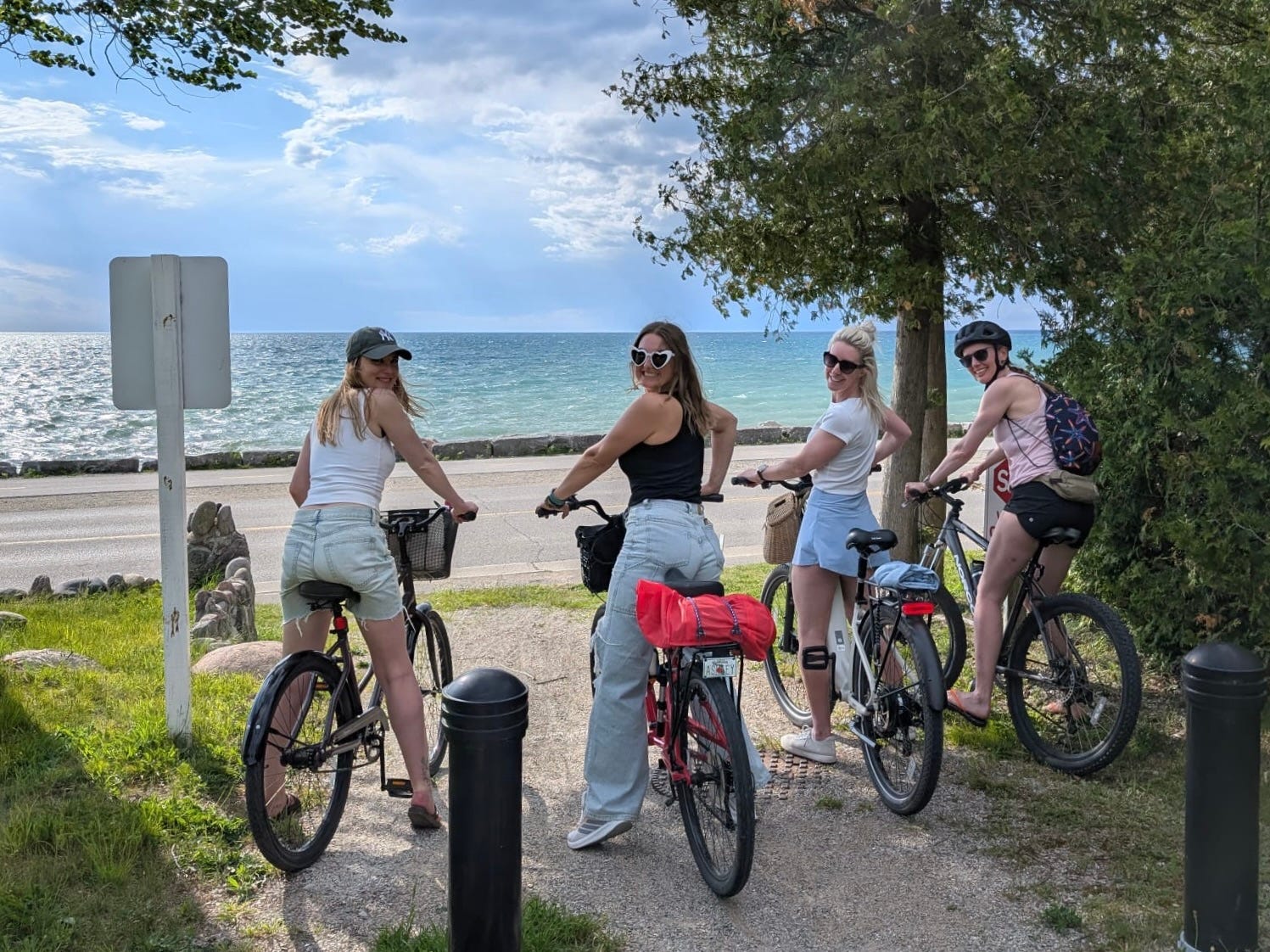
You can be that person for the people who know. Nurture the relationships you already have and start investing in them. Suggest concrete ideas for getting together, with dates and times and activities, not just vague statements like, “We should get together sometime soon,” that never come to fruition. I sometimes remind myself to plan the event that I’d like to attend; if no one else is doing it, then why not make it happen myself? That how my Ladies’ Bike Around the World tour began, as well as my annual doughnut-making night. It’s also the impetus behind simpler events like summer barbecues and winter dinner parties.
I think of making friends as an ongoing long-term project. You’ll never arrive at a point of having a perfectly intact friend group, because people change or move away or start new relationships. Nothing remains the same, which is why you should always be in acquisition mode, scoping out interesting new people and striving to get to know them better.
This means that you’ll have friends at various stages of the friendship spectrum. Research from the University of Kansas suggests that it takes roughly 50 hours of time spent together to move from mere casual acquaintance to casual friend, 90 hours to move from that stage to simple “friend” status, and 200 hours to become close friends. That’s a significant amount of investment, so you should always be moving people through that process.
I hope I don’t sound creepy, but I keep a mental list of people I’m “targeting” as future friends. These are usually women I find smart, funny, and intriguing, whom I’d like to get to know better, and then I make a deliberate effort to do so. I invite them to events I’m hosting. I ask if they want to get coffee or go for a walk or have a glass of wine. If interest is reciprocated, then we have a burgeoning friendship. This is how I’ve made most of my friends as an adult woman. It takes effort, but it’s worth it.
Have kids. Once you get through the difficult early years, you will not be lonely if you have a bunch of kids around. Kids themselves are great company, but they also draw people into the home, in the form of their own friends. As I write this, I’m also thinking about the 15 teenagers I’ve agreed to feed tonight for my son’s going-away barbecue, which will make for a fun evening. We adults benefit from the presence of youthful energy.
Move to a small town. I have friends who recently uprooted themselves from downtown Toronto and relocated to my small town of 15,000 people. Two years have passed, and they tell me repeatedly how relieved they are that they took that leap. They tell me that their social life has taken off here, that they’re busier than ever, that people are warmer and more welcoming and tend to host more events in their homes than people do in the city. I don’t know if that’s the case everywhere, but it’s clear that they are enjoying it.
We won’t banish loneliness overnight. There is certainly a collective action problem here to solve, but doing so starts with each of us, as individuals, making an effort to connect with others in person. To paraphrase Derek Thompson, who has written extensively about the anti-social century we inhabit, the little decisions we make about spending time with other people can scale, which in turn create patterns of behaviour. Those create cultural norms, which also scale and become ages. Together, we can transform an age of social withdrawal into an age of meaningful reconnection.
I am able to write this newsletter, thanks to generous readers who enjoy my words enough to sign up for a paid subscription! Every bit helps. My dream is for this to become a full-time job someday, and the more paid subscribers I get, the more writing I can do. Thank you for your support.
No posts
Comments
Nothing yet. Say the first thing.
Sign in to join the conversation.