
This is the third part of our series on the displacement of judgment as illustrated by popular influencer, Taylor Marshall. In our first article, There’s No Turning Back Once You Accept Form, Matter, and Privation: The Philosophical Prelude to Our Critique of Taylor Marshall and the Conciliar Displacement of Judgment, we established the philosophical prelude: once form, matter, and privation are accepted, one can no longer pretend that effects can be understood apart from causes or that deficiencies can be overcome by multiplying explanations around them. In Taylor Marshall and the Conciliar Displacement of Judgment: How the Vatican II Doctrinal Debate Is Obscured and Replaced with the Entropic Time Loop, we showed how Marshall’s treatment of the SSPX already displaced judgment from the object to the subject. But the real object of judgment should have been Vatican II, the Novus Ordo, form, causality, finality, and necessity. Instead, Marshall shifted attention to the SSPX itself and its use of the title “auxiliary” bishop, its institutional history, its alleged“sheddings,” and the sociological effects of those departures.
More specifically, in that second essay, we argued that Marshall’s attention to “auxiliary bishops” magnifies a minor terminological defect while obscuring the reality the term was meant to communicate—bishops functioning extraordinarily for ordinations, confirmations, priestly succession, and sacramental life under necessity while stressing the reality of not setting up a parallel hierarchy and continuing to be attached to and serve Rome. And in that second article, we demonstrated how the use of the term “auxiliary” is particularly prudent in light of the unprecedented crisis and extraordinary situation and state of necessity. One cannot think of any more appropriate and better term in a position that stresses its attachment and service to Rome while ensuring the preservation of the Faith.
In this essay, we dissect Marshall’s latest intervention and argue that it no longer merely shifts attention from the object to the subject; it supplies the subject with a meaning the SSPX does not state, then condemns them for that manufactured meaning. Marshall accuses the SSPX of failing to tell the truth, but does not demonstrate the lie. Instead, they construct the lie their “argument” needs the SSPX to have meant. The displacement has intensified to IMPUTATION.
The structure is simple—Marshall imputes, but does not prove that the SSPX lied; constructs the interpretation necessary to make them appear to have lied; then condemns them for the appearance their interpretation produces—a damning chain of disordered assertions and imputation—one that fails scholarly rigorous, philosophical coherence, metaphysical judgment, and Catholic standards of justice and prudence. These problematic assertions and accusations by Marshall, however, are not unique; they are representative of the larger runaway train of “arguments” that are, in reality, accumulated assertions.
But before we proceed, we must make explicit that we have not (and will not) judge intention here (nor did we in the previous articles). Our critique has always been and will remain structural, on the object, where the subject (Marshall) is but a case in point of the displacement of judgment, which is now this runaway train of manufactured constructs as premise and proof for rationalized and justified imputation.
Below are Marshall’s posts alongside the actual SSPX declaration read before the episcopal consecration found here.
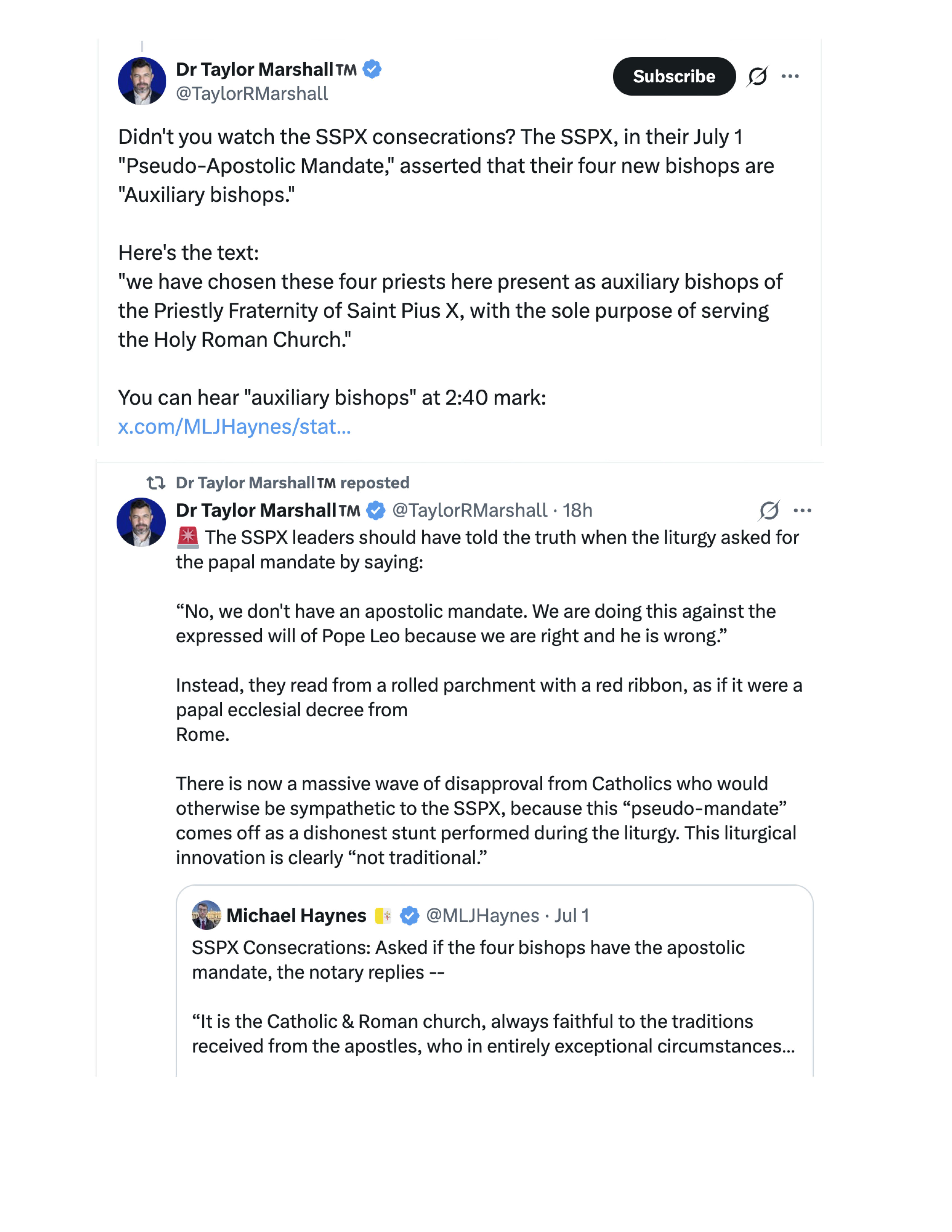
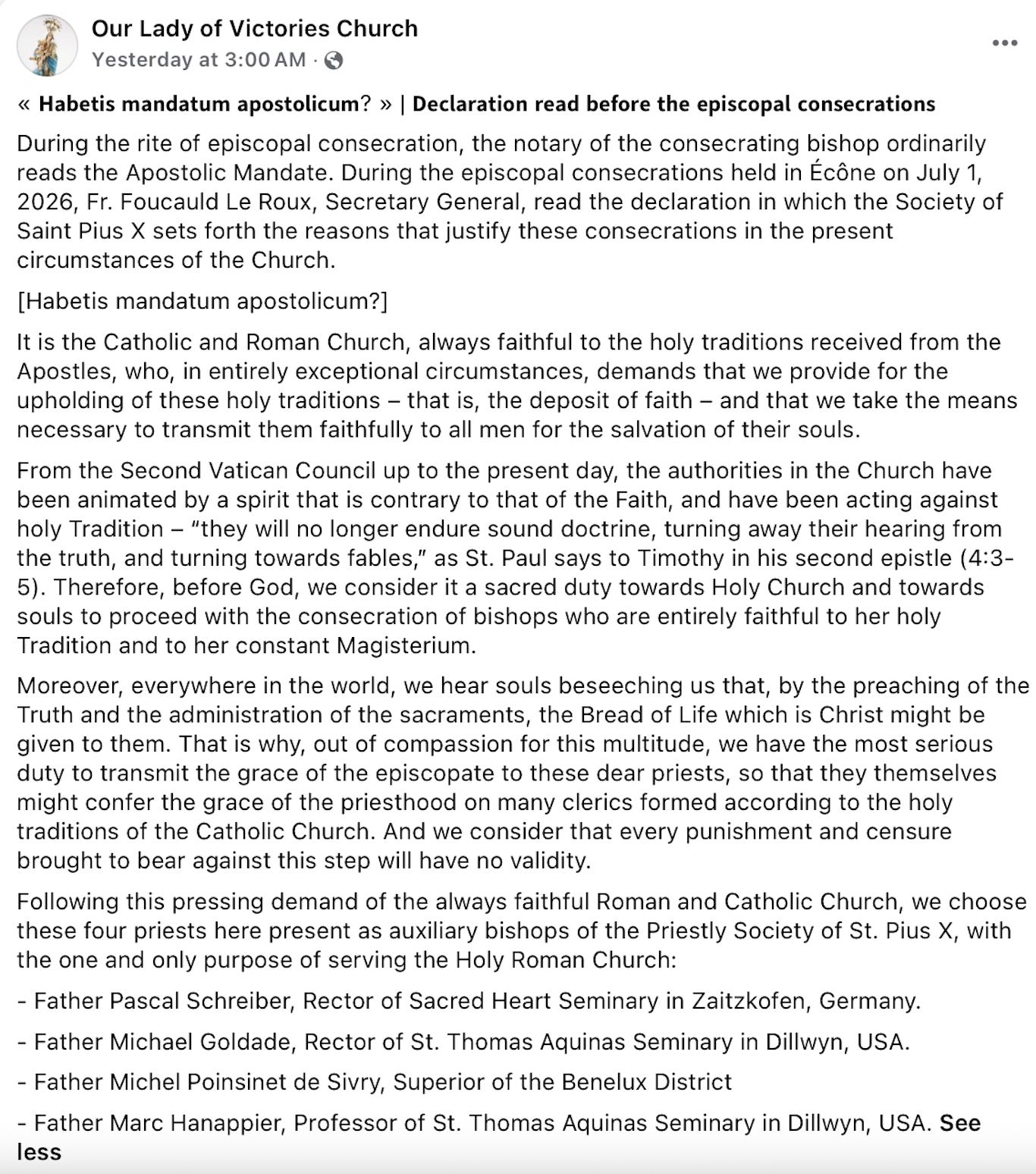
Accusation by Accumulation: When Assertion Replaces Demonstration
Marshall’s accusation is a layered chain of accumulated assertions, not arguments. They imply but do not demonstrate the lie, which they accuse the SSPX of. Then they supply a false version of what “truthfulness” would have required, and condemn the SSPX for not saying what they themselves falsely constructed. Then they escalate from terminology to deceit, from optics to fraud, and from irregularity to non-traditionality.
That is structurally damning for Marshall—on all counts: scholarly, philosophically, metaphysically, Thomistically, and most importantly as a Catholic way of reasoning and judging reality, especially when it involves imputing deceit, bad faith, and implying interior moral culpability—worse, as those whom they are accusing are explicitly invoking a state of necessity for the salvation of souls, which they have maintained from the very start and have managed to preserve for decades while keeping that attachment to Rome and the papacy.
Marshall’s claim that the SSPX “should have told the truth” is not neutral language, as it implies that the SSPX did not tell the truth. But where is the demonstrated lie? Did the SSPX claim to possess a papal mandate from Pope Leo XIV? Did they claim ordinary diocesan jurisdiction? Marshall does not establish any of this. Instead, they make the accusation operate by suggestion, where the force of the accusation comes from the rhetorical atmosphere created around the words “pseudo-Apostolic Mandate,” “dishonest stunt,” “massive wave of disapproval,” and “not traditional” vs. a real structural demonstration that might be properly considered as an argument. The whole “argument” depends upon each assertion being granted before the next can function—this is accusation by accumulation. But reality does not become true simply because we proclaim and assert it, or rhetorically arrange words around it. In effect, this is what Marshall does—declare their accumulated assertions into reality.
The Manufactured Lie of the Cartesian-Marshall Enclosure
And we have yet to cover the most damning point—that Marshall’s proposed “truthful” statement is itself false in relation to the SSPX position. Marshall declares the SSPX should have said: “No, we don’t have an apostolic mandate. We are doing this against the expressed will of Pope Leo because we are right and he is wrong.” But Marshall puts words in their mouth—reducing a metaphysical and ecclesial claim about necessity, Tradition, the deposit of faith, and the salvation of souls into a crude psychological posture: “we are right and he is wrong”—a formulation that turns the SSPX’s stated position into an act of self-assertion and arrogance.
But that is Marshall’s manufactured construct of “reality”.Thus Marshall accuses the SSPX of failing to tell the truth while offering as “truth” a caricature of what they actually meant. This is a performative contradiction as the charge of falsehood depends upon Marshall’s own false construction of the SSPX position. In effect, Marshall is projecting his plane of reality onto the SSPX and the larger unsuspecting public, which is objectively being fed his plane of reality or what we might also call the Cartesian-Marshall enclosure.
But the Cartesian-Marshall enclosure, Marshall’s constructed version of reality, is simply not the same as the actual declaration, which invokes exceptional circumstances, the need to uphold the holy traditions received from the Apostles, the deposit of faith, the faithful transmission of those traditions, and the salvation of souls. It also frames the act as service to the Holy Roman Church, not separation from her. So the formal claim is not that the SSPX possess a papal mandate or reject Roman authority. The formal claim is the same claim the SSPX has been invoking since 1988—the crisis creates a state of necessity in which the Church herself, semper fidelis, demands the means necessary to preserve and transmit Tradition. That is the object Marshall needs to adjudicate, but instead, they move through various tangents and go further, imputing bad faith and deceit without even demonstrating the necessary premises. Layers of logical jumps and assertions are framed as facts. But fundamentally and essentially, they remain assertions of reality according to Taylor Marshall. In our terms, Marshall constructs a Cartesian-Marshall enclosure, applies Kantian-Marshall lenses, and powers the whole through a Hegelian-Marshall dialectic. We have demonstrated this framework elsewhere, especially in The Encyclical of Perpetual Arrival.
Here we invoke our previous article, “Form Before Obedience”. Whether the parchment looked Roman, whether the ribbon was red, Marshall claims there was a “massive wave of disapproval”, or whether the word “auxiliary” is perfect in ordinary canon law—these are secondary to the underlying question of what kind of act was it? Moreover, did it renounce Roman primacy, claim ordinary jurisdiction, and establish a parallel hierarchy? Or is it ordered toward preservation under necessity while continuing to profess service to the Holy Roman Church? Marshall does not adjudicate this. They activate the lower registers—optics, reaction, terminology, suspicion, and juridical normalcy—before resolving the higher question. Before calling the act dishonest, schismatic, rebellious, fraudulent, or non-traditional, one must determine the formal species of the act—Marshall does not.
Our corpus (here, here, here, and here) has already argued that “separation” cannot be presumed until the act is specified in its kind (form and end) — and that metaphysical necessity must be adjudicated before juridical evaluation. Marshall skips this step entirely, beginning from a lower-register irregularity and then escalating to moral accusation.
Marshall commits three errors at once. First, they misidentify the object, as the object is not whether the SSPX used the word “auxiliary”, but what the formal species of the consecration is under the claimed state of necessity. Second, they misread analogy as canonical assertion, treating “auxiliary” as though the SSPX meant “auxiliary bishop of a diocese under canon 403.” Third, they convert their own interpretation into an accusation of dishonesty. The alleged lie depends on their (Marshall’s) prior misreading. Marshall’s “auxiliary bishops” objection rests upon treating an analogous term as a univocal canonical claim, and then using that imposed univocal reading to support the larger accusation of a “pseudo-Apostolic Mandate”. But as we argued here, it is true, in the strict canonical sense, “auxiliary bishop” refers to a bishop deputed to assist a diocesan bishop. Marshall is correct at that lower level. But his conclusion does not follow, because the SSPX is not using “auxiliary” to claim ordinary diocesan jurisdiction. They are using it analogically, in an extraordinary situation, to indicate bishops who assist the Society without claiming to rule dioceses or establish a parallel hierarchy. Murray Rundus notes that the 2026 text was virtually the same text used by Archbishop Lefebvre in 1988. They also note that because no univocal canonical title exists for these bishops, analogy becomes necessary. But most importantly, as we already argued in Taylor Marshall and the Conciliar Displacement of Judgment, the Society made a prudential decision to use the term to precisely make it clear, their bishops would have no jurisdiction and they have no intention of setting up a parallel hierarchy. But in effect, Marshall is forcing the SSPX to do just that while he condemns exactly that which he is structurally implying they must do.
The term “auxiliary” functions to deny precisely what Marshall’s framing insinuates— the creation of a parallel hierarchy or a claim to ordinary jurisdiction—as it signals assistance, not diocesan rule. As Rundus notes, the bishops are not auxiliaries of a diocese in the strict canonical sense, but helpers of the SSPX. That is exactly the point. Ordinary canonical categories do not neatly capture an extraordinary ecclesial condition; therefore analogy becomes necessary. Marshall’s error is to treat the strain in language as proof of deception rather than as evidence of the crisis.
The irony is that Marshall judges the SSPX for allegedly judging the Pope, while supplying the very formulation that makes the SSPX appear to do so. The SSPX does not state its act as “we are right and Pope Leo is wrong.” Marshall does. They then treat that construction as the “truth” the SSPX should have spoken. Thus Marshall places in the mouth of the SSPX the very posture they condemn—a self-authorizing judgment over the Pope.
Marshall’s messaging collapses from analogy to accusation. They escalate by treating an analogous term as a strict canonical claim, then treat that supposed canonical claim as false, then treat the alleged falsity as dishonesty, then treat dishonesty dishonest proof of a “pseudo-mandate,” and finally treat the “pseudo-mandate” as liturgical innovation and evidence of non-traditionality. This is structurally unstable, because for Marshall, analogy is univocity, imprecision is fraud (but as we have argued, “auxiliary” is actually precise and prudent in light of the crisis and the absence of a terminology base to capture reality), appearance is proof, and accusation replaces judgment.
Marshall’s reasoning performs the very post-Conciliar instability we have been treating, where terminology is detached from form, reaction substitutes for judgment, and a lower-register ambiguity is made to carry accusations it cannot sustain.
This line of “reasoning” would not satisfy secular scholarly rigor, much less philosophical or metaphysical demonstration. But most importantly, it breaks with Catholic standards of morality, charity, justice, and prudence—something we do not say based on speculation, a judgment of intention or an imputation of bad faith—but based on the very unstructured messy structure of the movement of Marshall’s “arguments”.
We proceed by exposing a disproportion, where Marshall turns a terminological question into a moral indictment and escalates from “auxiliary is canonically imprecise” to “pseudo-Apostolic Mandate,” from “pseudo-Apostolic Mandate” to “not telling the truth,” and “dishonest stunt,” and finally to “liturgical innovation” and “not traditional.” Marshall resembles the “reasoning of Maxim Grigorieff, which we critique here, where multiple registers are layered together, assertions are stacked, and the reader is moved through rhetorical force rather than logical demonstration. The levels collapse as canonical terminology, moral accusation, liturgical judgment, public reaction, and implied intention are made to function as though each proves the next.
Let’s zoom into Marshall’s assertion of a “pseudo-Apostolic Mandate”—a term, which itself is rhetorically loaded as it suggests imitation, counterfeit, and deception. But we must ask, counterfeit of what? One must show that the SSPX intended to deceive, claimed a papal mandate it did not have, or formally replaced Roman authority with its own jurisdiction. Marshall demonstrates none of this. If the SSPX claimed that the declaration was a papal mandate from Pope Leo XIV, then “pseudo” might be warranted. But if the declaration was read precisely because there was no papal mandate and because the Society judged necessity to supply the reason for proceeding, then Marshall must demonstrate deception vs. merely assert resemblance.
A document read where a mandate would ordinarily be read is not necessarily fraudulent. Marshall needs to show whether the replacement text falsely claimed what it did not possess, but Marshall does not.
Here we address Marshall’s assertion of “liturgical innovation”—to which we say, ordinary rubrics cannot be absolutized without adjudicating whether ordinary conditions obtain. In ordinary circumstances, reading a declaration in place of a papal mandate would indeed be irregular. But the SSPX’s entire claim is that these are not ordinary circumstances. To reply, the ordinary rubric requires a Roman mandate, without first adjudicating the state of necessity, is precisely to put the cart before the horse (see how we use this term here, here, and here). It is the same juridical displacement our corpus has repeatedly criticized, where the lower level is activated before the higher level has been judged (see here, here, and here). The act may be materially irregular, but whether that irregularity is morally and ecclesially justified depends on the prior metaphysical question, which all of the SSPX’s critics have chosen to ignore and obscure since the 1970s, which Marshall has now chosen to do and hence, devolve the situation further into the entropic time loop.
On Marshall’s claim that there is a “massive wave of disapproval” line—that is social proof masquerading as argument. Best case scenario for what Marshall intends for their “argument” (assertion), which is, if we assume there is truly this “wave of disapproval”—disapproval does not determine the formal species of the act—and we stress, this is structurally the best case for Marshall’s claim. Social reaction is not metaphysical adjudication and public discomfort is not proof of dishonesty. Optics are not form. This is similar to the pattern we identified in our series on “Pre-Crime” here and here—speculation, prediction, psychological framing, strategic concern, and sociological reaction displace prior judgment concerning truth, form, causality, and finality. And with Marshall, the object vanishes again, and the questions are of this sort—how did Catholics react, how did it come off, did it look strange, did it appear traditional—while the real question on what the act was and whether there is a state of necessity remains unasked.
The reader is thus invited to remain in the subject-centered register—reaction, appearance, suspicion, and accusation—while the object itself remains unadjudicated. This is the entropic time loop in its accusatory form.
Marshall’s accusation is self-indicting. They supply a false version of the SSPX position, read analogy as univocity, convert imprecision into fraud, turn social reaction into proof, and treat optics as judgment. In other words, Marshall commits in essence what they accuses the SSPX of doing: presenting as truth what has not been demonstrated as truth. To be very clear, Marshall does not prove the SSPX lied. Marshall constructed the lie they needed the SSPX to have meant. And we will stress again, we have not asserted, accused or imputed anything against Marshall here. We have merely exposed the structural reality and truth in their messages as they are.
In the prior essay (see here), we also argued and demonstrated how Marshall displaced the doctrinal object into the SSPX as subject. In this essay, we have demonstrated how the displacement has become more severe, because the subject (SSPX) is no longer merely examined, it is ventriloquized, as Marshall creates a version of the SSPX position—“we are right and Pope Leo is wrong” — and then condemns the Society under that construction. This is worse than mere juridical flattening, as it is the movement from object to subject, then from subject to imagined subject, then from imagined subject to accusation.
Marshall has structurally created a Cartesian-Marshall arcade, and they are insisting (ventriloquizing) that the SSPX play in their arcade, while the rest of the audience remains trapped within the same plane of enclosure. It is almost as if Marshall projects the very framework of the Novus Ordo DIY, which we demonstrated here, onto reality itself, where the agreement between mind and reality is overridden.
The following is a summary of Marshall’s structure: 1) Marshall says the SSPX should have told the truth. But they do not prove they lied; 2) Marshall says they should have said, “we are right and Pope Leo is wrong.” But that is not the SSPX’s stated position; 3) Marshall says there is a massive wave of disapproval. But they do not demonstrate this, nor would such disapproval prove the moral species of the act; 4) Marshall says this was a “pseudo-mandate.” But they do not establish that the SSPX claimed its declaration was a papal mandate; 5) Marshall says it came off as dishonest. But “came off as” is phenomenological reaction, not proof of deception; 6) Marshall says it is liturgical innovation and “not traditional.” But they apply the ordinary rubric without first adjudicating the extraordinary condition being claimed.
Every movement in this chain is a jump. The conclusion only works if the reader grants each unsupported transition before the next accusation is introduced. The argument therefore advances by accumulation (vs. demonstration), where each assertion is made to carry the weight of the next, until accusation appears to have become proof.
In addition, Marshall reads an analogous term (“auxiliary) as a strict canonical claim, supplies the interpretation necessary to make the SSPX appear to have lied, and then condemn them for the appearance their interpretation (Marshall’s) produced.
Marshall’s “argument” collapses because it requires the reader to accept their interpretation before the accusation can even begin. They must first flatten “auxiliary” into a strict canonical claim, then treat that claim as false, then treat the falsity as deception, and then treat the deception as a pseudo-mandate. But the first move is already wrong. Marshall’s accusation therefore rests on the very misreading their argument requires.
In addition, Marshall accuses the SSPX of not telling the truth while themselves misrepresenting the truth of the SSPX’s stated position. They claim to expose a “pseudo-Apostolic Mandate,” but what Marshall actually exposes is a pseudo-argument: an accusation built on equivocation, rhetorical escalation, and the refusal to adjudicate the object.
This is imputation—not judgment or argument. It is assertion layered upon assertion, as the object is not adjudicated, the subject is accused, and the conclusion is imposed before the formal species of the act has been determined. The result is the cart before the horse, accusation before evidence, and condemnation before adjudication. In our terms, it is the Cartesian enclosure with Kantian lenses on a Hegelian dialectic—with the entropic time loop as the inevitable consequence—all of which in Marshall’s arcade/ world.
In Influencers, the Entropic Time Loop & Probabilities, we widened the frame from Marshall to the Catholic influencer structure. But we stress, we speak in probabilities, not absolutes, and not claiming every influencer necessarily generates noise. But the structural incentive exists—and if we might add, due respect to those influencers who are able to ward off the negative tendency proposed by this incentive. We follow some of them. But popularity is generally sustained by engagement and engagement is more easily generated by psychological, rhetorical, personalist, and subject-centered content vs. metaphysical adjudication.
Subject-centered commentary generates endless starting points: appearance, tone, reaction, terminology, supposed intention, institutional psychology, and social consequence. Object-centered reasoning constrains the discussion because it forces the intellect to ask what the thing is, what it is ordered toward, and what follows from that. The former produces chatter. The latter seeks judgment. Therefore, as influence grows, the probability of generating noise and its more advanced form: the entropic time loop—increases. Influence rewards engagement. Engagement is more easily produced by accusation, optics, reactions, and personality-centered claims than by metaphysical adjudication. “Pseudo-mandate,” “dishonest stunt,” and “massive wave of disapproval” travel faster than “what is the formal species of the act under necessity?”
When we apply that directly to Marshall: “pseudo-mandate,” “dishonest stunt,” “massive wave of disapproval,” and “not traditional”—are engagement-generating phrases. They move quickly to produce reaction, but they do not adjudicate the object. Hence, the significance of testing Catholic commentators and whether they begin with the object, or with the subject; with form, finality, causality, and truth; or with optics, psychology, personalities, reactions, and drama. Do they appear to pass through the theological register, but resolve the question juridically?
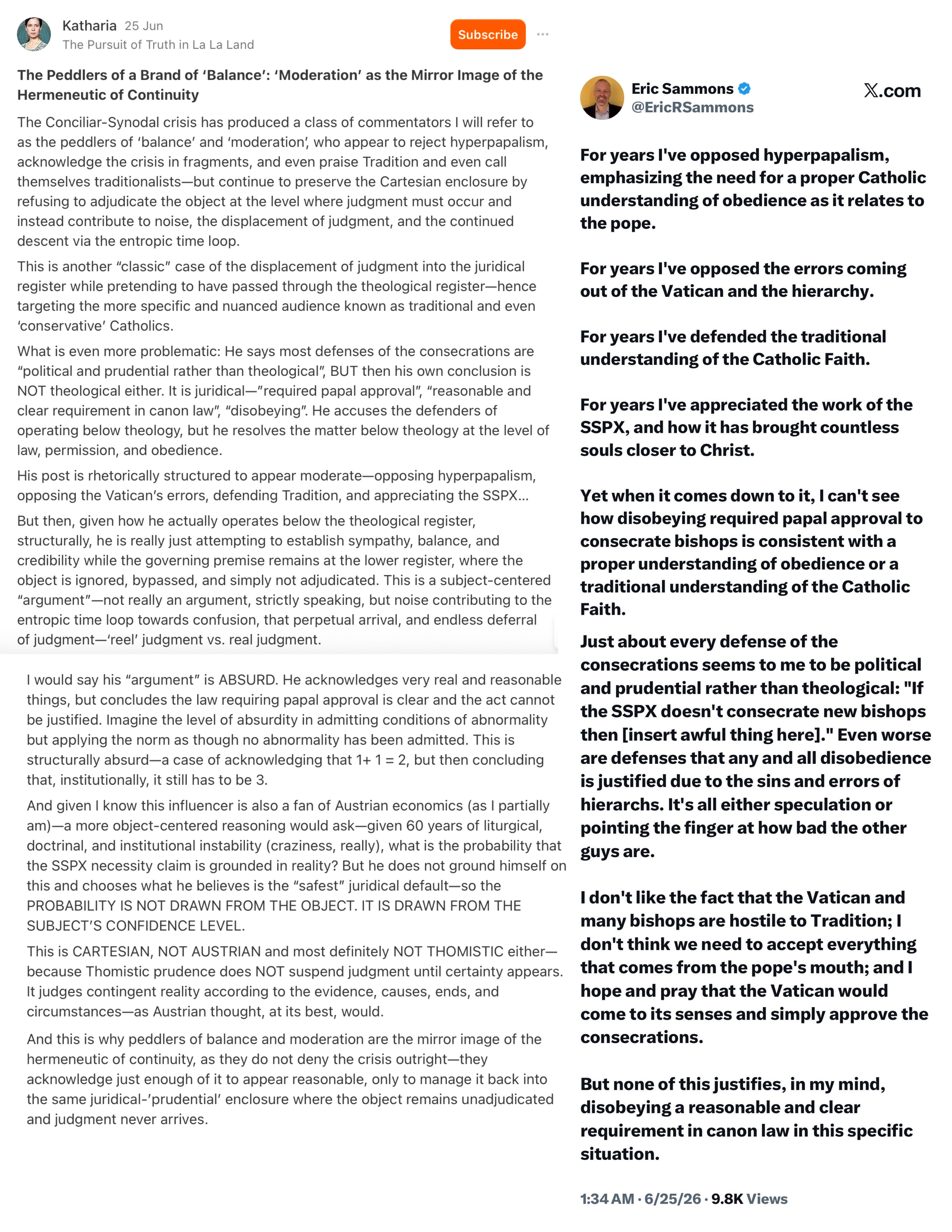
We have made a related point (see here and screenshot above) concerning the peddlers of “balance” and “moderation.” Their error is subtler than Marshall’s because they often acknowledge fragments of the crisis, reject hyperpapalism, praise Tradition, and even express sympathy for the SSPX. But structurally, they still preserve the enclosure when they resolve the question at the level of law, permission, obedience, and prudential safety without first adjudicating the object. They appear to pass through the theological register, but the governing conclusion remains juridical. The result is “reel” judgment rather than real judgment: movement, moderation, and credibility without arrival.
As we were writing this article, we came upon Kennedy Hall’s recent article on Marshall. Hall’s article is useful, because it shows that even within the lower canonical-juridical register in which Marshall prefers to “argue” (assert), Marshall’s objections remain unstable and collapse. In other words, even within the Cartesian-Marshall enclosure—below the order of form, finality, causality, and metaphysical necessity—Marshall’s case is incoherent.
Hall also correctly notes that the 2026 declaration substantially follows the 1988 precedent. This does not merely make Marshall’s claim that the Society has suddenly “changed” less persuasive; it makes the claim structurally untenable unless Marshall can identify the relevant formal difference between 1988 and 2026. Without that demonstration, the accusation is an insinuation.
Hall also treats the “auxiliary bishops” objection with more proportion than Marshall does, arguing that the term is not canonically perfect in ordinary circumstances, but the SSPX situation is not ordinary, as the word functions to describe assistance without claiming ordinary diocesan jurisdiction or a parallel hierarchy.
Hence, Hall’s article confirms even from below (Marshall’s register and enclosure) what we have argued from above, where the fundamental arguments for the SSPX position lie—the metaphysical register, where all enclosures would ultimately disintegrate. But even from below, the canonical-juridical objections do not hold. From above, the reason they do not hold together is that they begin at the wrong level of judgment. The question is the formal species of the act: what was done, why it was done, toward what end it was ordered, and whether the claimed state of necessity is real vs. parchment, ribbon, optics, tone, or terminology. But even the cart before the horse collapses and cracks.
Hall should be commended. They are a Catholic commentator with a large following, and yet they attempt to close the loop rather than extend it. They do not merely add more reaction to reaction. They try to adjudicate and even meet those who do not actually argue (they assert) on their plane and enclosure—and adjudicate from within their terms. That is rare enough in the Catholic influencer ecosystem to be noted. It is also humanly difficult, since Hall personally knows Marshall and clearly wishes to preserve the friendship. We do not personally know Marshall, so it is easier for us to write with structural directness. Note too that directness is not the same as harshness. To judge a public argument according to its object is not cruelty, but simply justice to truth.
In a recent post, we wrote that before publishing, one must pause and pray, lest the work become another contribution to the entropic time loop: assertions in the name of obedience, accusation in the name of truth, and imputation of bad faith where adjudication is required. That warning applies to us as much as to anyone else. Hence, our insistence that the issue is not Marshall’s soul, but the structure of Marshall’s public argument.
We need not impugn Marshall’s motives in order to say that their argument is false, reckless, and structurally disordered. Hall rightly refuses speculation about Marshall’s interior state. We do the same. But public claims must be judged publicly. If one accuses the SSPX of dishonesty, dissimulation, and a “pseudo-Apostolic Mandate,” then one must demonstrate dishonesty, dissimulation, and a pseudo-mandate. Marshall does not do this. They construct, declare, accuse, assert, and impute—placing the cart before the horse by issuing judgment before adjudication, accusation before evidence, and moral condemnation before the formal species of the act has ever been determined. Marshall’s “arguments” are but assertions of reality according to Taylor Marshall, which includes imputation without proof, accusation without demonstration, and condemnation without prior formal adjudication.
We too once accepted the familiar categories: “schismatic,” “excommunicated,” and “disobedient.” We were originally JPII Catholics, where the crisis in the Church was practically non-existent—all was not just well but great with JPII’s World Youth Day (WYD), globe-trotting papacy, and anti-communist stature. We did not yet see that this “greatness” concealed the crisis. The same pontificate that looked conservative gave us Redemptor Hominis, where “man” becomes “the way for the Church”; Assisi, where interreligious prayer was normalized; Ut Unum Sint, where the ecumenical venture was presented as an irrevocable path; the “elder brothers” language; the papal synagogue and mosque visits; and Theology of the Body, which clothed sexual discourse in theological language and helped normalize making what should have remained private, parental, modest, and morally guarded into public catechetical speech. What we thought was Catholic triumph was, in reality, the Conciliar displacement of judgment wearing conservative, JPII Marian devotion, anti-communist, in personalist and affective garments—appeals to the emotion. But these supposed great things are revealed to be fundamentally problematic once one gets off the Cartesian enclosure which the media and secular establishment helped to prop up.
We too once thought the safe position was the Ecclesia Dei position, and the John Paul II/Benedict XVI position (see our brief discussion on the TLM tolerated/ offered as an aesthetic concession while the doctrinal crisis is ignored). That journey will have to be treated more fully elsewhere, in a future essay on our path to the SSPX position, which we have come to see as the structurally Catholic position in the present crisis. But it is important to note, our position is not tribal loyalty, as it emerged from choosing to adjudicate arguments we had once merely inherited. The SSPX position must be adjudicated, not caricatured, psychologized, or buried under juridical labels.
Just as 2020 unveiled how easily the supernatural could be displaced by temporal, biological, and bureaucratic priorities, the present SSPX controversy unveils whether Catholics will judge according to the doctrinal object or retreat once again into secondary categories: canonical penalties, optics, institutional safety, and accusation (see our post here).
We expressed as much here, signaling the crucial significance of the recent SSPX appeal against the Vatican’s decree of July 2, 2026, which at minimum brings into view the necessity of adjudication, due process, and actually addressing the arguments vs. asserting conclusions. In other words, not placing the cart before the horse. This is precisely the order Marshall reverses. The object must be faced, and the crisis must be judged at the level at which it exists.
Finally, Marshall’s case fails because it is born from the very displacement we have been tracing, where analogy is flattened into univocity, irregularity is inflated into fraud, optics replace form, accusation replaces demonstration, the SSPX’s stated position is replaced by a constructed posture of arrogance, and then the Society is condemned for the posture Marshall supplied. This is the entropic time loop in accusatory form.
Marshall’s error is that they treat the strain in language as proof of deception rather than as evidence of the crisis. Marshall’s argument takes the less prudent and more reckless path of imputation rather than the more Catholic and Thomistic path of remaining with the object and refusing to accuse without proof. Imputation is not only difficult to prove; it is dangerous to maintain, because it moves from the public object into claims about deceit, bad faith, and interior moral culpability. And until the SSPX position is actually adjudicated—rather than talked past, caricatured, psychologized, or buried under juridical labels—the loop will continue, and the demolition will proceed under the appearance of management. The crisis will continue to be described, narrated, reacted to, and administratively handled, but not judged.
We end with this conclusion, drawn from our prior demonstrations—the SSPX position is the intellectually honest and perhaps the only truly “recognize and resist” position, because it does not merely lament effects downstream. It officially and publicly identifies the doctrinal object of the crisis upstream—the ambiguities, equivocations, and even error in the Council’s texts, and the way these have issued in the Conciliar-Synodal settlement.
No posts
Comments
Nothing yet. Say the first thing.
Sign in to join the conversation.