
Today is my 48th birthday. Every year, I have a slice of caramel cake from Piece of Cake, a bakery in Atlanta. (They ship anywhere in the U.S., and they’re not paying me to say this. Check them out.) My mom used to send one of their chocolate chip pound cakes to my dorm room at Princeton every birthday for me to share with my friends. For more recent birthdays, I’ve requested that my husband purchase an entire caramel cake so that it would last a while – but then it wouldn’t last a while because I’d eat it all. Twenty-five pounds later, I now have one (generous) slice of caramel cake annually.
That’s not to say that I don’t eat cake the rest of the year – just not that cake. In fact, I have a sweet tooth, and it’s a problem. My history is typical: in my youth, I ate whatever I wanted and never gained a pound. “Slender and pretty” was who I was. Others might have a weight problem (or a lack of self-discipline, perhaps?), but I would never eat more than I could burn. Until I had children, of course, and turned 40, etc., etc. Now I am “matronly” – and claim to have self-discipline about other things.
However, I still identify as “slender and pretty” even though the mirror in my closet tells me otherwise. To be fair, it is a fat mirror that widens everything and needs to be replaced – but somehow, I think a new mirror would not be satisfactory either. I know what it will show: Me, but swelled – an unacceptable vision. Therefore, in the latter half of my life, I am counting calories, doing Pilates and walking miles in the fantastical hope of excavating that “slender and pretty” person from this middle-aged matron. And as I sit here munching sugar-snap peas, watching the clock for my next meal, I suddenly ask myself, Why?
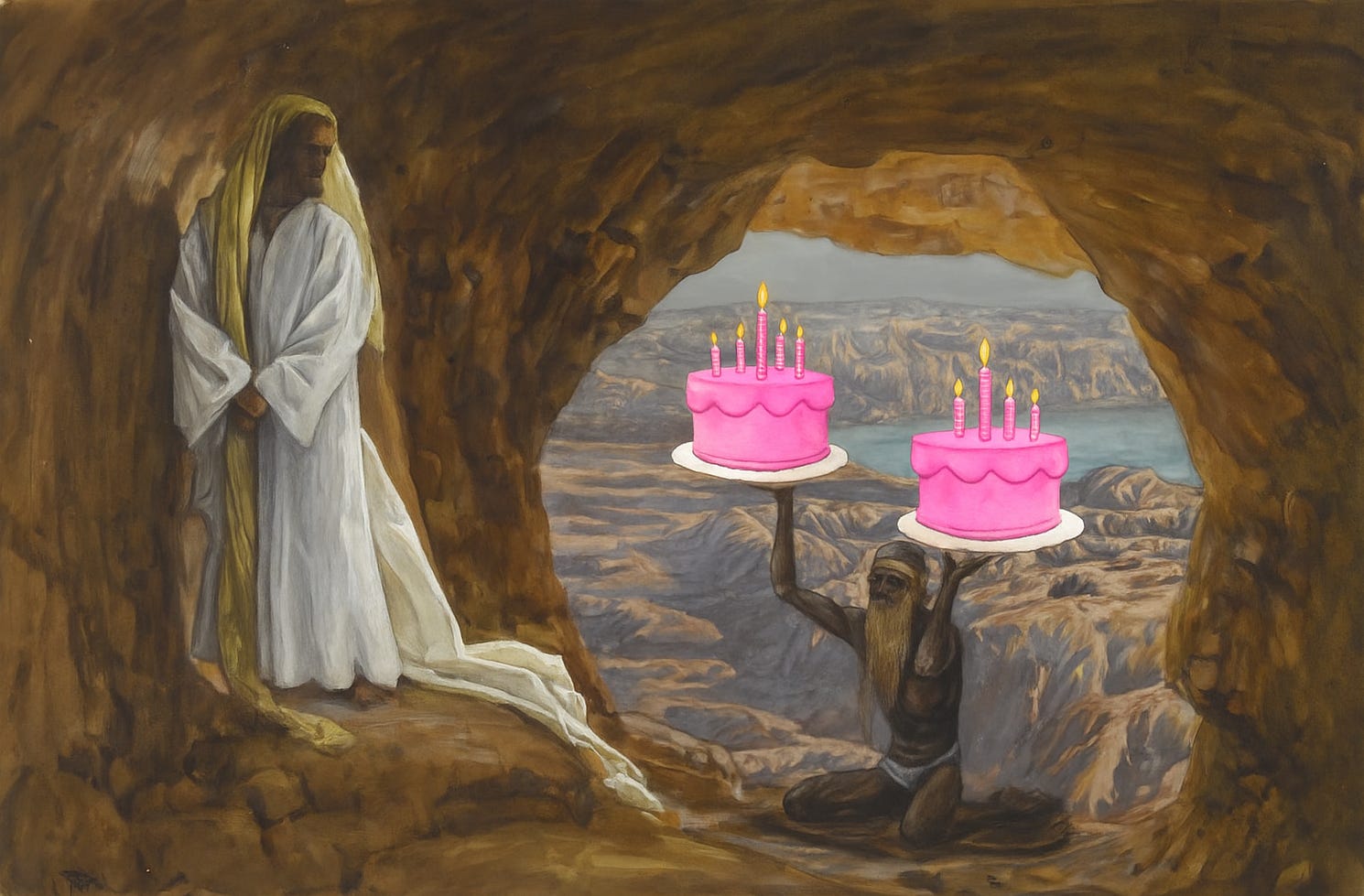
I learned from an early age that what you do, how much you do, and how well you do it define your worth. Fill out a college application and see what I mean. To be clear, I don’t believe that this works-righteousness earns my “salvation.” Along with other reformed Christians, I know that I’m saved from my sins by grace alone – not by my virtue, but Jesus’. Nevertheless, I functionally believe that my worth and identity hinge on my own choices, achievements, and actions. (And weight.)
Not that my parents ever taught me that – I know they would have loved me no matter where I went to school or whether I succeeded or failed. Nevertheless, the culture of achievement is the polluted air we breathe here in upper-middle-class Atlanta. Does the smog choke you, too, in your part of the world? Where did you go to school? What do you do for work? Where do your children go to school? What church do you go to? (Oh…, that kind.) Do you work outside the home? Where do you volunteer? How involved are you?
(None of the answers are good enough, by the way. You could be doing more, you know.)
These are all innocent questions asked of me – and asked by me – at countless cocktail parties, dinners, and gatherings. The pollution is not in the questions, but in my own mind – or heart, if you will. I cannot respond to these questions innocently because the answers carry the burden of my whole existence: I’m an interesting person whom you should want to know because of my resumé. Lest you think I have matured past caring about it, I will now list a few highlights: I was a superb violinist and a nationally awarded actress and studied at Princeton and Columbia and acted in New York City and started an opera company. (It produced only one opera before dissolving, but we won’t go into details).
If you noticed that all of those things were in the past tense and wonder how long one’s identity can rest in past achievements before they become obsolete, you’ve identified the raisin in what should have been a chocolate chip cookie. My indignation is extreme: What I’ve done is never enough. Someone else has done more or can do better – and tomorrow is another day that must bring new achievements. Otherwise, why am I here? Aren’t I supposed to bring glory to God through my awesomeness?
Nothing is exempt from this standard of excellence. Let us turn away from resumé building and take virtue as an example. Surely my legendary thoughtfulness is uncorrupted from this striving for glory! After all, the Bible tells us in Philippians 2:3-4 to “do nothing from selfish ambition or conceit, but in humility count others more significant than yourselves. Let each of you look not only to his own interests, but also to the interests of others.”
My mom raised me right. I know how to put others first. In fact, I bet I can do it better than you – like during that whole six-year episode in which I cared for my dying mother-in-law who was Very Difficult (extra points!) and even brought her to live in my home during her final, protracted illness all while having daily migraines (triple bonus!). If you’ve read my essay about those years (entitled “She’s Dead!!!”), you know the real story – but what I wrote just now are the important facts about how thoughtful I am.
There have been many less dramatic opportunities to exercise my thoughtfulness, but I’ll share just one. During the years that I cared for my mother-in-law and began having those daily migraines, the mother of our pastor’s wife died after a long illness through which her daughter had nursed her in their home. Some thoughtful person in the church had started a Meal Train for the pastor’s family to give them a break as they grieved. (Dang – wish I’d thought of that.) Wanting to serve their family (as well as to demonstrate my thoughtfulness), I signed up for a Friday several weeks in the future and put it on my calendar. Anything sooner had already been spoken for – they were well-deserving of their congregation’s care.
In the meantime, a dear friend who lives out-of-state offered to meet me for a girls’ weekend, and we planned it for a Friday in the near-future. The day finally arrived, she flew into town, and we drove together to a resort about an hour away. We had a marvelous afternoon and were dressing for a late dinner when I received a phone call from my pastor’s wife. How exciting! We weren’t close, personal friends – just friendly. I liked her and hoped we could grow closer –perhaps through my thoughtfulness in taking them a meal in a couple weeks? The conversation went something like this:
“Anne, hi! How are you?”
“Hi, Kate! We’re fine – and we really appreciate your signing up to bring us dinner tonight. What time should we expect you?”
The thrill of panic that shot through my body can be compared to the terror experienced during a car accident. I hurriedly checked my calendar while stalling with some inane comment and confirmed that she was not wrong as I’d hoped. I then began talking about the plan for dinner (as if I hadn’t thought of it that moment) in which my husband Kirk would bring them dinner and would be there within the hour. I conveyed my apologies that I hadn’t touched base earlier. It was already 6:30 p.m.
I then called my husband at work (he was a long-suffering associate at a law firm in those days) and gave him his instructions. I may have gotten as far as saying, “...put the chili from the freezer in a basket – they’re on the top shelf of the utility closet—” when he said,
“I’m not doing that.”
“But it’ll look so much better!”
“No, I mean, I’m not delivering food in the next hour.”
“WHAT?? But I signed up to bring them dinner tonight, and – and – I forgot! You have to do this for me! Please!!”
“The case I’m working on goes to trial on Monday. I can’t leave the office right now.”
“But—”
“Call her back and offer to order them takeout.”
“But that’s so humiliating! I can’t tell her I forgot! It’s supposed to be a home-cooked meal! What will she think of me??”
“She’ll think that you’re human and made a mistake. I gotta go. Good luck.”
I stood in the middle of my hotel room, half-dressed for dinner, an hour away from Atlanta and decided to throw my husband under the bus and blame the entire failure on his court case. I called the pastor’s wife back.
“Anne, hi! Listen, I… I am so sorry that Kirk is… the fact is that, unexpectedly… Anne…” It wasn’t coming out right, so I took a deep breath and tried something I had learned from a Bible study I’d recently attended – taught by her, incidentally. “I’ve made a big mistake. I’m out of town right now, and I completely forgot that I was supposed to bring you dinner tonight. I’m so sorry. And… I’m mortified. May I please order you takeout? What would y’all like?”
Anne laughed. She has a delightful laugh, and she said, “Grace to you, Kate. Let it go, and don’t worry about it. We have leftovers that we can eat. You have so much going on taking care of your mother-in-law – please don’t think about it again. Get back to what you’re doing, and I’ll see you soon!”
We hung up – and I did not feel relieved. In fact, I felt a migraine coming on. I faced a choice. I could concede that I was not as thoughtful or capable a person as I wanted to be, accept my need for her graciousness, and acknowledge that signing up for the Meal Train had been the backdrop for the real show – **Kate Susong: Chef and Friend Extraordinaire** – which had folded before opening night and wasn’t worth seeing anyway. OR I could increase the pressure on myself to do better. I could mine this embarrassment for the fuel I needed never to make a mistake like that again. I was an organized person; a thoughtful person. I hadn’t been good enough this time; but next time would be different. I simply needed to try harder.
Naturally, I chose the latter and said to myself, Failing to meet the standard is unacceptable! I reject the notion that I’m not good enough and need grace! (Well, I did that time.) But I don’t need it in general!
There may be those among my readers who have discerned a primary cause of my migraines. Congratulations. You’re geniuses.
In my essay back in March, The Astonishment of Resurrection, I came to my own conclusion about the cause of my decade-long struggle with near-daily migraines: I was doing too much. Basically, I concluded that I had unrealistically assessed my capabilities and was signing up for too many commitments – kind of like when a job interviewer asks, “What’s a fault you need to improve?” and you say, “I work too hard.” Yes, it’s true. I’m such a hard worker, and I need to do less, people! I need to scale back on how much Kate I share with the world – I need to ration my sparkly greatness a little more responsibly.
I sat with that resolution over the summer while the reality slowly occurred to me that the work is not the problem – it’s me. I’m the problem. I am now remembering that several healthcare professionals over the years have come to this conclusion, as well, when their therapies, surgeries, diets, or medicines haven’t worked. Each time someone washed his hands of me, I heard some version of this refrain: “You might want to try counseling,” which I promptly dismissed as sour grapes since they weren’t able to help me. A couple of years ago, my physical therapist friend put it differently. He said, “You need to pray about this, Kate. There’s something else going on.” OK, Brian. Whatever.
Then, at the beginning of this school year, the migraines redoubled. By saying no to everything since March, I had reduced their frequency to a couple times a week – but in spite of these efforts, the daily migraines returned. This new onslaught made me think.
Living under that dome of pain felt like crouching in Plato’s Cave. I was aware that my joie de vivre – my own spark of energy and joy – was dim. I had been living by that light for so long and believing that the shadows cast by my light were real: I matter because of what I do, how much I do, and how well I do it. Could I find my way out of that cave and see by a different light?
The 19th century French author Jules Verne was obsessed with the idea that our own light is insufficient. On their expeditions in The Mysterious Island, 20,000 Leagues Under the Sea, and Journey to the Center of the Earth, the heroes bring lamps or torches that eventually run out of fuel or are extinguished, plunging the explorers into terrifying darkness. However, before despair overtakes them, a mystical phosphorescence or bioluminescence – unseen while using their own light – illuminates their way for the rest of their journey. I’m seeing a metaphor here. Jules Verne feared the darkness of his own insufficiency – and imagined a light source beyond human power that would show the way. Perhaps you see where this is going. As always, it’s about Jesus. (Jules Verne wouldn’t have put it that way – he was a Deist.)
While sitting in the dark a few weeks ago – literally a dark room (because migraines) but thinking about Plato’s Cave and Journey to the Center of the Earth – my perspective changed. There was another light source that I already trusted for my salvation, and I needed to understand my life from that perspective. Over time, in the dark, things turned inside out and upside down and began to make sense. I didn’t hear a literal voice, but nevertheless, here’s what I understood God saying to me:
Stop trying to manufacture your own light. Compared to mine, yours is pretty pitiful, and you’ve fallen on your face. (Isaiah 50:11)
Stop meddling. Stop inserting yourself into jobs that I’ve assigned to someone else. You are not the savior. I AM. (Isaiah 43:11)
You can do nothing right; and I love you. (John 15:5-9)
Try being still and watching me work. (I Samuel 12:16)
Take every thought captive for Christ. (II Corinthians 10:5)
I do not love you because you are (or are not) thin or smart or virtuous or talented or thoughtful or pretty or generous. I love you because I AM love. I made you and know you and have rescued you from your striving for glory. Rest in Me! (I John 4:8, Isaiah 30:15, Matthew 11:28-29)
Ruminating on these messages, I sensed that the migraines were an outward explosion of an inward pressure, self-applied. Every pound gained, every ball dropped, every appointment forgotten, every appointment attended, every parenting failure, every parenting success carried the weight of my self-worth and could not be sustained.
One might think that those messages were revelatory enough. But God likes symbols and tangible lessons, not just nebulous thoughts that can be forgotten. So he arranged an allegorical, real-life story with an unforgettable moral. It unfolded three weeks ago.
For a few years before my husband’s 50th birthday in August of 2024, he knew he wanted a really nice watch. He has never had one before – it didn’t seem to be a justifiable expense, previously. But at 50, he would have reached an age and stage in which a nice watch would mark an arrival at maturity and be symbolic of a life well-lived. He is no collector – this would be a one-time purchase – and he set aside the money and researched watches off and on for years before this special occasion.
Some might say my husband is nit-picky – but let’s call it detail-oriented. He knows precisely how things should be done, and he’s right. I did not need to shop for this watch – it was best to let him do it himself. The research was so far-ranging that by his 50th birthday, he still had not found the right watch.
Another year passed, and Kirk’s 51st birthday came and went before he finally identified The One. He was most interested in the innovations of a particular watchmaker who combined newly engineered gears with a new face design unlike anything else he’d seen – but there were only 33 of this design ever made, and none were on the market.
But last month, one of these 33 watches appeared at a vintage watch dealer. Kirk would have pounced but for a major complication: the watch was owned by a British shop that could not ship purchases internationally. Kirk would have to go to England to retrieve the watch himself.
My reaction? He must go. My husband is always making sacrifices for us, and if a plane ticket were part of his 50th birthday present, then it would mark the occasion all the better.
From London, he reported that he had a few days after purchase to evaluate and send it back if dissatisfied – and ultimately, for reasons that weren’t perfectly clear to me (nit-pickiness?), Kirk decided to return the watch. The kids and I picked him up from the airport, expressing our disappointment that years of research had come to nothing. At dinner, we assured him that he could still keep an eye out for another of the 33 watches. Perhaps a different one would become available? Or did he not like that model anymore…? In response, Kirk said,
“Well, children, I’ve decided that I want a different birthday present.”
We all gaped. Inconsistency is not one of his characteristics.
He continued, “The best adornment for a man… is a well-adorned wife.”
He set a small, green leather box on the table, and we all stared at it.
“What’s happening?” my daughter asked.
“Is that your 50th birthday present?” my son asked him.
Already in tears as the significance dawned on me, I said, “You spent your birthday money on me?”
He nodded. “I love you,” he said.
But I heard, “I love you even though you’re 25 lbs overweight. I love you even with middle-age forgetfulness. I love you even though you’re sometimes incapable. I love you apart from anything you accomplish or fail to accomplish. I just love you.”
It turns out, they were beautiful earrings, but don’t get distracted. The real gift was the sacrifice. Without my achieving a fit body or an organized home or a published book or even remembering the dry cleaning, he gave up something he’d spent years of time and money to pursue – because he loved me. This unexpected grace condensed all those messages God had been teaching me into two Stones of Remembrance, earrings that will forever remind me of the Gospel message: Because of what Jesus has done, I’m already chosen, already accepted, already loved, and there’s nothing I can do to earn or lose that.
I’m hesitant to write this next part – because I don’t want to put God on the spot? (like he couldn’t handle it?) because I’m afraid another migraine will shatter my conclusions? – but here it is: I haven’t had a migraine since. As I sat in tears at the dinner table, staring at my new earrings, a weight lifted from my body. I breathed more easily, and I relaxed as if a spring inside me had uncoiled. The defenses I had constantly maintained against the flood of my insufficiency gave way – and it didn’t matter. I didn’t drown, not because I can swim – but because I can walk on water. I am free.
In closing, I acknowledge that I’ll have migraines again at some point. We’re already saved but not yet perfected. Like the apostle Peter, I’ll take my eyes off of my Savior while walking on the water, think everything depends on me again, and start to sink. But then I’ll see my earrings, and – I’ll stop now before getting lost in a life-preserver metaphor.
All of this freedom has clarified something for me. Since I’m loved anyway, I’m having two slices of birthday cake.
I AM the Light of the World. Whoever follows me will not walk in darkness,
but will have the light of Life.
John 8:12
Comments
Nothing yet. Say the first thing.
Sign in to join the conversation.