
Dear reader,
Several weeks ago I shared about how I was creating a new time blocking schedule. A fellow mother said in the comments:
I have a 3 year old, 18 month old, and one on the way - and life/our home honestly feels like chaos 🙈 I’ve been noticing the need for a schedule, but haven’t really known how or where to start. Would love to hear more about this!
I’ve got lots of thoughts on the topic of time, so let’s dig in.
Time is a resource that you cannot make more of. It’s finite nature, coupled with the fleeting seasons of motherhood, can make a person feel like they never have enough. We personify time, declaring that it’s getting away from us or we ran out of it, turning it into an entity outside our control. On the other hand, trying to control time can feel like trying to control the tides; it can be a losing battle.
So what is a mother to do about time? Are some women more time-cognizant and able to organize it better than others? What about the way time tugs at your heart, reminding you that you’ll never have this moment again, while simultaneously feeling like a day in early motherhood never ends?
As a mom for nearly 15 years, I’ve had my share of grappling with time, lamenting the loss of it, feeling ashamed at my inability to control it, and trying to futilely make more of it. At the same time, I’ve had stretches of motherhood where I’d swear I lived 5 memorable, life-changing years in the span of just 6 months. How is that possible?
The way you relate to time often determines your experience of it. If you believe that you don’t have enough time then you may feel anxious, frantic, or overwhelmed. The opposite is also true; it’s possible to believe that there is indeed enough time and to feel calm moving throuh your day. Therefore, your ability to manage your time well as a mother is predicated on what you’re believing about the availability of time.

As a homeschooling mother of 4 who has almost always had a side hustle, business, or job, I deeply know how it feels to have limited time. The periods of my life where I let myself be reactive about my time unfortunately also led to me frittering it away due to a perceived lack of it. It’s interesting how if you believe you don’t have enough of something, you’re more likely to waste it. It’s when we trust that there is enough time and value what we do have that you may find you show up differently to your days.
One of my favorite sayings I remind myself of on days where I’m running my oldest to dance, trying to homeschool the middle two, take care of the baby and the home, and I’m feeling stretched is:
“I have more than enough time.”
It feels like a big exhale to repeat that to myself and look for evidence of how that might be true.
What’s your relationship to time like?
When my children were little, I focused on creating a simple daily rhythm to give purpose and a plan to our days. It helped me to not get lost in the weeds of housework and to also feel intentional in the way I cared for our home and met my children’s needs. Our daily rhythm was governed by the needs of their bodies: food, sleep, nature, and play.
A simple daily rhythm for a young child is first an exercise in observation: when does your child gravitate toward rest? A meal? Going outdoors or for a walk? What needs to happen on a daily basis to keep the home running?
The goal here is to find the pulse of your home and turn it into a repeatable pattern. It may look something like:
Morning | wake, breakfast, outdoor outing
Midday | lunch, nap (housework), independent play
Afternoon/Evening | errand, dinner, bath, sleep
A simple, daily rhythm is very soothing for young children and gives them an understanding and anticipation of how they’re day will go most days. It’s important to remember that children live in the concrete when they’re young, they don’t have a true concept of time. So a rhythm is a way of creating “time” for them and orienting them to the order of the day.
As your children get older or if you homeschool like me, you may find time blocking helpful. It’s not always necessary (or even a good idea) to overly schedule your days down to the 30 minute or 15 minute block. It’s tempting, for sure, to do so. But I’ll be honest — any time I’ve tried to do this we only stick to it for a week, max. Family life is too variable to do so. One of the kids would get a bloody nose or we’d tussle about starting math or I’d get a phone call, and poof! The whole schedule was blown.
Time blocking is a gentler way to create order in the day and is a bit more detailed than the daily rhythm. In a nutshell, you chunk time into blocks that are then assigned to a specific use. Which means you’re ideally not scrolling social media during the homeschool block or running errands during the evening block. You know what to do when, and it creates order and consistency.
I personally like making my practice time blocks using Google calendar or a Canva template. I color code my blocks based on their use and this allows me to see overall patterns or problems in my weekly plan. When I’m making my To Do list, I then assign the tasks to the appropriate time block. I don’t know about you, but if I don’t do this, then I may be tempted to try to deal with an issue with the health insurance company during the homeschool block. Just because something feels urgent doesn’t mean it needs to take over the day.
Boundaries around tasks are a good thing.
Here’s an example of an older time block I used when I was working from home (and had help with homeschooling the kids on Monday, Tuesday, and part of Wednesday):
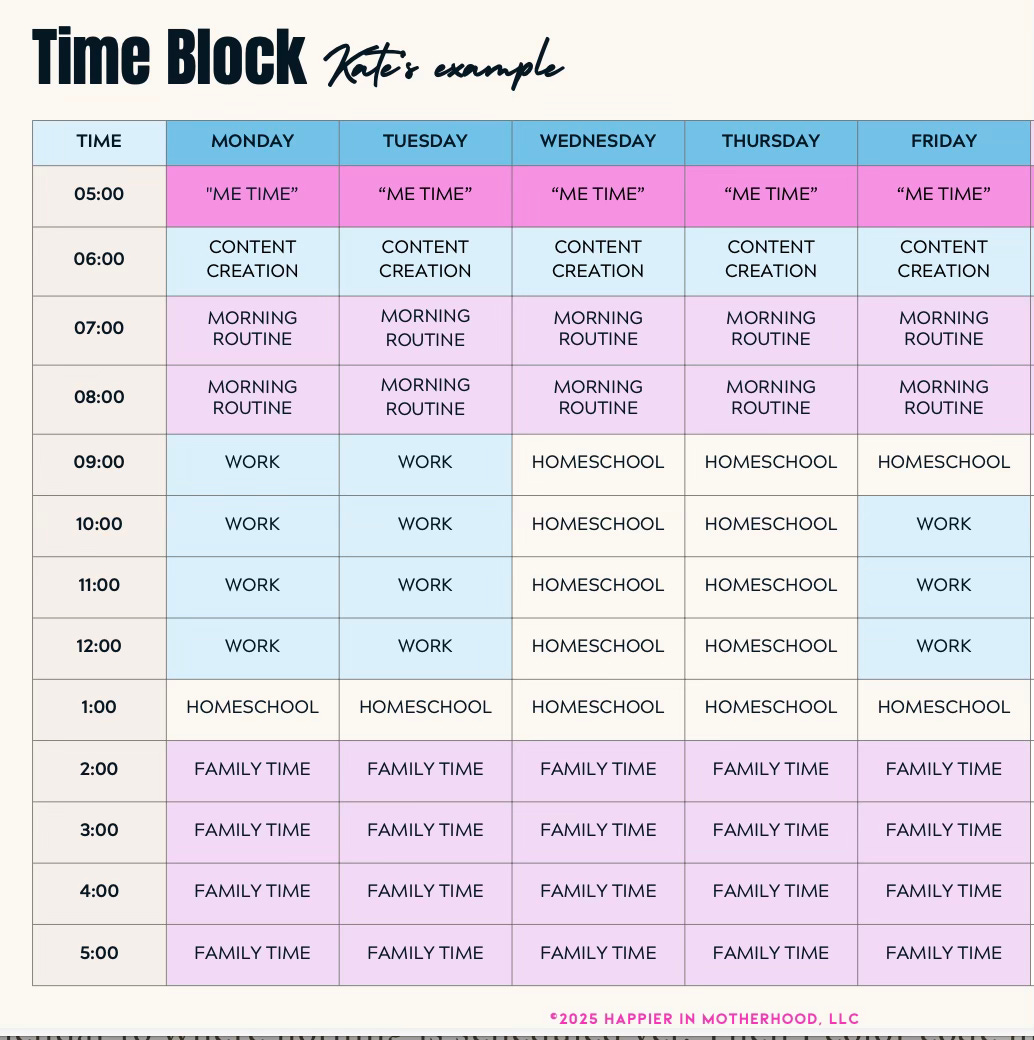
I’d totally share a visual of my current one, but I haven’t made a pretty version of it yet (I wrote it out on paper this time.)
6am-9:30am morning block | my Bible and prayer time, getting myself ready and preparing for the day, breakfast, dropping oldest off at ballet
9:30am-1pm homeschool block | homeschooling my middle two children, trying to keep the baby occupied and happy, and eating lunch together
1:30pm-2:30pm transitional block | pick up oldest from dance and memory work in car
2:30-5:30pm “getting stuff done” block | my time to do admin tasks, cleaning and laundry, earrands if needed, kids do their chores, oldest starts on her school work, dinner prep
5:30pm-8:30pm evening block | dinner and clean-up, showers/baths, stories and prayers, everyone in bed, my reading and Substack time
These time blocks have changed many times over the years as my children’s needs have changed. However, it does have a flavor of our old daily rhythm! The seeds you plant when your children are little will become engrained ways of being as they age.
And if this is new to you and you’ve never planned for your time before? Be kind to yourself as you build the habit. It won’t go perfectly, you may get frustrated and want to throw in the towel. Keep trying. Your kids will also need time to adapt to the new rhythm, and they may resist too. For all of your sakes, really commit to putting this into place, and give it a full 30 days.
Most of all, slow down and savor the time you do have with your children. Whether you perfectly manage your time (or not!) this time together is still a gift.
I hope this was helpful to you! Let me know in the comments any thoughts you have to share on time blocking daily rhythms — are you a fan of them? Brand new to it? Can’t wait to hear and thank you for reading!
No posts
Comments
Nothing yet. Say the first thing.
Sign in to join the conversation.