
She was three and a half years old, alone in her hospital room, clutching a teddy bear. A PICC line ran from her arm. The nursing handover that morning had included a warning: draw labs before she wakes up, because she really hates lab draws.
She was already awake.
Mary Jenner was a new face, in an isolation gown and mask, there to do the very thing this child had learned to dread. But instead of proceeding with the task, Mary paused and asked a simple question: did she want to put an IV in her teddy bear?
The child lit up.
What followed wasn’t complicated. Mary let her play nurse. She showed her what she was going to do. The lab draw happened, and it was fine. But the moment stayed with Mary long after the shift ended, quietly gathering meaning alongside all the other experiences that would eventually lead her to create Butterfly Pig — a range of realistic, 3D-printed medical play tools that are now used by children, families, and clinical teams across the world.
In a recent episode of the Dr Play podcast, Mary and I talked about what it actually means to centre children in medical environments, why play is often the most underutilised clinical resource in a paediatric setting, and what happens — to children, to families, and to staff — when that changes.
Mary trained as a paediatric nurse with a longstanding interest in patient experience. Before Butterfly Pig existed, she was conducting video interviews with NICU families about what made or broke their care, and evaluating the efficacy of patient education materials. She understood, theoretically and practically, that children needed more than verbal explanations and handouts. What she didn’t have was the what — the actual tools to bridge the gap between adult medical language and a child’s way of knowing the world.
“When you’re a paediatric nurse,” she told me, “you get the education on providing age-appropriate patient education, but then you get to the bedside, and you’re like — with what?”
That question became the engine behind Butterfly Pig. Starting with oven-baked clay, painting hearing aids to match individual children’s devices from photos sent by families, Mary began making what she couldn’t find. When child life specialists started reaching out and more complex requests came in, she shifted to 3D printing — a technology that made something genuinely new possible. Instead of a $30,000 manufacturing mould overseas, she could iterate, adjust, discontinue, and respond to a changing medical landscape with flexibility. Over one hundred toys later, Butterfly Pig is still growing.
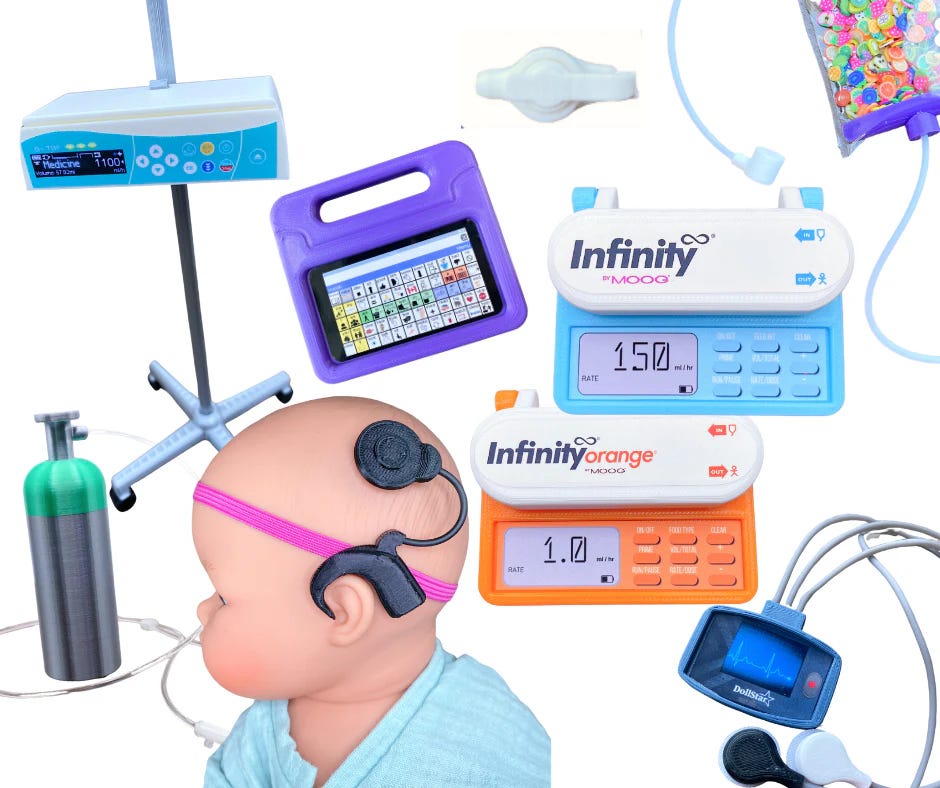
What makes Butterfly Pig’s tools interesting from a play therapy lens is the specificity. These aren’t generic doctor’s kits. They’re realistic miniature replicas of actual medical devices — glucometers, PICC lines, echo machines, infusion pumps. And that specificity matters.
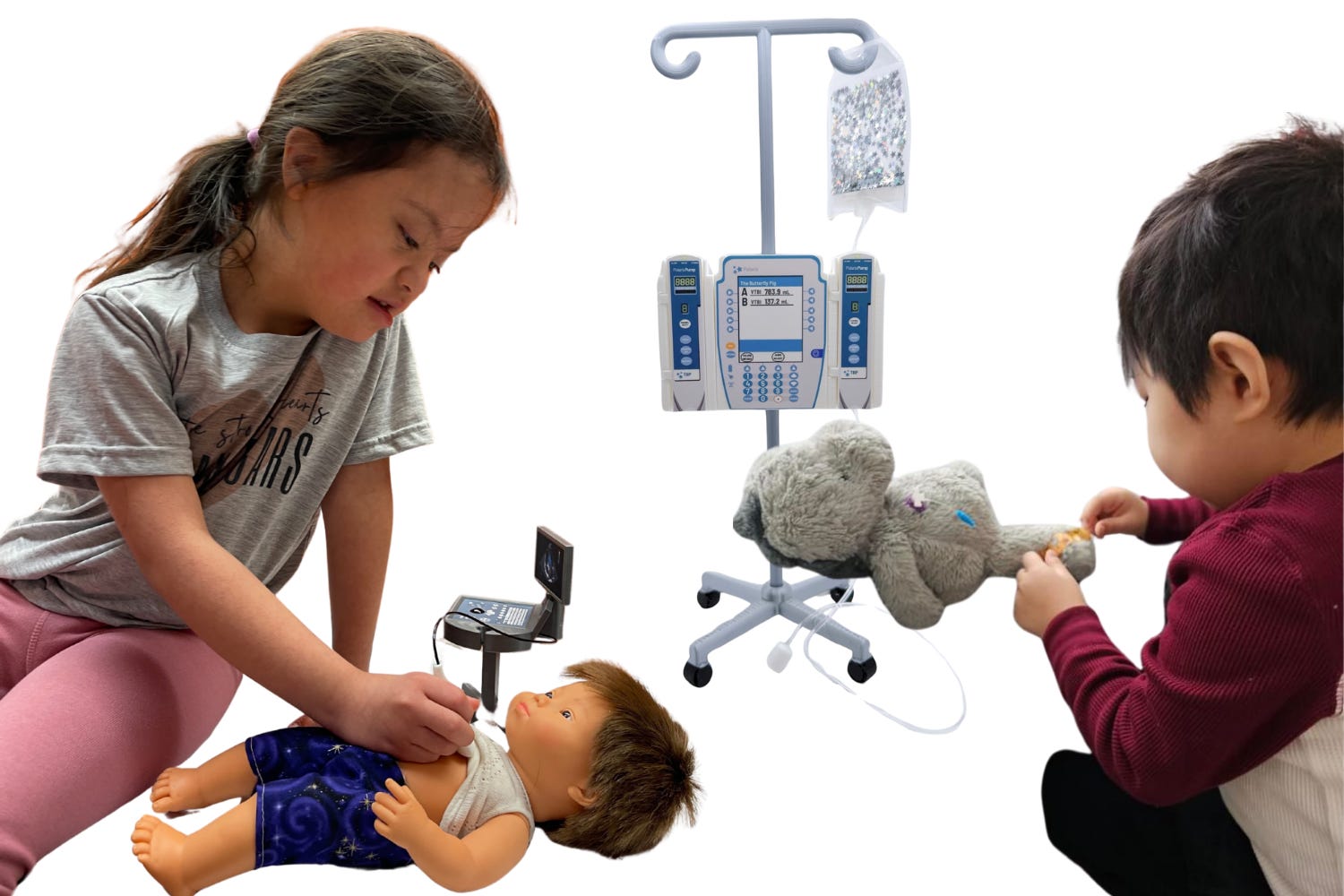
When I think about small world play and sand tray therapy, one of the things we understand is that psychological distance can be protective and generative at the same time. A child who is bigger than the scene has some measure of power over it. A syringe that fits in a child’s hand, rather than looming toward their arm, is a different kind of syringe altogether. It becomes something they can explore, something they can pick up and put down, something they have agency over.
Mary described watching an echocardiograph technician roll a large machine into a child’s room — unfamiliar equipment, unfamiliar face, and the child’s defences immediately rising. Then she described what happens when that same professional has a toy echo machine in their pocket: the child’s posture changes, their curiosity activates, they start asking questions. “You don’t see that when the toys aren’t there,” she said. “They’re not as empowered to be involved.”
Play, in this sense, is not supplementary to medical care. It is a language through which children can actually be in the room rather than enduring what happens to them there.
One of the themes that kept surfacing in our conversation was parental confidence — or the absence of it. Mary has heard many parents express hesitation about medical play: what if it makes them more scared? What if I can’t answer their questions?
Here in Australia, the Royal Children’s Hospital’s annual play survey tells us that around 60 per cent of parents don’t feel entirely confident playing with their children, even as more than 90 per cent recognise play’s importance. So families arriving at a paediatric appointment or hospital admission are sometimes carrying a double uncertainty: they don’t fully know the medical world, and they don’t entirely trust their own capacity in the play world either.
What Mary’s work quietly addresses is both. The tools give parents a way in. They don’t need the medical language. They don’t need to know how the equipment works. They just play — and in doing so, they’re present with their child in a way that doesn’t require expertise or performance. Several parents have told her it’s healing for them, too.
That resonates deeply with what I see in filial therapy: when parents begin to truly witness their child’s play, to observe rather than direct it, something shifts. A mother watching her daughter point to the toy syringe and say “this is going to hurt” discovers something about her child’s understanding — and perhaps a misunderstanding to gently address. The play reveals. It also connects.
Not all medical play is carefree. This was an important thread in our conversation, and one I think it’s worth holding with some care.
For the majority of children — particularly those without significant medical history, who have relatively secure relational templates and the emotional resources to engage in exploratory play — medical toys will likely be an empowering experience. They’ll play, they’ll ask questions, they might be tentative at first, but the play itself will carry them forward. This is one of the remarkable things about children: they are usually very good at titrating their own psychological experience in play, rarely going further than they are ready to go.
For children with significant medical trauma, however, things can look different. Mary has observed children who have been in the medical system so long, and subjected to so many procedures without adequate preparation or agency, that they have gone quiet in a particular way — not peaceful, but withdrawn. Compliant in the way of someone who has learned that resistance is futile. That is not healthy adaptation. That is a child whose nervous system has learned to shut down as a form of survival, and it warrants a different kind of attention.
There is also what we know from the research on post-traumatic play — described compellingly by Lenore Terr from her work with children following a mass kidnapping — where play around trauma becomes repetitive and joyless, a looping without resolution rather than a working through. It doesn’t happen often, but it happens, and it looks quite different from healthy exploratory play. Children stuck in this pattern are not telling us play is harmful. They are telling us they need more support than play alone can offer.
The good news is that play itself often reveals this. If a child has access to medical play tools and begins to show us that something is unresolved — through their play becoming rigid, frightening, or impossible to engage with — that is not a failure of the tool. It is information. It is the child communicating in the only language available to them, and it gives us something to respond to. This might be a child in need of additional psychotherapy support, like play therapy.
One of the things I have found most moving about Mary’s work is the way it ripples outward — not just to children and families, but to clinical staff themselves.
There is emerging research on nurse retention that identifies joy in the workplace as one of the most significant factors. In paediatric settings, that joy is, in theory, available in abundance. Children are inherently playful beings. But when staff are in survival mode — running through tasks, behind on documentation, stretched across too many rooms — accessing that part of themselves feels impossible.
What interests me, from my own research, is that the benefit appears to flow in both directions. When teachers in my PhD research engaged more consistently in playful, humanistic practices with children, they experienced what I’ve come to think of as an emotional splashback of nurturance. Using those skills genuinely seemed to give something back to the person using them. I wonder whether the same is true for paediatric nurses, and whether tools like Mary’s create not just an invitation to play with children, but an invitation back into the kind of care that drew people to paediatric nursing in the first place.
Play, as Jaak Panksepp’s neuroscience research established, is one of the primary affective systems in mammals — and Joy is its companion state. If joy is what retains staff in paediatric settings, then play is the gateway. Not as a performance or a program, but as the fundamental orientation toward children that good paediatric care has always required.
Mary and I ended up, as these conversations often do, talking about where all of this might be heading. She spoke about what she sees as an emerging shift — from a physical patient safety movement toward an emotional safety movement — and her hope that reimbursement systems will begin to reflect the clinical value of child life services, play therapy, and tools like hers.
I think she’s right that something is building. The Starlight Foundation’s work in the UK, the growing body of evidence on procedural support and preparation, the slow but real cultural shift toward including children as participants in their own healthcare rather than subjects of it — these feel like threads of the same larger weave.
In the meantime, the most immediate change is simpler: putting a toy in the room. Pausing before the procedure. Asking what the teddy bear thinks. Remembering that the child watching you roll in your equipment is not a variable to manage but a person who needs to understand, in their own language, what is about to happen.
That’s where Butterfly Pig began. With one nurse, one child, one teddy bear, and a moment of genuine curiosity about what might be possible. I find myself wondering what becomes possible when that curiosity is held jointly — by toy creators who understand medical worlds, and play therapists who understand what children do with what they’re given.
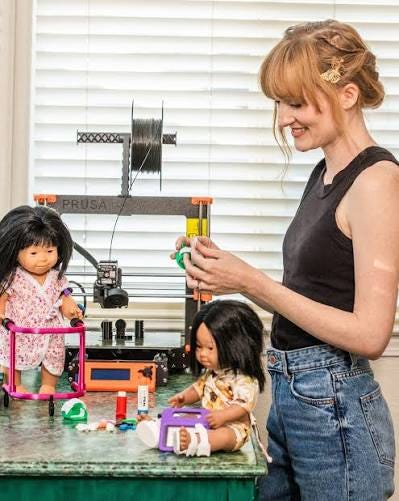
Mary Jenner, is a nurse, healthcare innovator, and founder of The Butterfly Pig, a company dedicated to transforming children’s healthcare experiences through play-based education and trauma-informed tools. Her educational tools are used by over 150 hospitals worldwide, and by tens of thousands of families. She is also the host of the Care Rewritten podcast, deepening her mission to end preventable medical trauma in children — not by asking overstretched clinicians to do more, but by redesigning the systems around them.
Find her on social media @TheButterflyPig.
Dr Kate Renshaw (PhD, RPT-S™) is a play therapist, researcher, educator, author, and advocate with over 20 years of experience working therapeutically with children and families. She is the developer of the TORA and the Multi-Tier Play Therapy (MTPT) framework, and is the founding director of Play & Filial Therapy. Her work spans clinical practice, doctoral research, sole-authored practitioner guidebooks, parliamentary advocacy, and international conference presentations. She is based in Ballarat, Victoria, Australia.
🌐 playandfilialtherapy.com
💼 linkedin.com/in/drkaterenshaw
No posts
Comments
Nothing yet. Say the first thing.
Sign in to join the conversation.