
I had many new sign-ups this week. If you are new to gender (in)equality—welcome! My name is Kate Mangino; I research and write about gender norms at home and at work. I am the author of Equal Partners and a co-host of the podcast Equal-ish.
This newsletter will never be behind a paywall, comes out (about) every other Wednesday, and is a grab-bag of whatever gender-related news and research is on my mind. I am always interested in reader experiences, perspectives and opinions – so feel free to share in the comments, or send me an email. Welcome!
Have you listened to Equal-ish lately? I’m really excited about the last two episodes. It was our first double! Rachel and I spoke to Dr. Leah Ruppanner, who is the author of the new book Drained: Reduce Your Mental Load to Do Less and Be More. We had so much to cover with Leah that we chatted with her for two episodes. We defined the Mental Load in Episode 36 (last Wednesday) and then talked about how to lighten one’s load in Episode 37 (today!)
The mental load is a term that has been thrown around a lot over the last several years, but there’s never been one solid definition – until now. Leah suggests…
Mental Load = The invisible, boundary-less and enduring “emotional thinking work” that is required for home, work, and life.
I’m not too big on semantics—which is probably why I made a terrible academic—but generally, I think this proposed definition makes sense. The words “emotional thinking work” suggest both cognitive and emotional labor. And I like the “home, work, and life” part, because we all know the mental load is not just something that happens at home—it follows us everywhere, including our workplaces.
And of course, Drained has a heavy gender angle—because what we carry in our mental load, and how large our load is, often links to our sex.
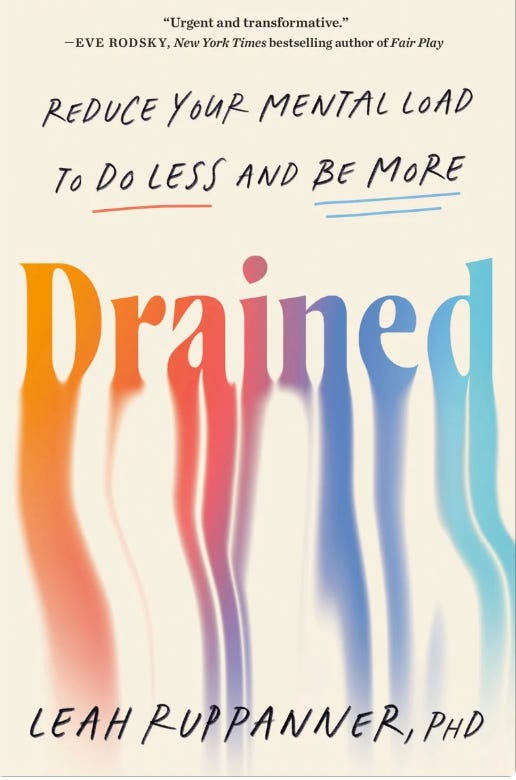
Part of Leah’s research and book writing was to create a website that is solutions-focused. So, if you are feeling the weight of a heavy mental load and want to know more—or do something to lighten your load—check out Lighten Lab. It only takes six minutes to complete Leah’s free Mental Load Assessment.
I took the assessment, and here is what they came up with:
You constantly measure yourself by achievement = 92% YEP
You constantly fear letting other people down = 91% Oh, for sure
You constantly manage other people’s well-being = 87% Uh-huh
You feel like you’re running on empty at work = 100% Oh geez
I reported my results to Leah and asked her—now what? How can I use these results to lighten my load? And here’s what she told me:
“Use this information to decide if your mental load is being spent strategically. If your mental load aligns with your goals, dreams, and purpose—then great. Keep on keeping on. But if your mental load is not aligned with your goals—and it is making you feel heavy and drained—then this is a great time for some reflection and realignment.”
This tracks with what Leah told us during the Equal-ish recording. The capacity to carry our mental load is like currency; it is finite. The best way to fight burnout is to make intentional decisions about how to spend our mental load capacity. If we spend time and energy worrying about something outside our control, something that doesn’t actually matter to us, or something that does not help us get to where we want to be, then it is draining. The goal is to invest our precious capacity into things we care about—and try our best to have enough left over for rest.
Leah also points out that everyone’s mental load shifts. We might have different results on Monday compared to Friday, or January compared to June. Over time, it changes depending on the ages of your kids, the health of your friends and family, your financial stability, and your workplace environment. And if we take this assessment regularly, we can start to see patterns in ourselves—which gives us the information we need to make more strategic decisions. So Leah invites you to take this as often as you want—as often as it is helpful.
If you take the test and have thoughts, let me know! And if you want to know more, listen to Leah on Equal-ish and read Drained. I think you’ll love it.
This newsletter will always arrive on a Wednesday afternoon. This is in honor of my dad, who used to call Wednesdays “hump day.” He did this to cheer me up when I was a kid slugging my way through the week; he’d assure me I was already over the hump, and nearly to the weekend. So, when this hits your inbox – even if you don’t read it – think to yourself: congratulations! You made it over the hump, and the weekend will be here before you know it.
Thanks for reading gender (in)equality! This post is public so feel free to share it.
No posts
Comments
Nothing yet. Say the first thing.
Sign in to join the conversation.