
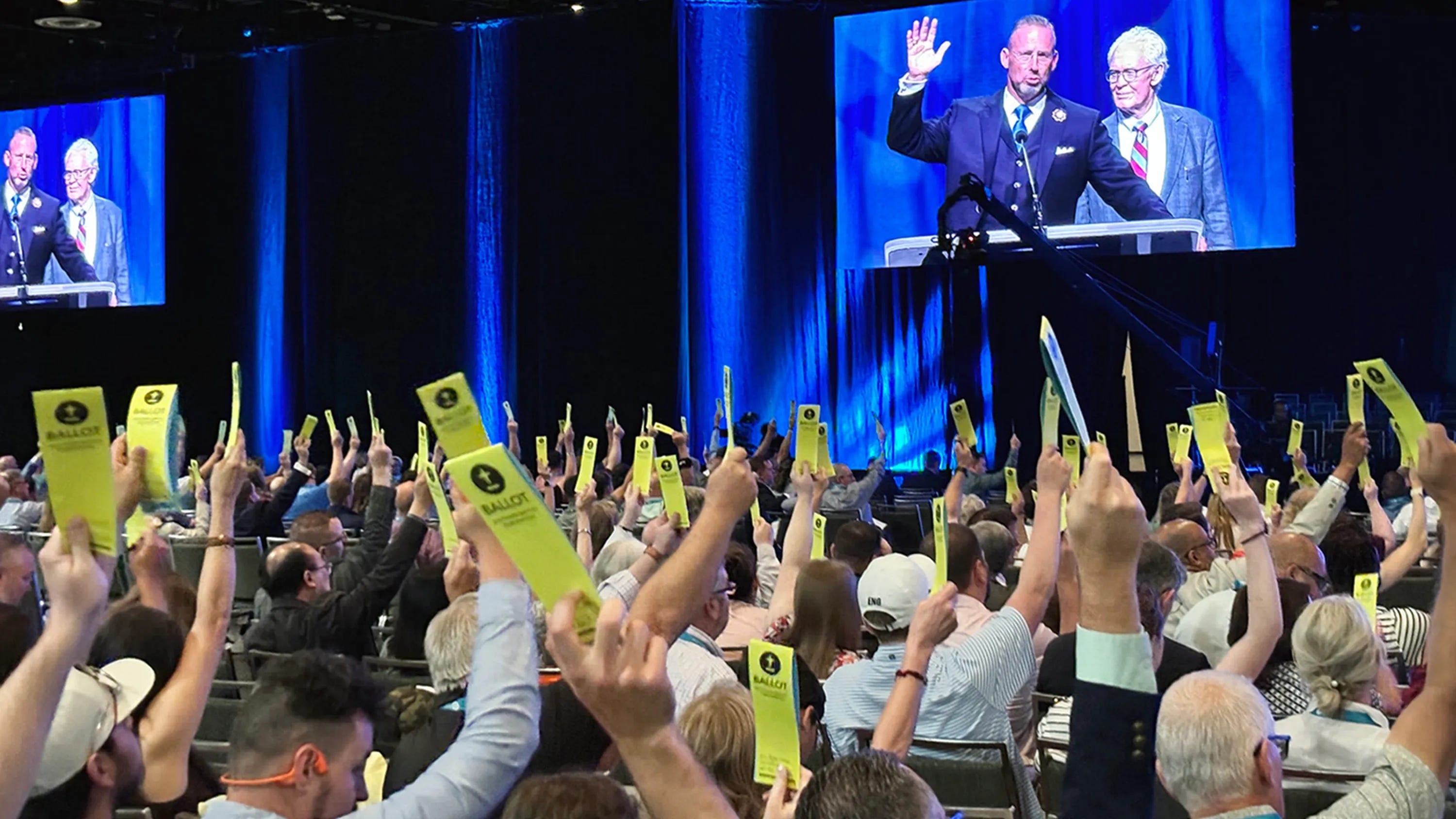
I learned of the news of the Southern Baptist Convention’s vote to ban women as pastors, elders, and overseers at the baggage claim after 12 hours of travel and a three-week trip to care for my grandfather in hospice. Waiting for my bag, I listened to Beth Allison Barr talk about the vote with my headphones on, absorbing the news. My body felt tense. I felt distant for the rest of the night, moving between righteous anger and grief.
Exhausted and grieving for multiple reasons, I took time to process my thoughts. I took time to rest. My partner and I went to the beach for a much-needed vacation. Over dinner, the Catholic Church arose as a topic of conversation. My husband mentioned how he wouldn’t mind joining.
I would. I thought.
I understood where he was coming from. The tradition. The incense. The liturgy. The emphasis on caring for the poor. It’s very appealing. But when he mentioned the Catholic Church, I had to ask myself “The Question.”
So why do I bring up a story about the Catholic Church in reference to a vote made by the Protestant Southern Baptist Convention?
Because “The Question” is the same one that always crosses my mind whenever I think of joining another denomination:
Because the SBC vote is not just about the SBC. It brings to the surface “The Question” women have been asking for centuries when attending churches throughout Christianity:
“Will my voice carry the same value here?”
As a man, my husband has never had to ask “The Question.” I doubt any of the men who voted at the Southern Baptist Convention have either.
For many people, “The Question” when starting a new church is: “Is the preaching good,” “Is the theology sound?”, “Is there good fellowship?”
But women must ask an additional question, “Will I and my voice be taken seriously as someone also made in the image of God?”
And even further:
Will my gifts be valued and welcomed,
Will my voice matter?
Will I be believed if something goes wrong?
Those are two different questions.
One is preference. The other is safety.
One is finding a church. The other is knowing your voice will be believed if something goes wrong.
One is about doctrine. The other is about dignity.
Growing up in the United Methodist Church with a mother in church leadership, my husband has always believed in women in leadership. It’s always been a given for him, like saying the sky is blue. Yet, even with this background, he carries the privilege of being able to walk into any door and not wonder whether or not his voice will be taken seriously because of his sex.
For those of us raised in conservative denominations like myself, it was never a given my voice would carry the same weight. As a pastor’s daughter, I’ve been told my whole life how God prefers me to use my voice. I’ve been told I couldn’t pray out loud in front of boys. I’ve been told I couldn’t go to seminary to become a pastor. I’ve been told I couldn’t speak where there were rooms of men.
Online, I’ve had “Heresy Detected” gifs and 1 Timothy 2:12 thrown at me more times than I can count. I’ve been told how God doesn’t approve of what I do, as if they are my still, small voice.
Women ask “The Question” because we learned early that our voices were treated differently.
I had a Sunday school teacher who once pointed at the Bible and declared:
“Never trust a woman.”
No one challenged her on it. We were all young. We silently accepted it without question.
Maybe she was referencing the story of Adam and Eve, maybe she was referencing the story of Samson and Delilah, maybe it was Rachel sitting on the idols. Whatever the story was, I know she was not alone in her assessment. There’s been a culture of not trusting women’s voices throughout the church, of blaming them when things go wrong.
When we create a culture where women are considered untrustworthy, where we throw 1 Timothy 2:12 and similar verses like confetti, we protect institutions rather than people. We disrespect the testimony, the wisdom, the dignity, and the labor of our sisters in Christ.
The intensity with which the authority of women’s voices is undermined, despite evidence to the contrary within the church, tells us something important: Churches know women’s voices matter. They have power to reveal and speak of the justice and compassion of God.
If women’s voices truly didn’t matter, this much energy wouldn’t be spent trying to silence them.
Debates about church leadership are often framed as issues about church structure. We frame this as theological disagreements to Bible verses, often referencing letters written to a specific church at a specific time, for a specific situation, in a specific cultural context.
But for all the women I’ve ever known, the issue of women in church leadership has never been an interesting thought experiment. It’s their lived reality.
We are tired of having 1 Timothy 2:12 hurled at us every time we raise our voices. We are tired of being told that God’s voice carries different authority depending on the sex of who is speaking. We are tired of being called heretics by our siblings in Christ who believe in a book that says, “Your sons AND daughters will prophesy.” We are tired of churches enabling abuse and telling us it’s our fault in the name of preserving hierarchy. We are tired of being told to submit to hierarchy when the Bible preaches mutuality. We are tired of having our dignity and humanity diminished in the name of a God of love, compassion, peace, and justice.
We are tired of being told this is about faithfulness when it so often functions as the preservation of power.
The church trusts women’s labor. It struggles to trust women’s authority.
The reality is that we DO trust women with various leadership roles throughout the church. We trust them to organize VBS, to teach our children, to lead choir, to provide pastoral care without the title of pastor. The church would not run without the paid and unpaid labor of women.
The issue with the church and women is not a trust problem. The church trusts in the labor of women. It would not survive without it. If women were incapable of leadership, churches wouldn’t depend on them so heavily.
What it struggles to trust in is women’s authority.
Every hierarchy depends on whose experiences are considered authoritative. It shapes who we believe, who gets dismissed, who gets to interpret events, who gets to define what is harmful, who gets to decide what happened.
If your leadership depends on women’s silence and submission, it’s not leadership.
The question of pastoral leadership is not just about leadership. It’s never been about women “seeking power.” It’s always been about preserving the power structures Jesus never sought to preserve himself.
Jesus formed communities around service, mutuality, and dignity. He uplifted the voices of the lowest in society to the point that his movement was called “the religion of women, slaves, and children.”
The radical nature of the gospel lies not in its preservation of hierarchy or patriarchy. It lies in the Beatitudes spoken on the Sermon on the Mount, in the voices Jesus trusted and uplifted as part of his ministry, in his trust of the voice of the Apostle to the Apostles Mary Magdalene who preached the news of the Resurrection.
The pulpit is simply the most visible manifestation of whose voices we consider authoritative.
The voices we trust and give authority shape the culture we create.
They shape how our churches respond to abuse, how they respond to accountability, how we respond to conflict.
So, what culture are we creating when we rely on women’s labor, but continually undermine the authority of the voices at every turn?
A culture that consistently labels women’s voices as deceptive, divisive, emotional, rebellious whenever they speak with authority is not merely preserving hierarchy.
It’s a culture that encourages rhetorical violence.
It does not just damage women’s opportunities. It damages their credibility, undermines their testimony, teaches others not to listen to them, and creates conditions where abuse flourishes.
That is what misogyny looks like in practice.
Misogyny was never part of Jesus’ ministry.
If your witness is focused on preserving power and patriarchy rather than a Jesus who moved power to the margins and built a culture of dignity and mutuality, then we have confused faithfulness with preservation of power.
Authoritarianism teaches us to distrust women. It teaches women to distrust themselves. It teaches others to distrust their voice.
As survivors, we recognize this pattern immediately. It is how we keep ourselves safe within a place meant to be a sanctuary.
I’ve seen what happens when churches become more concerned with protecting authority than listening to people, when difficult questions are seen as threats, when a woman is labeled as divisive, bitter, a Jezebel, or angry when raising concerns about abuse, misconduct, or unhealthy power dynamics.
Worshiping in an environment where the authority of your voice is distrusted is a dangerous place to be.
While men might say that it is their responsibility to exercise that authority, how can you exercise that authority responsibly for ALL members of your congregation when you can’t even take the voices and authority of women seriously?
When protecting the institution becomes more important than protecting the vulnerable, it is worth asking ourselves: who is being asked to stay silent for the sake of unity? Who is being protected through our silence?
Surely, not the God of justice and mercy.
When denominations like the SBC are faced with questions about power, accountability for abuse and harm, the healthy response isn’t to narrow the range of voices at the table in the highest places of leadership.
It’s to broaden it.
If an institution has struggled with abuse, secrecy, or accountability, why would we want fewer perspectives involved in leadership?
If we want an institution designed for all members of the kingdom of God, we need to include all of those voices.
In fact, how much do you lose out on when you can restrict part of the image of God?
The issue is not who gets to stand behind the pulpit. “The Question” is are we creating a culture where the authority of a woman’s voice is taken seriously when something goes wrong. Are we creating an environment that practices the same justice, compassion, and love for the vulnerable as the Christ we follow?
The issue is not ordination. The issue is whether women can trust that they and their voices will be seen as authoritative, credible, and honoring of their full humanity as part of the image of God.
Despite everything I just said, I don’t think the SBC’s vote is just primarily about women.
When an institution faces anxiety about the future, hierarchy and control often seems safer than change.
The SBC is facing declining membership, declining trust, and declining income.
When you face anxiety about the future of your church, it is easier to fall back on the familiar rather than ask the difficult questions about why people are struggling in the first place.
An institution like the SBC appears to believe that if they believe in stronger authority and male hierarchy, then it will fix the problems created by institutional decline.
If you believe God has established a particular hierarchy, doubling down on that hierarchy can feel like faithfulness. Following the rules you believe are set out by the Bible can seem like the most reasonable path to stability and self-preservation.
I’m not convinced everyone in the SBC is acting in bad faith. Many people sincerely believe they are being faithful to scripture, despite the cultural context. But sincerity does not exempt us from asking what kind of culture our beliefs create.
Because what we believe about authority, shapes how authority is exercised. It shapes who we trust. It shapes who we protect and who receives justice.
In fact, our silence can enable abuse.
When we spend years telling a person that a man’s interpretation of God, scripture, their calling, their body, their sexuality, their trauma, their experience, is more trustworthy than their own, are we truly clothing women in the strength and dignity bestowed upon them by God themself?
Or have preserving power, patriarchy, and control become idols that prevent us from hearing the message and wisdom Jesus is trying to teach us?
Because every time we ignore part of the image of God and the gifts women bring to the table (including pastoral leadership), the church does not become stronger. It becomes weaker. Women are not the only ones who lose. Everyone does.
A healthy church is not threatened by the voices that keep it accountable. It welcomes and uplifts them.
This brings me back to “The Question.”
“The Question” is not whether women can be pastors. Women have always been pastors. They will continue to be pastors, whether they have the title or not.
At this point, “The Question” expands to multiple. It asks:
Is the church willing to trust women when their voices challenge existing power?
Are women welcomed as full participants in the life of the church as long as their voices remain non-threatening?
Who becomes safer when women’s voices are out of the leadership conversation?
Who are we to decide who God, who created all of humanity in their image, decides to speak through?
The Southern Baptist Convention’s vote did not create the “Question.” It reminds millions of women why they keep asking it.
No posts
Comments
Nothing yet. Say the first thing.
Sign in to join the conversation.