
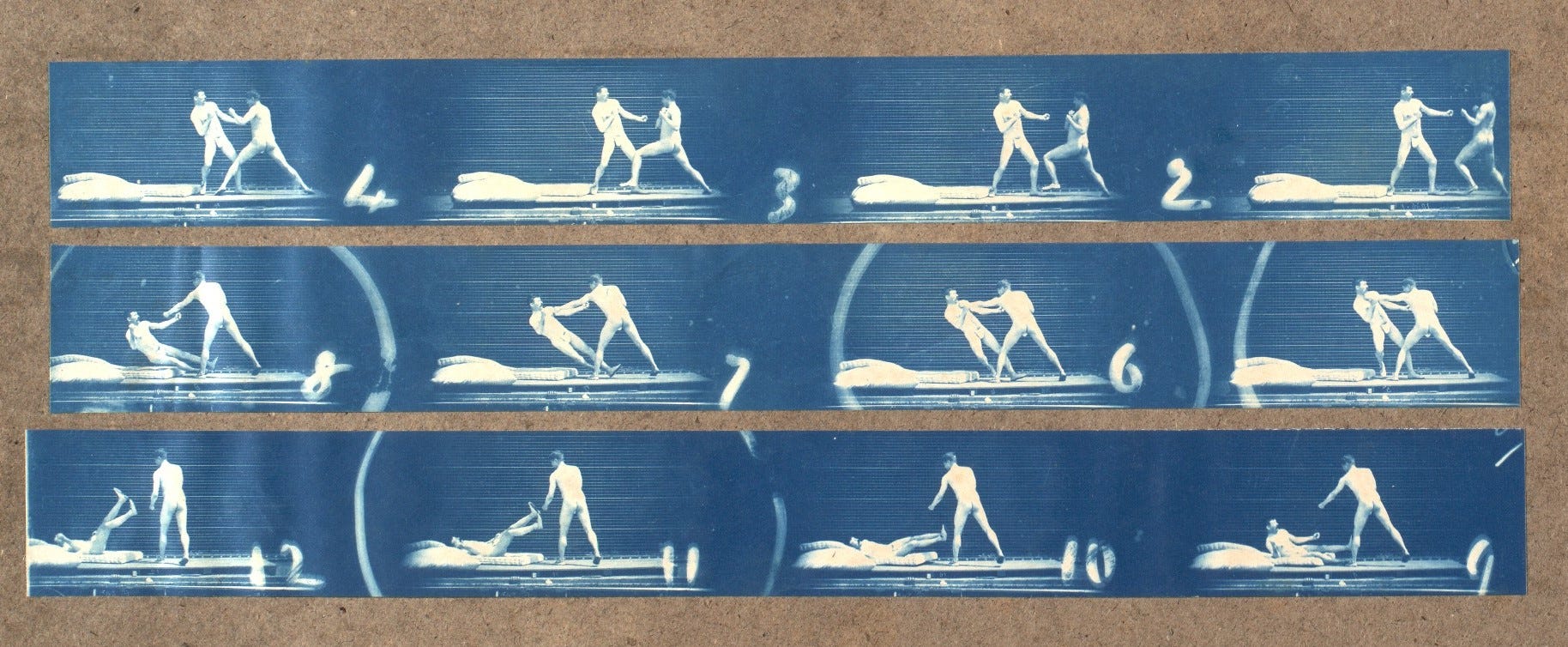
Boxing has a reputation for being a serious, tough-guy sport, but gyms—at least all the ones I’ve been to—are silly. Learning a sport is an act of play. Play is fun and childish. A playful attitude develops successful athletes by making learning low-stakes, and so athletes can practice failing and improve their ability to fail alongside their other athletic skills. As a result, the gym is rife with silly games.
“Knee-taps” is a reflex-building game. You and your partner/opponent stand across from each other in your boxing stances. The goal is to dart forward and tap your opponent’s knee. If you succeed and tap them, they do one burpee. As the game progresses, stances widen and lower, and competitors look more like light-footed quick-handed wrestlers; the silliness and frustration lead to smiles and groans.
The first time I played this game I did a lot of burpees. My opponent’s hands flashed like fish darting in and out of a river, and I could barely track the movements, let alone avoid them. After a dozen or so burpees, my opponent, an experienced practitioner with the blocky torso boxing creates and efficiently produced, well-distributed sweat, took pity on me. “Don’t look at my hands,” he said. “Look at my face.”
Not easy. Staring directly at him felt strangely intimate and unnecessarily competitive. This was silliness, not a locked-eyes game of intimidation. I did it, though, and focused on his wide nose, small eyes, hairline pulling back at his temples, a big scar over his left brow.
His hand darted out.
I stepped back, more like a little hop, back foot drawing my body just out of range. I was still looking at his face. His mouth twitched. It wasn’t a smile, but it was a pleased, coach-like expression: a note taken and executed. Suddenly we were well-matched. I was landing taps, pivoting away to dodge his counter-taps, my own hands flashing.
I had thought the game’s movements were driven by my own intention: watch the hand, predict its aim, move out of the way. But my animal brain was capable of processing his intentions faster than my conscious mind. To look at his face was to allow the animal brain to determine the appropriate response.
At its most high-level, boxing is a beautiful show of automaticity. “Flowing,” “reading,” “being locked in”: all describe the mind stepping aside so intuition can drive. Now whenever I am working with a partner, in sparring, or mitts, or silly games, I look at their face. I try to trust my body to interpret what my animal eyes see on their face. It’s still hard for me. I flow for moments, not minutes. I want control in a sport that demands release.
When it works, and I manage to execute a skill at a speed and level I previous thought beyond my ability, the experience is revealing and surprising. It makes me wonder where else in my life I might be limited not by real boundaries, but by a routine lack of self-trust. Where have I demanded perfect understanding, when I might be better served by intuition and experimentation?
Last week, I was the boxer with the blocky torso and the frustrating ability to tap my opponent over and over and over. I watched her try to track my quick-moving hands. I teased her, feinting, turning, leading her around the ring. Finally I offered the same tip I had been offered. She looked at my face. We squared up. I struck, she dodged and countered. Got me. She was stunned. It does feel good to share the secret knowledge. I did a burpee.
No posts
Comments
Nothing yet. Say the first thing.
Sign in to join the conversation.