
Today is the 106th anniversary of the ratification of the 19th Amendment, which finally granted most, but not all, American women the right to vote. On August 18, 1920, Tennessee became the 36th - and final state - to ratify it. And yet, in 2026, it’s one of the states actively redrawing maps to dilute the voting power of Black constituents, including Black women. How’s that for irony? It was slow to make positive change, and quick to take us backwards.
To understand what’s being taken away we should appreciate the stakes. Getting to ratification was long and painful. The baton was passed from the women who were behind the 1848 Seneca Falls Convention to the activist generation who took voting rights over the finish line. This period marks the end of the hard-fought journey for the right to vote, which took several generations of women, and men like Frederick Douglass who supported their activism, an astonishing seventy-two years to complete. And still, even after the 19th Amendment became law, it left poll taxes and literacy tests in place that made it impossible for many women of color to exercise their right to vote. It wasn't until the Voting Rights Act of 1965, which eliminated many of these restrictions, that women of color finally had access.
The bumpy road to get to the 19th Amendment was paved by activists, both peaceful and radical—sisters, wives, and mothers.
Often it was paved by women who were not rowdy activists at all, but who used their influence on their sons, brothers, and husbands to have a lasting impact.
Harry Burn was a twenty-four-year-old state representative from eastern Tennessee. On August 18, 1920, he was called to vote for ratification of the Nineteenth Amendment. On voting day, according to his great-great-grandson, Burn “had pinned to his jacket lapel a red rose representing his intent to vote against suffrage.”
It was a letter from his mother, Phoebe Ensminger Burn, that changed his mind. Known as Miss Febb, she implored her son to change his mind vote for suffrage.
“Hurrah, and vote for suffrage... be a good boy and help Mrs. Catt [suffragist leader Carrie Chapman Catt] put the ‘rat’ in ratification.”
It worked; the young man listened to his mother. Harry Burn voted for ratification and the Nineteenth Amendment became the law of the land.
Yet where is Miss Febb’s statue in the U.S. Capitol for finishing the decades-long fight for a woman’s right to vote?
Burn would have been standing on the wrong side of history had he not listened to his mother - and to the women who had bled for the right to vote.
The amendment’s passage emerged from a unique historical moment when traditional arguments against women’s suffrage—that women were too delicate for politics, belonged only in the home, or were not intelligent—had been proven wrong time and time again.
Throughout U.S. history, American women of all races and religious backgrounds had served in every war (sometimes secretly), defended every ideal, and yet been denied the most basic freedoms—like voting, owning property, or getting divorced. They risked everything for a country that often failed to return the favor or even grant them the freedoms promised in the Declaration of Independence. Public opinion didn’t always support women’s suffrage, but it began to shift in the early twentieth century—especially during World War I, when women took on important jobs at home.
In 1917, led by Alice Paul and the National Woman’s Party, a dozen suffragists began standing silently outside the White House, holding banners demanding the right to vote. The group grew to about two thousand and they called themselves the Silent Sentinels as they endured in all kinds of weather—freezing rain and sweltering heat.
Their peaceful protest was met with hostility. Between June and November 1917, more than two hundred women were arrested on vague charges like “obstructing sidewalk traffic.” Ninety-seven of them were jailed from a few days to up to six months. The conditions were terrible: Women were crammed into cold, filthy cells and fed food that was often infested with worms. When they protested by going on hunger strikes, refusing to eat, the authorities retaliated by force-feeding them, a brutal and dangerous practice. Alice Paul was sentenced to seven months in jail, and when she began a hunger strike, she was force-fed raw eggs through a tube, which made her violently ill. Another suffragist, Rose Winslow, wrote: “Miss Paul vomits much. I do too. . . . We think of the coming feeding all day. It is horrible.”
A woman who worked as a night guard at the Occoquan Workhouse in Virginia, where the suffragists were held, was fired for being too kind to them. When she left, she went straight to the headquarters of the National Woman’s Party and told them the brutal treatment she had seen. When Illinois Senator J. Hamilton Lewis went to visit the suffragists in prison, he was shocked. “In all my years of criminal practice,” he said, “I have never seen prisoners so badly treated, either before or after conviction.”
The worst of it came on the night of November 14, 1917—a night the press would later call the Night of Terror. That evening, thirty-three women were beaten, choked, and hurled against walls and iron beds by guards at the Occoquan Workhouse. Dora Lewis was knocked unconscious, and her cellmate, Alice Cosu, suffered a heart attack, believing Lewis had been killed. Lucy Burns was handcuffed with her arms above her head and left standing all night. Dorothy Day, who would later go on to co-found the Catholic Worker Movement, was thrown violently over an iron bench.
When news of the women’s treatment reached the public, it sparked national outrage. The brutality they faced behind bars only strengthened public support for their cause. And in March 1918, the D.C. Court of Appeals ruled that their arrests had been unconstitutional.
The women had endured arrests, hunger, and violence to secure the vote—and now the nation was finally paying attention.
On January 10, 1918, Representative Jeannette Rankin, the first woman elected to Congress, reopened debate on the Nineteenth Amendment, then called the Susan B. Anthony Amendment, which would prohibit states from denying citizens the right to vote based on sex. There were only two women on the House floor the day of the vote: Congresswoman Rankin and May Offterdinger, the clerk of the Woman Suffrage Committee.
People for and against the amendment packed the House gallery to catch a glimpse of the debate. Suffragists came prepared with knitting needles and lunches, ready to wait all day. The night before the vote, President Wilson—who had long said suffrage should be decided by each individual state—announced his support for the amendment because it was “an act of right and justice.”
Congresswoman Rankin’s final lines brought down the House: “How shall we explain the meaning of democracy if the same Congress that voted for war to make the world safe for democracy refuses to give this small measure of democracy to the women of our country?”
Rankin’s presence alone was proof that women were ready to lead. How strange, she argued, that she could serve in Congress, yet most American women still couldn’t vote.
It would take another Congress—and another year—before the Nineteenth Amendment finally passed in 1919.
It wasn’t officially adopted until August 26, 1920. For Americans, it would mark the single greatest act of mass enfranchisement in history.
But real equality took time. Twenty-six million women finally had the right to vote after the Nineteenth Amendment was passed. But the new law of the land had limits. It made discrimination on the basis of sex against the law, but it did not address persistent discrimination faced by women of color.
It wasn’t until the 1965 Voting Rights Act that Black and Brown Americans in the Jim Crow South could get anywhere close to the same access Miss Febb’s letter won for (mostly white) women in 1920.
Here’s the problem today: That’s the same 1965 law now getting hollowed out by Louisiana v. Callais and the current redistricting fights in Tennessee — the very state where Harry Burn cast the deciding vote.
The Supreme Court decided Louisiana v. Callais this spring, and it’s a tremendous blow to the Voting Rights Act. The Court weakened Section 2 — the provision that’s stopped states from drawing maps that dilute Black and Latino voting power. Justice Alito leaned on cherry-picked turnout data from the President Obama’s years in the White House to argue the racial turnout gap has closed (it hasn’t — it’s widened).
The fallout was immediate and is still unfolding: Louisiana suspended its own congressional primary so lawmakers could redraw the map; Alabama, Tennessee, Florida, Mississippi, and Georgia are all mid-redraw or gearing up for it, mostly aimed at breaking apart majority-Black districts before the November 2026 midterms. Tennessee’s push — reportedly under pressure from President Trump — targets the one Democratic-held, Memphis-centered district in the state. North Carolina already redrew its map back in October 2025, flipping its House delegation from 10-4 to 11-3 Republican by “cracking” Black communities into GOP-safe districts, and it’s also seen early voting days cut and its Board of Elections moved under a single Republican-appointed official.
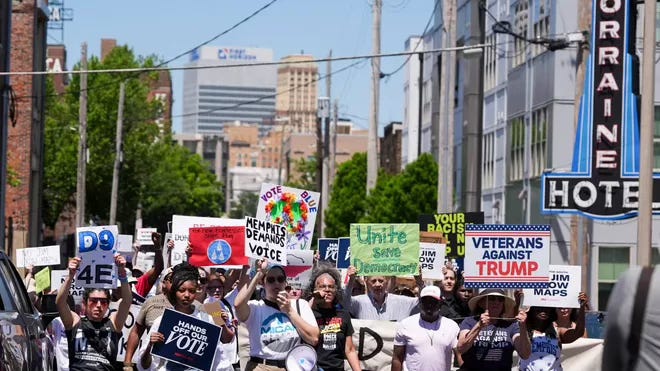
Meanwhile, the League of Women Voters marked the 61st anniversary of the voting Rights Act on August 6 with a national “Unite & Rise for Voting Rights” day of action, explicitly framing 2026 as the test of whether the law still has teeth.
This is not what suffragists fought for and it is not something we can let slide. History won’t let us.
Tennessee helped enfranchise more Americans, and now we can’t let it take those rights away.
No posts
Comments
Nothing yet. Say the first thing.
Sign in to join the conversation.