
Apparently, we’re all competing with artificial intelligence now.
Which feels unfair, because you should see me try to manage two-factor authentication or figure out how to sync my photos to the cloud? (While we’re on the subject…what even is “the cloud”!?).
It all leaves me with one surprisingly ambitious goal: I’d like to remain a person. Thankyouverymuch.
I want to take a moment to discuss what makes you absolutely lovely and vital to the universe. You and your weird hours staring at a screen or trying to read your own handwriting. You and the things you make with your mind and your typey type hands. You and the work you do with your spirit in prayer and reflection. You and your very specific hobbies.
So if you only hear one thing from me today, I hope it’s this: you are vital to the universe. Your musings and puttering about and work are necessary. And to do that necessary work, it is really important that you are not a robot.
A few weeks ago, we talked about how much extra work is going to take for you not to be alone all the time, since the world is conspiring to make every interaction “frictionless” (read: entirely lacking in human interaction). But today I thought I’d dig a little more into the kind of work it will take to resist what AI will do to our experience of being a person.
What a strange thing to say that we are living in the Age of AI. The Age of Manufacturable and Scalable Forms of Humanity. The Age of Corporate Personhood. It will be difficult to explain to our children that first they allowed corporations the rights of people, and then they told people they didn’t have many rights at all.
The other day, I was reading advice from the heads of social media empires, and I began with a firm sense that I am a writer, a professor, and a podcast host. But according to this advice, the more significant role I should inhabit is that of an “influencer”—a horrifying description of any person-rendered-as-a-brand inside the modern attention economy. After that, it mostly devolved into advice about whether we all feel ready for TikTok.
And are we ready? Do you feel ready to dance your life story or primary theological arguments for TikTok?
No ma’am. I don’t think so. I’m a Mennonite, and the one great gift the Lord gave us is that he looked into our eyes and said: I love you. You are precious to me. Stick to that four-part harmony. Just please don’t dance.
“Be online all the time! Just be authentically you,” says the advice from social media gurus. It sounds like they are telling me to be sincere, artless, transparent to the naked eye—what Joshua Speed said of his closest friend, President Abraham Lincoln: “He could act no part but his own.”
But, as Tara Isabella Burton explored in her book Self-Made, there are different historical forms of this quest for authenticity.
In Europe, over the last few centuries, the imperative to “be authentic” was a marker of sophistication and entrance into elite society. In the United States (and Canada, mostly), authenticity became synonymous with a kind of “girl next door” and democratic sensibility. The European version asks you to perform the ease of a “natural aristocrat,” the other the gritty ambition of a try-hard bootstrapper, but both demonstrate an obsession with authenticity as an externalization of the inner life. Our insides rendered as outsides.
You impress your own perspective—make your mark—on otherwise unyielding customs and culture.
So when you feel that the internet is asking you to post your photos and tell your life story in a particularly curated way, you know that you are not being asked to really “be yourself.” We are being asked to perform our humanity, from curtain up to curtain down.
But this is a strange breed of optimizer—desperate to perform authenticity, but making us something closer to a very grim kind of striving, apocalyptic optimist.
What I think is missing from our apocalyptic optimism and our obsession with authenticity as self-creation is an element that is hard to see unless we spot it in others.
I noticed it recently when I was reading a very sad book about Abraham Lincoln, which—if you know me, and now you do—you know I am Canadian and have basically zero American presidential feelings. But there I was. Somehow having a favorite president.
Lincoln lived in an age of self-making, a market revolution, de Tocqueville’s wry observation that only a new word, “individualism,” suited this new nation at odds with tradition, conformity, and community. The people with the fortitude, scrappiness, and courage to rise were mythologized as self-made men. And though Lincoln possessed so many of those golden qualities, by his late twenties it was clear that he could not keep easy company with people climbing the ladder to importance.
He possessed an unshakable sadness that kept him teetering at the brink of greatness or failure. And contrary to the promises of self-help, success did nothing to diminish his pain. There was the death of his son, Willie. His wife’s own fragile sorrow. Then, of course, the burdens of the nation. By the summer of 1863, he wasn’t thumbing through essays on self-reliance, though he had met Ralph Waldo Emerson the year before. He was rummaging around in the book of Job, searching for words to account for the incomprehensible suffering of a war he had come to believe was a tragic reckoning and a test of the nation’s character.
He was not an optimist, but a tragic realist. Lincoln spoke of suffering as a crucible, a refining, and a reckoning.
When I was reading about Lincoln’s life, it occurred to me that our modern understanding of how to be ourselves in the grand future of AI is almost entirely missing Lincoln’s understanding of the tragic.
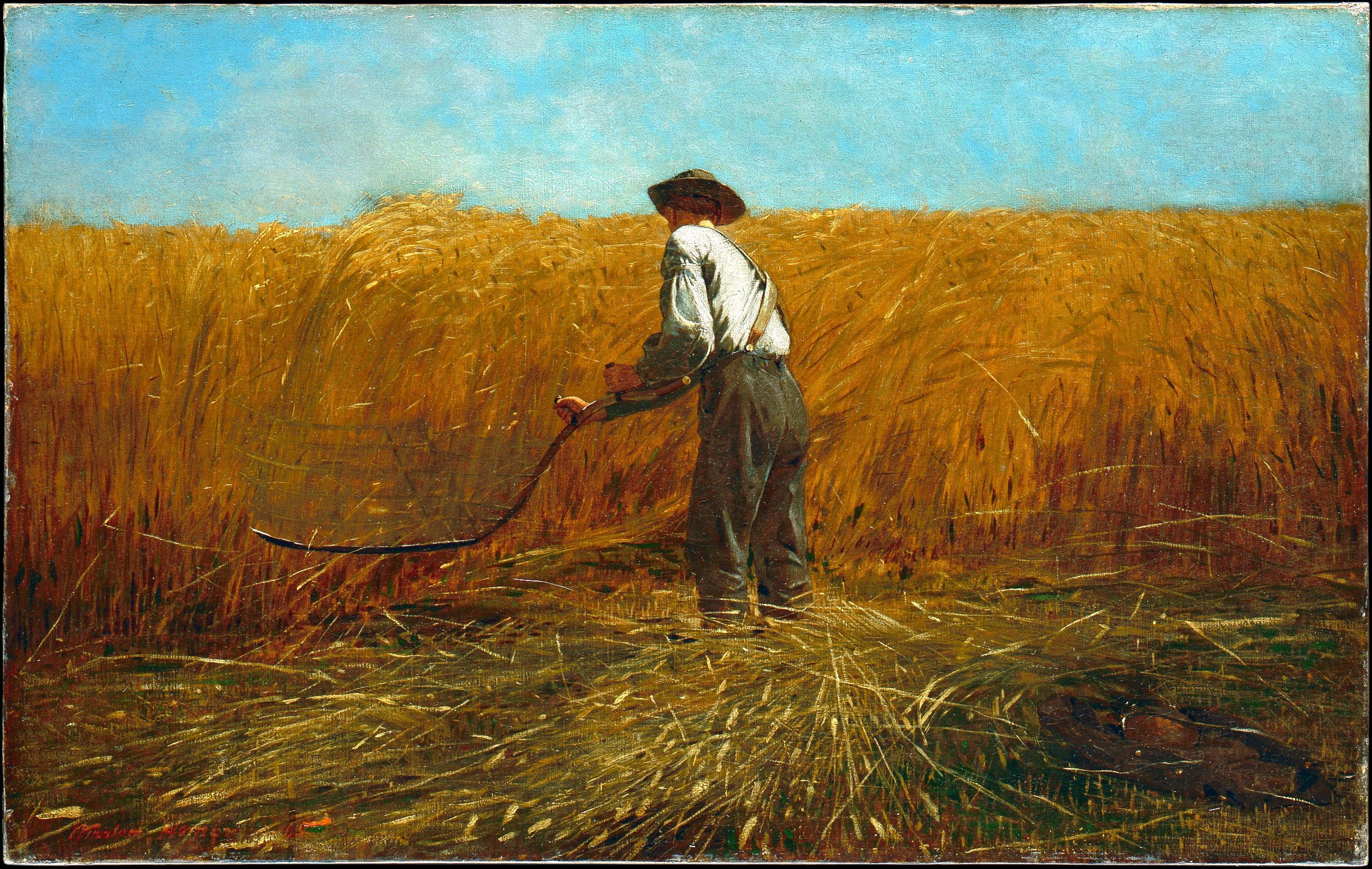
Living with the tragic means we understand the degree to which we act in concert with forces we cannot control. We start to understand that the future isn’t simply lived; it is grappled with. We ask ourselves: what do we do with what’s left of our energy? What truth needs to emerge? What evil must be confronted? And we do all this as people who know that the hardest parts are unavoidable. We must act in the light of our undoings. We never simply talk about progress, because we would be acting like we forgot all that we learned when we are unmade.
The age of AI likes to act like we are all machines. But if a machine can always improve, always optimize, always progress, what does that say about us? Are we supposed to conclude that our limitations, our faults, our quirks, our suffering, our humanity, make us flawed machines?
But what if…. we are exactly what we need to be. Are there forms of truth-telling that can ONLY come from our limitations, our faults, our quirks, our suffering, our humanity? What would that be like, if you trusted yourself to be a person who can face the future not in spite of your limitations but because of them?
Who would you trust yourself to be?
I’d like to declare that you would know that you are vital to the universe. Your work is precious and irreplaceable. That you, because you are limited and sometimes unmotivated, or run down the wrong road and have to circle back, are in possession of a certain kind of wisdom. That hard-won wisdom we pluck out of the fire.
Lincoln’s biographer Joshua Wolf Shenk called what Lincoln learned the “delicate fruit of a lifetime of pain.”
Delicate fruit. I like that.
Recently I read about how the musician Nick Cave started getting fan mail from people sending him songs written by artificial intelligence in the “style” of Nick Cave. They thought it was a tribute. He thought it was a tragedy. Why? Because Nick had lost his fifteen-year-old son. So when a machine is told to write as Nick—to shape his language around something like “write a song about a boy”—what could it possibly say? Songs, he argued, “are predicated upon the complex internal human struggle of creation and, well, as far as I know, algorithms don’t feel. Data doesn’t suffer.”1
Without our limitations, suffering, quirks, humanity, how can we possibly say that we have discovered what it means to be human.
We cannot say that we know empathy—that powerful antidote to cynicism or disgust—if we have not felt the initial failings of our own emotional imagination. We cannot learn courage without that gnawing fear that nothing can be different, until it is.
We could write an obituary. We could rehearse a person’s accomplishments and report who they left behind. But we could never write a eulogy. We could never know, as the Ogden Nash poem says, what an old man knows when an old man dies. Or, in the words of Rabbi Steve Leder, that the beauty of a flower is that it fades.
Can we do the kind of work we need to do in the age of AI?
Yes.
But I have a theory about what’s going to happen. I think it’s going to be easy to copy the shiny versions of who we pretend to be. It will be easier and easier to pretend, because our technologies can scale our positive expressions—our goodwill, our easy wisdom, our clichés. Those are the maximizable forms of intimacy. But it will require less and less of the texture of our actual humanity.
We will need to commit to trying and puttering around and making beautiful things precisely because it is an act of sacrifice. Precisely because we know our days by our nights. Because, as bell hooks said, and I’m paraphrasing here, there is no safety in love.
There is no safety in this kind of wisdom, friends.
So if you feel like a human today, with all of your garbage and beauty and limitations, may I say, congratulations. That is precisely what is required of you.
Today, as your Joyful Anywhere prompt, notice one place where your limitations made you more human instead of less.
Maybe it was changing your mind.
Maybe it was apologizing.
Maybe it was laughing at yourself.
Maybe it was sitting with someone else’s sadness instead of trying to solve it.
Remembering that not everything worth keeping can be optimized.
And tell me: Which of your quirks has become one of your greatest gifts to other people?
https://www.bbc.com/news/entertainment-arts-64302944
Comments
Nothing yet. Say the first thing.
Sign in to join the conversation.