
Oh hello there,
It delights me to no end that we get to spend our summer reading together. I’ve loved going through your comments, watching you discuss ideas with each other, and just generally loving July’s pick, Shark Heart. Aren’t Wren and Lewis just something?! If you missed it, here’s a recording of the chat I had with Emily Habeck, the author, whose heart and mind are so delightfully brought to life in those pages.
Before we get into this month’s pick (How is it August…HOW?) I wanted to check in on any progress toward a joyful anyway summer. Back in June, I vowed to be more open to the world around me and let myself be porous. I wanted to let things in, remember the absurd specificity of an evening sky, reignite old friendships, and spend less time optimizing and more time doing nothing.
And, while I’ll say that I very much tried to be chill, I still found time to work in the mornings, keep my inbox from becoming an absolute pile of steaming garbage, and even managed to stop talking about how well or terribly I slept a couple of times.
But here’s the thing nobody tells you about trying to be porous and open and soft to the world: it can be exhausting. Being awake to everything—the sky, the ache, the old friend you haven’t called—it takes energy I apparently only have in reserve because I’m spending the rest of it managing the spreadsheet that is my actual life. The machine of modernization is EVERYWHERE, and it’s not just doing things to us; it’s something we keep opting back into because the alternative—actual unstructured, ungoverned time—feels a bit like standing at the edge of a cliff.
Routine, predictability, and step counts keep my brain firmly in the land of a certain promise: that this optimization will make me a better person, mom, friend, co-worker, etc. And when the exhaustion gets loud enough, I don’t actually crave less structure. I crave a more totalizing kind of it—a rule that makes every other decision for me, a belief system with no gray areas, a life stripped down to one clean, undebatable set of instructions.
If you’ve ever been tempted to try to make your life into a system too, bless you. Let’s bless any version of ourselves that color-coded our calendars, meal-prepped on Sundays, and developed a five-year plan whilst doing so. When so much feels out of control in our bodies or lives or countries, a little predictability sounds nice, doesn’t it?
Do you ever just want to drop it? Leave everything behind—or trade it in for something simpler, stricter, someone else’s certainty instead of your own endless negotiating?
I think we’ve all yearned for that at one time or another. What if we just holed up in the woods somewhere and went completely off grid? Or surrounded ourselves with people who only think/vote/believe/act as we do?
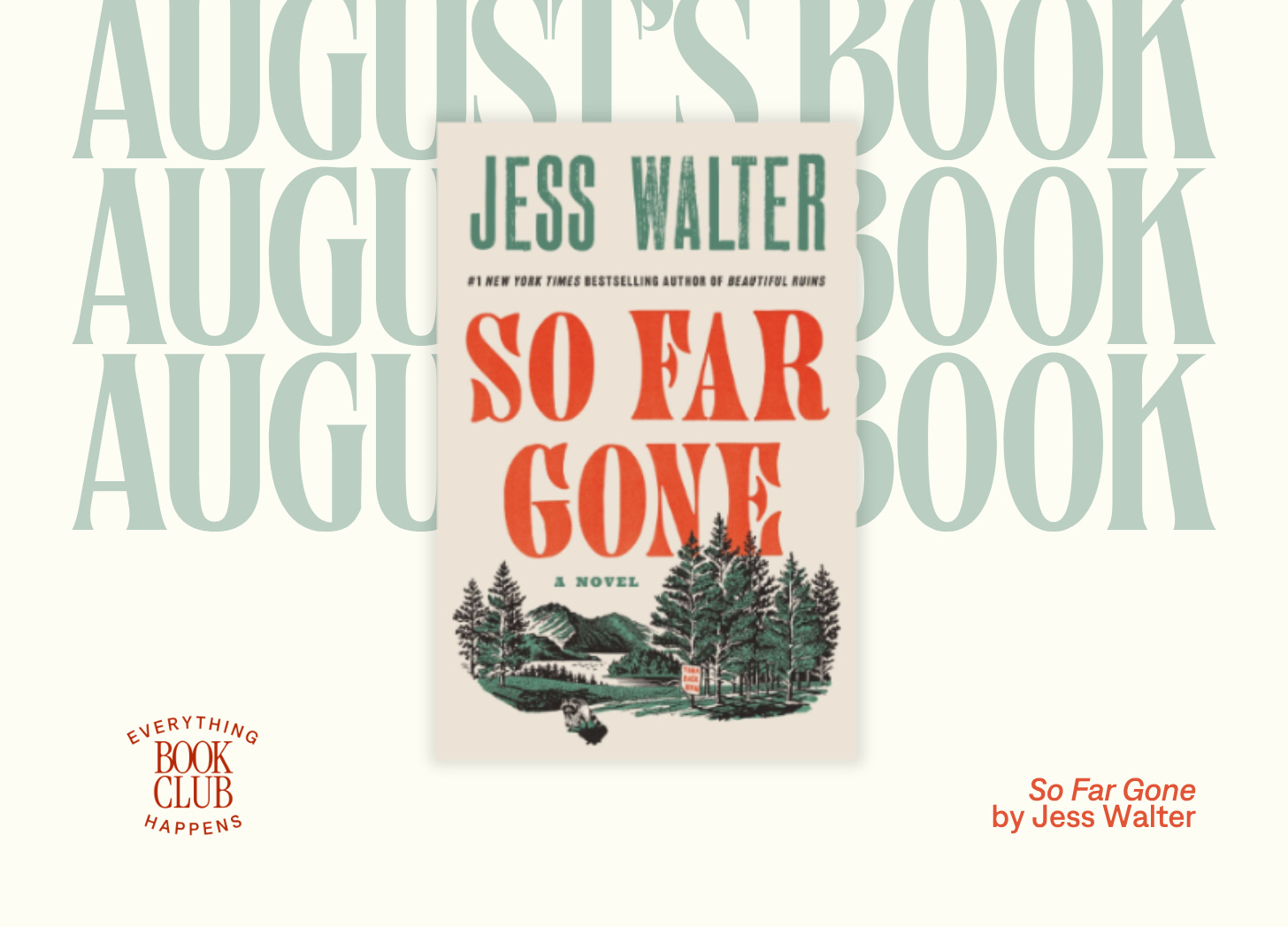
Enter this month’s book club pick: So Far Gone by Jess Walter. The story opens with two children standing on the porch of a decrepit cabin in the middle of nowhere, Washington state—and a grandfather who doesn’t recognize them at first.
Rhys Kinnick—the grandfather in question—is a failed husband and father, best known for one Thanksgiving blowup when he punched his conspiracy-theorist son-in-law, left, and never came back.
Yes, So Far Gone is about complicated families, the exhausting nature of politics today, and disappointing institutions, but it is also about how people remain strangely lovable, anyway.
We here at Everything Happens are a group of people who don’t believe in tidy stories or certainty.
This book gives us neither. It’s an extreme depiction of some of our greatest daydreams (living off grid in a cabin) and our biggest fears (severe radicalization in the name of certainty). Dear reader, here is your warning: this is not exactly a warm and fuzzy book.
We chose So Far Gone because it captures something we talk about all the time: what it means to keep showing up for life when you’re exhausted, disillusioned, or tempted to disappear altogether. It addresses our fear of what happens after we retire (will I still matter?), estrangement from people we once held dear (will things ever be the same?), and the absurdity that has become our political divides (insert all the curse words). It’s funny, sharp, and deeply humane (and a little unhinged). It’s a novel that refuses easy answers while making plenty of room for grace, laughter, and the often painful work of loving imperfect people.
If you’ve ever wondered whether hope is still possible in a complicated world, this is exactly the kind of story worth reading together.
This is very much a Choose-Your-Own-Adventure situation. Participate in the comments and discussion here on Substack. Or treat this like a book recommendation from someone who likes you a whole lot and add it to your must-read list.
There will be two main ways to engage: discussion questions and chat opportunities. To stay updated on these offerings, make sure you are subscribed to the Book Club section here on Substack. You can do this by switching on the toggle for Book Club (in the Notifications section) right here in your Substack account settings.
Read along. Read with friends. Read with your mail carrier or hairdresser - take your pick!
Before you dive in, make sure to grab a copy of So Far Gone from your favorite indie bookstore, or listen through Libro.fm, request it on Libby, snatch it from a used bookstore, or borrow it from a friend.
Read at your own pace. There’s no prize for following directions here! If you’d like to race ahead, do it. If it takes you a while to get through, no problem.
Tell me! What book has helped you to think about or see life differently or changed your perspective on a long-held belief?
Comments
Nothing yet. Say the first thing.
Sign in to join the conversation.