
[this was originally published in the 03/25/2024 edition of my author newsletter, Readiculous Musings]
When you’re an author, you get compared to others. It’s a sadly inescapable reality of this industry. It’s built into the very fabric of what makes publishing run. When a book is bought, comparative titles are used to decide how much the book is worth monetarily. After it is bought, more comparative titles are used for marketing and promo. When the book comes out, books are placed in themed lists where books are of similar topics or genres. When festivals place us on panels, we’re often put with authors who write similar stories so we can discuss themes and tropes that are applicable to all of our books.
Of course, these comparisons run the gamut from neutral or innocuous to complimentary to damaging. It’s the damaging comparisons that I’m going to talk about. Because inevitably when you’re compared to others, it’s a short slide into thinking you’re competing with others. And that sense of competition can lead to bad or toxic behavior (recent instances include an author who made fake accounts to 1-star fellow debuts, an author who tried to threaten another into not writing about sun-powers, and the list goes on)
A follower of mine asked in my Ask-Me-Anything post: “Can you talk about what to do if someone else has the same book idea as you?” This really got me thinking of comparison and competition in publishing.
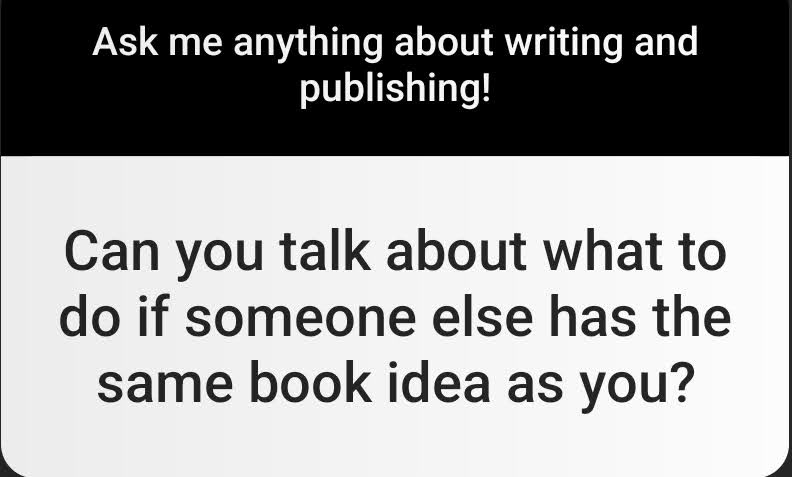
So I want to answer the initial question first, but then I want to get into the more general issue of comparison and competition in publishing.
“What do you do if someone else has the same book idea as you?” So, my assumption is that someone probably pitched a book or had a book announcement where the concept or inspiration was a big part of your WIP. I completely understand the drop in the gut that you’d feel at seeing that pitch or announcement. And I completely get that you’d have an initial reaction of wondering if your book will no longer sell or be marketed because this person “did it first.” But to that I call BS. 1) no idea is completely original 2) just because a book is pitched similarly doesn’t mean it’s the same as yours and 3) who cares if two similar books comes out? If done well, readers would probably want to read both since they obviously liked the concept enough to pick up a book about it.
Okay to expand on each of my points. The idea that no idea is original. It’s kind of true. In the most extreme version, it’s why everything we see on TV looks exactly the same. Or why people complain that everything is a remake now. Because stories, at their root follow core tropes and beats. But that doesn’t mean those tropes and beats can’t be done a thousand different ways. With each small creative choice you make, your story becomes uniquely yours. And as long as you are writing it from a personal place then no one else will be able to recreate the story you tell, because no one else has your exact mix of life experiences and point of view.
When we pitch a book or give a quick blurb, the point is to include the most hooky or high-concept elements of the book. So, often people will grab onto whatever can be boiled down to flashy concepts (or tropes). If I said I watched a movie about a rising-star chef is found in an unexpected and underestimated nobody in Paris. What would you think I was talking about? I could be referencing the delightful comedy-drama Julie & Julia just as easily as I could be talking about Disney classic Ratatouille. Pitches, while good at getting an audience to want to hear more, is not the end-all-be-all of what makes a book.
Finally, so what if your book is very similar to another one? There are hundreds of Beauty & The Beast retellings. There was a boom of dystopian that gave us many beloved authors that still write today. Remember vampires? It was the only thing we talked/read/watched for like five years. Do not let the fear of another’s book stop you from writing or publishing your own. If the book is something you are passionate about, write it. Focus on the parts of publishing you can control. Unfortunately, how well our book is marketed or received is too often out of our hands.
So, the sad reality is that we will probably never be able to stop publishing from comparing us to other authors. as an author of color this can be both tiring and frustrating. So often am I compared to other Asian or Korean authors when our books have literally nothing to do with each other except that the other author and I happen to be the same ethnicity. The habit of publishing to boil us down to our most simplistic parts just for the easy pitch is exhausting and often harmful to marginalized authors (but this is a topic that would need way more time and space to really explore).
So, how should we react to this constant comparison? I, unfortunately, do not have the magical solution. All I can say is that it will happen and it shouldn’t matter as much as publishing makes it matter. But, I can say that the worst thing we can do is let the comparison consume us and our thoughts. It’s hard not to let the anxiety take over or to compare others, because it’s what publishing teaches us to do from day one. But, outside of objectively understanding where you land in the market and on the bookshelf, comparison is a slippery slope into toxic competitiveness.
I’m not going to go over the recent blow-ups on book-tok-gram-twitter. But I will say that, to me, the overarching theme seems to be that a case of over-competitiveness and over-comparison caused some authors to act out in harmful ways. But, there was never any need for competition in any of these situations. Publishing is not a zero-sum game. If someone else gets an accolade or success, it’s not because they took it away from you. It’s because the variables aligned for them (these variables include hard work and perseverance too).
I made a quick TikTok about this before. But I don’t think jealousy should make you feel ashamed as long as you’re not acting out with bad behavior due to the jealousy. Instead, use it to fuel yourself. Use it to identify the things you want and then reach for those things through your own grit and merit. Do not let your jealousy convince you that you need to step on anyone or push them down to get to your goals. I’m not saying that no one has succeeded that way, but it’s a pretty awful way to succeed.
Another big issue here, outside of potentially harming your own career, is that it ruins any chance of creating positive relationships with other authors. And in this industry, other authors are our peers, our coworkers, and, if we’re lucky, our friends.
I’ve found that the best way to create a sustainable author career is to have a good support system, around you. And who better to support you than someone who already innately gets the complicated, messy maze that is publishing?
At the end of the day, focusing too much of your energy on comparing yourself and your writing to others mostly just results in making you anxious, insecure, and depressed. It doesn’t help you be a better writer. And it almost definitely doesn’t help further your career. So, although we can’t get publishing to stop comparing us to others, we can work on not doing it to ourselves.
Comments
Nothing yet. Say the first thing.
Sign in to join the conversation.