
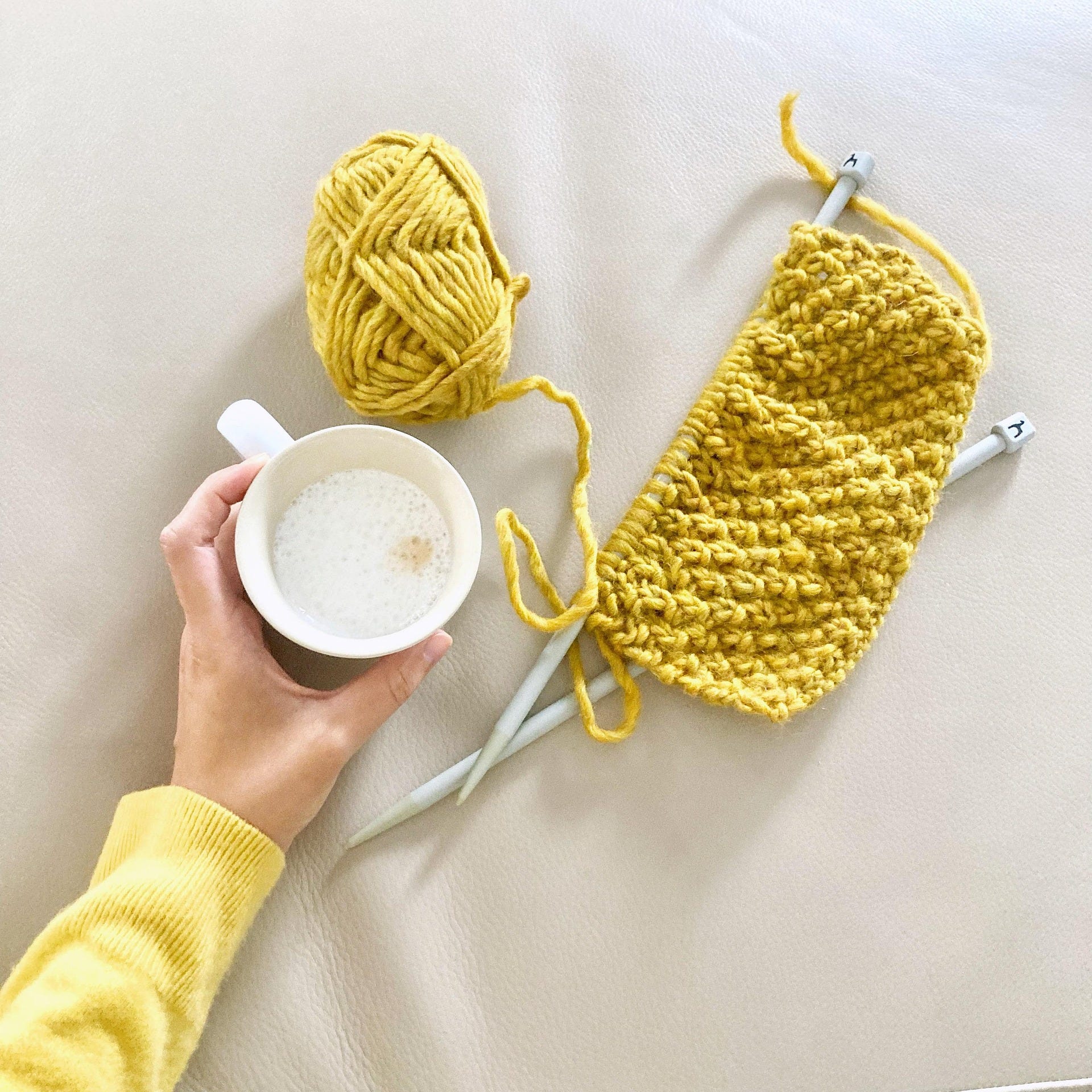
There’s a particular kind of exhaustion I’m carrying right now, and I know I’m not alone. It’s not just physical exhaustion, it’s emotional, mental, and deeply cumulative. The news cycle never slows. Our responsibilities don’t pause. Even in our homes, true rest can feel out of reach. But one Comfort for Critters volunteer, Hazel, has quietly built something remarkable. To her crafting isn’t just a hobby, it’s a daily ritual of restoration. It’s also something we can all learn from.
“I make time to knit every day…”
Hazel doesn’t wait for relaxation to happen, she creates space for it. “I make time to knit every day, usually in the evening, after I’ve stopped working and after dinner.” That intentional boundary, crafting after work or other obligations, is powerful. Research consistently shows that creating a clear transition between work and rest helps reduce stress and improve overall well-being. According to studies in occupational health, even small, consistent rituals can signal to the brain that it’s safe to unwind. Hazel doesn’t just hope for calm, she schedules it.
A Room of Her Own
Hazel has taken things a step further, by designing an environment that supports her peace. “I set up a knitting room in the smallest of our three bedrooms. No animals allowed, since my kitties will try to steal the yarn! The door is always closed. I plop down on the couch, stretch out my legs, and knit. Often, I listen to an audiobook on my Kindle. Usually, I’ll bring a mug of decaffeinated or herbal tea in with me.” To me that sounds like an oasis I usually only find on a vacation! This helped me realize it’s something I too, can create for every day.
Not elaborate, not expensive, but intentional
Environmental psychology tells us that dedicated spaces for relaxation can significantly improve our ability to mentally “switch off.” Even simple cues - a closed door, a specific chair, a favorite drink - train the brain to associate that space with calm. Hazel has created what so many of us are missing, myself included, a boundary between the noise of the world and the quiet she needs.
Process Over Product
In a culture obsessed with productivity, Hazel offers a radically different perspective. She explains, “I’m not a project knitter. It normally doesn’t matter when I finish a project. Instead, I’m a process knitter. I just enjoy the feel of the needles in my hand. I love the feeling of the yarn. If a yarn is unpleasant to the touch, I won’t use it! The repetition of the stitches, the flow of a particular pattern, leave my mind free to float.”
There’s science behind this. Repetitive, rhythmic activities like knitting and crochet have been shown to induce a state similar to meditation. Studies published in journals like the British Journal of Occupational Therapy have found that knitting can reduce anxiety, lower heart rate, and even decrease symptoms of depression. What Hazel describes, a mind free to float, is what psychologists call a “flow state,” where the brain is both focused and relaxed at the same time. “Sometimes I don’t believe I think about anything. Sometimes ideas and plans come to me when I’m that relaxed.” In other words, stepping away from constant input doesn’t dull the mind, it restores it.
Crafting Through Crisis
Hazel’s practice didn’t just help her unwind, it carried her through one of the most difficult seasons of her life. “Some years ago, I came down with Bell’s Palsy. It paralyzed three-fourths of my face completely. I had difficulty eating and my speech was barely comprehensible. I couldn’t do anything. I’m not used to being helpless, and this was the most helpless I’d ever felt in my life.”
But Hazel’s kind heart spoke. “I wondered if perhaps I could knit.” What followed is a testament to the healing power of creating. “I dug through my patterns to see if there was something ultra-easy, and found a knitted blanket pattern created with circular needles.”
“The pattern said to take out all of your odds and ends of yarn and throw them into a bag you couldn’t see through, then knit with whichever yarn came out, no matter what the color was. I cast on over 300 stitches. I knitted on, with a wildly colored and cozy blanket forming around me.”
There’s something profoundly moving about this image, someone in the midst of physical and emotional limitation, still choosing to create. “The ability to actually create something when I felt so impaired helped me to feel better about myself and my ability to actually do something constructive during that miserable time.”
Modern research in art therapy supports exactly this. Creative expression can restore a sense of control, identity, and purpose, especially during illness or trauma. Hazel wasn’t just passing time. She was choosing to reclaim herself.
What I Learned from Hazel
Hazel’s routine isn’t complicated and that’s what makes it so powerful. When the world feels overwhelming, I try very hard to keep these five things in mind.
Create/craft daily, even for short period of time. Consistency matters more than duration. To me, ten minutes of intentional calm is better than none.
Create a dedicated space. It doesn’t have to be a whole room. A chair, a corner, a basket of supplies will suffice. It just needs to signal, “this is where I rest.” I personally appreciate having my “art” area, even when I can’t use it. Just passing through the area on my way to work, reminds me that “rest” is waiting for me.
Engage your senses. Soft yarn, warm tea and a favorite audiobook. Follow Hazel’s lead and let your environment support your nervous system.
Let go of productivity. You don’t need to finish anything. You don’t need to be efficient. As Hazel shows us, the process is the point.
Use your hands to quiet your mind. Repetitive motion, from activities like knitting, crocheting and stitching, can gently guide your brain out of stress mode.
Hazel’s story is both deeply personal and universal. In a world that constantly asks us to do more, know more, worry more… her practice is a quiet act of resistance. It says to the world, and the news cycle, “I will make space for peace anyway.”
At Comfort for Critters, we often talk about the comfort these blankets bring to shelter pets, but stories like Hazel’s remind us of something just as important: The act of creating them can comfort us, too. So tonight, or tomorrow, or sometime this week, consider this your invitation. Pick up the yarn, find a quiet corner, take a breath and begin a blanket for a pet. Begin a blanket for you.
No posts
Comments
Nothing yet. Say the first thing.
Sign in to join the conversation.