
This is part 4 of a 4 part summer series on why the world resists the change it needs, and what would actually deliver it. Four essays, one argument: limits are the answer, the system refuses them, only organized power can impose them, and that power is already in us.
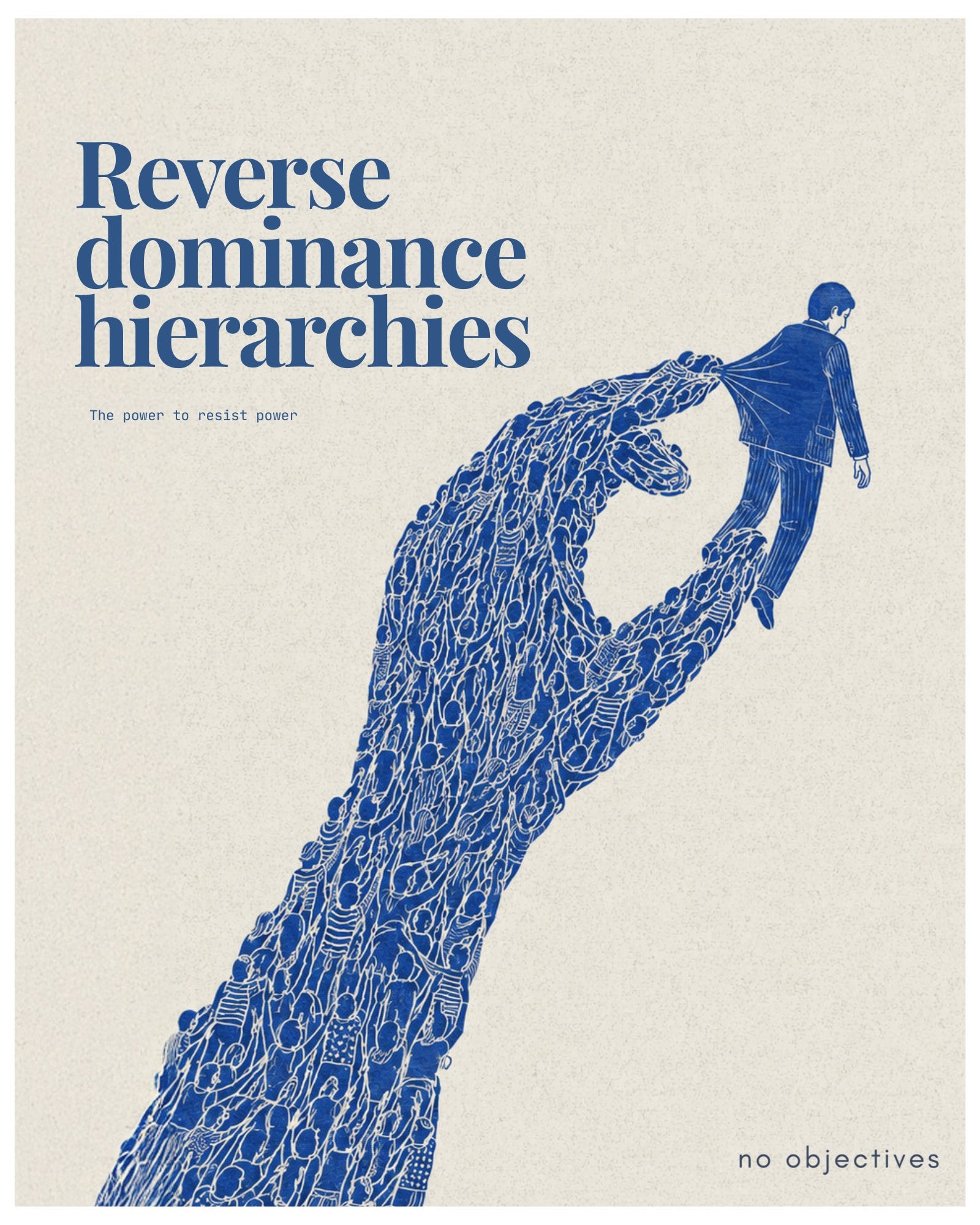
There is a quiet wisdom built into every close friendship, no one rules, and no one submits. When someone gets too controlling, the others push back. Not with violence, but with laughter, an eye roll, a flat refusal to play along. These small moments point to something we rarely name about human nature. We are not wired for dominance. We are wired for equality, and we enforce it together.
Anthropologists call this the reverse dominance hierarchy: a social order where the many actively prevent any one person from consolidating power over the group. A political order without rulers, held in place not by laws or police but by solidarity and social intelligence. At a moment of extreme inequality, political disillusionment and ecological breakdown, this form of bottom-up power is more than an anthropological curiosity. It may be the most practical starting point we have for a democratic and livable future.
What a reverse dominance hierarchy is.
The anthropologist Christopher Boehm coined the term to describe how groups resist domination rather than submit to it. In egalitarian hunter-gatherer societies, leaders were tolerated as long as they served the group. The moment they tried to coerce or elevate themselves, the community pushed back. Usually with mockery. Sometimes with ostracism or quiet non-cooperation, and in the rare extreme case with expulsion.
Power in these societies flowed in the opposite direction from what we are used to. People still led, but leadership was on loan. It could be revoked at any time, and it was never allowed to harden into domination. Most of us practice reverse dominance every day. In a healthy friend group, nobody can monopolize decisions without resistance. Leadership rotates. Decisions get made by rough consensus, and anyone acting too self-important gets brought down to earth with a joke. There is a deep, practical sense that we are equals. Not in the abstract. In how we actually treat each other.
These instincts are ancient. For tens of thousands of years, humans lived in small interdependent groups where survival depended on cooperating and keeping each other in check, not on outcompeting each other. Suppressing dominance was not a flaw in our nature. It was our greatest social technology.
Modern society is structurally hostile to reverse dominance, for four reasons. Power now buys things. In a friend group, dominance is symbolic. In our political economy, it buys influence, access and security, and the systems the powerful build protect and expand that advantage. The powerful no longer need us. Whatever they once depended on their neighbors for, they can hire, automate, or move somewhere cheaper. The mutual dependence that once sustained equality is gone.
Institutions entrench hierarchy. Hunter-gatherers kept power in check with social pressure. You cannot ridicule a CEO out of office, and you cannot mock a law into changing. And we have normalized it. Domination now passes for leadership, competition for virtue. Inequality, we tell ourselves, is just how nature works. So we reward those who rise above others rather than those who rise with them. But something deeper is at play: a social atrophy that sets in when people stop being embedded in interdependent communities.
As surplus grew and mobility expanded, we gained the ability to leave. Leave the group we grew up in, the community, the partner, the job. We stopped working through relationships and started walking away from them. It felt like freedom. It cost us connection. Where we once had no choice but to resolve tension through negotiation, we can now simply move on. When people isolate, patience and the craft of staying in a disagreement wither from disuse. The fewer everyday interactions we have, the less practiced we become at being with others.
Think how many places of interaction existed just thirty years ago, before the internet, remote work and hyper-individualized lives. We chatted at bus stops. We argued politics at the bar and debated at the union hall. We played cards at the community center and swapped recipes over the fence. Now we stream alone, exercise alone, get dinner delivered to the door. The isolation feeds itself: the less we interact, the worse we get at it, and the worse we get at it, the less we seek it out. Our tolerance shrinks. So does our trust, and with it our ability to hold each other accountable. This is one of the great unspoken reasons reverse dominance no longer emerges on its own. We do not get enough practice being together.
Which is why we must rebuild the third places, the informal public spaces where people meet without a transaction: parks, libraries, repair cafés, community kitchens, tool libraries, saunas, sports clubs, gardens. These are where social trust gets built, where people relearn how to deliberate, disagree and remain. Without them there is no solidarity, and without solidarity there is no resistance to power.
How to rebuild a society of reverse dominance
To build a society that reflects our egalitarian instincts, we have to redesign the conditions of power itself. Nobody needs to abolish leadership. What we need is a culture and a structure where no one can rise above the group in a way that undermines it.
Start with citizens’ assemblies that hold real power. Strip power from career politicians by institutionalizing democratic lotteries: assemblies of everyday people, selected at random, deliberating on key decisions with binding rather than advisory authority. Unlike elected officials, they are not chasing money, status or re-election, so they can decide through deliberation instead of lobbying. Horizontal decision-making returns to the heart of governance.
Then guarantee universal basic access. Make the essentials free: housing, food, healthcare, education, public transport, clean energy. This decommodifies survival and removes the leverage dominant actors hold over everyone else. When you do not depend on an employer or a landlord to survive, you gain the freedom to say no, and that freedom is the material basis of social equality. Add a green job guarantee. Instead of waiting for markets to create employment, commit to publicly funded work in ecological restoration, care and community resilience, so that no one has to compete in a market for survival.
Pair it with steep wealth taxes. Reverse dominance cannot coexist with extreme inequality, so taxes on capital, inheritance and passive income must ensure that no one can accumulate the power to dominate others through wealth alone. Redistribution is not punishment for success. It is what keeps democracy from being bought.
And underneath all of it, change what leadership means. True leaders hold responsibility in service of the group, temporarily and accountably, and they can always be recalled. We need new narratives, in education and art and storytelling, that prize listening over commanding and stewardship over status. Power understood as stewardship stops being worth hoarding. We do not need to invent a new way of being. We only need to scale up what we already do in miniature. Reverse dominance lives in our friendships, in our grassroots movements, in the best moments of our shared lives. Reclaiming it at the level of society means designing systems that restore interdependence and make domination both materially unrewarding and socially unacceptable.
It means refusing to be ruled. Not through revolution. Through refusal, through redesign, through relearning how to be together. This is not a utopia. It is a return to who we already are when we are most human.
Sources
Christopher Boehm, “Egalitarian Behavior and Reverse Dominance Hierarchy,” Current Anthropology 34, no. 3 (1993), and Hierarchy in the Forest: The Evolution of Egalitarian Behavior (Harvard University Press, 1999). The foundational account of how egalitarian societies actively suppress domination.
Ray Oldenburg, The Great Good Place (Paragon House, 1989). The original theory of third places and their role in building social trust.
Robert D. Putnam, Bowling Alone: The Collapse and Revival of American Community (Simon & Schuster, 2000). The empirical record of declining everyday association and civic participation.
OECD, Innovative Citizen Participation and New Democratic Institutions: Catching the Deliberative Wave (OECD Publishing, 2020). Documents nearly 300 deliberative processes worldwide and the case for giving citizens’ assemblies real decision-making power.
Lucas Chancel, Thomas Piketty, Emmanuel Saez and Gabriel Zucman, World Inequality Report 2022 (World Inequality Lab, 2022). The data behind the claim that wealth concentration has reached levels incompatible with democratic equality.
No posts
Comments
Nothing yet. Say the first thing.
Sign in to join the conversation.