
TL;DR Agentic commerce is shopping delegated to an AI agent, and the payment rails are further along than the products they’ll pay for. The agentic commerce protocols split into layers: Stripe’s ACP runs checkout, Google’s AP2 handles spending permission, x402 and MPP move the money, and Google’s UCP now out-stars ACP on GitHub two to one. I read the x402 and MPP specs and dug through ZeroClick’s docs, where its pricing is nowhere to be found, which is its own finding. ZeroClick, this article’s sponsor, publishes any API as a machine-readable storefront agents can pay. If Gartner is right, one in five digital-commerce transactions will run through AI platforms or agents by 2030, whether or not your checkout is ready.
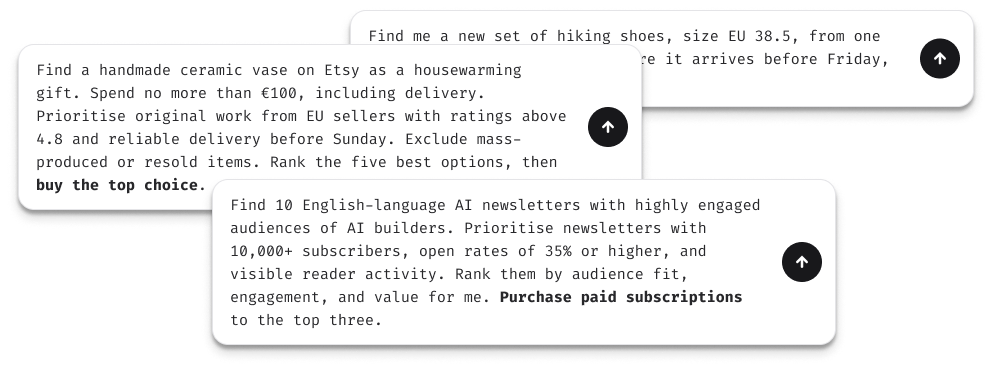
Agent-executed commerce is still tiny today, but if the predictions are right, it won’t stay that way much longer. Gartner expects it to become part of one in every five digital-commerce transactions by 2030. So while agentic commerce is only 3% of online transactions today, 89% of merchants say they are actively building for it.
When that happens, the products you build will need an entrance, a checkout, and an access mechanism built for agents. Your checkout redesign will meet customers who don’t even look at it. That’s if you’re a seller.
If you’re a buyer with a shopping agent, you’ll want it to understand your budget, have access to a payment method, and know when to double-check with you.
And if you’re my grandma, you’ll just shake your head.

Part 1: How AI agents pay, and what ACP, AP2, x402, MPP, and UCP do
Part 2: How ZeroClick sells to agents
Part 3: Build for agents, block them, or let them buy?

Hey, I’m Karo Zieminski 🤗.
AI PM and builder. I write Product with Attitude, an AI newsletter for tens of thousands of readers across 146 countries, helping them develop critical AI literacy the only way it sticks: through practice.

Agentic commerce is shopping delegated to an AI agent. I’ve found three main ways this works. Sometimes a browser agent clicks the buttons (think: Perplexity Comet). Or it’s a protocol handshake with no browser involved at all. Or a hybrid.
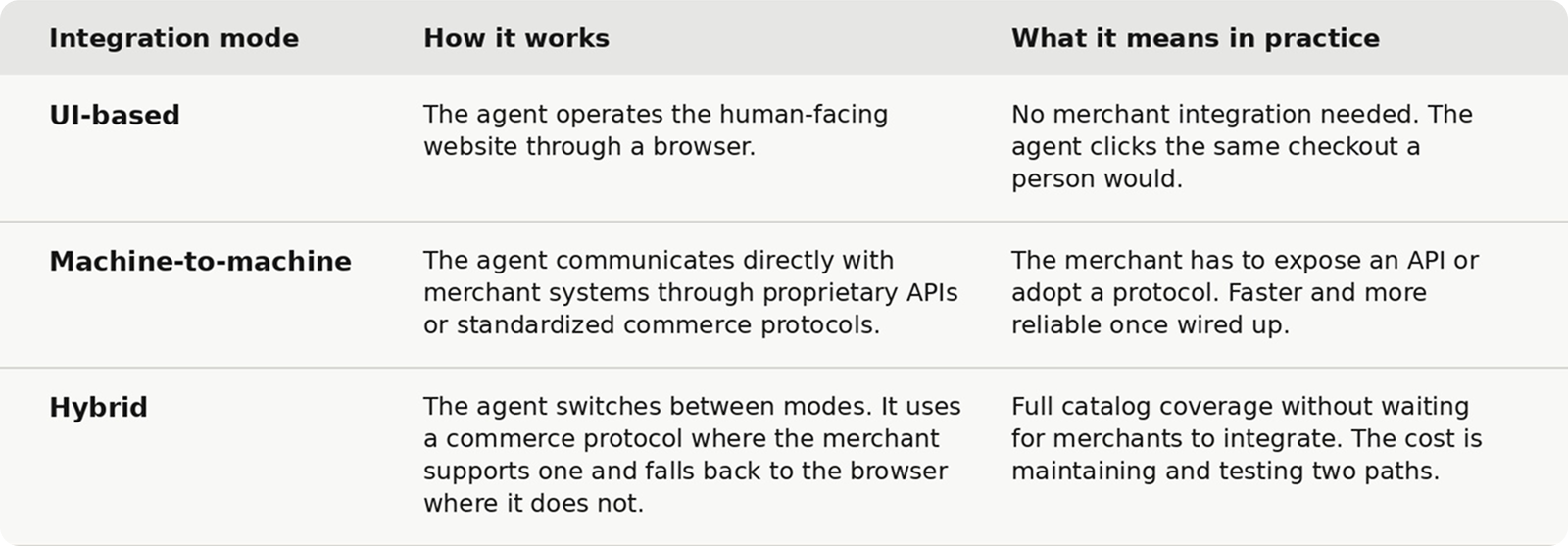
Today, we’re focusing on the protocol-based agentic commerce.
57% of all web traffic is already non-human. Very few of those visitors are reaching for a digital wallet. They’re AI-training crawlers, uptime checkers, Googlebot, price scrapers. They aren’t on a shopping spree. Yet.
Warning: Tech loves abbreviations. There are many of them ahead.
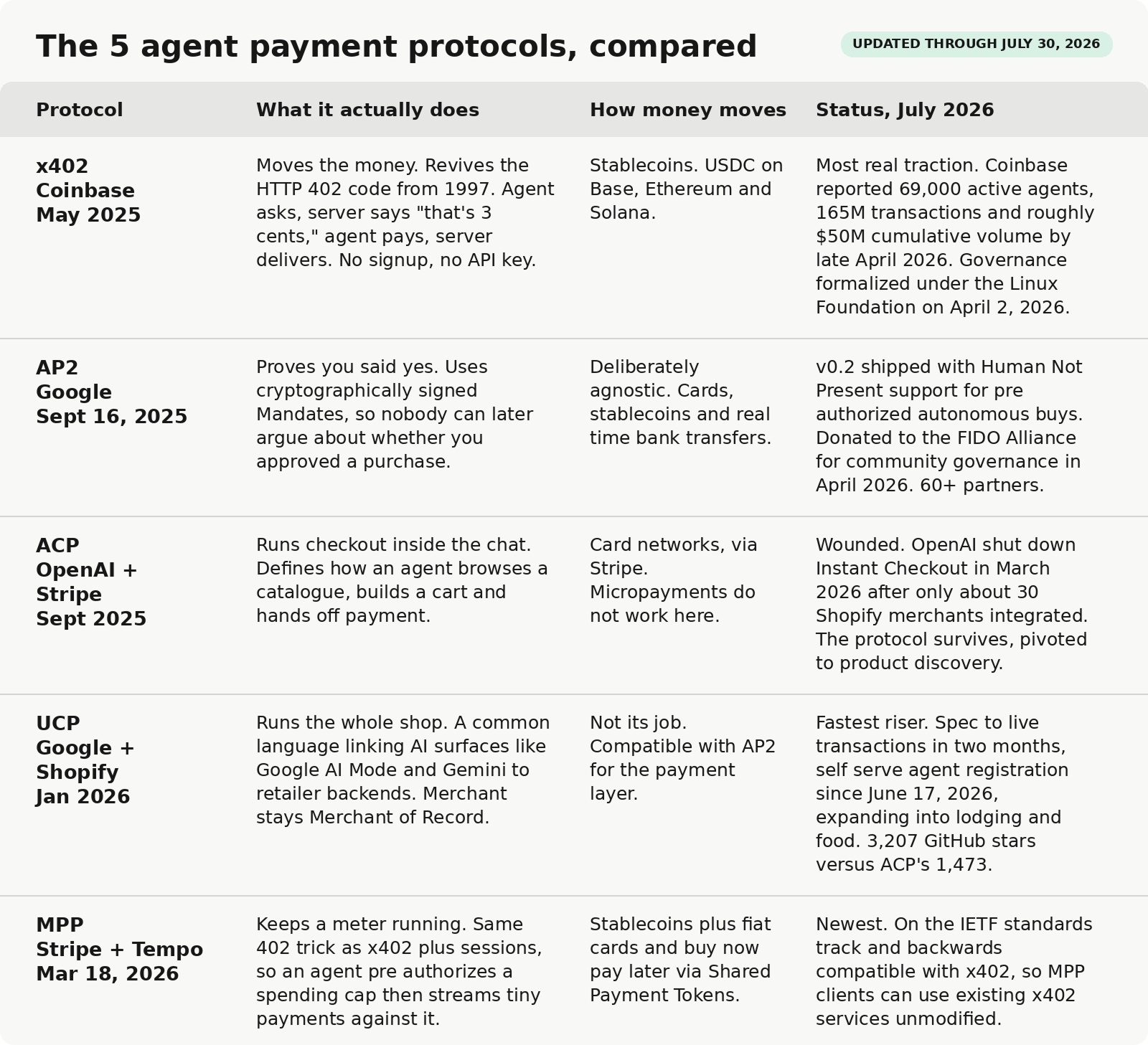
Consult the comparison table at the end of this section to avoid a headache.
Google and Stripe are already preparing for agents to arrive en masse. They’re releasing features such as digital wallets, AP2’s signed mandates, and other infrastructure designed for agentic commerce.
Stripe’s Product Lead Jeff Weinstein announced in 2025 that the company had developed the Agentic Commerce Protocol (ACP), back when most of us were still trying to work out what an AI agent even was.
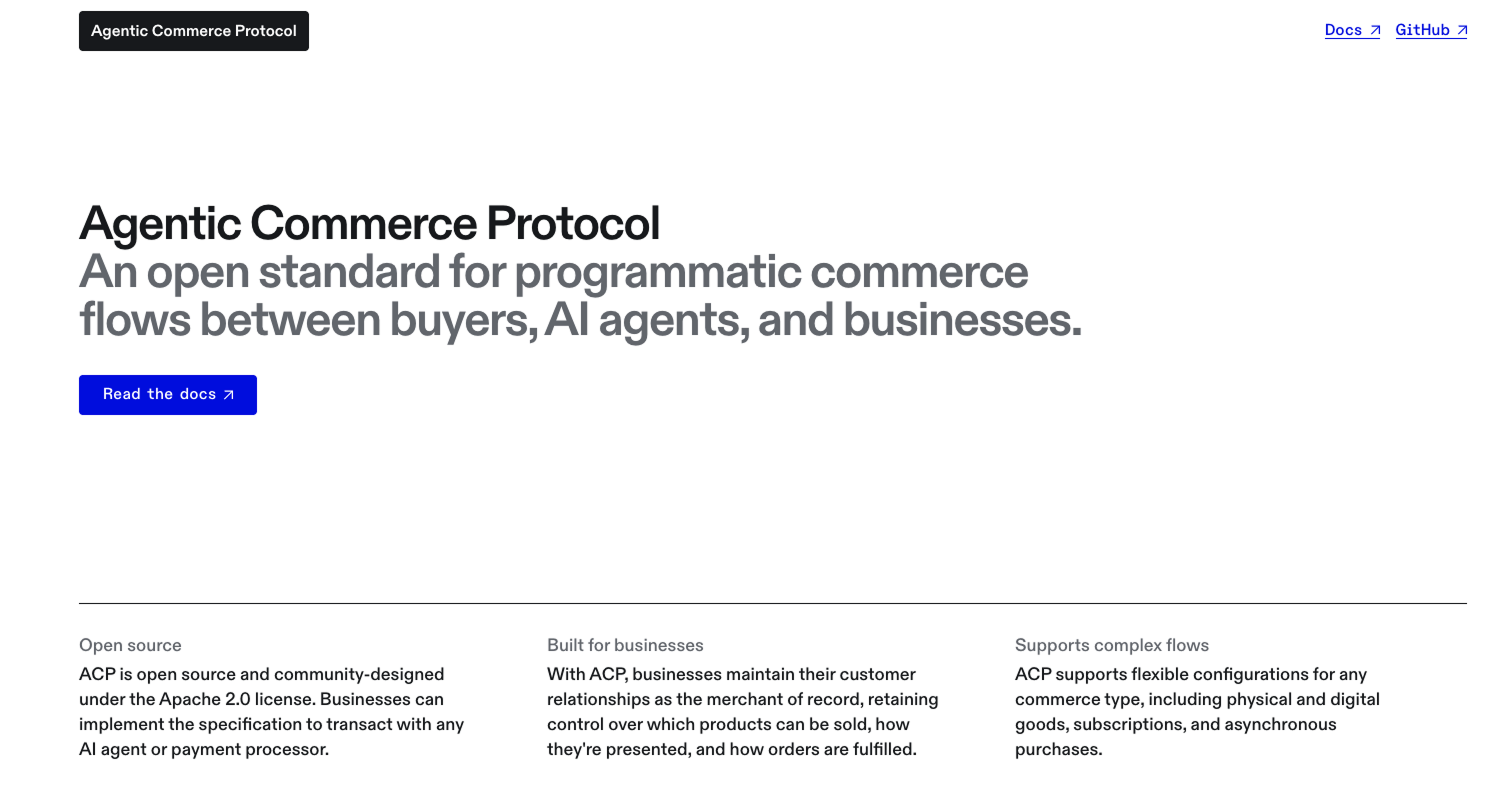
The open-source standard was co-developed with OpenAI, which launched Instant Checkout that same day, putting a purchase flow inside the chat window. (OpenAI has since phased it out, but that’s for another post).

Stripe didn’t stop at ACP. By October, it was already working with Microsoft Copilot, Anthropic, Perplexity, Vercel, Lovable, Replit, and Bolt. In December came the Agentic Commerce Suite: one integration for discovery, checkout, payments, and fraud detection.
A month later, Copilot Checkout went live. US users could buy from Etsy sellers, Urban Outfitters, and Anthropologie without leaving the chat. Then Stripe added support for Coinbase’s x402 protocol, allowing agents to pay programmatically for APIs, data, and compute using USDC on Base.
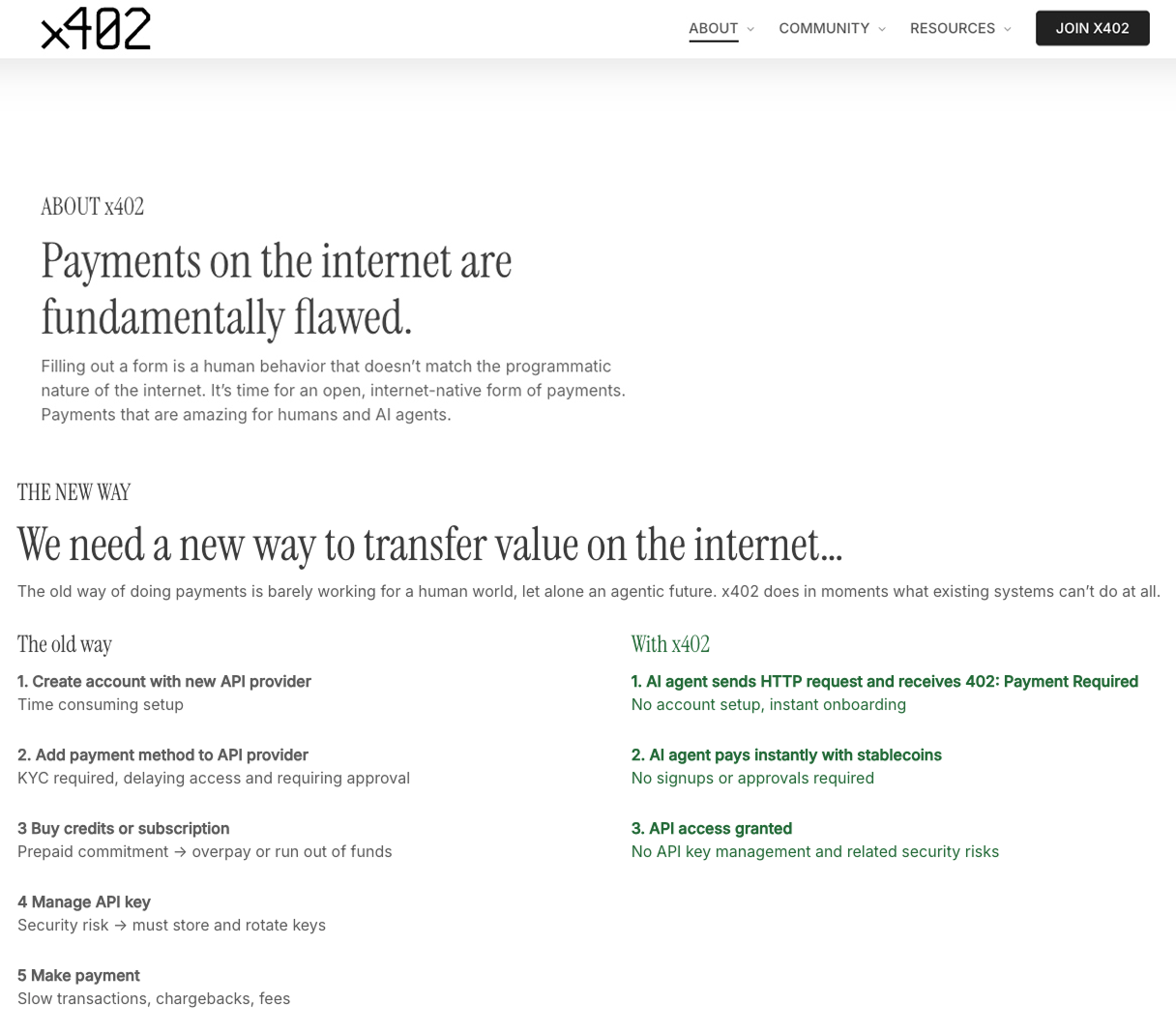
We’re laying the groundwork for an economy run not just by people, but by software; autonomous, intelligent, and always on.
— Erik Reppel, Head of Engineering at Coinbase Developer Platform
By Stripe Sessions 2026, the company had 288 new products and features to announce. One of them was MPP (Machine Payments Protocol), released by Stripe and Tempo. Another open protocol for agentic payments.
UCP (Universal Commerce Protocol), Google's answer to ACP, launched at NRF in January 2026 with Shopify, Etsy, Wayfair, Target and Walmart. By today, its GitHub repo collected 3,249 stars vs ACP's 1,497. Roughly 2.2x the community traction.
Another layer of services is appearing too. Companies such as ZeroClick add the payment and access systems to existing products, so AI agents can buy them.
Taken together, these pieces look like an operating system for what is now called ‘zero-click commerce’. ZeroClick is also the name of the company that sponsored my research for this article.
Support for today’s article comes from ZeroClick. Learn how I evaluate sponsorship requests.

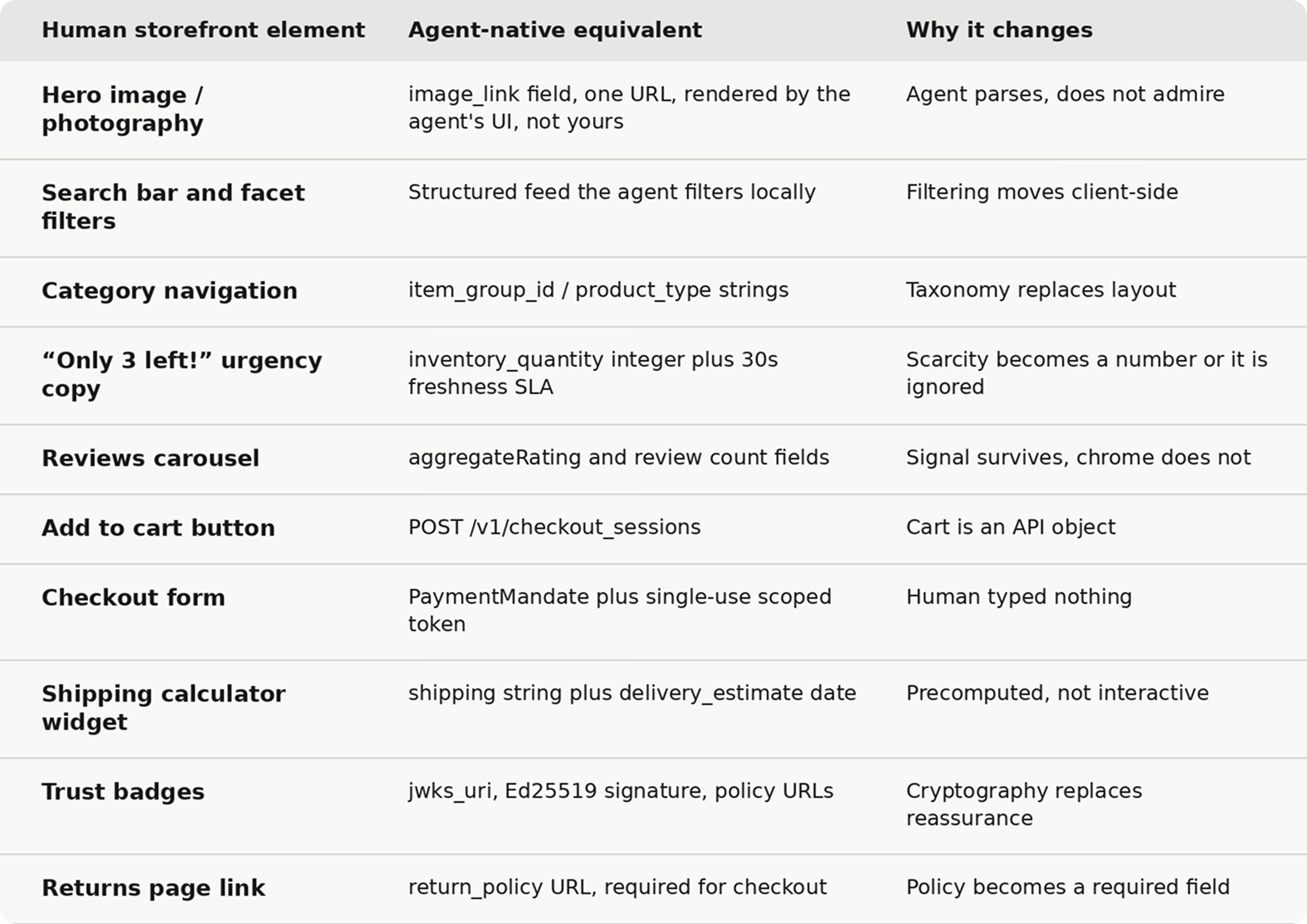
Humans shop with feelings: browsing, and abandoning carts are part of our process. Agents shop with infrastructure: structured product feeds, AP2 mandates, single-use payment tokens via the ACP.
The PM in me processes market shifts by mapping user journeys. This one came out too tall to fit in your inbox without crushing it: preview below, full version here. Take a look at it before you continue. The rest of the visuals will make more sense.
Raise your hand if you’ve never abandoned a shopping cart. Or spent three days comparing two nearly identical table lamps before choosing the one that’s the super-mega-optimized version for you.
Some rather elaborate revenue machines were built around that behaviour.
Since the first day of ecommerce, the funnel assumed a human moving slowly enough to be observed and sold one more thing. The storefronts were built to charm them.
If Gartner is right, by 2030, one in five digital-commerce transactions will follow a completely different product discovery logic.
AI agents are practical creatures, with minimal interest in seductive product photography or beautifully designed search bars and filters. They’re drawn to two things: machine-readable product data and real-time inventory. Which means that the ‘storefronts’ will look very different:
ZeroClick provides the practical layer between a product and an agent prepared to pay for it. With it, any seller's API becomes an agent-purchasable service: a machine-readable storefront with controls for pricing, identity, and agent transaction analytics. In the same way Shopify helped businesses sell to humans online, ZeroClick helps them sell to agents.

ZeroClick launched in August 2025, with $55 million in funding, as an ad network for AI chatbot products. As late as March 2026, it was still framed as an ad framework. But in July 2026, ZeroClick relaunched with x402 and MPP payments at the centre of its pitch. That’s a pivot. Most of what’s written about ZeroClick still describes the old business.
A year ago we set out to help companies sell more as AI shaped purchasing choices. Now the AI agents are ready to buy.
Ryan Hudson knows his way around the machinery of online transactions. He co-founded Honey (the browser-extension coupon company PayPal bought for $4 billion in 2020), then founded Pie Adblock before spinning out ZeroClick.
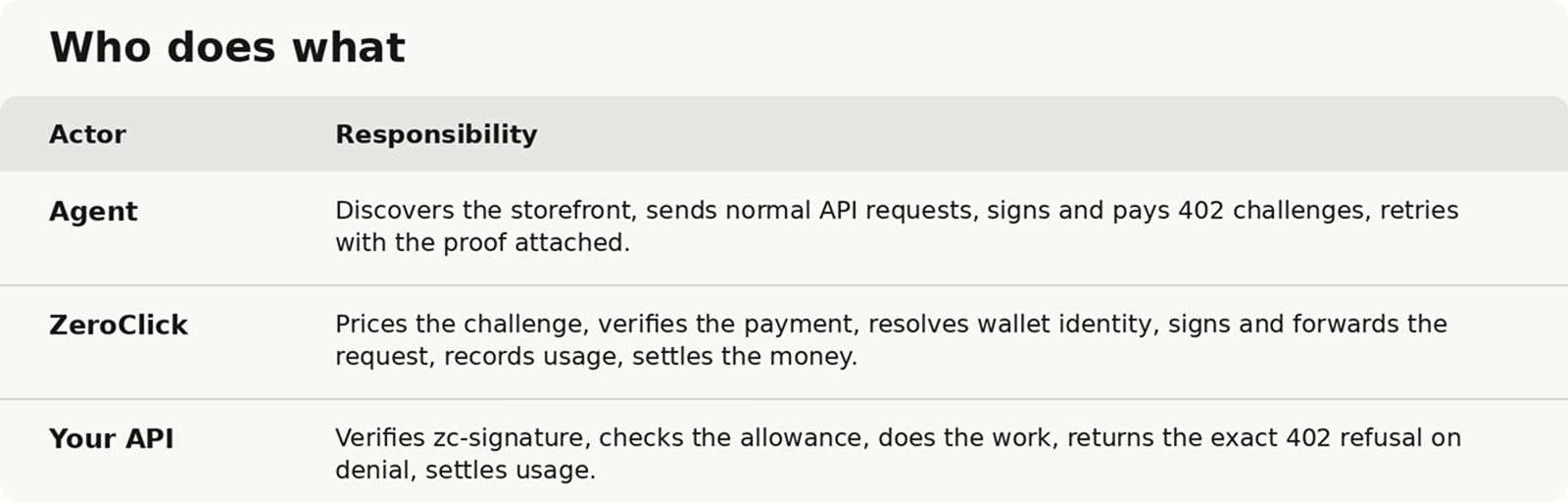
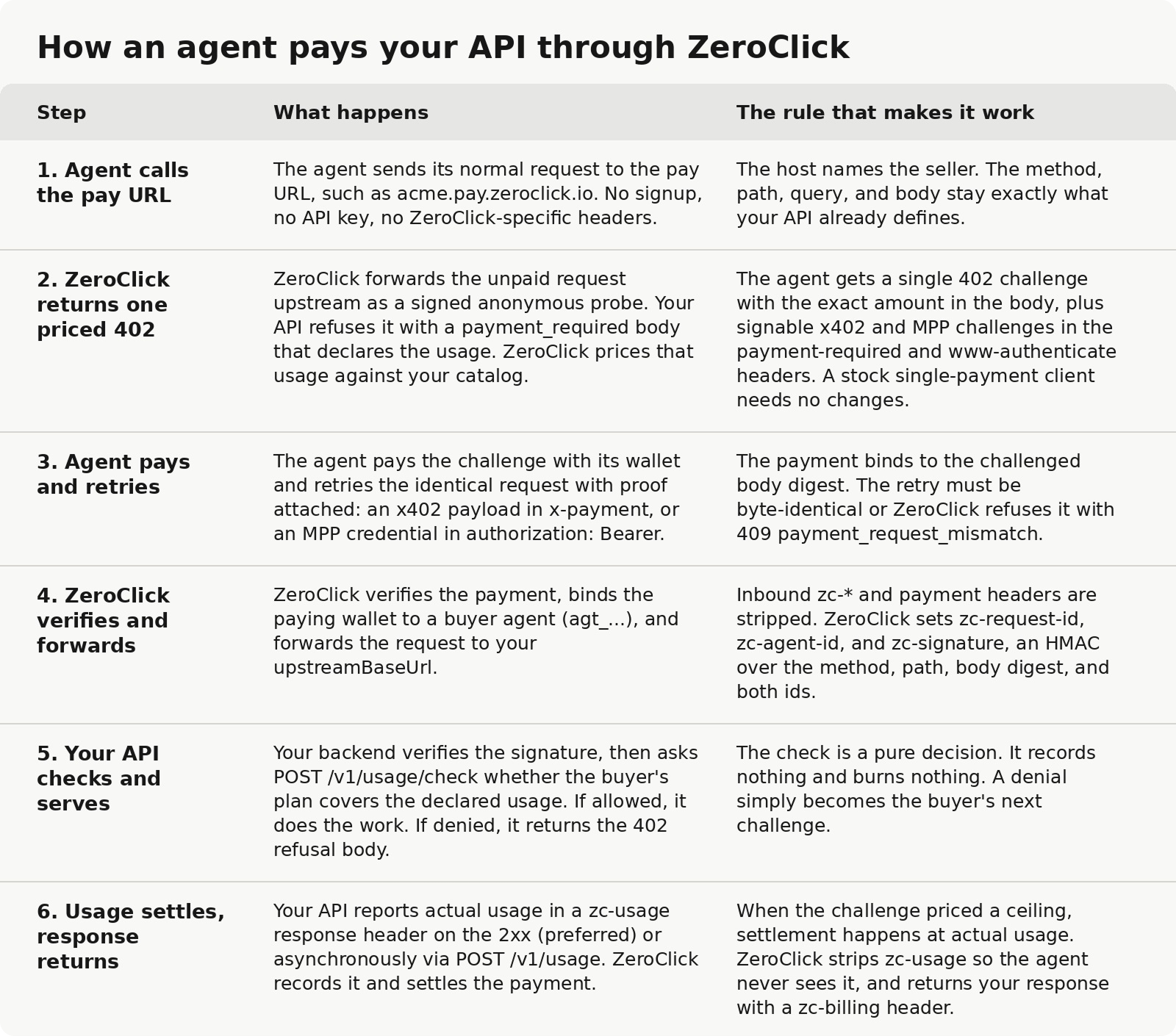
Sellers bring their service, ZeroClick publishes it as a machine-readable storefront that agents understand. A buyer-agent calls your endpoint, ZeroClick checks if it’s allowed to spend. If greenlighted, it logs all the consumption. The idempotencyKey prevents asynchronous retries from being billed twice. The money lands in your Stripe balance.
Skyfire is an agent-first checkout counter with its own ID system.
Where ZeroClick wins: ZeroClick accepts more payment types, sends money straight to your regular bank via Stripe, and handles tricky ‘we don’t know the final price yet’ charges (think: pay-per-use AI where the bill depends on usage). Reserve pricing solves a real, weird problem and I couldn’t find anyone else handling it so cleanly: ZeroClick reserves the max amount, then settles for the actual one.
Where Skyfire wins: it tells you what it costs.
Where ZeroClick wins: it was built for agents from day one. It tracks who each agent is and what it’s doing. Stripe, at least today, does not.
Where Stripe wins: Stripe is Stripe. Every developer already has an account.
Where ZeroClick wins: You don’t need to build everything yourself.
Where x402 wins: It’s free. Or rather, you pay whatever building and maintaining it costs you.
Kontext is helping brands get found by AI (not paid by AI).
Where ZeroClick wins: ZeroClick processes the sale.
Where Kontext wins: It can point at real numbers, the 'we got you cited X% more in ChatGPT' kind. ZeroClick can't yet.
Just like Kontext, Scrunch AI is helping brands get found by AI (not paid by AI).
Where ZeroClick wins: ZeroClick processes the sale.
Where Scrunch AI wins: It can point at the same kind of citation-lift numbers. ZeroClick can’t yet.
Nekuda offers closed, invite-only agent payment systems.
Where ZeroClick wins: ZeroClick supports multiple payment standards, not just one. And its documentation is dramatically better.
Where Nekuda wins: It can point at named customers and success stories. ZeroClick can’t yet.
Payman offers closed, invite-only agent payment systems.
Where ZeroClick wins: ZeroClick supports multiple payment standards, not just one.
Where Payman wins: It can point at named customers and success stories. ZeroClick can’t yet.
No public pricing = enterprise-only?
I reaaaaally tried to find out what ZeroClick charges sellers. I looked directly in the primary sources (zeroclick.ai, the developer docs, the Zero FAQ). ZeroClick's take rate on agent transactions is nowhere to be found. The pricing URL sent me straight back to the homepage. I found some billing models in the docs, but they explain what sellers can charge agents, not what ZeroClick charges sellers.
I see two possible explanations. Either ZeroClick hasn’t finished its homepage, or it’s going enterprise-first.
And I see mixed signals.
Its $55 million seed round and partnership strategy (Mermaid, AskCodi) suggest a company built to win large deals.
If startups, indie devs and solopreneurs are a target too (startups ARE mentioned on the homepage), they’ll need a self-serve tier and a published take rate.
Possible roadmap
If I were a PM at ZeroClick, my next priorities would likely include:
One: a public seller directory. Agents find supply, sellers get distribution. ZeroClick builds a supply-side moat. And moats are nice.
Two: dedicated landing pages for selling through every major AI platform: “Sell to Claude,” “Sell to ChatGPT”. These are almost comically obvious.
I’d watch this space closely.
If you’re building all that infrastructure yourself: Connect MPP and x402, create agent-facing endpoints. Register them across indexes. Be prepared to manage the payment protocols, access provisioning, conversion analytics and, as a little treat, every update to the standards that follows.
If you want to sell to agents without changing your API, or want an agent-purchasable API without needing to rebuild it every time a protocol changes, ZeroClick is a solid option. Getting an x402-compatible endpoint live soon, with or without ZeroClick, is worth testing.
Which protocol is best?
Pick based on what you’re building.
Each protocol I listed in this article solves a different layer: ACP runs checkout, AP2 handles authorization, x402 and MPP move the money. I read specs for MPP and x402 and they use different mechanics. MPP is session-based and bank-native, x402 is per-call and crypto-native.
Can I block AI shopping agents? I’m afraid I don’t have great news. You can’t, at least not entirely. Not even with robots.txt. Robots.txt is non-binding and non-enforced. It basically asks crawlers to stay out, but doesn’t stop a determined one.
From what I can see, courts and sellers are all confused. Amazon blocked Perplexity's shopping agent, but the Ninth Circuit heard the appeal on June 11, 2026 and hasn't ruled. Every deeper how-to I read on this turns out to be content marketing from a company selling agent detection. Which tells you plenty about how solved it isn't.
Can I opt out from agentic storefronts on marketplaces like Shopify? I found a Reddit r/shopify thread where merchants ask outright “what are the specific steps we can take to disengage from this nonsense”. Feel free to explore it. It seems possible, but confusing.
Analyst forecasts for agentic commerce by 2030 run from $144 billion to $5 trillion. But according to Gartner, consumers disagree. Only 11% of US consumers would let AI make the purchase decision. As usual, the tech is sprinting, trust is walking.
I’m collecting real transaction stories for a follow-up. If an agent has already bought something for you, or you’ve built something an agent can buy, I’d love to chat. And if you’ve watched a shopping agent do something that made you shake your head like my grandma, let me know too.

Comments
Nothing yet. Say the first thing.
Sign in to join the conversation.