
You wake up in the morning.
You try to eat enough to have energy for the day, which you keep not doing.
You apologize to your dog, Django, for leaving him at home.
You get a taxi.
The driver turns out to be one of your favourites, a guy who’s picked you up a few times before. He always looks in the rearview and checks to see if you’re ready to go, and says “yalla” as he takes off, as if you are both headed off on a long and perilous journey, rather than the 12-minute trip to Mar Mikhaël.
As the taxi sails along the highway, you think, for the thousandth time, how Beirut, is your city. How after all that searching for home, you’re finally here, on the land of your father, and of your grandmother. How despite the absolute shitshow that it is right now, there is nowhere else you’d rather be.
You pass seas of tents by the port. Displaced kids playing football. Women hanging clothes in the sun.
You arrive at the restaurant. Here, a makeshift kitchen has been set up downstairs, where you have been helping to cook and package food for the 1.5 million displaced people in your country. You’ve been doing this for the past three weeks. Or four? You don’t remember. Time has gone weird.
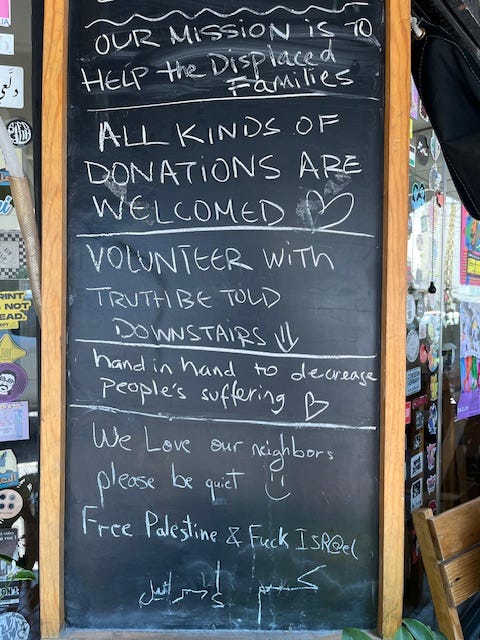
You and the taxi driver exchange warm goodbyes.
You go downstairs.
You greet some volunteers you’ve never met before, put on your hairnet and get to work, chopping onions and cabbage.
After an hour or so, the food is ready to be cooked, so there’s a break. You go back upstairs and do some work on your laptop. You worry about your dad, who has been having back issues. You worry, a little bit, about your love life.
Some volunteers you know arrive, so you sit with them in the sun, talking about the latest updates on the latest bombings; the latest politicians’ latest promises. The chef comes up to say the food is ready, and you all head back downstairs to package it. There is barely any cell reception downstairs, so it’s not until someone’s phone accidentally gets service that you all realize what is going on.
Everyone races upstairs, calling their families. People start calling out neighbourhoods that were struck. The one you live next to. The one where you walked the other day. One near where friends of yours live.
Beirut neighbourhoods are tiny, sometimes two or three blocks.
You quickly text your dad.
“Stay away from glass,” he orders.
You look around the restaurant, which is walled on two sides by floor-to-ceiling windows.
“Okay,” you text back.
Traffic backs up to a standstill. Sirens everywhere. You sit down at a bar table, at a loss for what to do.
“Nowhere is safe,” one of the volunteers says, staring at Instagram. “We’re fucked.”
A song about breakups comes on the stereo. You had listened to on repeat a few weeks back, before this all started, after a bad end to a bad situationship. You stare outside at the traffic, thinking about how you felt back then.
It seems, from here, like a 2D cartoon.
The volunteer who said that nowhere is safe asks if you are okay. They ask it so gently, you almost start crying. You text your housemate for the 40th time and ask how Django is doing. You know that the sound of the bombs terrify him.
“They’re calling it Operation Eternal Darkness,” another volunteer says, looking up from her phone. “If I used that in a book, people would laugh at me.”
At a loss for what else to do, you all head back downstairs and package the food.
After you’re finished, it’s time to face facts: you need to get home. Eventually. Probably. It’s going to get dark soon. Your housemate suggests walking, and together, you come up with the safest route. You text your dad with this plan.
“Are you insane?” he writes back.
But traffic is still barely moving, and if something is to happen, being in open air somehow seems preferable to being stuck in a taxi, especially one surrounded by other cars. And Israel likes to do their dirty work after dark.
“Go now,” your dad relents. “Call me every 20 minutes.”
You take off.
You pass a woman getting her highlights done.
An old man sitting on the sidewalk, selling flowers.
Two separate men jogging with headphones in.
Empty cafes, still open, employees hunched over their phones.
Even though it is sunny and bright, it starts to rain.
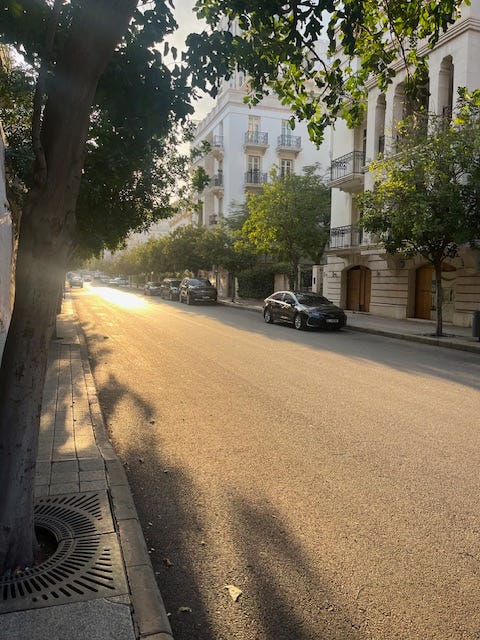
Beauty. So much beauty. So much history, like all the rah-rah-Beirut instagram posts say, but it is. It really fucking is. There is nowhere on earth so beautiful and so real.
You realize there’s no cell reception.
You shove your sunglasses on.
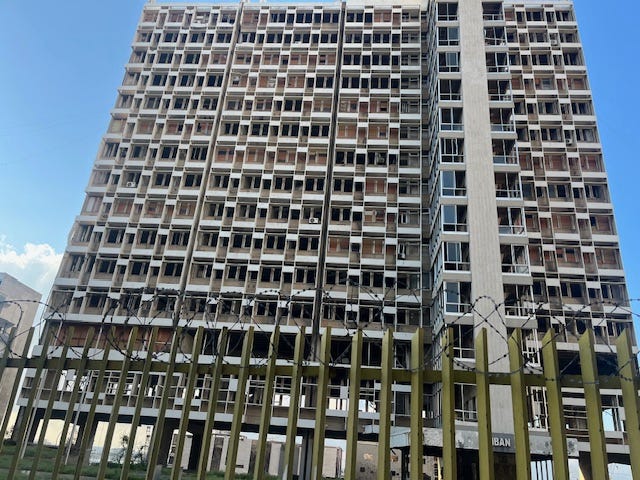
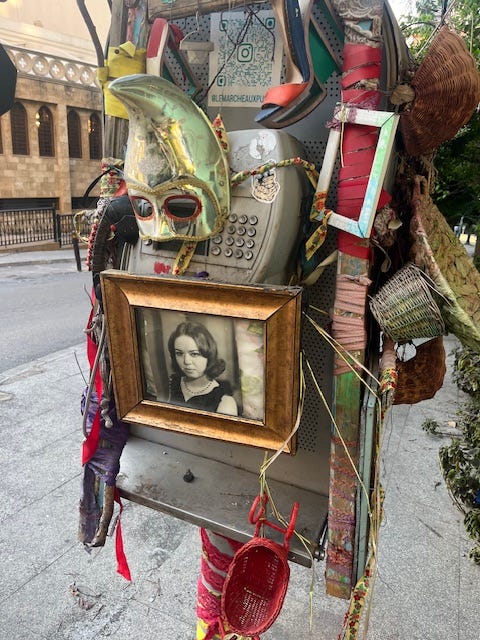
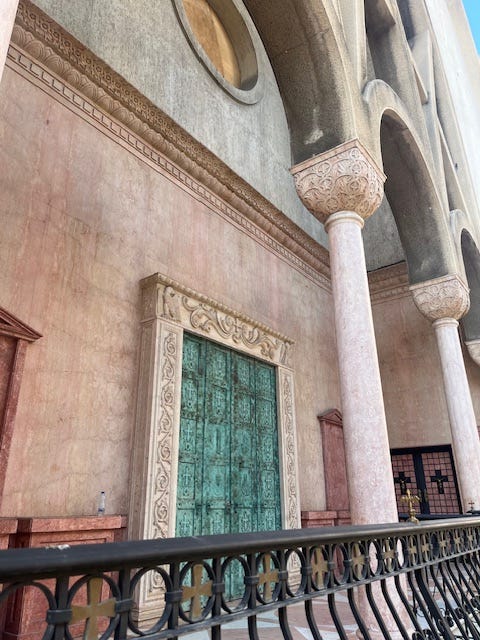
You pass through Martyr’s Square, the main square of the city, home to a huge church and a huge mosque. It’s empty, save for a few displaced families, huddled together, staring at the sky.
You pass a Lebanese Armed Forces guy standing on the street. You smile at him. He stares at you suspiciously.
The traffic has cleared up. You could hail a taxi now, but you don’t. It’s as if you need to be here. This walk has become a mantra. An honouring. A prayer.
Also, you’re more or less levitating with adrenaline.
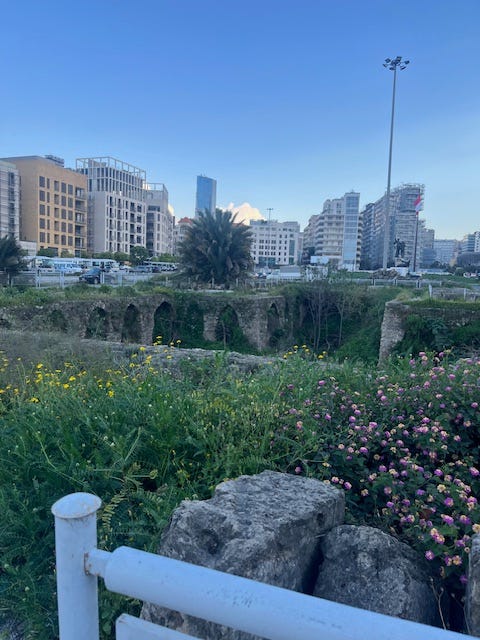
“I’m following your location,” your dad texts, which means cell reception must be working again. You realize that this might be as close as you’ve ever been to the James Bond movies you two used to watch together when you were little, and still do at Christmas time, which always felt so far from reality.
You realize you have no cash. You don’t want to stop, but what if you need cash tomorrow? Because who knows what’s going to happen? This would never happen to James Bond. Very quickly, you get cash from an ATM, and walk on.
“What’s happening?” your dad texts.
“I’m passing the Rolex store,” you say. “I’m definitely safe.” Winky emoji.
You’re almost running.
Around the curve. Across the main road. Up the street you walk most mornings with Django. Around the corner to your street.
Inside.
You text your dad.
“Home,” you say.
“Thank god,” he says.
Django goes insane, barking and hopping up and down on his hind legs. You sit on the floor, covered in sweat, hugging him and kissing him, whispering to him what a good boy he is. You get up to take a shower.
Another boom.
And one more.
You and your housemate move away from the windows, Django in your arms.
Eventually you just fucking shower. Then you sit on your bed and eat the Cadbury Cream Egg you buy every Easter and save for a special occasion, because god almighty.
You scroll, through names and photos of the dead.
A man who worked at the nearby Thai place you always go to.
A man who worked for a beloved local nut company.
A 2-year old boy. A famous poet. Entire families.
A building 1km away has come down. People are still trapped inside.
The number of martyrs from this one day will be over 300.
You post on Instagram, again and again, news stories and statistics and videos of smoke and destruction.
And it occurs to you. For the first time, clearly, why you do this. Why you have been doing this for so long.
It is a plea for people to care.
It’s the same plea people have made to you from the wars and genocides they were living in, as you sat in the safety of your life.
A plea for people to look up from their jobs and daily stresses and see us.
To see us, and to do something, even if that something is collective care in their own communities.
But also, to remind them that there is so much more they could do.
What’s it going to take?
That’s what people asked you, and now you are asking others, from your bed in your safe apartment as the sun goes down over the land you choose and millions did not choose to call home.
As rescue workers dig up bodies, as families reel with shock, as people’s lives end.
You never thought you would live a day like this.
If you hadn’t lived through it—I mean, not all the way through it—some people from the west might care more.
But you did.
So what’s it going to take? Does this have to happen to everyone?
Because if we all start doing something before that, we might stand a fucking chance.
Comments
Nothing yet. Say the first thing.
Sign in to join the conversation.