
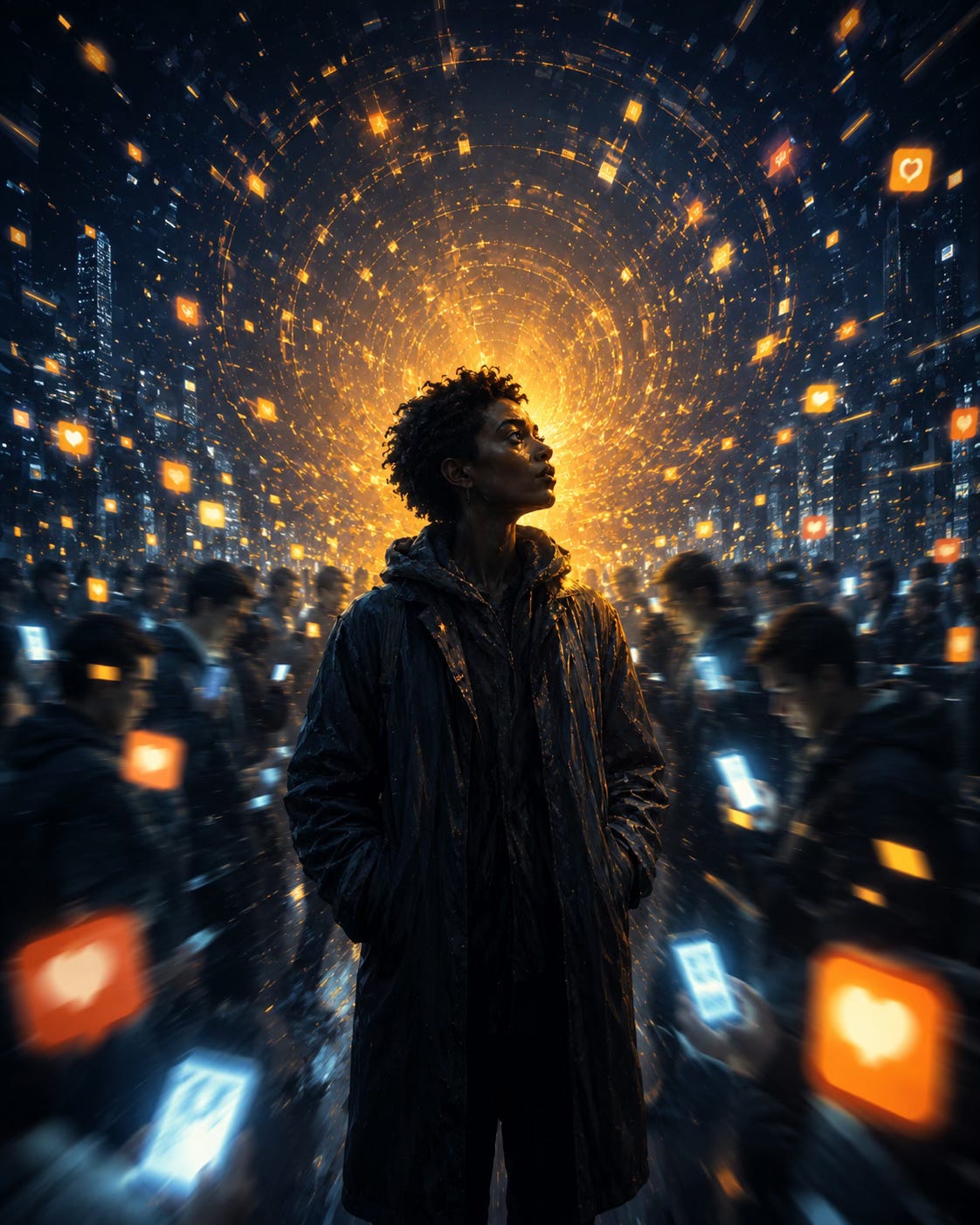
Something is happening to you.
You may not have the language for it yet, but you can feel it.
You are tired, but not in the way you used to be tired.
The people you once enjoyed no longer feel familiar. The conversations feel repetitive. The job you prayed for now feels like a trap. The dreams that used to motivate you do not move you anymore. Even your tastes may be changing. Different food. Different music. Different clothes. Different desires.
You look around and everyone else appears to be carrying on as usual.
They are posting.
Working.
Dating.
Shopping.
Networking.
Making plans.
Setting goals for a future you are no longer certain will exist.
Meanwhile, you feel as if you have awakened inside a simulation that everyone else has agreed not to question.
You have gone to therapy.
You have read the books.
You have done the shadow work.
You earned the degree, built the career, learned to communicate, set boundaries, healed your childhood, updated your resume, prayed, journaled, manifested, meditated, and tried to become the healthiest version of yourself.
You did what they told you to do.
And still, something feels wrong.
Not necessarily wrong with you.
Wrong with the world around you.
Here is what I want you to know.
You may not be falling apart.
You may be becoming incompatible with a way of life that is already disappearing.
And what you are feeling has a name.
But before I give it to you, we need to understand what is ending.
Most of us were raised according to a basic agreement.
Work hard.
Get educated.
Become good at something.
Build a career.
Save money.
Find a partner.
Buy a home.
Be responsible.
Keep producing.
If you followed the instructions, life might not be easy, but it would at least make sense.
That agreement is breaking.
People who did everything right are being laid off through a fifteen minute video call.
Degrees that required years of sacrifice no longer guarantee stability.
Creative skills that took decades to develop can now be imitated by a machine in seconds.
People who built their identities around being writers, designers, educators, analysts, administrators, strategists, or experts are now being asked to prove why they should not be replaced by a subscription.
Entire professions are being reorganized before the people inside them have had time to understand what is happening.
Artificial intelligence did not create every crisis we are living through.
It did not create economic inequality.
It did not create loneliness.
It did not create racism, sexism, homophobia, corporate greed, political cruelty, or our addiction to productivity.
It did not create a culture in which human beings were already being treated like machines.
But AI arrived in the middle of all of it.
It landed in a civilization already exhausted, fragmented, distracted, unequal, and spiritually hungry.
And now it is accelerating everything.
When an asteroid struck the Earth millions of years ago, the impact itself was only the beginning. The atmosphere changed. Food systems collapsed. Habitats disappeared. The creatures that had dominated the planet suddenly found themselves living in conditions they were not built to survive.
Artificial intelligence is not a literal asteroid.
But historically, it may function like one.
Not because it will destroy everything overnight, but because its arrival is changing the conditions under which everything must now live.
Work is changing.
Education is changing.
Art is changing.
Politics is changing.
Business is changing.
Relationships are changing.
Our understanding of intelligence is changing.
Even our understanding of what makes a human being valuable is being challenged.
The question is no longer simply, “Will AI Take My Job?”
That question matters, especially when your rent is due and your livelihood is threatened.
But there is a deeper question underneath it.
Who must I become in a world where the person I was trained to be may no longer be enough?
Every major social change reaches different people at different times.
Some people feel the tremor before the building visibly moves.
The Black community knows something about this.
So do queer people, immigrants, disabled people, working class people, and anyone who has had to survive inside systems that were never designed with their full humanity in mind.
When you have historically been watched, judged, excluded, underestimated, or required to outperform others just to remain in the room, you learn to notice shifts early.
You notice when the language changes.
You notice when institutions begin protecting themselves.
You notice when diversity becomes expendable.
You notice when the invitation is quietly withdrawn.
You notice when the job market becomes colder, the culture becomes crueler, and the future begins narrowing.
Other people may call you negative.
They may say you are overthinking.
They may tell you to be grateful, work harder, stay positive, or stop making everything so deep.
But sometimes what other people call anxiety is actually perception.
Sometimes your body knows an era has ended before your mind can explain it.
That does not mean every fear is prophecy.
It does mean your discomfort deserves investigation.
Your exhaustion may not be a failure of discipline.
Your confusion may not be a lack of gratitude.
Your inability to return to who you used to be may not be self-sabotage.
You may be receiving information.
We need to be precise here, because many people are spending years treating the wrong condition.
Tired can be helped by sleep.
Tired can be helped by rest.
Sometimes tired can be helped by a vacation, a lighter schedule, or a few quiet days away from the demands of your life.
But you have slept.
You have taken the trip.
You have taken the day off.
You have tried yoga, therapy, better boundaries, supplements, morning routines, breathing exercises, and turning your phone over at night.
And when you returned, the feeling was still there.
Waiting for you.
Unmoved by any of it.
That is not ordinary tiredness.
That is fed up.
Tired is the body asking for rest.
Fed up is the spirit staging a protest.
Fed up is the part of you that has decided it will not continue on the old terms, no matter how much rest you give it.
Fed up does not want to be restored to its previous level of productivity.
Fed up does not want to get back on the machine.
Fed up wants the terms to change.
That is why so much self-care does not work.
You are trying to recover from a life your spirit no longer consents to.
You do not simply need more energy.
You need a different relationship with work, time, technology, ambition, love, money, attention, and yourself.
You do not need to become better at tolerating what is destroying your coherence.
You need to stop living a life your spirit has already voted against.
Long before most people began talking about artificial intelligence, algorithms were already reshaping human life.
They learned what made us stop scrolling.
What made us angry.
What made us afraid.
What made us feel undesirable.
What made us buy.
What made us compare.
What made us return.
We thought we were using social media.
Social media was also studying us.
We thought the feed was showing us the world.
It was showing each of us a different world, selected according to what could hold our attention.
Slowly, the phone became more than a tool.
It became a nervous system outside the body.
A notification told us what deserved our attention.
A like told us whether we mattered.
A view count told us whether an idea was valuable.
A dating app told us who was desirable.
A search engine told us what was true.
A platform told us when to speak, how long to speak, and whether our words would be seen.
We became easier to reach and harder to know.
We became surrounded by information and starved for meaning.
We became visible to strangers and invisible to ourselves.
This is the Algorithmic Age.
It is a period in which algorithms do not merely organize information. They increasingly shape what we see, believe, desire, fear, trust, and become.
And because we adapted gradually, many of us never noticed what was being taken from us.
Our attention became a product.
Our emotions became data.
Our relationships became content.
Our lives became performances.
And our sense of self became increasingly dependent on systems designed to keep us reacting.
Think about how many years you have spent responding.
Responding to messages.
Responding to emails.
Responding to headlines.
Responding to emergencies.
Responding to other people’s opinions.
Responding to trends.
Responding to outrage.
Responding to opportunities that disappear if you do not act immediately.
Responding to an economy that keeps raising the cost of being alive.
Responding to family members who refuse to heal.
Responding to workplaces that call exploitation excellence.
Responding to dating cultures where people treat human beings like profiles that can be discarded with a swipe.
We came to believe that being constantly reachable meant being responsible.
That being constantly informed meant being intelligent.
That being constantly productive meant being valuable.
That being constantly visible meant we existed.
This was the Notification Era.
It trained us to react before we reflected.
To answer before we understood.
To perform before we knew what we believed.
To speak before we had anything to say.
To remain available even when our souls were asking us to disappear for a while and listen.
Now many people are reaching a limit.
The nervous system is refusing the assignment.
The body is saying no before the mouth has found the courage.
The old ambitions are losing their power.
The old distractions are no longer distracting.
The old relationships cannot survive the questions you have begun asking.
The old version of success no longer feels worth the price.
And because the world taught you to measure your health by how well you function inside unhealthy systems, you assume your inability to keep functioning means something is wrong with you.
But what if this is not a malfunction?
What if this is discernment?
What if some part of you has recognized that you cannot produce your way out of a crisis of meaning?
Here is the name.
The Post-Notification Era does not mean phones will stop ringing.
It does not mean technology will disappear.
It does not mean everyone will delete social media, move to the woods, and grow tomatoes.
It means something more difficult.
It is the cultural and spiritual transition from a life governed by reaction to a life governed by intention.
It begins when you stop asking only, what needs my response.
And begin asking, what deserves my life.
It begins when attention is no longer treated as an unlimited public resource.
When availability is no longer confused with love.
When speed is no longer confused with wisdom.
When visibility is no longer confused with significance.
When productivity is no longer confused with purpose.
When constant access is no longer confused with intimacy.
When you understand that every notification is making a request, but not every request is sacred.
The Post-Notification Era is not a digital detox.
It is not a weekend without your phone.
It is not another self-improvement project designed to make you more efficient.
It is a human recovery.
It is the recovery of attention.
The recovery of intention.
The recovery of inner authority.
The recovery of the right to decide what enters your mind, shapes your identity, and directs your days.
It is the moment you stop allowing every institution, platform, employer, family member, political crisis, and cultural demand to behave as though it automatically deserves access to you.
It is the moment you begin returning to yourself.
An Emerging Human is not a superior person.
It is not a new lifestyle brand.
It is not someone who has transcended pain, mastered the correct morning routine, or learned how to make AI do all their work.
The Emerging Human is a person learning how to remain deeply human in conditions that reward the mechanical.
This person understands that information is everywhere, but wisdom is not.
Artificial intelligence can generate language, but it cannot take responsibility for the life built from that language.
Efficiency can save time, but it cannot tell us what our time is for.
Technology can predict behavior, but prediction is not destiny.
A machine may reproduce our patterns, but human beings still possess the capacity to interrupt them.
The Emerging Human does not compete with artificial intelligence by becoming more machine-like.
They become more human.
More perceptive.
More ethical.
More imaginative.
More relational.
More spiritually grounded.
More capable of discernment.
More willing to sit with complexity without demanding an immediate answer.
More willing to create meaning where no algorithm can provide it.
This person is not anti-technology.
They simply refuse to worship it.
They use tools without surrendering judgment.
They value efficiency without sacrificing depth.
They understand that convenience is useful, but it is not a moral compass.
They know that intelligence without wisdom can become destructive.
They know that the future of humanity will not depend only on what machines can do.
It will depend on whether human beings remember who we are.
This is the Post-Notification Era. Not a detox. Not a trend. The name for what you already feel.
Karmen Michael Smith is the founder of Emerging Human Lab and creator of the Post-Notification Era framework, exploring what it means to remain human in the Algorithmic Age.
No posts
Comments
Nothing yet. Say the first thing.
Sign in to join the conversation.