
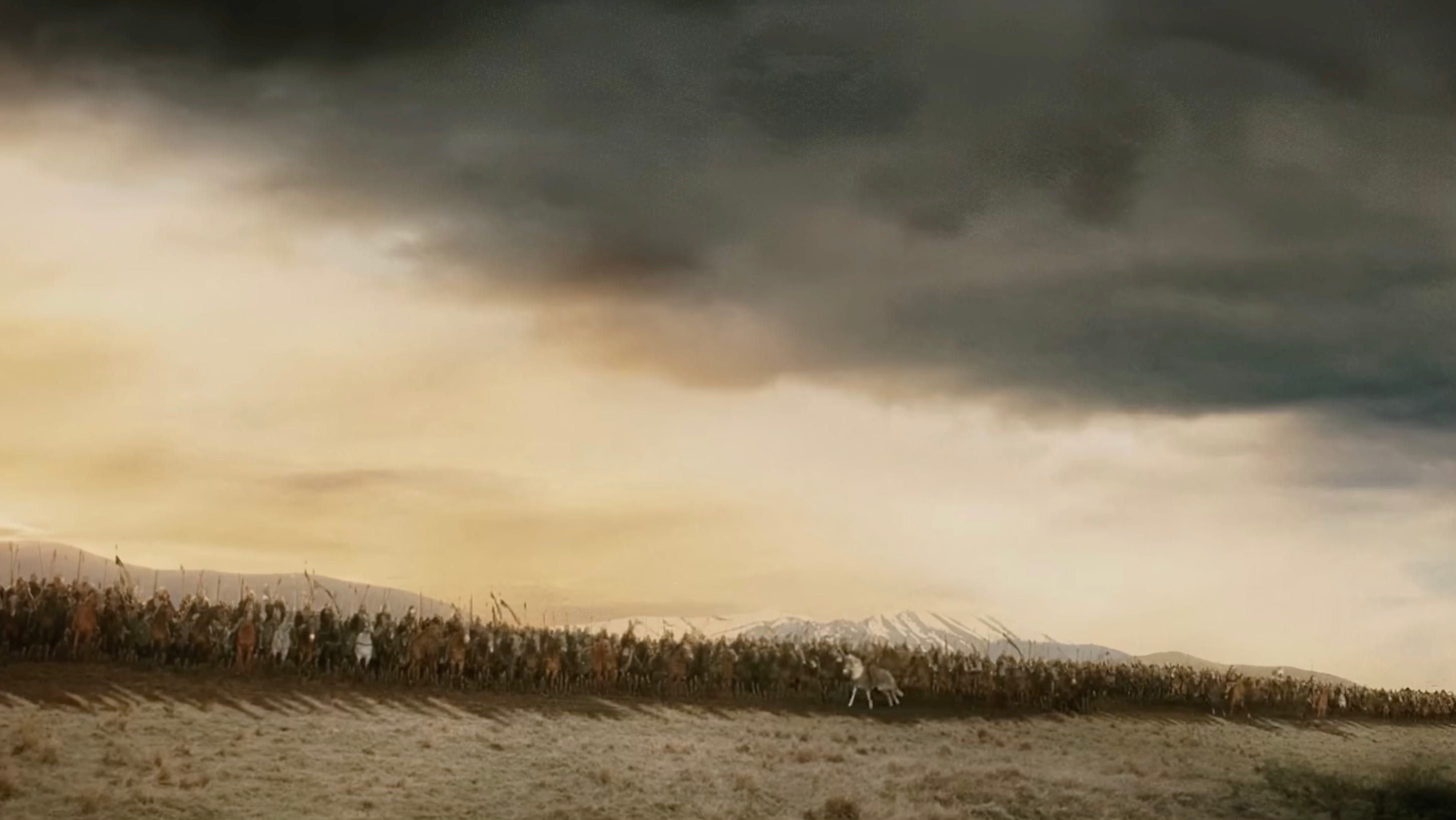
Some friends and I watched The Two Towers tonight. It started raining halfway through, and I decided to step outside to enjoy it as soon as we reached a bit I was less invested in.
The problem is, I’m invested in… all of The Two Towers.
Finally, we reached the full-out brawling of the battle of Helm’s Deep, and I spirited myself away for a few minutes. There are, after all, fewer lines to quote when orcs are climbing up ladders and then falling off again.1
It’s always interesting, learning how best to handle battle scenes. We tend to keep them out of movies meant for young children, as we should. But as the audience grows older, more questions are asked—how realistically should such-and-such be portrayed? How much screen time should be dedicated to the non-art of killing?2
The last time I watched The Return of the King, I found myself, as I always do, near tears at the charge of the Rohirrim. And yet in that moment, a niggling question popped out its head. If war is an ugly thing (and it is), why would a tale so centered around war mean so much?
And just as quickly came a thought that I haven’t been able to shake off ever since—there will be a day when we no longer need stories of war.
If there will be a day when we no longer need stories of war, then, logically, there is a day when we do.
We live3 in a world where war does exist. Cruelty does arm itself with clubs. Greed does turn to violence to get what it wants. As Tolkien reminds us, those who do not have swords can still die upon them.
Stories are told by people, for other people, and that means stories must speak to the world in which those people live. We tell of forests growing green in the spring because we live in a beautiful world. We sing of love and kinship because we all know the warmth of human community.
And yes, we make movies of war because we live in a war-torn world.
When a story tells you to close your eyes because “none of that really exists,” it is lying to you. Lies do not protect. Those who say swords do not exist can still die upon them, too.
We must be equipped—and that comes down, as it always has, to stories. Stories such as The Lord of the Rings acknowledge war and cruelty as parts of the world we will encounter.
Now consider—a story may speak of a thing it does not condone.
We live in a world of war, murder, and rape. Stories may speak of those without creating them, or glorying in them. They are simply stating facts: These things are real.
What those stories do next, though, is important.
A tale of war ought to be one that showcases courage, sacrifice, and leaves the audience with a deep longing for peace. That is a tale of war well-done. That is the marriage of honesty and hope.
But even those stories, I believe, will one day be no more.
There is a verse, in both Isaiah and Micah, where the prophet speaks of the restored house of God, where nations will not lift weapons, and “neither shall they learn war anymore.”
War is something we learn. In stories, in songs, in cruel invitations and frantic fears.
One day, we will not learn it anymore.
There is another picture used in both these passages that S.D. Smith, author of The Green Ember, picked up: nations taking weapons of war and turning them into tools to tend their crops.
It is a vision of perfect peace. All that is ugly has been rejected—yet not merely cast aside; but undone, remade, turned inside-out and shining like the sun.
In The Green Ember, the vision comes in a stained glass window. I was very young when I first encountered it, listening to the audiobook through quiet afternoons, and it is a picture that has tunneled deeper and deeper into my consciousness.
I am glad that I was a child who dreamt of a stained-glass window where war itself was turned into peace. I am so grateful that this vision was given to me before I fully understood what hatred was. Later, when I did, I already had the tools to look at it and keep from despair.
One day, these weapons will be used to grow flowers and food.
One day, nations shall not learn war anymore.
One day, we will not need stories of war.
For now, I am thankful (so thankful) for stories that look at a world of darkness, step into it, and are willing to dirty their hands. They must speak of abhorrent things. They must tell of war and darkness.
And they do it to draw out the good that is here. Even in these awful things, good may be found in the lives of brave men and loyal women, in the redemption of God amid the hatred of humanity.
So I am thankful for the charge of the Rohirrim. I am thankful for stories of war that showcase courage and sacrifice.
And I am so, so thankful that one day, we will not need these stories anymore. I am thankful that eucatastrophe will splinter our understanding of the world, so that what seems natural (but is not) will fade away, and all that is “green and good” in the world will awake and find that it is strong.
This is a sword-day, a red day, and there is much valor to be found even here—
But all this is only the prologue. A sword-day—a red day—ere the sun rises.
Poetry: Malcolm Guite’s Galahad and the Grail. Read it out loud and feast.
Movies: No surprises here, Jackson’s Lord of the Rings trilogy. I also watched The Hobbit for the first time and heartily enjoyed parts of it (the Shire especially).
Observations: Both in Galahad and the Grail and in Dracula (which I’m reading for the first time), there’s much actual power in words and objects connected with the Church. I’ve no specific comments on this yet except that it’s interesting.
Music: Gregorian chants. Also, “Sing Hallelujah to the Lord” by Brothers in Arms.
Thanks for reading A Seat by the Fire! This post is public so feel free to share it.
Consider—cockroaches cannot climb ladders. I never thought to be grateful for this before, but now I am with a vengeance.
This is a common critique of Jackson’s movies, that they overemphasize the battles. The proportions of battle-to-non-battle scenes certainly differ from book to movie.
We live! That is an extraordinary gift. Maybe you need to be reminded of that today.
No posts
Comments
Nothing yet. Say the first thing.
Sign in to join the conversation.