
The moment someone died, a Victorian family hurried to drape every mirror in the house in black. And it wasn’t to shield themselves from their own grief. It was to shield themselves from the beyond.
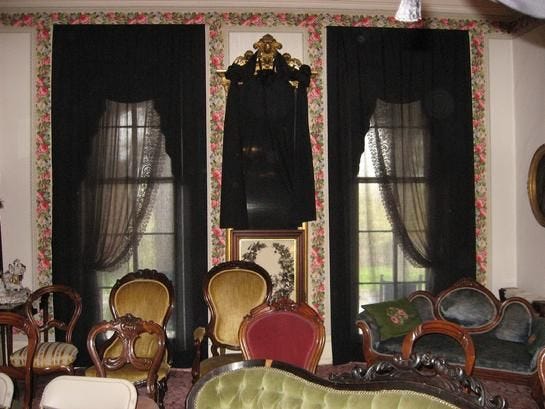
When death came to a Victorian household, one of the first things the family did, even before the body had gone cold, was to cover the mirrors. Every looking glass in the house was draped in black crape or simply turned to face the wall.
The Victorians believed mirrors could capture a soul. The newly dead, confused and perhaps not yet fully departed, might glimpse themselves in the glass and become trapped there, left to linger in the house they once lived in. And there was danger for those they left behind as well. A mourner who caught sight of their own reflection in a house where death had just occurred might find themselves marked as the next to follow.
For the Victorians, the mirror was not the only danger. After a death, the entire house was believed to be a perilous place. Clocks were stopped not only to record the exact hour of passing, but also to avoid inviting more misfortune. Photographs were turned face-down, so that the restless spirit could not slip into an image and possess the living person found there. And the body was carried out feet-first, so it could not look back over its shoulder and urge another soul to follow. Every part of it was carefully managed to avoid the unfortunate luck of the dead.
It seems the Victorians were completely fascinated with death. They wore mourning dress for long periods of time, including jewelry and embroidery samplers woven from a dead loved one’s hair. They photographed the deceased as if merely sleeping, or positioned them among family members, as a loving memorial. Queen Victoria spent four decades in black after the death of her beloved Albert, and made sure his clothes were laid out every day, as if he would step into them at any moment. In a world that was so intimate with its dead, a mirror that might be holding a lingering soul was a household hazard that needed to be dealt with to assure everyone’s safety.
Yet, a juxtaposing belief was also popular, which I find fascinating. While a mirror could trap a spirit, it could also be the door one came through. People gazed into the glass by candlelight hoping to call up their loved one, and children dared one to say a certain name into the glass three times, hoping that person would appear. It was a way to honor the dead and a way to keep them out.
Which brings me, at last, to the ghost who walks through all six of my Pryce of Murder novels.
Percival Blank. A dark, Byronic sort of figure in an exceptionally fine smoking jacket, who looks as real as the living when he’s in the mirror. While there, he cannot lay a finger on the living unless they are in the reflection with him. When he chooses to step out, he is as transparent as a dragonfly’s wings, and has no more substance than air. When I dreamed up that rule, I flattered myself it was original, but it was nothing of the kind. The Victorians had settled the matter a century before me. The mirror was precisely where a spirit would be found, caught between worlds, present but untouchable, there and not there, solidly visible only in reflection.
Percival is, I’ll confess, one of my favorite characters. A ghost in the mirror is a witness who is always somewhere in the room, watching from every corner. He also has a conveniently built-in alibi for anything that happens where there is no looking glass to be seen. He knows a great deal, yet, frustratingly for Arabella, provides very little crime-solving information. She is stuck with the most exasperating partner in the business.
If you’d like to meet him, he’s waiting in his mirrors throughout the Pryce of Murder mysteries.
So the next time you pass a dark mirror at the end of a hall, or catch your own face in a black windowpane at night, you might remember what the Victorians knew, or believed they knew: that the glass is a door, and you can never be quite certain it only opens one way.
Would you cover yours — just in case?
***
My dear partner in crime,
Every so often, I like to find out who’s actually on the other side of these posts and my newsletters. I’d love to know which of my books you’ve suggested others read and what you told them about it. Or who your favorite characters are and who you’d like to see more of. It’s a handful of questions, and it takes about three minutes to complete. This will greatly help me decide where to focus my efforts next. I’ll ask again now and then so I can watch how it changes.
Just click reply to send me and email and let me know.
No posts
Comments
Nothing yet. Say the first thing.
Sign in to join the conversation.