
Upon returning from a multi-week time-zone-spanning adventure – especially to a place far away from my everyday life, is there a question I dislike more than this? No.
Most of the time when I get home from a trip, I can’t easily answer that question. I don’t even want to, honestly. It’s impossible to transport my well-meaning friends back to a thousand sights, places and moments I experienced in the altered state we call “travel.”
Last spring I had an experience that seriously challenged the standard ‘trip in a nutshell’ summaries. I ventured to Bhutan, under the aegis of a small outfit called Himalayan Writing Workshop. I’ve long wanted to go to Bhutan, an ancient and tiny Buddhist kingdom wedged between China and India. Without knowing very much I assumed such a destination is under all kinds of geopolitical and cultural threats, so I knew I had to seize the chance.
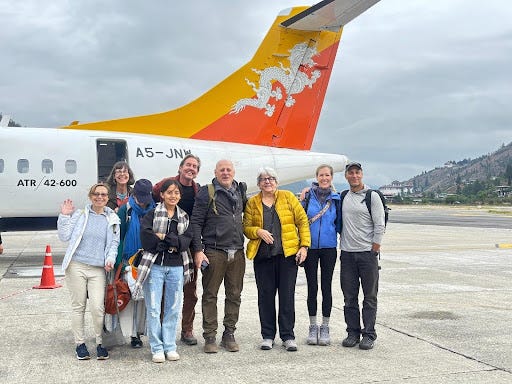
Our little group was game to do some writing, as well as see as many sights as we could. The workshop covered both wonderfully. Each day we focused on writing for a couple of hours, and then set out on excursions.
One of our daily writing exercises was to capture details in a list format. Not as a story, exactly — more a conjuring that could give readers a sense of this magical place. To me, it was so exotic that my eyes burned from looking intently at everything in view. Here’s my attempt at describing just bits of what I saw.
Vivid murals in baggage claim at the Paro airport, green mountains with bright white clouds — murals that even extend onto the hanging rubber strip curtain above the conveyor belt that deposits our incoming luggage.
The 6-foot statue of the goddess Tara greeting us as we exited the airport for local transport.
Our drivers greeting us at the airport with white silk khatas.
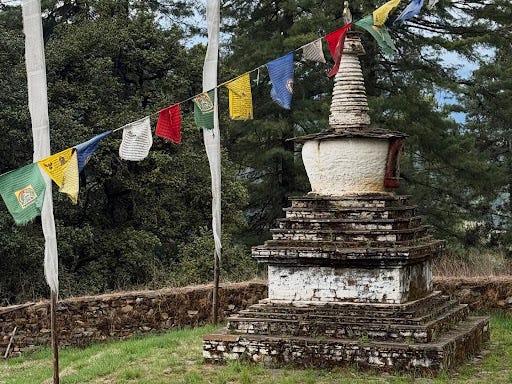
The traffic roundabouts that host small white concrete stupas or deities (there are no traffic lights in Bhutan).
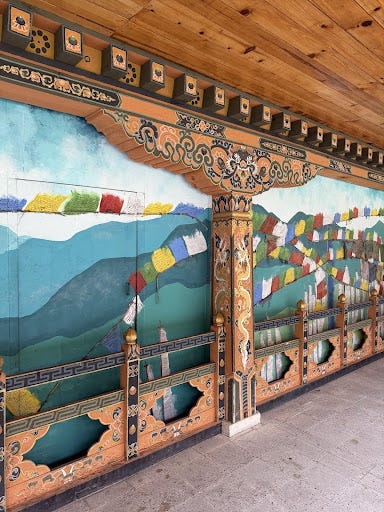
The painted wooden surfaces: doors and window frames, eaves, making everything beautiful. The colors, ochre, russet red, forest green, mustard, “French” blue, white accents. Humans mark their surroundings, and these are the best ways.
Watching Bhutanese people easily move and work in their multicolored woven gho (men) or kira (women) as they climb, lift, carry, run, shop, sit.
The comforting square hulk of buildings, whether they are schools, offices, monasteries, or hotels, always simply proportioned with elaborate wooden overhangs.
The intricate woodwork (so “unnecessary” from a no-frills construction perspective) that punctuates and humanizes buildings, walkways, staircases, gates and turrets.
The painted trim (a word that hardly conveys the amount, or detail) decorating every imaginable space: lintels, joists, steps, doorways, columns, eaves — and that’s just on the outside.
The friendliness of people who unhesitatingly offer a hand or arm, carry American-level bulky stuff, and always look after you with gentle kindness.
The raggedy sweet-eyed dogs (and a few cats) who live near people and don’t ask for much in return.
The dusty shops in little crossroad towns that sell yak milk candy, prayer flags and Thangkas.
In Bumthang Valley, the velvety green terraced hillsides, foreground to steep hills covered in blue pine.
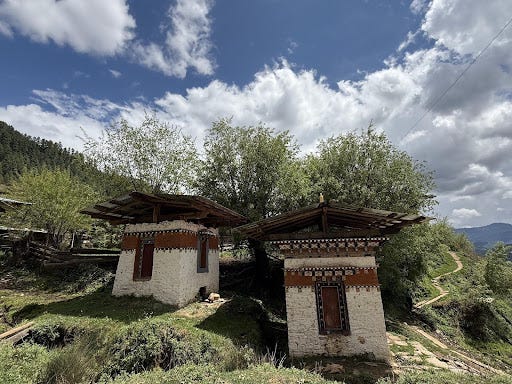
The seriously magical Oygen Choling Heritage House, dating from the 14th century (we spent 4 nights there), with its organic garden and reverberant meditation room.
The elder locals who perambulate the meditation space daily, turning each prayer wheel as they slowly follow their familiar route.
The centuries-old elaborate murals painted on adobe walls that grace every monastery and meditation space. The government’s historic preservation service tends to these, refreshing the colors and detail as accurately as possible.
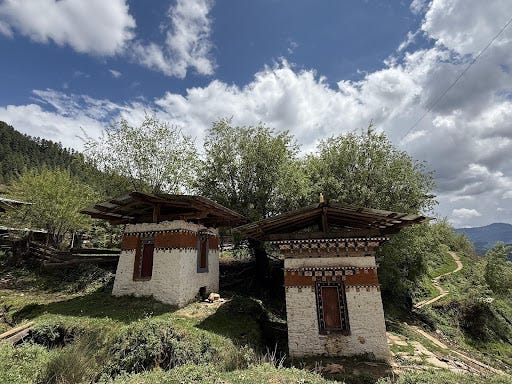
The lu khangs that dot the countryside: square stone and mud structures, sometimes painted white with a red band, that provide earthly homage to kanga spirits, both benevolent or destructive (either way, we must acknowledge and respect them).
The charming highway signs, designed in yellow with black boldface type, all caps, with their gentle and pithy messages: “No hurry, no worry”
“Driving faster causes disaster”And my favorite: “Be a predictable driver”
The majestic — there is no other word — Himalayan peaks, which the Bhutanese consider sacred. In 2003, the government banned all mountaineering in Bhutan, saving them the grief, garbage and tourist overload we see in Nepal and elsewhere.
I’ve worn out several friends with poorly organized but enthusiastic tales, all much longer than this list. As a writing tool, I like this approach — making a list to evoke and refresh my memories. Even if I never go again, I’ve got this. Try it yourself sometime as a rich adjunct to the scores of photos we all take along the way.
Comments
Nothing yet. Say the first thing.
Sign in to join the conversation.