
I thought it would be fun to offer some highlights from the history of the reception and literary criticism of Moll Flanders, along with Defoe more generally.
It’s important to know that coming from a Dissenting, working class family and therefore being outside elite educational and literary circles, Defoe was always considered an outsider by the literati. Being a journalist only compounded his lack of “credentials,” and writing for the masses and toward commercial success made it even worse. Defoe’s family name was “Foe,” and critics believe that it was changed to “Defoe” to make a common, humbler name sound more genteel.
The Scriblerus Club (which included our beloved Jonathan Swift, Alexander Pope, and John Gay) excoriated Defoe. Pope names Defoe in his mock-epic poem, The Dunciad, as one of the chief “dunces” contributing to the general decline under the reign of the goddess Dulness. The Dunciad is a brutal but brilliant satire of many of Pope’s contemporaries. Given the class and literary differences between him and Defoe, it’s not surprising at all to find Defoe among Pope’s targets.
Jonathan Swift—who had a kind of pamphlet war going on with Defoe—described Defoe as “so grave, sententious, dogmatical a rogue that there is no enduring him.” (You can read more about their rivalry here.)
Samuel Johnson—no easy critic—was more charitable. In James Boswell’s Life of Johnson, Boswell describes how Johnson “enumerated, allowing a considerable share of merit to a man, who, bred a tradesman, had written so variously and so well. Indeed, his Robinson Crusoe is enough of itself to establish his reputation.”
The famous nineteenth-century critic Charles Lamb admired Defoe’s Robinson Crusoe of all his works, but offered praise for other works by Defoe as well, including Moll Flanders:
While all ages and descriptions of people hang delighted over the “Adventures of Robinson Crusoe,” and shall continue to do so we trust while the world lasts, how few comparatively will bear to be told, that there exist other fictitious narratives by the same writer—four of them at least of no inferior interest, except what results from a less felicitous choice of situation. Roxana—Singleton—Moll Flanders—Colonel Jack—are all genuine offspring of the same father. They bear the veritable impress of De Foe. An unpractised midwife that would not swear to the nose, lip, forehead, and eye, of every one of them! They are in their way as full of incident, and some of them every bit as romantic; only they want the uninhabited Island, and the charm that has bewitched the world, of the striking solitary situation.
Lamb’s contemporary, critic Leslie Stephen, made this observation about Defoe in Hours in a Library:
One remark must be added, which scarcely seems to have been sufficiently noticed by Defoe’s critics. He cannot be understood unless we remember that he was primarily and essentially a journalist, and that even his novels are part of his journalism. He was a pioneer in the art of newspaper writing, and anticipated with singular acuteness many later developments of his occupation.
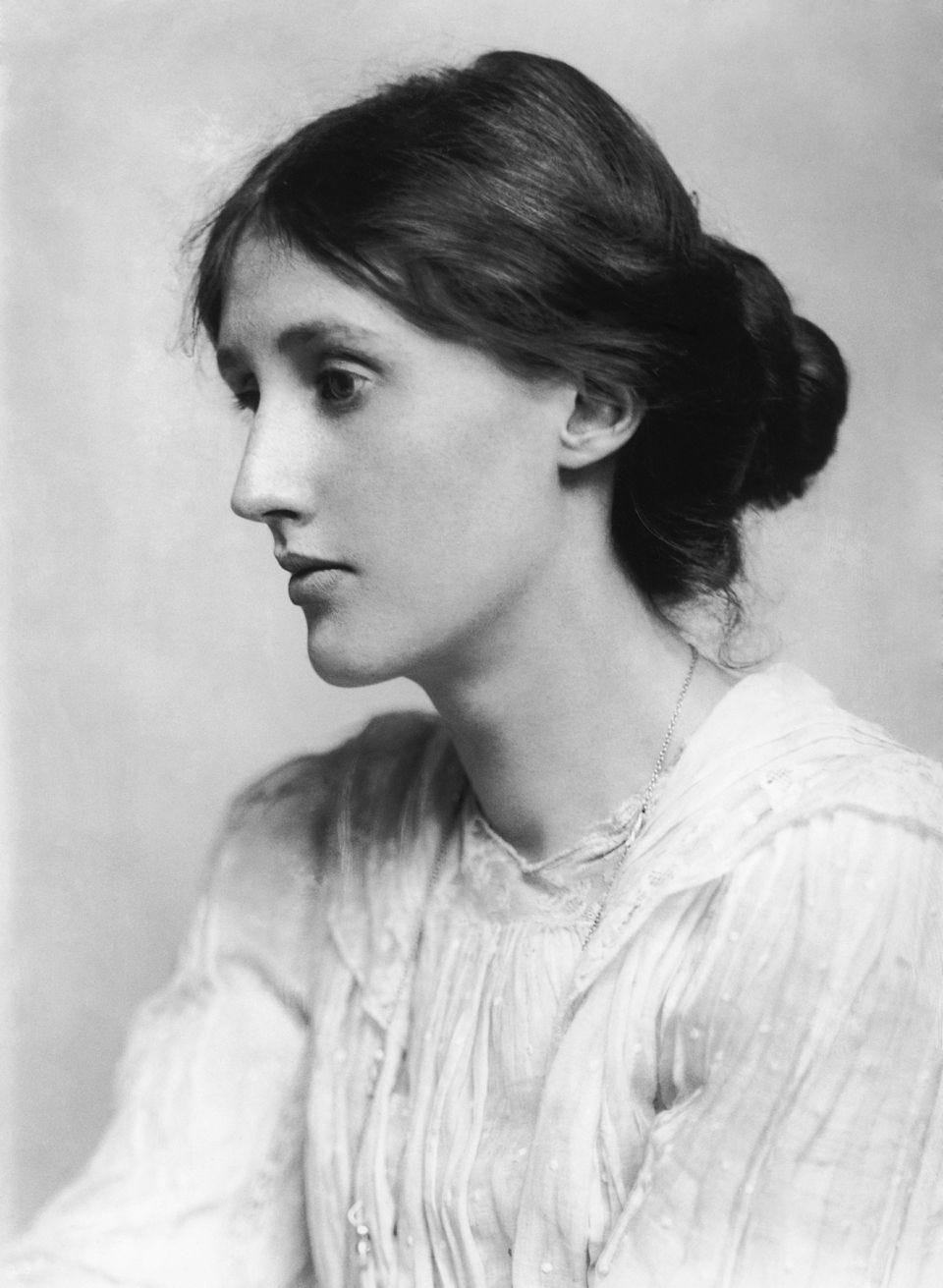
In The Common Reader, Virginia Woolf (daughter of Leslie Stephen) includes an entire chapter on Defoe in which she laments that Defoe is remembered more for Robinson Crusoe than Moll Flanders (and some of this other works). Here are a few passages from Woolf’s essay:
On any monument worthy of the name of monument the names of Moll Flanders and Roxana, at least, should be carved as deeply as the name of Defoe.
He had spent eighteen months in Newgate and talked with thieves, pirates, highwaymen, and coiners before he wrote the history of Moll Flanders. But to have facts thrust upon you by dint of living and accident is one thing; to swallow them voraciously and retain the imprint of them indelibly, is another. It is not merely that Defoe knew the stress of poverty and had talked with the victims of it, but that the unsheltered life, exposed to circumstances and forced to shift for itself, appealed to him imaginatively as the right matter for his art.
We find for ourselves meanings which he was careful to disguise even from himself. Thus it comes about that we admire Moll Flanders far more than we blame her. Nor can we believe that Defoe had made up his mind as to the precise degree of her guilt, or was unaware that in considering the lives of the abandoned he raised many deep questions and hinted, if he did not state, answers quite at variance with his professions of belief. From the evidence supplied by his essay upon the “Education of Women” we know that he had thought deeply and much in advance of his age upon the capacities of women, which he rated very high, and the injustice done to them, which he rated very harsh. [Here Woolf quotes Defoe]:
I have often thought of it as one of the most barbarous customs in the world, considering us as a civilised and a Christian country, that we deny the advantages of learning to women. We reproach the sex every day with folly and impertinence; which I am confident, had they the advantages of education equal to us, they would be guilty of less than ourselves.
The advocates of women’s rights would hardly care, perhaps, to claim Moll Flanders and Roxana among their patron saints; and yet it is clear that Defoe not only intended them to speak some very modern doctrines upon the subject, but placed them in circumstances where their peculiar hardships are displayed in such a way as to elicit our sympathy.
Note that point in the middle of these passages where Woolf finds that Defoe defies his Christian faith in painting Moll so sympathetically. Woolf famously rejected the faith of her forebears (including her conservative Christian father, Leslie Stephen) yet she very much admires Defoe—despite his Christian faith.
Defoe, Woolf concludes, “belongs, indeed, to the school of the great plain writers, whose work is founded upon a knowledge of what is most persistent, though not most seductive, in human nature.”
In Aspects of the Novel, E. M. Forster gives lengthy consideration to Moll Flanders. His analysis of the courtship scene between Moll and her Lancashire husband is particularly interesting and insightful:
He is a high-wayman, and each by pretending to wealth has trapped the other into marriage. After the ceremony, they are mutually unmasked, and if Defoe were writing mechanically he would set them to upbraid one another, like Mr. and Mrs. Lammle in Our Mutual Friend. But he has given himself over to the humour and good sense of his heroine. She guides him through.
“Truly,” said I to him, “I found you would soon have conquered me; and it is my affliction now, that I am not in a condition to let you see how easily I should have been reconciled to you, and have passed by all the tricks you had put upon me, in recompense of so much good-humour. But, my dear,” said I, “what can we do now? We are both undone, and what better are we for our being reconciled together, seeing we have nothing to live on?”
We proposed a great many things, but nothing could offer where there was nothing to begin with. He begged me at last to talk no more of it, for, he said, I would break his heart; so we talked of other things a little, till at last he took a husband’s leave of me, and so we went to sleep.
Which is both truer to daily life and pleasanter to read than Dickens.
Forster says that Moll Flanders is a novel in which “the character is everything.” And it is this kind of character that makes novels do what they do:
For human intercourse, as soon as we look at it for its own sake and not as a social adjunct, is seen to be haunted by a spectre. We cannot understand each other, except in a rough and ready way; we cannot reveal ourselves, even when we want to; what we call intimacy is only a makeshift; perfect knowledge is an illusion. But in the novel we can know people perfectly, and, apart from the general pleasure of reading, we can find here a compensation for their dimness in life. In this direction fiction is truer than history, because it goes beyond the evidence, and each of us knows from his own experience that there is something beyond the evidence, and even if the novelist has not got it correctly, well—he has tried. He can post his people in as babies, he can cause them to go on without sleep or food, he can make them be in love, love and nothing but love, provided he seems to know everything about them, provided they are his creations. That is why Moll Flanders cannot be here [in the real world], that is one of the reasons why Amelia and Emma cannot be here. They are people whose secret lives are visible or might be visible: we are people whose secret lives are invisible.
And that is why novels, even when they are about wicked people, can solace us; they suggest a more comprehensible and thus a more manageable human race, they give us the illusion of perspicacity and of power.
In The Rise of the Novel by Ian Watt, this foundational critic of the early novel does not count Moll Flanders as a novel, though he finds Defoe’s contribution to the emerging form to be of immeasurable significance. Defoe’s novels “lack both the consistency in matters of detail of which many lesser writers are capable and the larger coherences found in the greatest literature.” Defoe’s particular strength, argues Watt, and one that contributed to the rise of the novel, is “the brilliant episode.” Watt says,
Once his imagination seized on a situation he could report it with a comprehensive fidelity which was much in advance of any previous fiction, and which, indeed, has never been surpassed.
***
I will work on a fall reading schedule over the next week or so. As I mentioned, I have a couple other things in the next couple of weeks I want to write here. And I’m getting immersed in working on my next book, so I can use a little summer break — now that summer is almost over! I hope your summer has been warm and bright.
“Absolutely unmixed attention is prayer.” – Simone Weil1
Simone Weil, Gravity and Grace, trans. By Emma Crawford and Mario von der Ruhr (London: Routledge, 2002), 117.
Comments
Nothing yet. Say the first thing.
Sign in to join the conversation.