
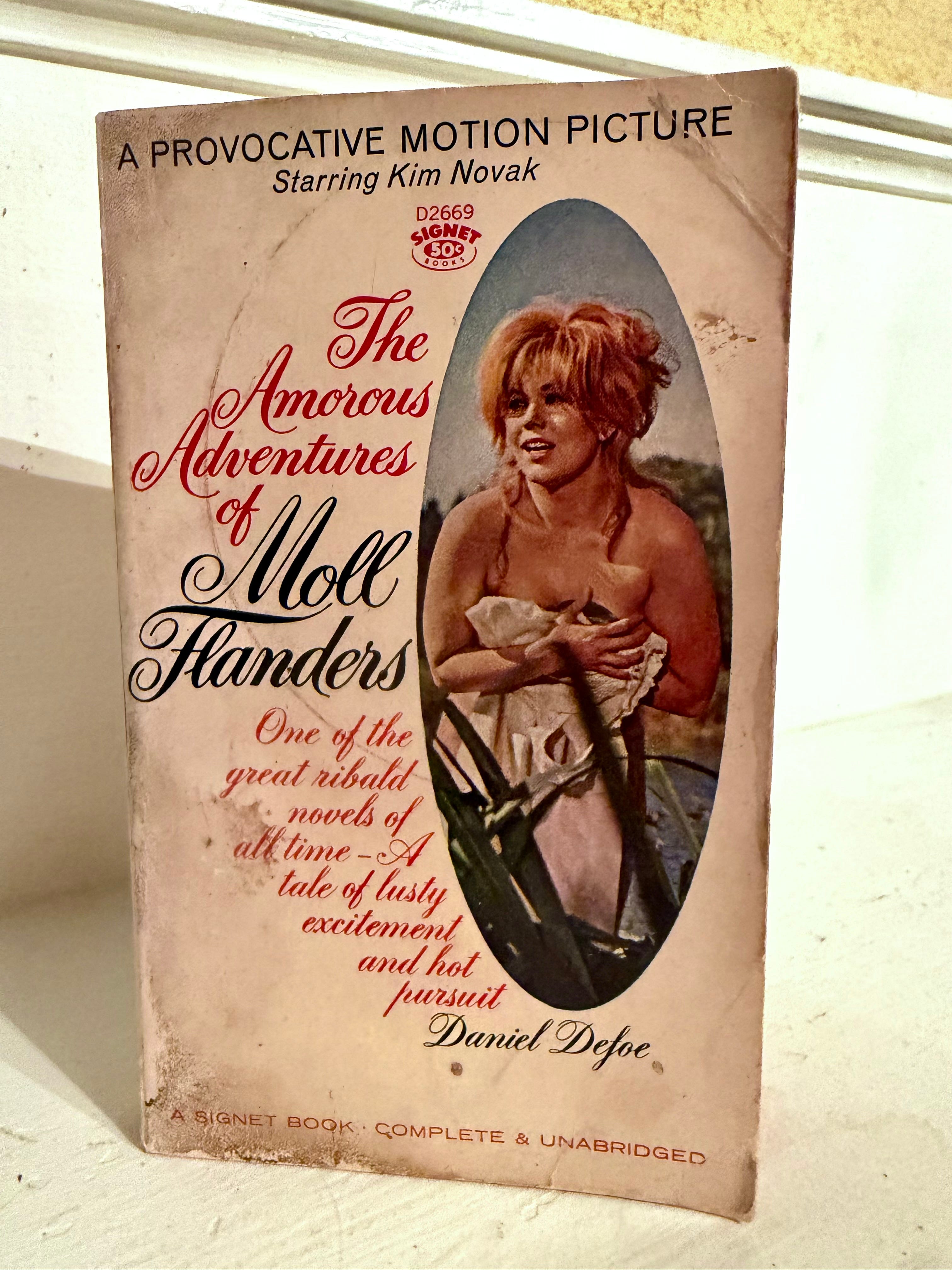
A lot more happens in this final section than I remembered. I wish I’d broken this week’s reading into two weeks! But, alas, here we are. We will cover the end here, but I’ve decided that I will do one more post on Moll Flanders next week by offering a few perspectives on the work (and Defoe) from literary critics. So many have you been engaged enough in our discussion that I think you will enjoy that. You’ve earned another week with Moll after the reading has finished!
Since so much does happen here, let me do a quick recap before commenting on some of the most significant aspects of this last (non)chapter of Moll’s story.
First, Moll nearly gets caught stealing on Christmas day. She is smart enough to outwit everyone, but she comes close. It seems she is slipping in her older age—as happens to us all. Then three days later, she is—unceremoniously and anticlimactically—caught. She is taken to Newgate, “the place that had so long expected me, and with so much art and success, I had long avoided.” There Moll sinks deeper and deeper into melancholy and despair but is delighted and shocked to find her Lancashire husband, Jemy, is at Newgate, too. They are reunited, transported to Virginia where she discovers her mother has died, her brother/husband is still living, and she joyously sees the son she left there. She and Jemy settle within the colonies and unbeknownst to him, she reunites with her son, who lets her know her mother has left her a great inheritance. Following the death of her husband/brother, Moll and Jemy return to England in old age and with great wealth. They “resolve to spend the remainder of our years,” Moll writes in the last line, “in sincere penitence, for the wicked lives we have lived.”
Whew! That is a lot. Even so, there is much I left out. But less important than all the events are the themes.
A central theme in this section is the same as that throughout the book: the need for and nature of true repentance.
While at Newgate, Moll experiences, at first, false repentance (that is, being sorry she got caught):
Then I repented heartily of all my life past, but that repentance yielded me no satisfaction, no peace, no, not in the least, because, as I said to myself, it was repenting after the power of further sinning was taken away. I seemed not to mourn that I had committed such crimes, and for the fact as it was an offence against God and my neighbour, but I mourned that I was to be punished for it. I was a penitent, as I thought, not that I had sinned, but that I was to suffer, and this took away all the comfort, and even the hope of my repentance in my own thoughts.1
The prison “ordinary” (what we’d call today the chaplain) comes to Moll, but he turns out to be a drunk. He tells Moll that God will not forgive her without a full confession and we learn later that it is his job to get prisoners to confess so that their confessions can be used against them.
It’s interesting that Defoe includes this portrayal of a corrupt clergyman because he offers a pointed contrast in the minister that comes and does lead Moll to true repentance. Moll’s friend and governess request him to come, and several pages of the narrative are spent in describing not only what true repentance can look like but also how a true minister of the gospel can help lead someone to it. This is Defoe at his theological best. The minister shares scripture with Moll, prays with her, and is kind and comforting.
This honest, friendly way of treating me unlocked all the sluices of my passions. He broke into my very soul by it; and I unravelled all the wickedness of my life to him. In a word, I gave him an abridgment of this whole history; I gave him a picture of my conduct for fifty years in miniature.
I hid nothing from him, and he in return exhorted me to sincere repentance, explained to me what he meant by repentance, and then drew out such a scheme of infinite mercy, proclaimed from heaven to sinners of the greatest magnitude, that he left me nothing to say, that looked like despair, or doubting of being accepted; and in this condition he left me the first night.
… I am not able to repeat the excellent discourses of this extraordinary man; ’tis all that I am able to do, to say that he revived my heart, and brought me into such a condition that I never knew anything of in my life before. I was covered with shame and tears for things past, and yet had at the same time a secret surprising joy at the prospect of being a true penitent, and obtaining the comfort of a penitent—I mean, the hope of being forgiven; and so swift did thoughts circulate, and so high did the impressions they had made upon me run, that I thought I could freely have gone out that minute to execution, without any uneasiness at all, casting my soul entirely into the arms of infinite mercy as a penitent.
Of course, Moll is not executed, nor is Jemy. In fact, one moving aspect of Moll’s repentance is her sorrow over her part in leading Jemy astray in encouraging him to the criminal life that led him to Newgate, too.
As rough and spotty as this narrative overall can be, Defoe circles back on a few things and includes some neat parallel points of the plot, too.
In Newgate, Moll dons another disguise, this time in order to see if the man rumored to be among the highway men imprisoned was Jemy. She pretends to be one of the victims of their robbery and confirms it is indeed Jemy. So disguised, she is able to reunite with him and during this conversation, they repeat almost exactly their discussion when they married, assuring each other that they are not seeking from the other money or fortune.
Later, Moll and Jemy “take stock” of all they have, as Moll does continually throughout the story, while they await transportation to Virginia. At the end, when Moll reveals all her riches to Jemy, he is amazed.
“Well,” says I, “what do you make of all that?” “Make of it?” says he; “why, who says I was deceived when I married a wife in Lancashire? I think I have married a fortune, and a very good fortune too,” says he.
Moll’s reunion with her son in Virginia is tremendously moving, the most emotionally-laden scene in the entire book, more so because at her first sight of him, she is not yet ready to reveal her identity to him.
Speaking of revelations, it is notable how shrewd Moll continues to be all the way to the very last pages in terms of telling the whole truth. To be sure, she has plenty of reasons for not revealing what she does as long as she does, but it seems pretty clear that she remains more shrewd than repentant up until the very end when she has nothing to lose and is certain to live the rest of her days in great comfort.
Defoe’s insight into a truth of human nature points to one of the tensions underlying the entire narrative. That truth is that we are made to share our griefs and joys with others. In reflecting on her failure to tell Jemy everything at first and his suspicion that something is wrong, Moll observers,
… let them say what they please of our sex not being able to keep a secret, my life is a plain conviction to me of the contrary; but be it our sex, or the man’s sex, a secret of moment should always have a confidant, a bosom friend, to whom we may communicate the joy of it, or the grief of it, be it which it will, or it will be a double weight upon the spirits, and perhaps become even insupportable in itself; and this I appeal to all human testimony for the truth of.
We are made to tell our stories to one another. In the modern age, we forge our identities by telling stories that show who we are, first to ourselves, then to others.
Even though Moll Flanders is fiction, it is a fiction that is based on this truth. Moll needs to tell her story. So she does.
Postscript:
I couldn’t find a way to fit this in above, but I did want to point out that when Moll is given a “Negro servant” in Virginia, that does mean an enslaved person. It’s mentioned only in passing here, but as I describe in more detail in The Evangelical Imagination, for Defoe, slavery was something he didn’t seem to question, especially in Robinson Crusoe. In that regard, he was a “man of his times.”
In reflecting on this, it occurs to me that we should read Olaudah Equiano’s An Interesting Narrative as we move along in the eighteenth century. In fact, let’s definitely do that.
I was reviewing Frances Burney’s Evelina as well. That would be one of the longest reads we’ve done (about 300 pages), but I’m game if we go slowly. (I am writing a book this fall!) I like the suggestion made presenting this as a work of interest not only in its own right but as one that Jane Austen read.
We’ll do some poems and perhaps a play, too. There are lots of great poems to cover in this half of the eighteenth century. I just need to take a few weeks to reset and move into fall. We definitely can stay in the eighteenth century a little longer. Please offer your response to these suggestions in the comments!
***
I have a column at The Dispatch this week. Here’s a gift link to the entirety. And here’s a snippet to tempt you:
When I began teaching literature at an evangelical Christian university almost 30 years ago, one daunting task I faced was introducing my bright-eyed, biblically trained, often sheltered undergraduates to modern schools of thought that undergirded some of the literary works I assigned. One of these was absurdism.
It was important at that time for my students to understand this philosophy in order to better appreciate the literature we’d be reading. It’s even more important now—especially for Christians—to understand absurdism so as to recognize how it is playing out today in real life.
“Absolutely unmixed attention is prayer.” – Simone Weil2
[Note: As an Amazon Affiliate, I may receive a small commission for qualifying purchases made through links here.]
It occurs to me in re-reading this passage how misguided Moll (and perhaps Defoe) would think evangelism efforts that emphasize the avoiding suffering in hell are. Here, Moll suggests true repentance is not about avoiding suffering as result of the harm we’ve done, but repenting simply for the harm we’ve done.
Simone Weil, Gravity and Grace, trans. By Emma Crawford and Mario von der Ruhr (London: Routledge, 2002), 117.
Comments
Nothing yet. Say the first thing.
Sign in to join the conversation.