
Last week I showed you what conditional love does to your body — the cortisol, the vigilance, the exhaustion that never fully clocks out (catch up on that post here).
This week I want to go back further than my own childhood to dive into what generational trauma looks like. And if you’re a trauma survivor, and many of us are, I’m wondering if you’ve done this deep dive looking at your family in the cultural and historical influences that shaped them. Because the unpredictability I grew up inside of didn’t start with me, and maybe it didn’t start with you either. It didn’t even start with my parents, not really. It started on a dirt road out of a city they were forced to leave — and then, for my mother, it happened again.
As I’ve shared before, my mother was a controlling, malignant narcissist, and it’s only recently that I found the right words to describe exactly who she’s always been. Her need to control and rule over her kids and grandchildren was second to none, and she was ruthless about it. As a child, I noticed that whenever we traveled back to India to spend time with her parents and our extended family, the control intensified until I felt genuinely terrorized — more than once — for simply being a kid. I remember my uncle’s wedding, I was about eleven, and I was being stubborn about wanting something, the way kids can be. My mother slapped me so hard in front of our entire extended family, she almost knocked me to the ground. The sting of shame I felt in that moment marked the beginning of a lifetime spent petrified of upsetting her, walking on eggshells, never sure which version of my mom I’d get on any given day. Now, in my 50s, since cutting off contact with her and with her recent passing, I’ve finally had the space to ask why. In conversations with my cousin, we’ve traced the dysfunction back further than either of us expected — to my mother’s childhood, and to my uncle’s, her brother.
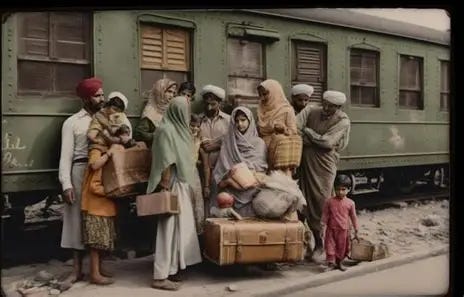
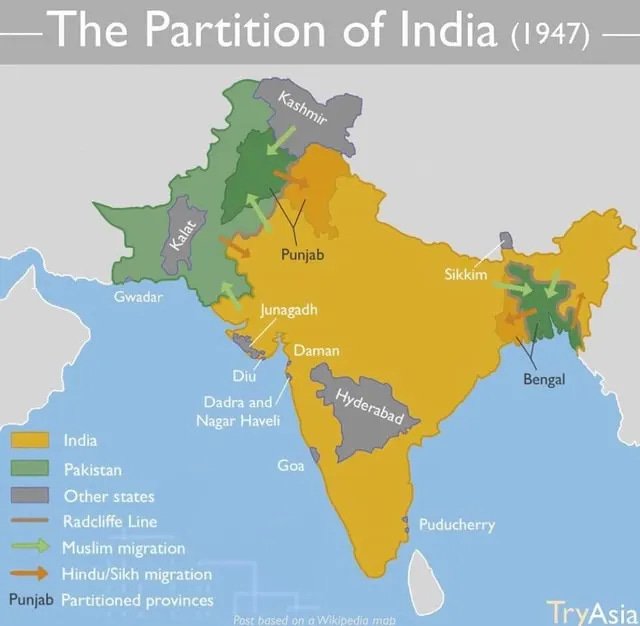
My mother was two or three years old when her family fled Lahore during Partition — when British rule ended in India and the country split into two in 1947: India and Pakistan. It’s hard to overstate the scale of what that actually meant: as many as 14-16 million people were displaced on foot, in bullock carts, and by train, amid riots and violence that killed anywhere from 200,000 to two million people, with women in particular targeted as symbols of community honor.
My mom was too young to have language for what happened to her and her family, which almost makes it worse — the body absorbed a rupture the mind was never old enough to make sense of. My father was twelve or thirteen when his family also had to leave, but his journey looked different. My grandfather was a magistrate under Lord Mountbatten, and that position carried security and resources most families fleeing at the same time didn’t have. Two children, from two unconnected families, living through the same historical rupture in almost opposite conditions — one stripped of any safety, the other cushioned by it.
But my mother’s ground didn’t just shift once. When she was fourteen, her older brother died — he fell from a cliff on a safari trip with their father and brothers. My maternal grandfather was an Ayurvedic doctor, a botanist, a wildlife documentary filmmaker, and the author of more than seventy books on nature and wildlife — a man whose wildlife conservation work and botanical research made him world-renowned. And still, on that trip, he couldn’t protect his own son.
The loss altered my mother and her three surviving brothers permanently. It altered my grandmother in a way that never healed — she never forgave my grandfather for taking her sons on that trip in the first place. I don’t know if she ever said so directly, or if it just lived in the house as a silence nobody could name. Either way, my mother grew up twice-displaced: once from a homeland at two years old, and again from a brother, and from a mother who may never have fully returned from her own grief. Two ruptures, stacked on top of each other, in a girl who hadn’t even finished growing up yet.
I didn’t understand until recently how much that might explain about the different shapes control eventually took in our home.
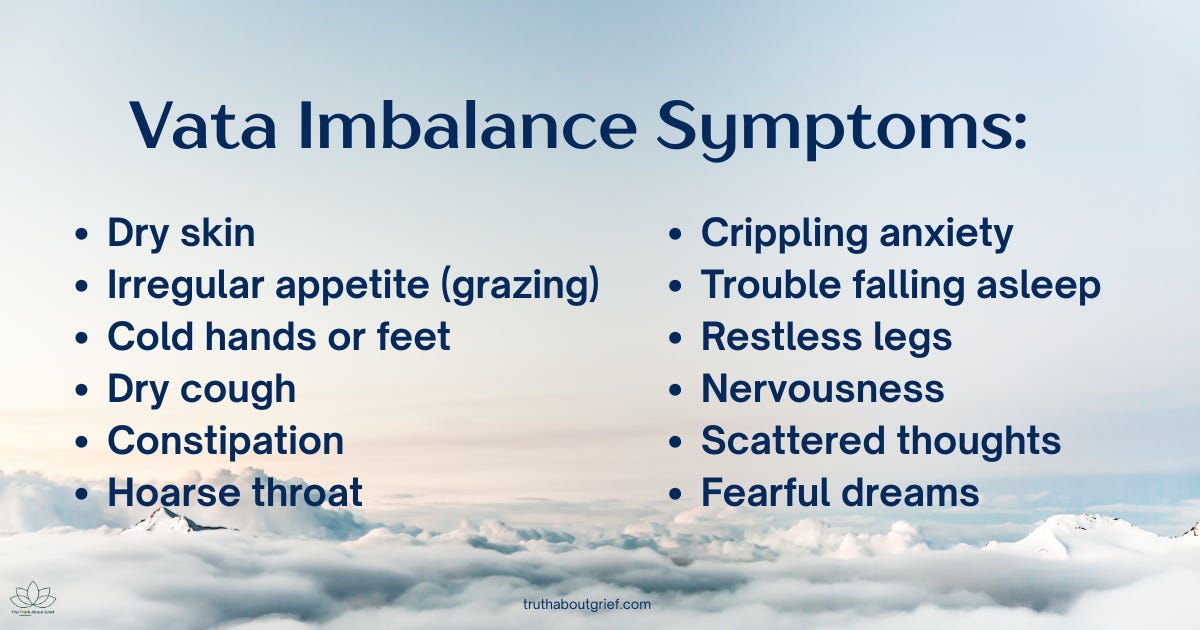
In Ayurveda, Vata is the qualities or “dosha” of air and movement — the force behind change, motion, and the nervous system itself. In balance, Vata gives us adaptability and quick thinking. Out of balance, it shows up as anxiety, irregular sleep, digestive unpredictability, racing thoughts, and a nervous system that struggles to find “still.”
Vata is aggravated by exactly what my mother lived through, twice: sudden change, loss of home, loss of a sibling, loss of a mother who was emotionally present in body but not fully in spirit. A childhood interrupted that many times doesn’t just create memories — it can leave a constitutional imprint, a nervous system calibrated toward instability before it ever had the chance to calibrate toward safety.
I believe that imprint didn’t disappear when she became a mother. I believe it became the reason control mattered so much in our house. If your own ground was taken from you — twice, before you’d even finished becoming yourself — control isn’t cruelty. It can become the only tool you have left to build something that finally feels solid. My father’s more protected journey may explain why his form of control looked different — less panicked, more procedural, values instilled rather than urgently defended. Two different nervous systems, two different parenting styles, built on top of ruptures neither of them chose.

None of this excuses what it cost me. It contextualizes it. I grew up always scanning — reading the mood in a room before I spoke, adjusting myself to whichever version of my mother I’d find in front of me that day. I didn’t know then that I was living inside someone else’s unfinished grief, shaped by ruptures that happened decades before I was born. I only knew that the ground under me never quite felt solid either.
Every holiday, birthday, anniversary, and milestone had to be about my mother — she held the cards on how the day would unfold, and if it didn’t go according to her plans, the whole occasion was ruined. As children, my cousins and I learned to brace for whatever wrath the day might bring. It’s little wonder so many of us have gone on to struggle with thyroid conditions, metabolic issues, mental health issues and skin disorders — the body keeping score long after the milestone dates were over.
That’s the quiet cruelty of inherited Vata: it doesn’t ask permission before passing itself down. A parent doesn’t hand you a story about Partition, or a brother lost on a cliffside, or a grandmother’s unspoken grief — they hand you a nervous system already tuned to instability, and yours learns the same frequency without ever being told why.
This week, notice where in your body you brace before you know what you're bracing for — walking into a room, hearing a certain tone of voice, checking a phone before you read the message. That anticipatory bracing is Vata in motion. You don't have to fix it yet. Just notice how old that reflex actually is, and consider that it might not have started with you at all. This one realization is the starting point to begin healing generational trauma.

Next week: we turn from where this came from to where it can go — the loyalty, the guilt, and the specific practices that have been proven to help heal generational trauma for good. Stay tuned.
This month, we’ve named what it costs to survive a family that treated you as property instead of a person and we explored last week the cost on your biology, your body. And now this week, we've traced that cost back further than any of us usually go. Underneath it is grief: grief for the ground your parents never got to stand on, to feel safe, and grief for the ground you were never handed either.
That’s exactly what The Truth About Grief Circle is for this month.
Paid annual subscribers are invited to:
A live Zoom gathering — September 15, 7:00 PM EDT — where we’ll talk openly about the grief of surviving generational and cultural narcissism (or anything else weighing you down). Cameras are always optional; you can also participate by just listening in if that’s all you’d like to do.
A private 1:1 mini-session with me
Both of my e-books on complicated grief, betrayal, and family estrangement
If you’ve been carrying generational trauma and layered grief, this circle is where you can begin to unpack all of it. I’d love to see you there.
Become a paid annual subscriber → click here.

Sending peace and love,
Karen xo 💜
P.S. If this post spoke to you and you know someone who needs to read it, share it with them. It’s free to read, and it just might be the one thing that helps them begin to make sense of their lifelong trauma.
Thanks for reading The Truth About Grief! This post is public so feel free to share it.
Before you go, please take a moment and help me out with this week’s poll:
Comments
Nothing yet. Say the first thing.
Sign in to join the conversation.