

At some point in the last decade, cutting off a family member stopped being a last resort — the agonizing, necessary decision of someone who had truly exhausted every other option — and became repackaged as something else entirely. Something clean. Something brave. Something you could post about.
It got a new name. Setting boundaries. It got an aesthetic. It got a community of strangers on the internet cheering it on. It got a therapist who validated it, a best friend who encouraged it, a forty-five second reel that told you anyone who makes you uncomfortable is toxic — and anyone who is toxic deserves to be cut off.
And somewhere in that repackaging, something important got lost.
This is not a post about whether estrangement is ever justified. It is — sometimes it is the only sane response to an impossible situation, and I say that as someone who has lived it. This is a post about what happens to a culture that has made exiting feel like the only available tool. That has dressed avoidance in the language of healing. That has confused the relief of leaving with the work of actually getting free.
“There is a difference between a boundary and a wall.
A boundary says: this is what I need to be safe. A wall says: I will never be hurt again. One is self-protection. The other is self-imprisonment dressed as strength.”
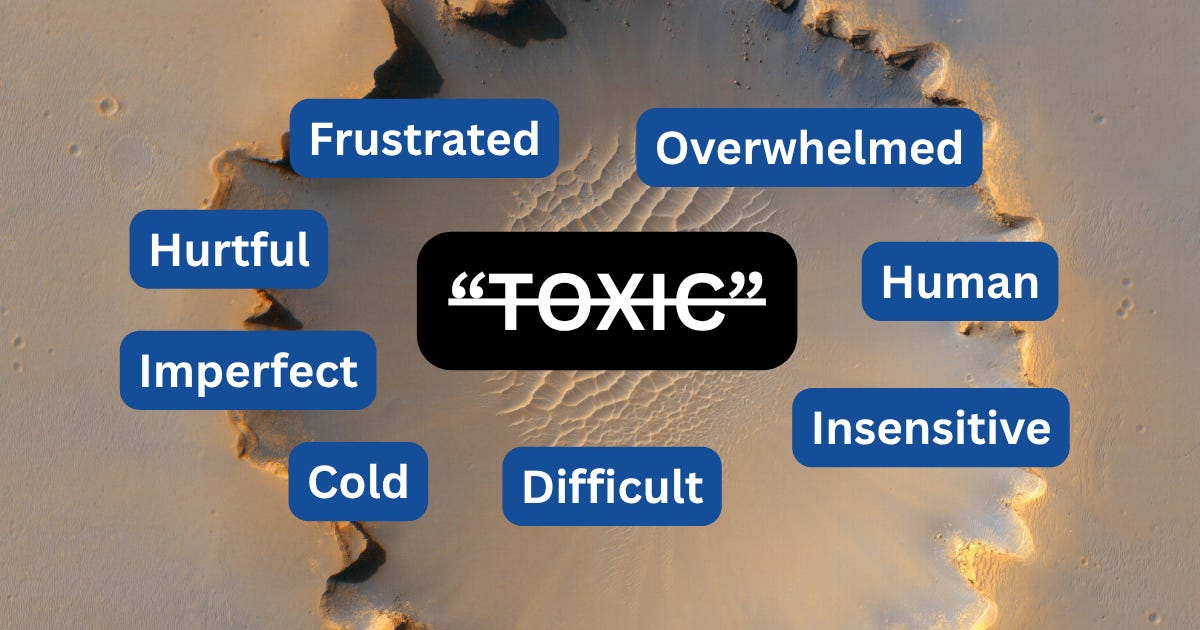
The word toxic has done a lot of heavy lifting in the last ten years.
Once a clinical descriptor for genuinely dangerous relational patterns — abuse, manipulation, coercive control — it migrated into everyday language and lost its precision entirely. Now it describes anyone who disagrees with you at Thanksgiving. Anyone whose parenting style differed from what you needed. Anyone who failed you in ways that were real but human. Anyone who makes you feel bad — which is not the same, not even close, as anyone who is actually harming you.
When everything is toxic, nothing is. When every difficult relationship becomes a clinical emergency, we lose the capacity to distinguish between the ones that genuinely cannot be salvaged and the ones that are simply hard. And hard relationships — the friction, the rupture, the repair — are precisely where most of our psychological and spiritual growth happens.
I’ve seen this up close, both personally and in my practice. I work with people at midlife whose adult children have walked away — because they were “too much,” because the generational cycle of “toxic abuse” apparently had to be broken. And when you dig into what actually happened? Hurt feelings. A disagreement where one side couldn’t see the other. A parent who asked too many questions, cared too loudly, or simply failed to be everything their child needed them to be. Whatever happened to holding space for healthy disagreement, mutual introspection, empathy — and the love that’s supposed to soften all of these hard feelings?
Here is what the algorithm serves someone who is hurting and searching:
Forty-five second videos telling them their pain is entirely someone else’s fault. Comment sections full of strangers validating their worst impulses. Echo chambers where leaving is always heroic and staying is always weakness. A curated feed that reflects their current emotional state back at them, amplified and unchallenged, until it starts to feel like truth.
This is not healing. This is a mirror that only shows you what you already believe, turned up to full volume.
The stranger in the comments does not know your mother. Does not know what she survived, what she carried, what her own mother carried. Does not know what she was trying to give you — however imperfectly, with the only tools she had. From her level of awareness at that time, and maybe she’s doing some inner work. And yet their verdict carries the full weight of consensus: cut her off, she’s toxic, you owe her nothing.
We have outsourced some of our most consequential relational decisions to people who know nothing about us except the story we told in our worst moment.
I’ll never forget the day a client showed me the reel her estranged daughter had sent her before walking out three years earlier. A therapist on Tik Tok, coaching adult children to “teach their toxic moms a lesson” — to break the generational curse of abuse. The notable abuse in this case? A mother who asked her daughter five times to clean her room. That mother was sitting across from me, devastated and bewildered, having simply tried to instill good habits in a twenty-year-old still living under her roof. The reel had thousands of approving comments. Not one of them knew her name.
I believe there is a quiet anti-family current running through our culture — one that has been fracturing families over the past decade or so, many now beyond meaningful repair. We are spending more time absorbing the opinions of complete strangers online than having real conversations with the people sitting across the dinner table from us. And we are paying a price for that none of us have fully begun to reckon with.
This one is uncomfortable to say. It is also necessary.
Not every therapist is a neutral presence in the room. Some bring their own unresolved family wounds — their own estrangements, their own unprocessed grief — directly into the therapeutic relationship without realizing it. A therapist who has not processed their own family pain is not well-positioned to help someone else navigate theirs with nuance, particularly when cultural, generational, and intergenerational dynamics are in play.
The result can be a subtle but powerful bias toward exit. Validation without sufficient exploration. Therapeutic cheerleading for separation that feels supportive in the short term and forecloses reconciliation in the long term — sometimes permanently.
Good therapy holds the full picture. It asks hard questions in both directions — not just what did they do to you but what do you bring to this, what will it cost you to go, have you sat with this long enough to be sure. It does not hand you a verdict. It helps you find your own.
I’ve experienced both kinds on my own healing journey. The good therapists broke me open — helped me see my shortcomings clearly, gave myself grace, and do the inner work so I could show up differently. The not-so-good ones kept me tethered to my pain, mirrored my narrative back without depth or challenge, and nudged me toward exit without ever helping me truly see the other side. I hear this story constantly from clients. Not all therapists, but more than enough.

There is a concept in Ayurvedic philosophy called tapas — often translated as discipline or austerity, but more precisely understood as the willingness to sit in discomfort long enough for transformation to occur. The heat of friction. The fire that purifies rather than destroys.
Tapas is not suffering for its own sake. It is the recognition that growth is not comfortable, and that the discomfort itself — if we stay present with it rather than flee — is the very mechanism of change. The oyster and the pearl. The fire and the gold.
A culture that has lost its capacity for tapas has lost its tolerance for the necessary friction of being in relationships with imperfect people. And all people are imperfect. Every family is. The question has never been whether your family hurt you — they did, in ways worth naming — but whether the hurt is the whole story, and whether leaving is the only possible response to it.
We have become very good at identifying pain. We have become far less practiced at sitting inside it long enough to discover what it is trying to teach us.
“Tapas is not punishment.
It is the willingness to be changed by what is hard — rather than simply escaping it.”
In the short term, leaving feels like relief. The absence of a stressor reads as safety. The nervous system exhales. And that exhale is real — in genuinely dangerous situations, it is everything.
But unmetabolized relational pain does not disappear when we cut off the person associated with it. It lives in the body. It shapes the next relationship, and the one after that. It creates a template — when this feeling arrives, I leave — that over time narrows the window of what is tolerable, what is survivable, what qualifies as safe enough to stay.
A generation that has learned to exit rather than work through difficulty is a generation accumulating unfelt grief in its nervous system. The estrangements multiply. The circle of tolerable people shrinks. And the original wound — the one that started all of this — never gets healed, because we keep leaving before the healing part begins.
The body keeps the score. And it keeps the tab.
Some relationships cannot and should not be repaired. That is true, and it deserves to be said plainly.
But there is a profound cost to a culture where leaving has become the first resort rather than the last. Where the vocabulary of healing has been conscripted into the service of avoidance. Where an entire generation is being counselled — by algorithms, echo chambers, and sometimes well-meaning but unexamined therapeutic voices — to mistake exit for freedom.
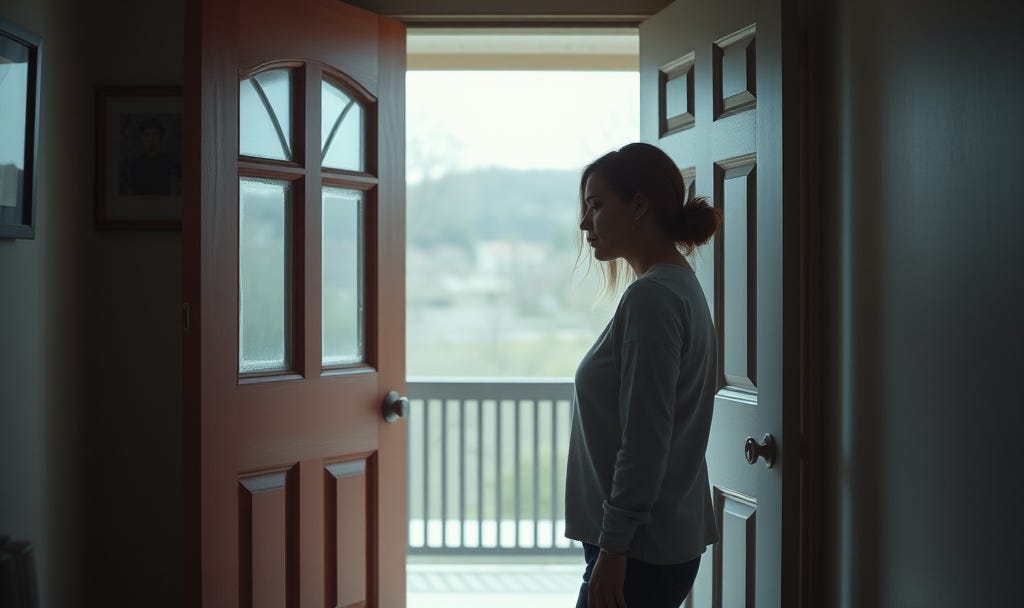
The people left behind know this cost intimately. The parents sitting with an estrangement they don’t understand. A door that closed without a conversation. A grandchild they have never met. Family members who were imperfect — undeniably, genuinely imperfect — but not dangerous. Not toxic in any clinical sense. Simply human, and now gone.
Repair is possible. Rupture followed by repair is, in fact, the foundation of secure attachment — the research is unambiguous. We learn to trust not by never being hurt, but by experiencing hurt and watching someone show up, acknowledge it, and try again. But both sides need to want to try again.
We need therapists who have done their own work. Algorithms that don’t profit from our pain. Friends willing to ask hard questions rather than only validate our worst moments. And we need, collectively, to recover some capacity for tapas — for staying in the fire long enough to be changed by it.
Because the relationships that transform us are almost never the comfortable ones.
Good. That discomfort, that trigger is worth paying attention to.
If any part of this cracked something open — if you found yourself in these pages, on either side of an estrangement you’re still not sure was inevitable — then you already know this work is yours to do. And you don’t have to do it alone.
Become an annual paid subscriber ($75) and receive:
A private invitation to join our Truth About Grief Circle via Zoom on Wednesday, July 15, 7-8 pm EDT. Come as you are, cameras are optional - a small, intimate space to be yourself.
A private mini-session with me.
When Grief is Complicated: Your Guide to Surviving Loss, Family Drama & Estrangement— e-book.
The Hidden Wounds of Grief: The Simple Guide to Decoding Your Symptoms, Healing from Loss, Family Drama/Trauma and Reclaiming Your Life— e-book.
Upgrade your subscription to paid here.
You have been carrying this quietly for long enough. And I feel your pain.

Sending peace and love,
Karen xo 💜
P.S. If this post spoke to you and you know someone navigating family estrangement, share this post with them. It’s free to read, and it just might help them feel less alone today.
Thanks for reading The Truth About Grief! This post is public so feel free to share it.
Before you go — here’s this week's poll. I genuinely want to know:
Thank you for being here. This one took courage to write, and it takes courage to read. Next week, we go to the place nobody wants to go: what it feels like to be the parent on the other side of a closed door — and why that grief is one of the most invisible of all.
Comments
Nothing yet. Say the first thing.
Sign in to join the conversation.