
Until recently, I thought the greatest danger posed by poppy seeds was getting one stuck between my teeth.
Then I learned that unwashed seeds can carry morphine and codeine residue, and that some people use them to create a drink capable of causing dependence, withdrawal, and death.
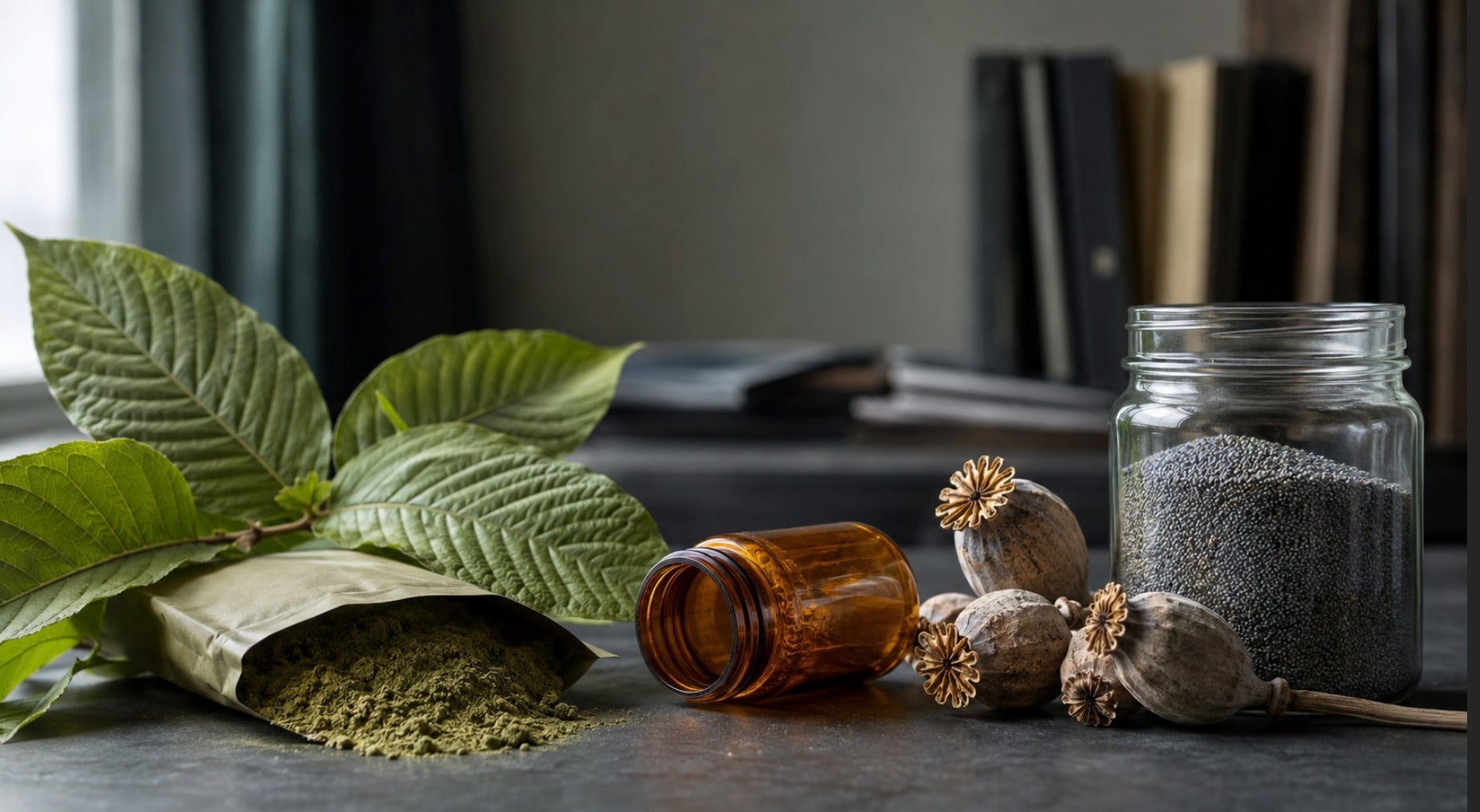
That discovery reminded me of kratom, a plant sold as a natural supplement even though its compounds act on opioid receptors.
Two ordinary-looking plant products. Two regulatory blind spots.
And one disturbing question: Why does America regulate substances by their names rather than by what they can do?
At first glance, kratom and poppy seeds appear to have little in common.
The first comes from a tropical evergreen tree native to Southeast Asia. Its leaves contain psychoactive alkaloids capable of producing stimulant-like effects at lower doses and opioid-like effects at higher ones.
Poppy seeds come from the opium poppy. Most Americans encounter them on bagels, muffins, breads, and pastries. Nobody looks at a poppy-seed muffin and thinks about morphine. Nor should they.
The Food and Drug Administration K(FDA) is not advising Americans to stop eating foods containing poppy seeds. The agency’s concern is far more specific, and much stranger.
The seeds themselves contain little or no opiate alkaloids inside. However, during harvesting and processing, residue from other parts of the poppy plant can remain on their outer surfaces. That residue may contain morphine, codeine, and other naturally occurring opiates.
Proper washing and processing can substantially reduce those residues. Unwashed or inadequately processed seeds may retain much more.
Some people purchase those seeds specifically to extract the residue into a liquid commonly called poppy seed tea. The FDA has linked that practice to serious medical emergencies and has received 11 reports of deaths purportedly associated with the homemade drink.
What looks like an ordinary food product can become something very different when it carries enough opiate residue and is deliberately misused.
We make sharp cultural distinctions between plants, supplements, medicines, and drugs. The human nervous system does not. It responds to chemistry.
Kratom’s primary psychoactive compounds interact with opioid receptors in the brain. Morphine and codeine residue on unwashed poppy seeds act on those receptors as well.
That doesn’t mean kratom, poppy seed residue, prescription painkillers, and heroin are the same. But they share an uncomfortable characteristic.
Repeated exposure can cause the body to adapt. Over time, some people need more to produce the same effect. If they suddenly stop, withdrawal can follow. That may include anxiety, sweating, insomnia, nausea, vomiting, diarrhea, muscle pain, restlessness, and powerful cravings. Withdrawal can be much worse for some than for others.
Physical dependence does not ask whether a substance came from a laboratory or a leaf. It does not care whether the package said botanical, natural, herbal, or wellness.
The body only knows that a chemical it has learned to expect is suddenly missing.
This product was once so obscure that many physicians and poison-control specialists rarely encountered it. That has changed.
According to a 2026 report published in JAMA, America’s Poison Centers recorded only 19 reports involving kratom in 2010. By 2023, that number had risen to 1,242 which is more than 65 times higher.
The severity of the reported exposures also increased. In 2010, none involved life-threatening effects, lasting disability, or death. By 2023, 158 did. Severe medical outcomes were documented in 13 percent of the kratom exposures examined.
In the most serious cases, adverse effects included seizures, dangerous heart-rhythm disturbances, respiratory depression, and death.
More recent figures are even harder to ignore. In a July 2026 health advisory, America’s Poison Centers reported receiving 3,803 exposure reports involving natural kratom or its many derivatives during 2025. During only the first six months of 2026, it had already received 3,190.
Those newer figures include kratom derivatives such as highly concentrated 7-hydroxymitragynine, commonly known as 7-OH, so they cannot be directly compared with every earlier data set.
But they demonstrate how rapidly the American marketplace is changing. Traditional kratom leaves are now sharing a name with extracts, enhanced powders, liquid shots, gummies, and highly processed products designed to deliver much stronger effects.
Consumers may see them all as different versions of the same plant. They’re not and their bodies may experience them very differently.
This is where the political argument becomes unusually complicated. Some people have used traditional kratom leaves or powders for years without continually escalating their doses. They credit the product with helping them manage chronic pain, remain productive, or move away from more dangerous opioids.
Their experiences are real.
But so are the experiences of people who became severely dependent, emptied their bank accounts, damaged their health, and endured withdrawal they could not manage without professional treatment.
Part of the conflict may arise because both groups use the word kratom while describing radically different products.
A traditional ground leaf is not necessarily equivalent to a concentrated liquid extract. Neither is automatically equivalent to a highly enhanced 7-OH product. Yet all may be presented to consumers beneath the reassuring umbrella of a natural plant.
The same problem appears with poppy seeds. Washed seeds intended for cooking are not equivalent to unwashed seeds carrying substantial opiate residue. A poppy-seed bagel is not equivalent to a concentrated liquid deliberately produced from contaminated seeds.
The differences matter enormously. Our laws do not always communicate them clearly.
Prescription opioids pass through a tightly controlled system. Their manufacture, dosage, distribution, labeling, and prescribing are regulated.
Kratom exists outside that system at the federal level. Depending on where someone lives, it may be prohibited, restricted by age, governed by consumer-protection requirements, or sold with relatively little oversight.
Unwashed poppy seeds fall into a different regulatory puzzle because poppy seeds are also an ordinary food.
The FDA is now studying opiate residue levels, processing practices, and potential safety standards for poppy seeds. The agency has said it intends to establish an action level for opiate alkaloids and specifically warns consumers not to make poppy seed tea.
But the marketplace has moved faster than the warnings. A person does not need to understand alkaloid concentrations, receptor activity, or the difference between traditional leaves and enhanced extracts to purchase these products. They only need money and a place willing to sell them.
That creates a system in which consumers are expected to distinguish among products that scientists, regulators, legislators, and even experienced users continue to argue about.
On July 1, 2026, Tennessee made its decision about kratom. Under Matthew Davenport’s Law, named after the young man who died from its use, knowingly possessing kratom became a criminal offense.
Manufacturing, delivering, selling, or possessing it with the intent to sell can bring felony charges. The law also requires testing for kratom in certain suspected overdoses, including fatal ones.
Supporters believe the ban will prevent addiction and remove dangerous products from stores. Opponents argue that it will eliminate something some people use for pain or as an alternative to more dangerous opioids.
They also warn that prohibition could drive the market underground which has been the case with other illegal drugs. Both concerns deserve to be taken seriously.
Removing kratom from gas-station shelves may prevent someone from casually purchasing a product they know almost nothing about. But a law cannot instantly eliminate physical dependence.
People who relied on kratom before July 1 did not wake up the following morning free from withdrawal. Their chronic pain did not disappear. Their bodies did not change because the legal classification did.
Other states are following Tennessee’s lead. Most notably is Michigan, South Carolina and Missouri.
A substance can become illegal overnight. Dependence cannot be legislated away on the same timetable.
America keeps trying to force this issue into two opposing positions. One side insists these products are natural medicines and that adults should be free to use them.
The other sees dangerous opioid-like substances and demands prohibition. Neither position adequately addresses the marketplace that exists between them.
Calling every kratom product harmless ignores evidence of dependence and serious medical outcomes. Treating traditional ground leaves, concentrated extracts, and enhanced 7-OH products as though they are identical ignores meaningful differences in potency and risk.
Likewise, frightening people about ordinary poppy-seed foods would be highly irresponsible. Pretending that unwashed seeds carrying variable amounts of morphine and codeine residue are no different from a supermarket baking ingredient would be equally misleading.
The choice does not have to be unrestricted sales or mass criminalization.
Lawmakers could require standardized testing, accurate potency disclosures, meaningful warnings, age restrictions, contaminant limits, distinctions between traditional and enhanced products, and accessible treatment for people who become dependent.
Those solutions are less emotionally satisfying than declaring a plant either miraculous or evil. They may also be more useful.
The word natural has become one of the most persuasive claims in American health culture.
It appears to promise purity, safety, tradition, and freedom from the dangers associated with pharmaceutical companies. But natural describes an origin. It does not describe a dose, a manufacturing process, a contaminant level, a drug interaction, or an addiction risk.
Morphine is natural. Codeine is natural. The active compounds in kratom are natural. So are countless substances capable of changing the brain, slowing respiration, producing physical dependence, or ending a life.
The problem is not that these substances come from plants. Nor is the answer necessarily to criminalize every plant capable of affecting human consciousness.
The problem is that America keeps allowing the word natural to substitute for the information consumers actually need. When a plant can behave like a drug, someone must take responsibility for explaining what it can do.
If manufacturers will not, regulators must. And if regulators cannot decide whether they are overseeing a food, a supplement, a medicine, or a drug, consumers are left to discover the difference inside their own bodies.
By then, the label may no longer matter.
No posts
Comments
Nothing yet. Say the first thing.
Sign in to join the conversation.