
If you knew me, you’d know that my historical interests are varied. I love popular culture—movies, television, consumer culture, and music. In fact, I’ve got a fully-researched book on hold right now that’s related to jazz, the Great Migration, and a tragic fire that bluesmen sang about, including Howlin’ Wolf.
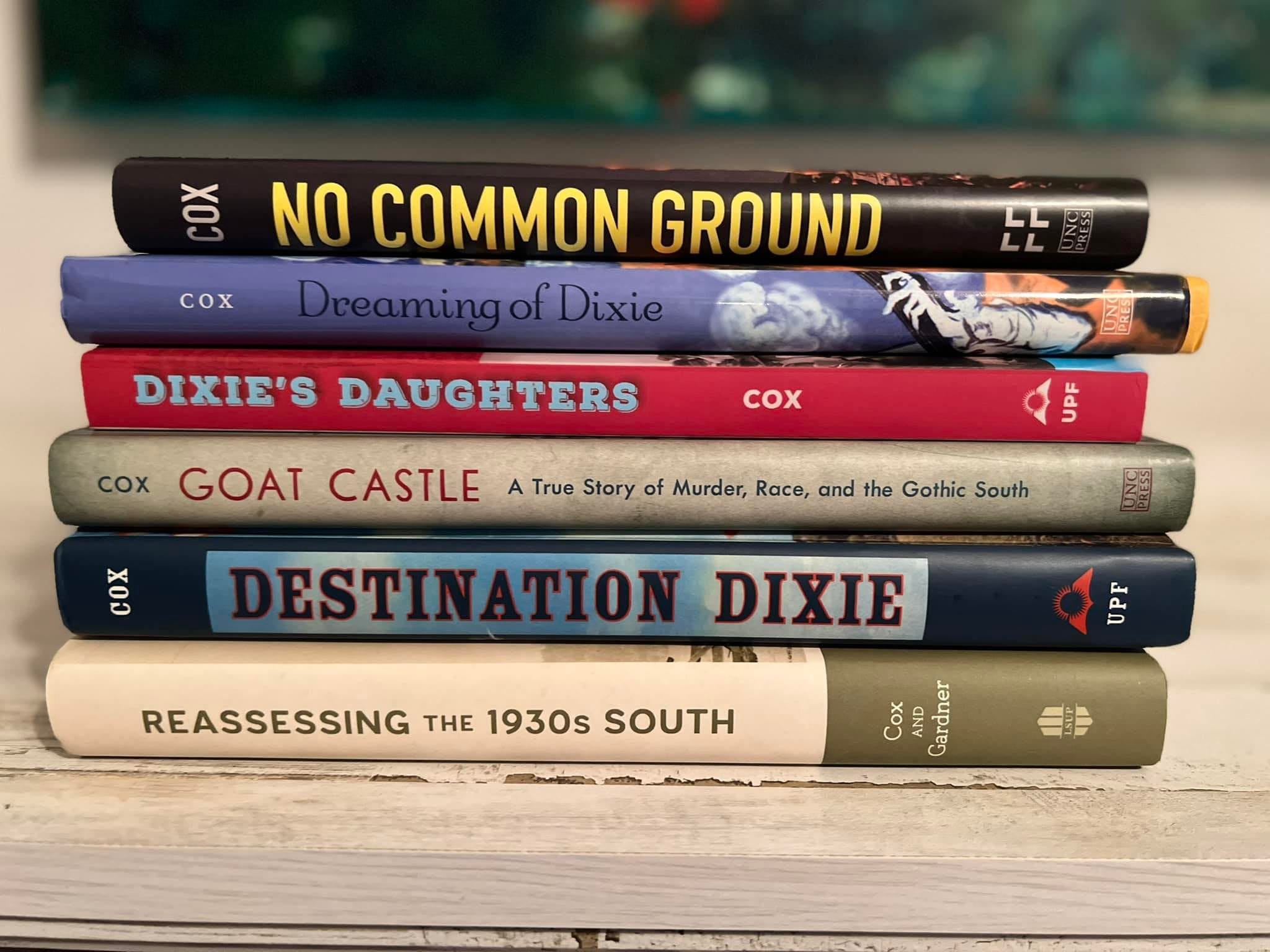
Much of my research involves Mississippi, more specifically Natchez. I wrote about a true crime that happened in Natchez in a book called Goat Castle: A Story of Murder, Race, and the Gothic South.
But it’s the Lost Cause that keeps calling my name and has since 1989, when I worked for a museum in North Carolina. Sad, but true. (Insert crying emoji here).
My first book? On the United Daughters of the Confederacy. My second book? Lost Cause adjacent. My most recent book? On the long history of Confederate monuments. An edited volume on tourism in the South? Scratch the surface and you’ll find . . . you guessed it, the Lost Cause. I’m currently working on another monograph about the Lost Cause.
I’m in documentaries speaking about the Lost Cause, including Henry Louis Gates’ Reconstruction: America after the Civil War (Episode 4), and the Emmy-nominated The Neutral Ground (“a film about sore losers”). You’ll see me this fall on Netflix, for better or for worse, talking about the Lost Cause in Ava DuVernay’s latest film, 14th. I’m even in a BBC show with Lucy Worsley called American History’s Biggest Fibs. Three guesses as to what I talk with her about; the first two don’t count.
The Lost Cause, however, is more than a trivial lie (a fib). It’s a false narrative that didn’t just whitewash slavery and the Confederate cause; it’s long been a white supremacy project. And I’ll keep saying that until I’m blue in the face.
The Lost Cause is not just something that softened the blow of Confederate defeat; it has actually done untold harm.
And as a white historian, but more importantly a white Southerner who writes from the vantage point of seeing the Lost Cause up close, I consider it my responsibility to write and speak about the harm it’s caused. It is past time for white southerners to speak up, and it is not fair for Black southerners to carry the water on this, because they are its victims.
This all came into sharp relief for me when Dylann Roof walked into Mother Emanuel AME in Charleston in 2015 and murdered nine Black parishioners because he wanted to start a race war. They were victims, in part, of Lost Cause thinking.
From that point on, I became more intentional in my approach to writing and speaking about the Lost Cause. While several historians were wringing their hands over what should be done, I wrote an op-ed—within days of the Charleston Massacre—saying that monuments do not belong on the landscapes of local and state government. I stand by that even today.
Yet the Lost Cause is not just about its symbols—the flags and the monuments. It’s an ideology/narrative/mythos that has sought to undermine racial progress even as it literally memorialized white men by erecting statues to them.
I’m here to call that out.
So, I will continue to write about the Lost Cause in this newsletter and elsewhere, to offer my expertise wherever needed, and to keep it real.
As a historian, and a white Southerner, I have to.
KLC
No posts
Comments
Nothing yet. Say the first thing.
Sign in to join the conversation.