
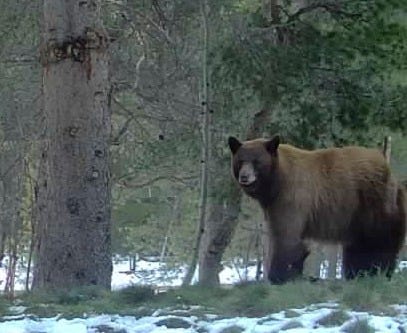
Text within this block will maintain its original spacing when published
The bear is a dark continent
that walks upright
like a man.
      ---"Bear" by Linda Hogan
Hello Lovelies—
Buckets of gratitude for reading A Woman’s Place Is In the Wild. I appreciate all of you who sustain and help me grow these weekly meditations by reading and commenting or sharing and supporting my work with a paid subscription. Your generosity means the world to me. Thank you for being here.
Did you know you can LISTEN to A Woman’s Place Is in the Wild? Click the play button on the upper right of your screen when you go to the page of this post.
Each weekly meditation of A Woman’s Place is in the Wild is an offering, an evocation of the world around me. You will rarely find me writing about climbing to the top of a mountain or counting the miles I’ve walked as if collecting notches on a belt.
Instead, I want to adventure in.
This is the kind of nature writing needed now, narratives of place—localities, with its root in the Latin, locus, for place—the kind that rise over time out of relationship, that allow us to understand that we are place, too. As the Scottish writer, Nan Shepherd says, “The first law of ecology is that everything is connected to everything else.”
This week, I offer my monthly Living Wild Creativity Practice—A Prayer for the Wild, a reciprocity practice for paid subscribers. If you can afford to support my Substack for as little as $7/mo and get access to my full archive, please do.
Last, if you are in the area, check out my Writing Wild Workshops in Rollinsville, CO.
26 August, Elokuu - Waxing Harvest Moon, Near the Eclipse of the Full Moon
I wake in the dark. 47 degrees this morning. The moon, tipping toward full is already down.
I feel suspended. Between day and night. Between summer and fall. Between this moment and what is to come.
My days shift with the beginning of the academic year, my time divided between teaching in town in a too hot classroom and refuge on the mountain. I feel the pendulum swing between aggravation and ease.
And worry.
Bears are having a hard year. In August they enter hyperphagia, a time when they are foraging and fattening, and their activity increases dramatically through September in preparation for hibernation.
Typically there are plenty of berries and grasses and forbs.
Not this year.
Drought, and sometimes wildfire, has greatly diminished these natural food sources, and some bears have increased their ranges in search of food. As a result, the number of human and bear encounters has doubled in Colorado.
Such encounters always end badly for the bear. Last week, a bear was tracked and killed after biting a man returning late from fishing.
I am choosing my words deliberately here.
I refuse to say “bear attack,” the phrase most often used to characterize what happens when a bear meets a human. Bear attack conjures images of teeth and claws, a viscous predator, a malevolent, stalking force, the stuff of campfire stories and lurid legends.
Nor will I repeat the DOW’s neutered terminology— “euthanized”—which makes the violence against the bear sound like a mercy.
In the bear stories in the news, bear is an animal, distinctly not human, so therefore, an other. It much easier to euthanize or, to use another phrase I’ve heard, decommission a thing whose inalienable rights or subjectivity we deny.
No subjectivity, no rights. It’s that simple. And in the deadly logic of objectification and othering, the “problem” bear can be killed.
In my own neighborhood, more human carelessness. There have been bear break-ins because food has been left unsecured (chicken eggs being “sold” from a refrigerator in a driveway and a jar of peanut butter stored in a yurt). I worry for the bear family, the one who visited in the spring. Once a bear learns to associate a place with food, she will return over and over
We are failing our kin. I use that word deliberately here. When I claim kin, then I claim a relationship that requires my attention and care. Our future lies in our ability to live with our more-than-human relations, to respect their lives as our own, to learn to co-exist.
There are certain trails in Boulder County that are closed during raptor nesting season, in the same way some trails are closed during moose calving season. Why can’t we close trails in August to let the bears, who are already stressed, roam? Why can’t all cities near bear habitat enforce bear-proof trash cans and bear-wise practices?
In Finland there is a beautiful story about the origin of Bear who was born “by the moon, beside the sun” in the cradle of Ursa Major and from there lowered by silver and gold threads to the earth to the Pine, her sacred home. In this story, Bear is a god.
When bear was hunted in ancient Finland, his skull was returned to the Pine so his spirit could ascend back into the stars.
This morning I go out to the ancestor pine in the yard, the place where I make offerings and where I have placed a small black bear to watch over my spirit kin, and where I placed the bear scat left on the trail in spring.
Here, I breath in Bear. I come from a Bear lineage and Karhu, the King/Queen of the Forest, he dwells in both my dreaming and waking worlds.
I think about how bear appeared in the yard—huge, magnificent—in the spring with her two cubs and a yearling—four bears in all. How she circled and faced me one dusk when I tried to shoo her from the yard, her cubs in the this same ancestor tree above her. I cannot say what transpired between us then, only that there was a deep recognition, a moment that flared into my awareness and then was gone.
I rest my mind on the bear family and all of the bears of this lineage on the mountain with the wish that they will find enough food to forage for what might be a deep and long winter.
Then I close my eyes and feel all of us in a great circle of being, one strand of the web of life, our bodies made from the same star stuff.
Here is where I find my hope. In the roots of these living beings, in the knowledge of my relationship with them, and in their lives lived alongside of my own, resolutely, fiercely, lovingly. In this beauty foraging in the woods, in the wildness that is bear and also me.
Let this week’s substack be my prayer:
I offer it to you and for Bear, my kin.
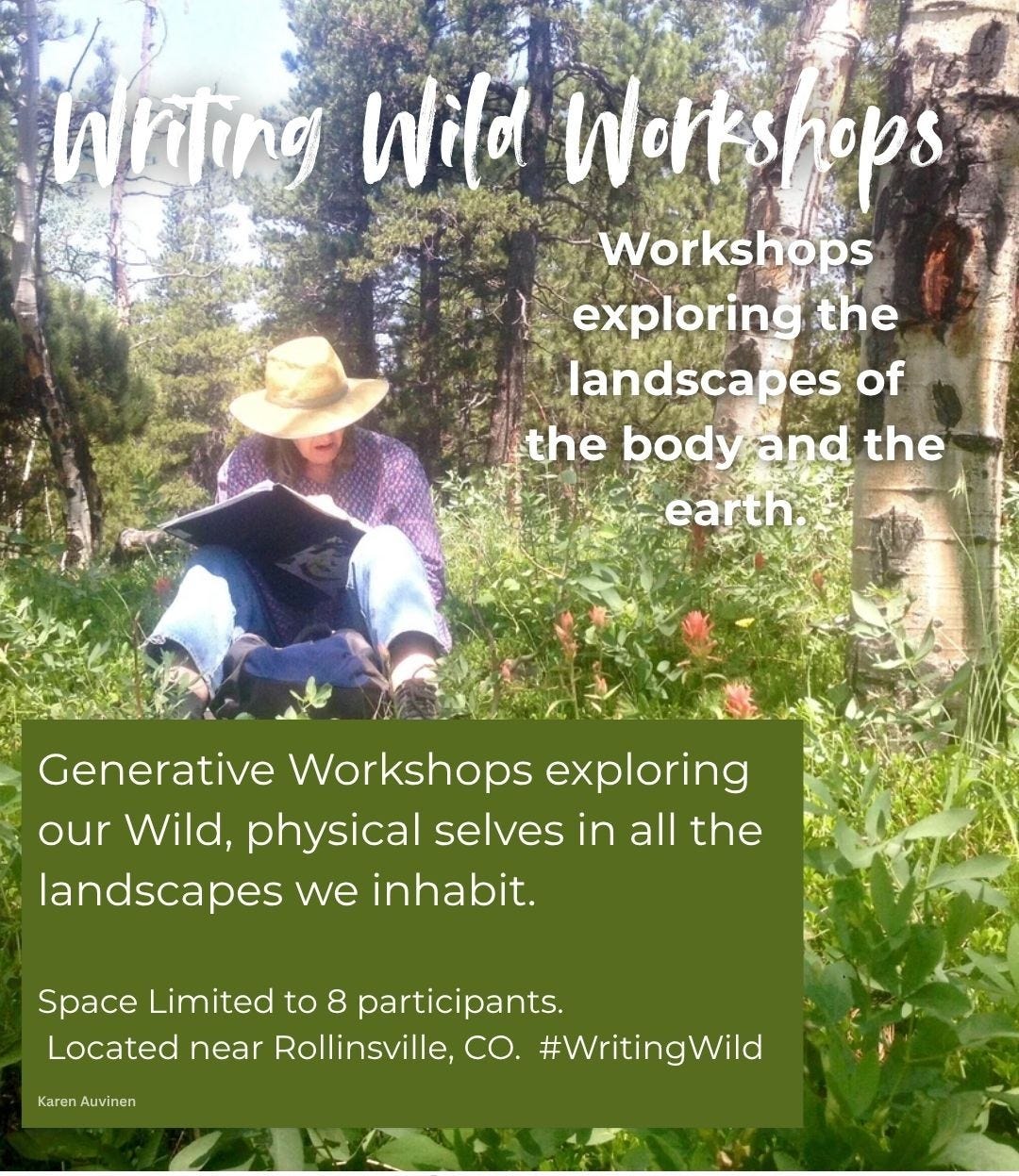
Sunday October 4th 10-3:30
As we prepare to enter enter fall, this daylong workshop focuses on not only helping your understand your own writing rituals (best times + places for inspiration, how to keep coming back to writing over and over) in order to help you feed your creative self, but also on inspiring some new ones. Plus, we’ll take a deep dive in the mystery with an intuitive inspiration hike and using tarot cards to help us access images, stories, poems swimming in our subconscious bodies and writing spells and incantations.
Sending you big love in this time of great change. Hold onto beauty, friends, and to each other. Carry hope. And practice being a good ancestor, practice loving the earth and each other, each day.
This week I offer a simple practice in reciprocity for our more-than-human kin along with a visualization of the great circle of being and all our bodies made from the same star stuff.
If you are a paid subscriber, read on. If you would like to support my Substack for as little as $7/ month, click below.
Please click heart if you appreciate this post and feel free to restack and share.
Big love,
Karen
This Week: Prayers for the Wild + Visualizing Kinship
Comments
Nothing yet. Say the first thing.
Sign in to join the conversation.