
Start with what was actually new last night. Trump has been claiming American elections are rigged for six years; that part is not news, and Arizona’s secretary of state said so in four words — “There is nothing new here.” What was new is what he was holding. Declassified intelligence. China, he said, carried out “the largest compromise of election data in history,” taking 220 million voter files. More than 250,000 non-citizens registered to vote across California, Pennsylvania, New Jersey and Nevada. Voting tabulators “extremely exposed to attack.” For the first time the fraud claim came dressed in the authority of the classification system — secret documents, now graciously unsealed for you. (NPR, Jul 16)
Now look at the documents. They are extensively redacted. The memo about the Chinese voter data — his own released memo — contains no evidence that China ever used that data to influence a voter or affect an outcome. The White House offered no method for the 250,000 figure; Nevada’s secretary of state called the numbers “wildly speculative at best.” A federal intelligence report from March 2021 had already concluded there were “no indications that any foreign actor attempted to alter any technical aspect of the voting process.” And Geoff Hale, an election-security expert, named the hinge the whole speech swings on: “claiming that vulnerabilities in voting systems exist is different from claiming that vulnerabilities in voting systems have been exploited.” A lock can be picked. That doesn’t mean your house was robbed. (NPR, Jul 16)
So the material is real and the conclusion isn’t in it — and the parts that would let you tell the difference are blacked out. Which is the exact structure the operator dissected in February, about a scandal with nothing to do with elections.
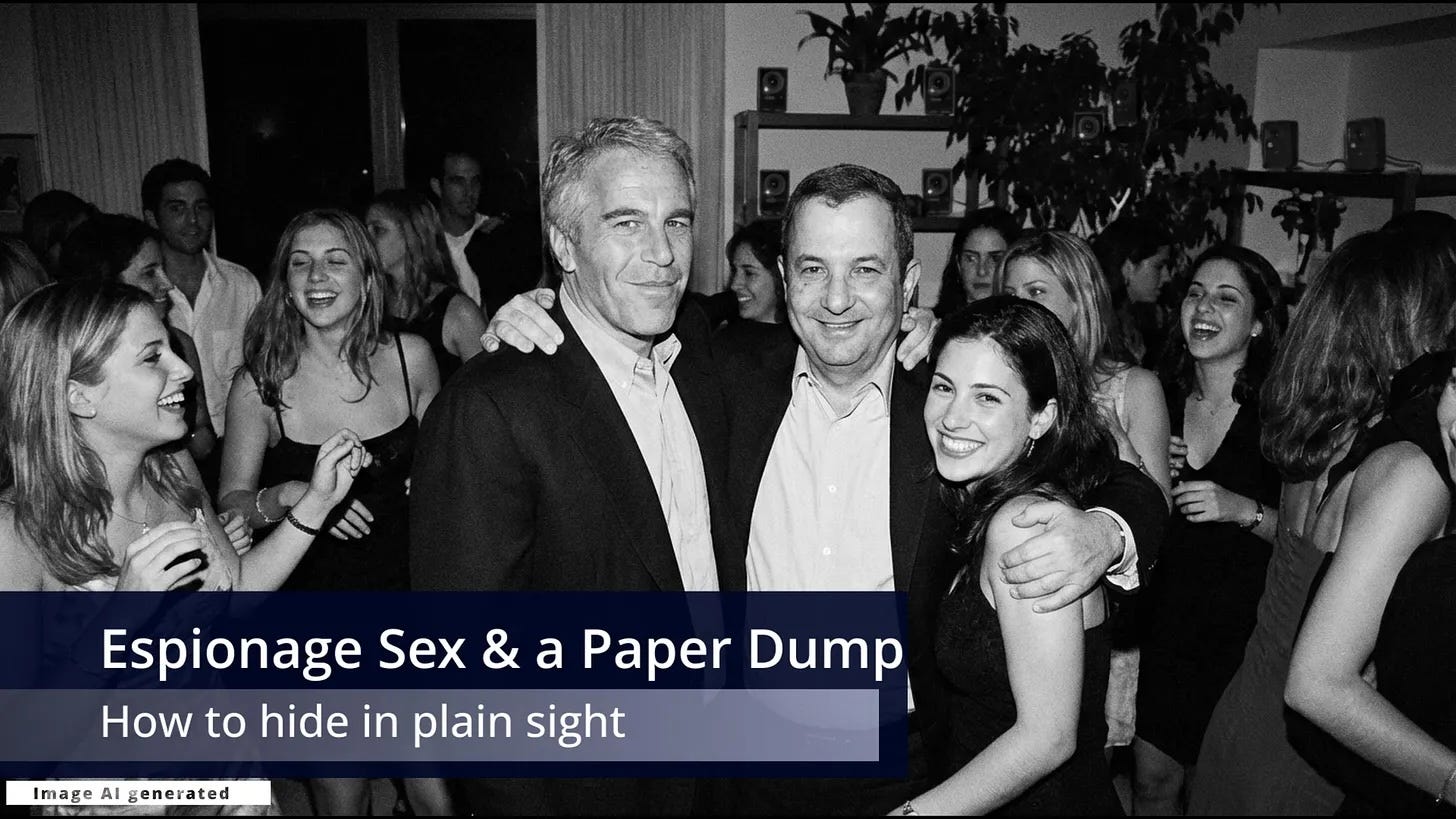
“The Epstein Files, Buried In Plain Sight” is not really an article about Epstein. It is an article about how a state controls what you are permitted to verify. Its opening move is to refuse the obvious question: “The conventional analysis treats this as a document disclosure to be mined for revelations about powerful men. The more instructive analysis examines what the structure of the release itself reveals — about who controls information, how volume becomes its own form of concealment, and why the how of disclosure may matter more than the what.” It reaches for Victor Marchetti’s tradecraft term, the limited hangout — “admitting, sometimes even volunteering, some of the truth while still managing to withhold the key and damaging facts in the case” — and notes why it works: “The public, however, is usually so intrigued by the new information that it never thinks to pursue the matter further.”
And here is the inversion that makes last night legible. In February the dial was turned all the way up: 3.5 million pages, dumped with “no sense of organization or context.” The essay does the arithmetic — 50 pages an hour, 70,000 hours, thirty-five years of full-time work for a single analyst — and concludes the asymmetry “is not incidental to the release’s design; it is fundamental to it.” Last night the same instrument ran at the opposite setting. Not too much to read. Too little. A handful of pages with the load-bearing lines blacked out. Opposite dials, identical output: a citizen who cannot check, and a state that has “satisfied” transparency anyway.
That is why the essay’s real payload is a question, not a revelation: it shifts the audit from what was releasedto “who chose what to release, and what was withheld and why.” Ask that of last night and the speech reorganises itself instantly. Who drew the black bars? The same government making the claim. Who is the one person on earth who could lift them tonight, in full, with a signature? The man at the podium. He has the sole authority to declassify, and he used it to declassify up to the line and no further. He isn’t showing you evidence. He’s showing you that he has evidence — and asking you to take the state’s word for the one thing a citizen is supposed to be able to check without asking anyone’s permission.
The essay closes on a line that was written about a document dump and reads, five months later, like it was written about a speech: “The architecture of this disclosure speaks more clearly than any document within it.” Read it, and you’ll have the thing the broadcast withheld — a worked standard for what an honest disclosure looks like, and the arithmetic proving the other one was a choice.
👉 The Epstein Files, Buried In Plain Sight: https://karat.substack.com/p/the-epstein-files-buried-in-plain
No posts
Comments
Nothing yet. Say the first thing.
Sign in to join the conversation.