
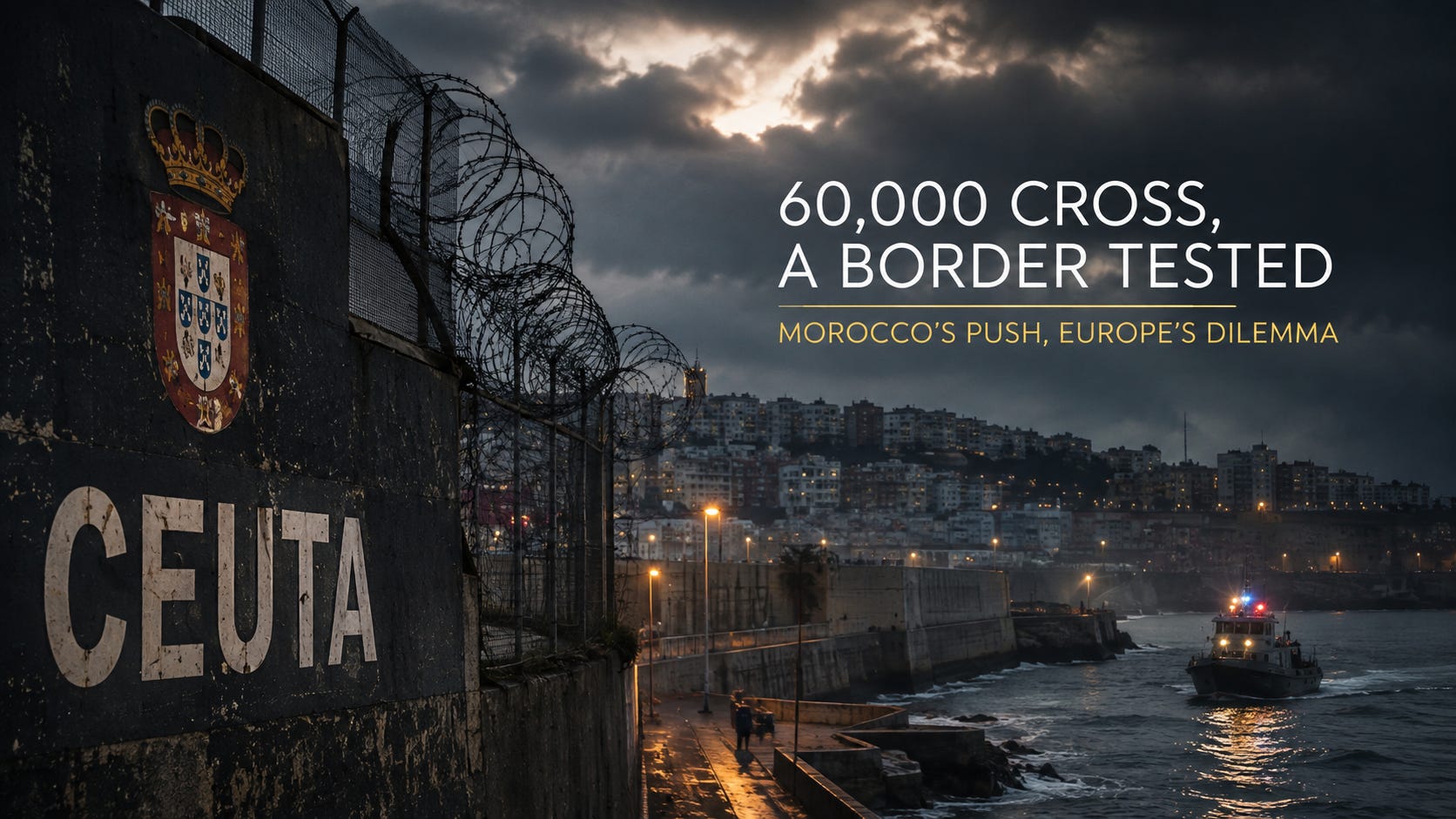
Sixty thousand people did not decide to cross into Ceuta on the same Wednesday by coincidence. Someone made a decision. The more useful question is who benefits, and the answer was published, in English, five months ago.
Let’s begin with the arithmetic, because the arithmetic is where the official story falls apart.
Between Wednesday and Friday of last week, somewhere between fifty and sixty thousand mostly young men crossed from Morocco into Ceuta, the seven-square-mile Spanish enclave on the North African coast. That figure equals roughly seventy percent of the city’s entire population. Spain’s prime minister called it an attack and a violation of the country’s territorial integrity, deployed the army, and watched the death toll climb, nineteen, then thirty-four, then fifty-seven, then sixty-seven, and by Sunday seventy-two, many drowned in the sea, others crushed against the Tarajal breakwater. Then, almost as suddenly as they had arrived, more than forty-eight thousand of them returned to Morocco within forty-eight hours.
Hold that number in your mind and ask the question no wire report asked. How do sixty thousand people, drawn from every part of a country, converge on a single stretch of border fence in 48 hours? A crowd that size does not assemble the way weather assembles. It is not a front moving across a map. It requires that people learn of a place and a time, that they travel, some of them hundreds of kilometres, that they arrive more or less together, and, above all, that the machinery of one of the most heavily policed states in North Africa decline to stop them. Every one of those conditions is a choice. And when a great many choices line up to produce a single outcome, the correct word for the result is not surge. It is operation.
This essay is an invitation to read the last week the way an intelligence analyst reads a cable. Avod the emotional surface, which is being manufactured for you, but look for the structure underneath. The surface says migration crisis. The structure says something colder: that a NATO member was punished for refusing to service a war, that the instrument of punishment were 60,000 men, and that the script for it was written and published in Washington last March. Once you see the structure you will notice that in the millions of words filed about Ceuta this week, almost no one connected the dates.
Let me give you the dates, but first:
The script
On the twelfth of March 2026, Michael Rubin, a senior fellow at the American Enterprise Institute and a former Pentagon official, published a commentary on AEI’s own website arguing that the United States should recognize Ceuta and Melilla as occupied Moroccan territory. Spain, he wrote, “remains a colonial power, running colonies across the Strait of Gibraltar on the northern coast of Morocco.” He invoked Trump’s first-term recognition of Moroccan sovereignty over the Western Sahara as the precedent to follow, and framed the whole matter as a favour Washington could grant and Madrid could not refuse.
Four days later, on the sixteenth, Rubin escalated. In a second piece, carried by the Middle East Forum, he stopped addressing Washington and began addressing Rabat directly. Morocco, he wrote, should gather, send bulldozers to the border, and enter Ceuta and Melilla unarmed to raise the flag, a conscious reprise of the 1975 Green March, when Hassan II sent 350,000 civilians walking into the Western Sahara. And then Rubin added the detail that turns an op-ed into a plan. He anticipated the obvious objection, that an assault on the enclaves would trigger NATO, and pre-empted it. Article 6 of the Washington Treaty, he noted, excludes territories south of the Tropic of Cancer. “Neither Ceuta, Melilla, nor the Canary Islands would trigger a NATO response,” he wrote, “just as NATO would not need respond to an attack on Hawaii or Puerto Rico.”
Read that again, slowly. A former Pentagon official, writing on the letterhead of Washington’s most influential foreign-policy think tank, laid out an operational method, mass unarmed civilians moving on the enclaves, and then lawyered the alliance’s non-response in advance. This is not the language of opinion. It is the language of someone who has thought about what happens on the day after, and wants you to know it has been handled.
If Rubin were an isolated crank, this would be a curiosity. He is not. On the first of April, Representative Mario Díaz-Balart, Republican of Florida, chairman of the House Subcommittee on National Security, and one of the closest congressional confidants of Secretary of State Marco Rubio, told the Spanish newspaper El Español that Ceuta and Melilla are not “in the geographic territory of Spain” but “in the territory of Morocco,” and that their fate “is established, negotiated, and discussed between friends and allies.” In six weeks, the annexation of two European enclaves had travelled from a think-tank op-ed to the mouth of the congressman who chairs the subcommittee that funds American diplomacy. That is not the fringe. That is the fringe being escorted into the building.
The motive, dated
Now lay the second timeline over the first, because the script did not appear in a vacuum. It appeared while Washington was already, openly, looking for a way to hurt Spain.
The grievance is a matter of record and Trump has never bothered to hide it. In March, Spain refused to allow the United States to use the jointly operated Rota and Morón bases for the strikes on Iran, with Madrid arguing the attacks lacked any basis in international law. Spain then closed its airspace to American aircraft involved in the campaign. Sánchez called the war an extraordinary mistake. And Spain had, separately, become the one NATO member to reject the alliance’s new five-percent defence-spending target.
For this, Trump promised punishment, not once, not vaguely, but repeatedly and by name. In October he threatened to make Spain pay “twice as much” in trade talks and added, “I’m actually serious about that.” In March, after the airspace refusal, he said Spain “has been terrible” and vowed to cut off all trade. In July, at the NATO summit in Ankara, he called Spain a “wasted cause” and a terrible partner: “Cut off all trade with Spain, please, including visits.”
Here is the problem Trump kept running into, and it matters more than it first appears. The trade weapon he reached for again and again is not his to fire. Trade policy for Spain is set in Brussels, by the European Commission, on behalf of all twenty-seven member states. A US president cannot tariff Spain alone; he can only tariff the European Union, which negotiates as a bloc and shields its members precisely so that no one of them can be picked off. Every time Trump threatened Madrid’s trade, he collided with the same wall: the collective is the shield.
So consider the shape of the problem as it sat on a desk in Washington in the spring of 2026. A president with a loud, public, year-long commitment to making one specific ally suffer. A conventional weapon, trade, walled off by the ally’s membership in a bloc. And, arriving in that exact window, a published proposal for a different kind of pressure: one that is uniquely Spain’s, that Brussels cannot intercept, and that comes with the NATO objection already neutralised. The border is the weapon that was left on the table when the tariff was taken away.
The tell
If you want to know whether the crossing was permitted or spontaneous, you do not need a leaked cable. You need only look at what the same state did the last time this happened, - or just a bit of common sense.
In September 2024, social-media calls went out to breach the Ceuta fence, and crowds gathered at Fnideq, the same border town, the same platforms, the same trigger. On that occasion, Moroccan riot police deployed in force and dispersed the crowds night after night. The attempt failed because the Moroccan state decided it would fail.
Last week, the same state made the opposite decision. Journalists from the local paper El Faro de Ceuta reported watching Moroccan soldiers encourage young men to cross, and noted the plain physical fact that no crossing on this scale was possible unless Moroccan police cordons let people through. Spanish police unions were blunter still, denouncing the absolute passivity of the Moroccan authorities and calling the episode blackmail within a strategy “propia de una guerra híbrida”, proper to a hybrid war. The mobilisation itself was traceable and open: Moroccan outlets described an intense digital convocation across social networks, Facebook groups circulating swimming instructions, people converging on Fnideq from across the country within hours.
And then the tell inside the tell. Once Rabat decided the operation was finished, it demonstrated exactly the capacity it had chosen not to use three days earlier. Overnight, the Moroccan state organised a fleet of buses to move hundreds of people out of Fnideq to cities across the country, orderly, coordinated, without incident. A government that can charter a bus fleet on a Friday night to empty a border town could have closed the road into that same town on a Wednesday morning. It did not close the road. That is not a failure of control. It is the exercise of control in the other direction.
A word on the trucks, because you will have seen the footage. Videos circulated showing young men transported toward the border in trucks as Moroccan agents stood aside, and these have become the crisis’s central visual exhibit. They should be handled with care. Spain’s fact-checkers at Newtral could not geolocate the main unloading video to Ceuta and documented AI-generated fakes circulating in the same stream, while Moroccan state media worked to reframe the same footage as authorities intercepting the trucks rather than waving them through. The truth of the videos is contested, but the contest is itself the evidence. Organised transport was filmed in the presence of security forces, and a state apparatus moved in real time to control how that transport was seen. That is what an operation looks like from the inside: the logistics and the information management running on the same clock.
Israel, in its own words
At this point the careful reader raises the obvious objection. Convergence is not coordination. Rubin’s script and Trump’s grievance and Rabat’s decision might simply be three actors with parallel interests, each moving on its own. And that objection would stand, were it not for a document published in the Israeli press in April that ties the three together, not as inference, but as the author’s own argument.
On the twenty-fifth of April, Ynet, one of Israel’s largest news sites, ran an analysis by Amine Ayoub, a fellow at the same Middle East Forum that carried Rubin’s Green March piece, under a title that leaves nothing to interpretation: “Abraham Accords reach the Strait: how Israel can help Morocco reclaim its north.” Spain’s refusal of Rota and Morón, its NATO record, and Sánchez’s posture, Ayoub wrote, had together opened a genuine crack in Spain’s strategic armor over Ceuta and Melilla, “and into that crack, Morocco’s most consequential new partner, Israel, is uniquely positioned to press.” He laid out three channels through which Israel could advance Rabat’s claim: direct diplomatic signalling, amplification through Washington corridors, and the public shaming of Spain for recognising Palestine while holding African enclaves.
And then Ayoub wrote the sentence that collapses the distance between all of this. Helping Morocco recover the enclaves, he argued, would serve the Abraham Accords framework and punish a NATO member that had repeatedly chosen obstruction over partnership at the alliance’s most critical juncture. Punish. The word is his, not mine. He named the prize, too: Morocco, “across the Strait of Gibraltar, holds the key to one of the world’s most vital maritime chokepoints.” The same piece independently referenced the internal Pentagon email, reported by Reuters in April, that floated suspending Spain from NATO altogether.
So the network states its own logic in public. A think-tank fellow writes the operational method and pre-lawyers the NATO response. A congressman close to the Secretary of State endorses the territorial premise. An allied outlet, through a fellow of the same think tank, frames the whole thing as a way to punish Spain and names the chokepoint as the reward. I am not asserting that an order was cut, a cable sent, a meeting held. I am telling you something more damning and better sourced: no order was necessary. The incentive structure was published, in English, across three countries, over six weeks in the spring. Everyone who needed to understand what Washington would reward understood it. The crossing was the market responding to a price signal that had been posted in plain sight.
The harvest
Watch, now, what the same actors did with the corpses.
Within hours of the breach, the US State Department blamed not Morocco but Spain, citing Madrid’s deliberate efforts to enable mass illegal migration into Europe, a remarkable inversion, given that the migrants crossed out of a country the United States designates a Major Non-NATO Ally. Trump called the surge a talking point for the midterms. And across Europe the manufactured panic performed exactly as designed. France ordered extra checks along its border with Spain. Italy imposed temporary controls. Senior politicians floated suspending Spain from the Schengen free-travel zone. Ursula von der Leyen declared the images from Ceuta unacceptable and lectured that no one may enter the union without abiding by its rules, siding, in effect, against the member state that had just absorbed the blow. In Madrid, Isabel Díaz Ayuso announced that Sánchez was allowing Spain to be invaded through Ceuta.
This is where the behavioural machinery deserves to be named, because the reaction was not incidental to the operation. It was the operation. The right-wing commentariat that spent the weekend converting seventy-two drowned bodies into an argument about invasion did not stumble into that frame. They were handed it. Robert Cialdini would recognise the mechanism instantly: scarcity and threat are the two levers that most reliably switch off deliberation and switch on compliance, and an invasion frame is scarcity and threat fused into a single image. George Lakoff would recognise the other half: once you accept the word invasion, you have accepted the entire strict-father moral frame that comes welded to it, the border as a body under assault, the strong leader as the only remedy, the compassionate response as weakness. The migrants were the ammunition. The European population’s fear was the target. And the politicians demanding Spain’s expulsion from Schengen were doing, for free and with enthusiasm, the fracturing that the operation existed to produce (i.e. the dividing of Europe).
Note the one actor who declined to play his assigned part. Sánchez, conspicuously, did not blame Morocco. He said communication with Rabat had been fluid and praised Moroccan forces for later dispersing the crowds. Read structurally, his restraint is not naivety. It is the caution of a man who understands that the crossing was aimed at his relationship with Morocco as much as at his border, and who refuses to hand his attackers the diplomatic rupture that would complete the job. His real fury he aimed elsewhere, at the selfish European response, the “selfish, polarising and unlawful reaction” of the allies who turned on him within the day. He was not describing bad manners. He was describing the payload landing.
The pattern
Step back far enough and Ceuta stops looking like an anomaly and starts looking like a method.
The United States has a structural interest, rarely stated but consistently served, in a Europe that is fragmented rather than sovereign, dependent rather than autonomous, a collection of clients rather than a rival pole. And the most efficient route to fragmentation is not confrontation with the whole; it is to find a seam, or manufacture one, and apply pressure across it until the parts turn on each other. This is not a theory that Ceuta requires you to accept on faith. It is a mechanism you have watched operate elsewhere, under other names.
Against Iran, the instrument is sanctions and strikes designed to sever a state from its economy and its people, in the wager that internal fracture accomplishes what invasion cannot. Against Russia, the rupture of 2022 severed Europe from Russian energy and the party most durably weakened by that severance was arguably Europe itself, now buying American gas at American prices, its industrial base bleeding, its dependence on Washington deepened in the very act of being told it was being protected. That is the tell that recurs: the fracture sold as security that leaves the fractured party more dependent than before. Across the wider Middle East, the same logic runs in constructive drag as the Abraham Accords, realigning a region around a US-Israeli axis, and now, by the open testimony of the Ynet piece, reaching across the Strait toward Europe’s southern edge.
The instrument changes, sanctions, energy, a recognition deal, a loosened border, and the objective holds. A Europe that cannot agree on how to respond to sixty thousand people at one enclave cannot mount an independent policy on Iran, or Palestine, or trade, or its own defence. Within a single day, one pressure operation at one breakwater produced Europeans demanding the partial expulsion of a member state from its own free-travel zone. That is not a side effect of American policy. On the evidence assembled above, it is the point of it.
Which returns us, finally, to the water. Ceuta sits on the Strait of Gibraltar, the western door of the Mediterranean, fourteen kilometres of sea through which a quarter of the world’s shipping passes. Whoever holds the enclaves and the Moroccan shore holds a hand on that door. This is why this particular seam was worth the widening, and why the Ynet author named the chokepoint as the reward rather than the enclaves themselves. The seventy-two dead at the Tarajal breakwater are what a dispute over airspace looks like when a superpower cannot reach its target through the front door and decides to reach it through the sea instead. Morocco has done this before, loosening its border as retaliation in 2021. What is new in 2026 is not the mechanism. What is new is that the script was written in Washington, the punishment was named in Tel Aviv, and the whole design was published, months in advance, for anyone willing to read the dates in the right order.
The panic you are being sold this week is real in its effects and manufactured in its origins. The people drowning were real. The crisis was not found. It was made, and the paper trail of its making is sitting in plain sight, on the websites of a think tank, a newspaper, and a congressman, waiting for someone to lay the pages side by side.
Congratulations if you made it that far! You now know more than most other people. Feel free to share to counter information control.
No posts
Comments
Nothing yet. Say the first thing.
Sign in to join the conversation.