
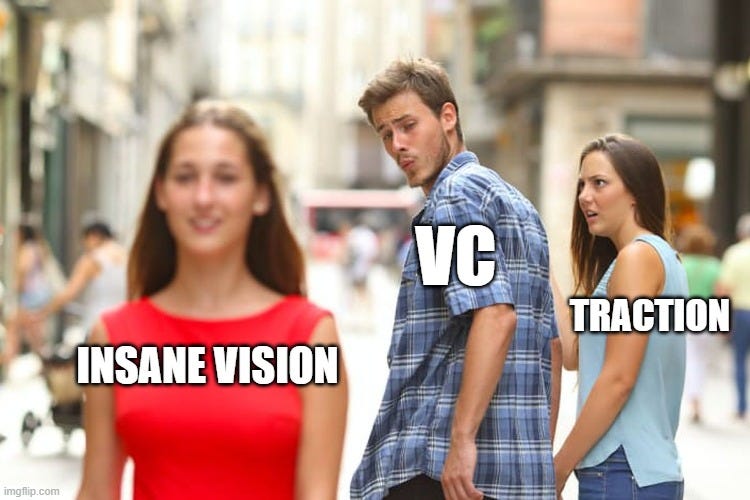
The startups with the best traction early on often have the smallest vision. And the startups with the biggest vision often have the weakest traction.
This is the paradox nobody talks about in fundraising. And once you see it, you can’t unsee it.
I see it constantly at Karaoke Club and beyond. A founder goes ultra-niche, say, AI software for Danish veterinarians, and within months they have €100k ARR, insane retention, and customers who love them. But when they sit down with a VC, the first question kills the momentum: “So where does this go from here?”
Meanwhile, another founder is building “the operating system for all European SMBs.” The vision is massive. The VC’s eyes light up. But six months in, they have 12 inactive users and no clear wedge into the market. Because when you’re building for everyone, you’re building for no one.
VCs say they want traction. VCs also say they want a massive vision. But rarely do they acknowledge that these two things are in direct tension at the early stage.
We have two founders in Karaoke Club right now who sit at either end of this spectrum, and the contrast is painful.
One has incredible traction. Razor-sharp focus on a specific customer segment, deep understanding of their pain, product that fits like a glove, customers who love them. But when they go out to raise? A lot of nos. They have to go volume to find the right VC, because most investors look at the vision and can’t see it scaling big enough. The traction doesn’t matter if the VC can’t map it to a multi-billion dollar outcome on their spreadsheet.
The other one has spent an equal amount of time building. They have a big vision, compelling story about where the market is going. Less traction, but a narrative that makes VCs lean in. Their round closed 3x oversubscribed. Most importantly, they barely had to spend any time fundraising. Any founder’s wet dream: to close within 2-3 weeks, then go back to building and selling. The vision was so large and so compelling that VCs were fighting to get in.
Same quality of founders. Same stage. Completely different fundraising experiences. And if I’m being honest, it’s the one with stronger traction that’s having a harder time. Because for VCs, a massive vision isn’t a nice-to-have. It’s a hygiene factor. Without it, you don’t even get past the first filter.
Share this with a founder who needs it:
If you’ve read our breakdown of VC math, you know that VCs need massive outcomes to make their fund economics work. They need multi-billion dollar exits. That’s not greed, it’s math. So when a VC looks at your startup and can’t see a path to a multi-billion dollar company, they’re not thinking “that’s a nice business.” They’re thinking “that can never return my fund.” No amount of traction changes that calculation.
This is the part that frustrates founders, and rightfully so. VCs also know that 70-80% of their portfolio will fail or return less than the original investment. The number one killer? Not a lack of vision. It’s lack of product-market fit. It’s startups that never found the customers who desperately needed them.
So there’s a real irony here. VCs filter first on how big the vision is, which eliminates many of the founders who have actually proven they can build something people want. Meanwhile, the founders who get funded on vision alone often spend years trying to find the traction that the rejected founders already had.
But that’s how the game works. A massive vision is the entry ticket. Without it, traction alone won’t get you through the door. You can argue this is flawed logic, and I’d probably agree, but understanding it is the difference between a smooth fundraise and a painful one.
The founders who crack this usually start narrow and expand. Stripe started with developer payments. Klarna started with Swedish e-commerce checkout. Amazon started with books. The niche wasn’t the ceiling. It was the wedge.

Join karaoke garden party at TechBBQ!
So here’s my advice: you need two completely different modes.
With customers, stay obsessively niche. Talk their language. Solve their exact problem. Be the product they’ve been waiting for. That’s how you get the traction that makes everything else possible. That’s how you find your passionate customers, the ones who don’t care that your MVP is buggy because you’re solving the problem they’ve been losing sleep over.
But the moment you walk into a VC meeting, flip the switch. Paint the massive vision. Show how your niche is the entry point to a $10B+ market. Show the expansion playbook. How you go from Danish dentists to Nordic healthcare to all of European compliance. Make them see the path to a company that could dominate an entire category.
This is where so many founders with great traction fail. They walk into the meeting proud of their numbers, and they should be, but they forget that VCs are not buying what you are today. They’re buying what you could become. If you can’t make the leap from “we own this niche” to “and here’s how this becomes a $10B company,” you’ll keep hearing “impressive business, but not for us.”
This isn’t being dishonest. It’s being strategic. Every huge company started somewhere specific. Your job in the pitch is to connect the dots between where you are today and where you could be in 10 years. The traction proves you can execute. The vision proves you’re worth betting on. But without the vision, the traction is just a nice story about a small company.
The best pitch decks I’ve seen handle this paradox explicitly. They don’t hide the niche. They celebrate it. The traction slide shows incredible numbers in a focused segment. Then the market slide zooms out and shows how that segment is the first domino in a much larger play.
The narrative goes something like: “We own this corner of the market. Here’s why that corner connects to a much, much bigger opportunity. And here’s exactly how we plan to expand.”
When you frame it this way, the niche becomes an asset, not a liability. It tells the VC: “We’re not dreamers who built a pretty vision slide. We’re executors who have already proven we can win, and now we’re going to do it again in an adjacent market.”
If you have incredible traction in a small market, your fundraising challenge is storytelling. You need to credibly paint the expansion path. Study how other companies expanded from their beachhead. Build the narrative before you start pitching. Because right now, VCs are looking at your numbers and thinking, “cool, but where does this go?” Give them the answer before they ask.
If you have a massive vision but weak traction, congratulations, VCs will take your meetings. But don’t get complacent. The round might close easily, but the hard part comes after. You still need to find your niche, your wedge, your first passionate customers. The vision won’t save you if you can’t execute.
And if you have great traction but can’t credibly tell the bigger story? That’s fine. Not every great business needs VC money. Some of the best businesses I know are profitable, growing, and were never designed to be unicorns.
But if you want venture capital, you have to make investors believe your niche is a launchpad, not a destination. Vision is the entry ticket. Traction is what makes you win long-term. You need both, but you need the vision first to even get in the room.
The best founders operate in both worlds simultaneously. They’re obsessively focused on day one and painting a multi-billion-dollar picture on slide five.
One of our founding teams at Karaoke Club, Terraspark, is building space solar. The idea: collect solar energy in orbit and beam it down to Earth, 24/7. The stated ambition is to become the largest energy company in the world.
Most founders with a vision that size have not much underneath it. It’s a beautiful slide and an empty room. This team is the opposite. They’ve sent hardware to Mars, built two unicorns, and already beamed energy wirelessly here on Earth. And they move about ten times faster than anything else I see at this stage, which is the part you can’t fake in a deck.
That’s the combination that ends the paradox. The vision is what a VC puts on an exponential chart, and the chart tells them this one investment could return their entire fund several times over. The traction doesn’t make the outcome bigger. It answers the only question left once the vision is on the table: is this the team that actually gets there?
And the roadmap makes the leap believable, because each step is the same technology at a bigger scale. First, they’ve now proven they can beam energy wirelessly on the ground, short distance, real hardware. They’ve started to sign contracts for the hardware and the energy. They’ll soon starting beaming from orbit down to Earth. Then scale that to power an entire industry. The niche isn’t the ceiling. It’s the first rung of a ladder that goes all the way up.
This is the whole point in one company. Vision tells an investor how big the outcome can be. Traction tells them why it’s you.
So if your traction is already proving you’re the team that gets there, you don’t have a traction problem. You have a framing problem. Put the vision on the table first, and let your traction answer the question it was always going to answer.
Keep hustling,
Melinda
No posts
Comments
Nothing yet. Say the first thing.
Sign in to join the conversation.