
In early 2025, Ethena’s founder Guy Young published a roadmap outlining bold ambitions for the protocol, Ethena 2025: Convergence.
Fast forward to September 2025, those ambitions have materialized, and Ethena is now assembling its own Survey Corps to hunt the Titans beyond the walls.\

As the pioneer of the yield-bearing stablecoin category, Ethena entered 2025 with explosive TVL growth, cementing itself as the undisputed #3 stablecoin. Every strategic move like DAT, Converge, Fee Switch, Hyperliquid integrations, Stablecoin-as-a-Service has rippled across the market, forcing incumbents to take notice.
But how did Ethena grow this strong, and what missions remain before unleashing its own Rumbling?
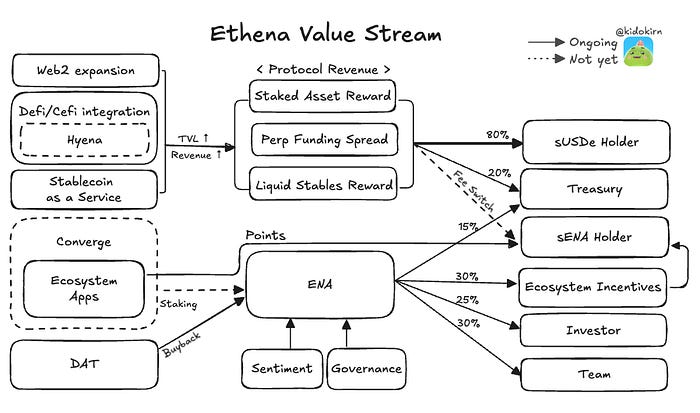
Ethena’s 2025 updates can be understood as advancing three core objectives:
Creating demand for ENA via DAT and Converge.
Expanding TVL through Stablecoin-as-a-Service, Hyperliquid ecosystem, DeFi integrations (Aave, Pendle).
Strengthening rewards for sENA holders via Fee Switch and Converge ecosystem incentives.
DAT
Ethena’s DAT initiative functions much like a corporate share buyback. The protocol announced two rounds of ENA buybacks in 2025, $360M in July and $530M in September, totaling $890M in committed capital. By systematically removing ENA from circulation, DAT creates instant demand and confidence for the token.
Converge
In collaboration with Securitize, Ethena is building Converge, a blockchain network launching in late 2025. ENA will serve as the staking token for the Converge Validator Network (CVN), a core validator set responsible for network governance and security. This introduces a new, tangible use case for ENA, embedding it into the very fabric of the chain.
Hyperliquid Ecosystem
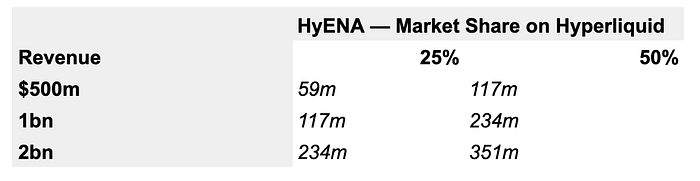
Through HIP-3, anyone can deploy new trading pairs on Hyperliquid. Ethena plans to provide USDe pairs across assets and even launch a perp DEX called Hyena. Users could deposit sUSDe as collateral, maintain ~11% yield, and trade seamlessly. As the deployer, Ethena would capture 50% of fees, with projections ranging from $59M to $351M in potential annual revenue.
Stablecoin-as-a-Service (SAAS)
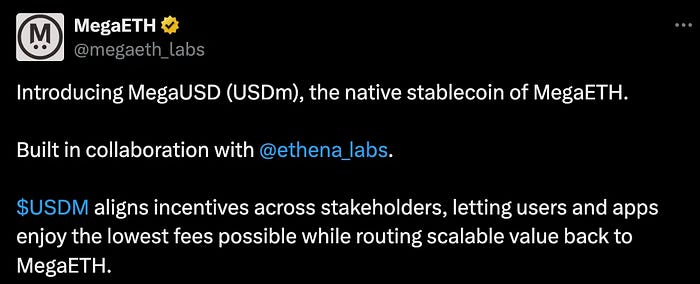
Ethena’s collaboration with MegaETH to launch USDm introduced a new stack: enabling ecosystems to issue their own native stablecoins. Instead of ceding stablecoin revenues to issuers, chains can now capture that value internally while Ethena benefits from adoption of its SaaS model. This positions Ethena as both infrastructure provider and liquidity driver across ecosystems.
(Just before publishing the article, news also broke in the Sui ecosystem about suiUSDe and USDi as part of its Stablecoin-as-a-Service initiative)
Fee Switch
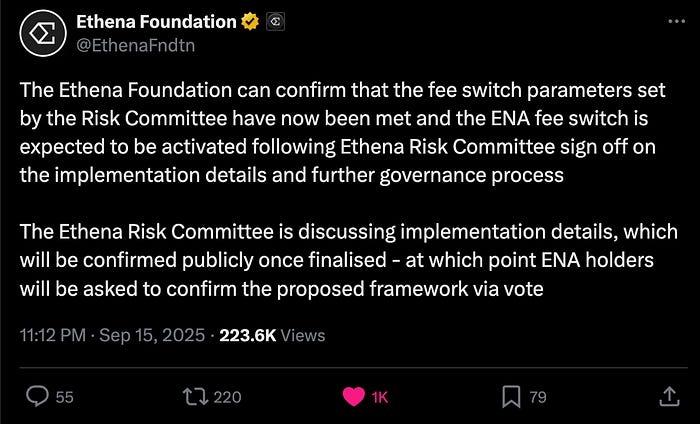
Fee Switch is a mechanism that distributes protocol revenues to ENA token holders. Specifically, a portion of the fees earned by the Ethena protocol is redirected to users who stake ENA (sENA holders). First proposed in November 2024, the initiative had, by September 2025, met all execution conditions and entered the implementation phase.
Until now, sENA holders were not directly exposed to protocol revenues, even though Ethena was generating substantial revenue ($>500m). With the Fee Switch, they will now be directly exposed. How much could they receive? While the exact percentage is not yet finalized, industry precedents suggest an allocation in the range of 5%–15% of revenues.
Previously, Ethena’s revenue distribution allocated 80% to USDe holders and 20% to the Treasury. Some users expect that a portion of USDe rewards might be redirected to sENA holders, but my perspective is slightly different.
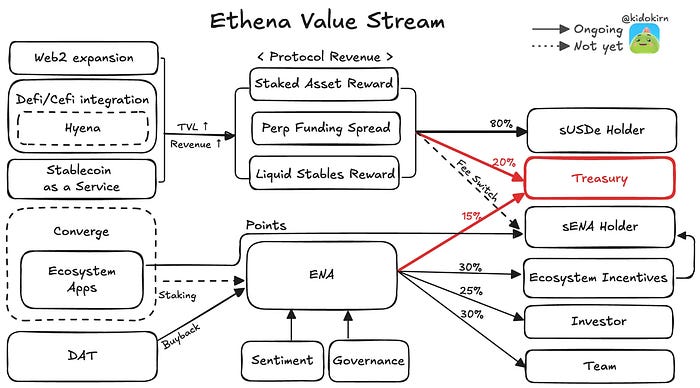
Looking more closely at the Ethena Value Stream, the Treasury receives not only a share of protocol revenue but also vested ENA tokens.
So, how much is directed to the Treasury? Roughly speaking, in August 2025 alone, about $40M likely accrued to the Treasury:
Protocol revenue: $54.7M monthly revenue × 20% → ~$11M
Token vesting: 40.6M ENA vested monthly × $0.70 (average August price) → ~$28M
Of course, in the early stages of a protocol, a large share of revenues must be reinvested for aggressive growth. But Ethena has now reached a level of stability. Moreover, reducing rewards paid to sUSDe holders would undermine liquidity attraction, making that option less viable.
Thus, the most reasonable path forward is to allocate a portion of what previously went to the Treasury and redirect it to sENA holders through the Fee Switch.
Converge Eco Points
Through Converge and the dApps announced to be deployed on it, sENA holders are currently receiving Converge ecosystem points. This exposure positions them for a variety of potential future airdrops. By strengthening rewards for sENA holders in this way, Ethena increases the incentive to stake ENA, ultimately reducing sell pressure on the token.
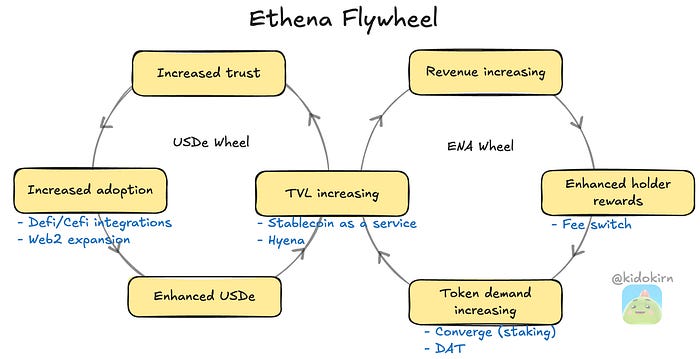
Ethena is structured as a dual-token protocol, built around USDe and ENA. By analyzing the flywheels of each token separately, we can gain a clearer structural understanding of how the protocol operates. The most striking feature of the model is that “TVL increasing” appears as a common driver in both flywheels.
This aligns with Ethena’s recent strategic updates like Stablecoin-as-a-Service, expansion into the Hyperliquid ecosystem, and looping integrations with Aave and Pendle, all of which ultimately feed back into TVL growth. Taken together, these moves represent highly deliberate choices aimed at reinforcing TVL as the central axis of Ethena’s design.
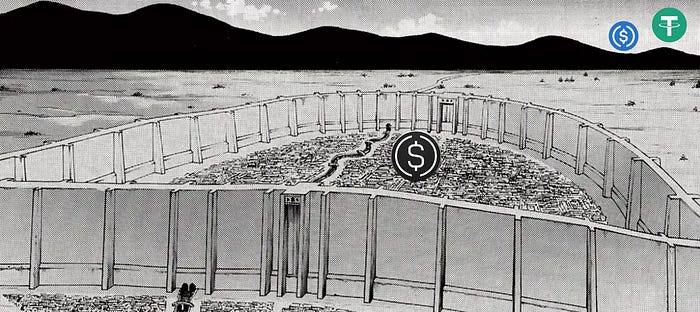
I believe Ethena now stands at a stage where it is transitioning from a yield-focused protocol into the realm of a true stablecoin. By “true stablecoin,” I don’t simply mean a dollar-pegged asset, but rather a currency that functions as money.
To function as money, a stablecoin must secure the three fundamental roles: medium of exchange, store of value, and unit of account. Achieving this requires two indispensable values: Trust and Adoption.
Trust means that people must believe, “If I accept this token, others will accept it too,” and that under any circumstance, one stablecoin will always equal one U.S. dollar. Building trust takes immense effort, but losing it can happen in an instant — making it all the more critical.
But trust alone is not enough. For a stablecoin to gain true monetary status, it also needs adoption. Even the most stable and trustworthy asset is meaningless if only a handful of parties accept it. Adoption is directly tied to network effects: the more people use it, the more valuable it becomes, and the more entrenched its monetary role.
When trust and adoption reinforce each other, a stablecoin acquires genuine monetary characteristics. This is the deep moat that USDT and USDC have successfully built.
From this perspective, Ethena’s major protocol updates can be interpreted as steps along USDe’s journey toward becoming a true stablecoin.
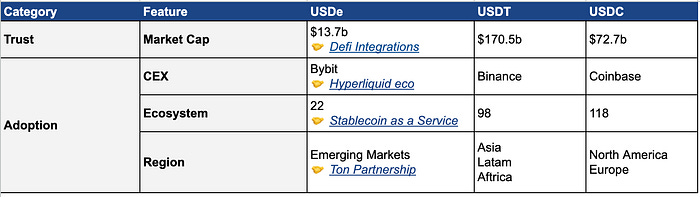
DeFi Integrations → Market Cap → Trust
Through partnerships with protocols like Aave and Pendle, Ethena has achieved explosive TVL growth. This helps compensate for its relatively smaller market cap compared to USDT and USDC, while reaching a certain scale serves as a proof point for the protocol’s credibility.Hyperliquid Eco → CEX → Adoption
Since the early days of Web3, centralized exchanges (CEXs) have been the most powerful players. They are where the overwhelming majority of trading takes place, where asset prices are determined, and where the largest revenues are generated. While Ethena has Bybit as a partner, it lacks a dominant CEX relationship on the level of Binance for USDT or Coinbase for USDC.
Ethena appears to be addressing this gap through a strategic partnership with Hyperliquid. Hyperliquid is considered strong enough to challenge Binance’s dominance, making this a highly meaningful strategy.Stablecoin as a Service → Ecosystems → Adoption
The number of chains that support a stablecoin is one of the most direct indicators of its adoption. Compared with USDT and USDC, USDe is currently supported on fewer chains. However, through Stablecoin-as-a-Service, Ethena can expand to more ecosystems, improving not only TVL but also overall adoption.TON Partnership → Region → Adoption
USDT and USDC each have distinct regional strongholds: USDT leverages its first-mover advantage in Asia, Latin America, and Africa, while USDC’s regulatory compliance gives it strength in North America and Europe.
By contrast, USDe does not yet have a strong regional foundation. In my view, this will be one of Ethena’s biggest challenges going forward. Securing regional dominance generally comes only after a stablecoin has already proven itself as “true money,” which means building trust and adoption must come first.
From this perspective, considering Telegram’s strong user base in emerging markets, the TON partnership can be interpreted as a strategic attempt to expand Ethena’s footprint in those regions.

Limited Long-term Testing
Ethena launched in 2024. Compared to USDT and USDC, it has not yet been tested over a sufficiently long period. Given that Ethena’s primary revenue source, perp funding spreads, tends to weaken during bear markets, the protocol must prove it can survive through harsher and more prolonged downturns.
Need to Demonstrate Regulatory Readiness
It remains unclear how well-prepared Ethena is for regulatory scrutiny compared to Tether and Circle. This may explain why USDe is often emphasized as a “synthetic dollar asset” rather than a stablecoin. Since North America and Europe are the largest and most heavily regulated markets, demonstrating regulatory readiness is an essential capability.
Lack of Strong CEX Partners and Regional Base
Although Ethena is making progress by leveraging the Hyperliquid ecosystem, the absence of a powerful CEX partner remains a drawback. Similarly, the lack of a strong regional foundation continues to be a challenge. But recently, Ethena started to making a strong partnership with Binance.
Big Remaining Emission of $ENA
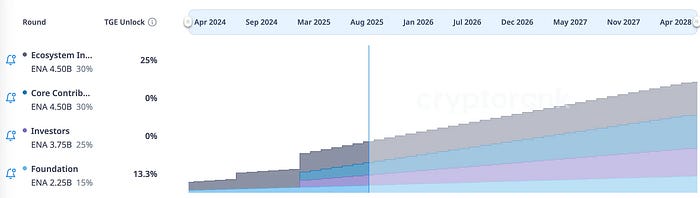
Roughly half of ENA tokens are still locked. While these reserves can serve as resources for reward programs and other protocol initiatives, they also represent potential sell pressure. This overhang could weigh on the price of ENA.

If Ethena succeeds in securing the Korean market, one of the largest countries by global spot trading volume, it could simultaneously resolve two persistent challenges: the lack of a strong CEX partner and the absence of a regional stronghold.
Upbit currently records the highest spot trading volume worldwide, and Bithumb has also been expanding its share. Both exchanges are deeply rooted in Korea’s retail-driven market, where investor purchasing power is exceptionally strong.
Of course, the Korean market comes with its own constraints: it is centered on KRW trading pairs rather than USD pairs, and it operates under a stringent regulatory environment. Nevertheless, opportunities are there. Korean investors maintain consistently high demand for USD assets; following the recent change in government, discussions around introducing a KRW stablecoin have accelerated; and the recent launch of Upbit’s Layer 2 “Giwa” highlights room for collaboration.


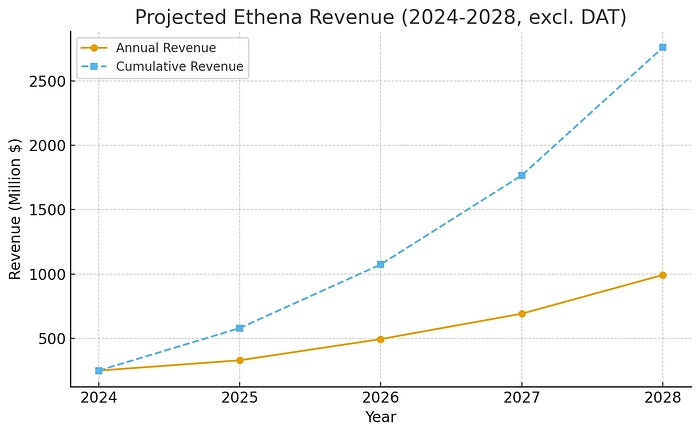
Ethena is expanding its business across multiple fronts, and protocol revenues are expected to diversify as well. This makes it difficult to forecast revenues with precision. Still, even a rough projection can provide valuable insight into Ethena’s future trajectory.
Using the Tokenomics Simulator developed by Nonce Classic, and assuming Ethena maintains its historical growth rate, while incorporating Hyena’s projected revenues based on the bear- and bull-case estimates suggested by Delphi founder Jose, Ethena’s cumulative revenue could reach approximately $3B by 2028. For comparison, Aave has generated around $1.6B in cumulative fees since 2020, making Ethena’s projection an attractive figure.

In 2025, Ethena is fully arming itself to challenge the two Titans. From creating ENA demand through DAT and Converge, to expanding across chains with the Stablecoin-as-a-Service stack, to partnerships with Hyperliquid, and MegaETH, and finally activating the Fee Switch, Ethena has entered a phase of comprehensive mobilization. These moves are not mere updates; they are rewriting the playbook of a stablecoin market once considered untouchable.
If Ethena succeeds, it would not only mark the triumph of a single protocol but also ignite a broader paradigm shift in the stablecoin sector. By securing both trust and adoption, and strengthening its monetary status, Ethena’s path would serve as both a guide and a challenge for other DeFi projects.
As 2025 closes and 2026 begins, the question remains: will Ethena slay the Titans and establish itself as the “third Titan” in the truest sense?
Reference
No posts
Comments
Nothing yet. Say the first thing.
Sign in to join the conversation.