
A big takeaway from this episode is Matthew’s work on exponential growth rates and how they align with Geoffrey West’s faster treadmill theory.
This theory mathematically explains why life speeds up because of technological innovations. This increasing speed is what eventually kills exponential systems.
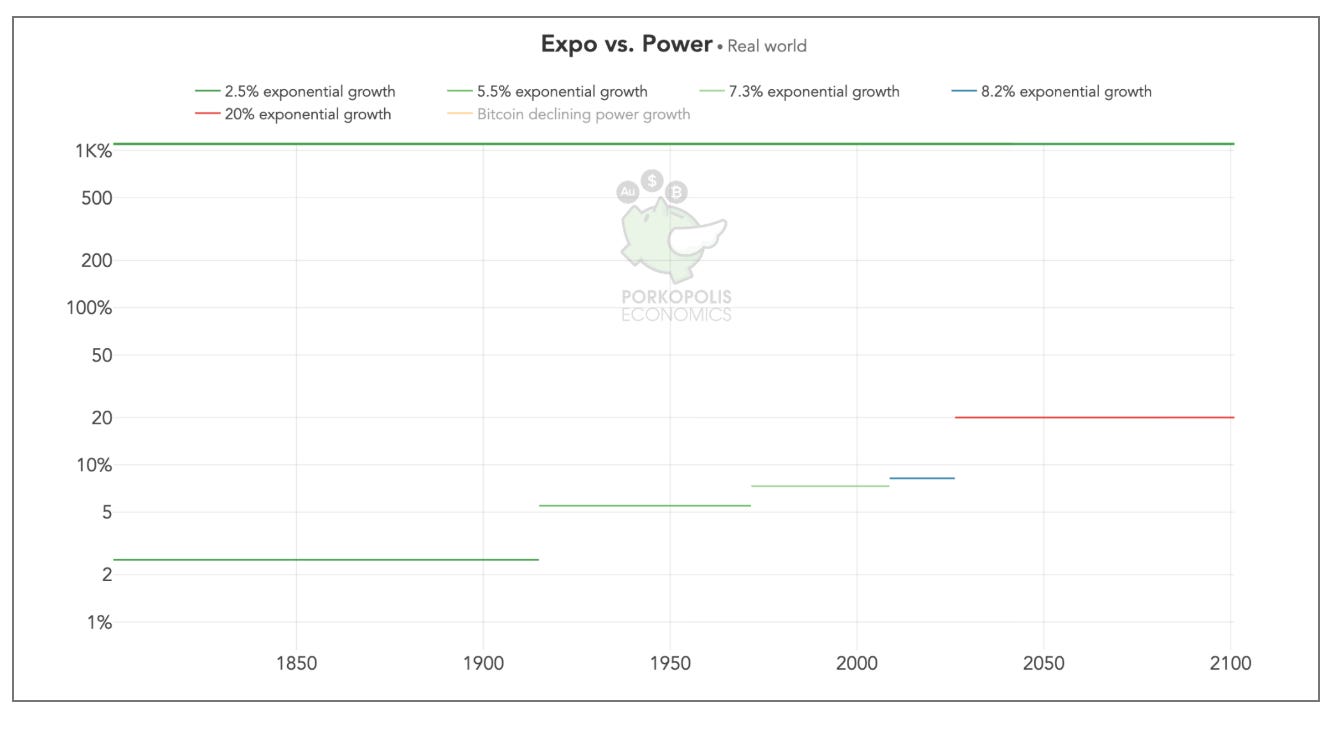
As shown in Scale, here is the impact of the ever-increasing speed of a system. Some of these points I discussed previously in deeper detail here (as it relates to entropy, chaos, and scaling limits) and here (as it relates to our obsession with growth without regard for the proper support structure required).
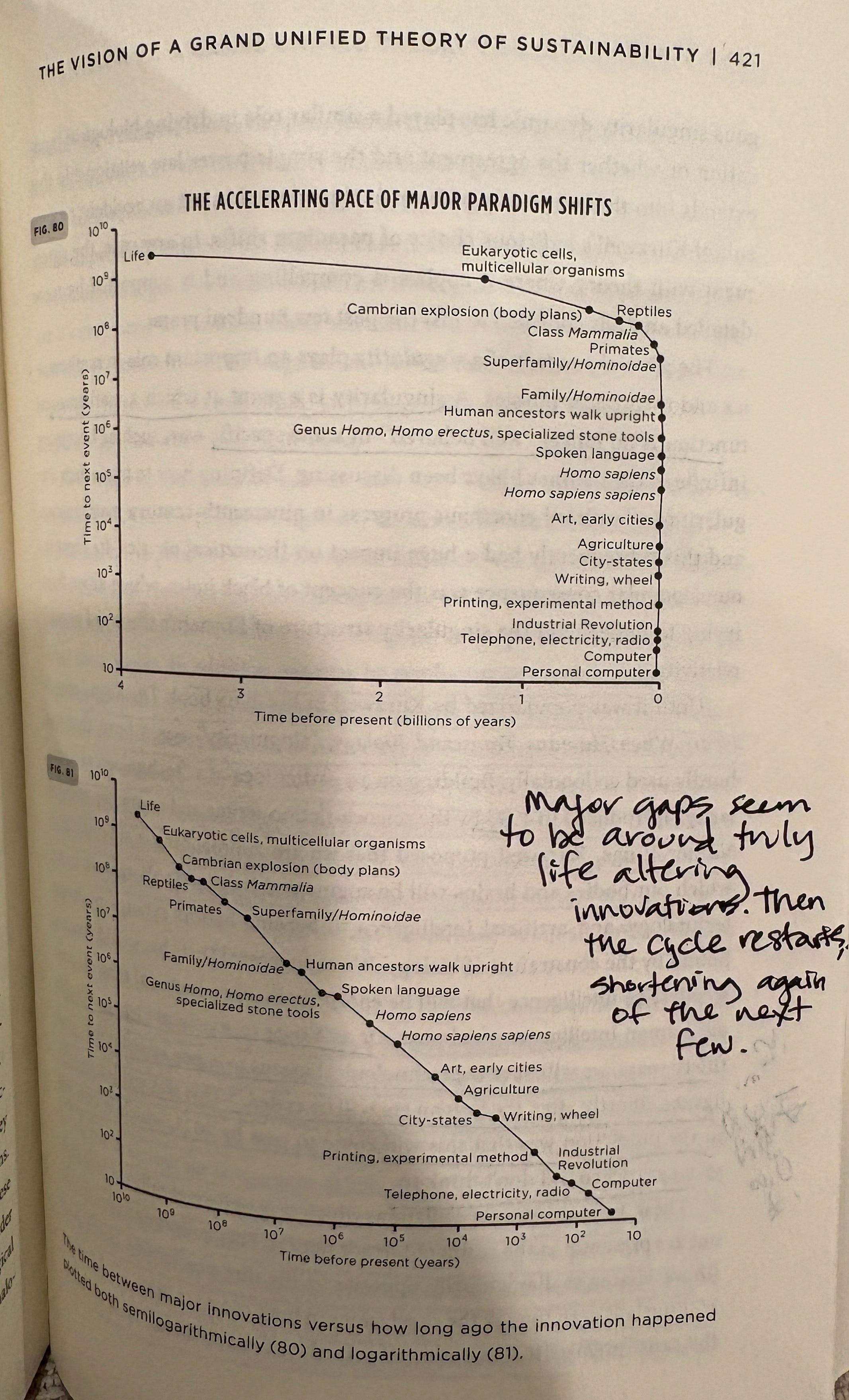
You could easily throw Bitcoin and AI into the life-altering innovations that restart but shorten the cycle by speeding things up.
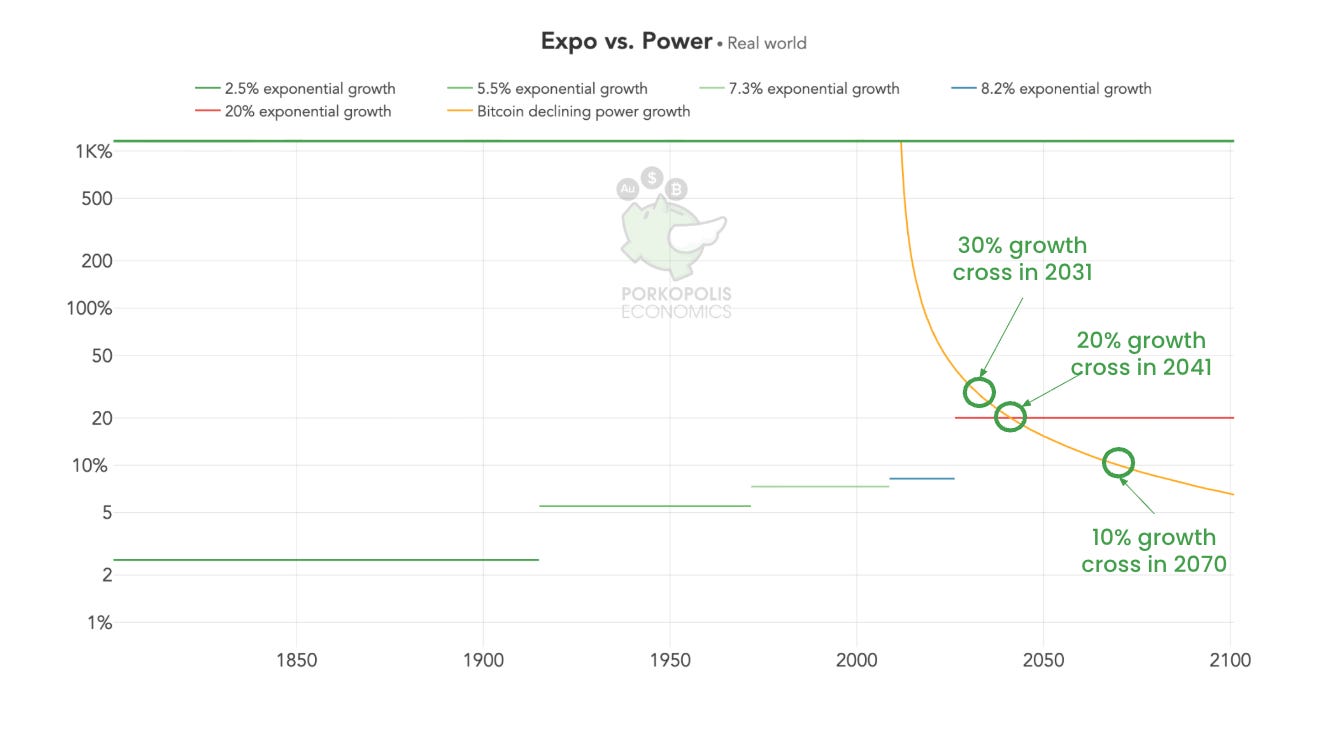
Below is a chart of Matthew’s laying out his belief that at some point our existing system is likely to collide with the new Bitcoin system, whose compound annual growth rate (CAGR) is declining and will eventually lead to the crossing of paths between our exponential system and the new scale-invariant system (Bitcoin).
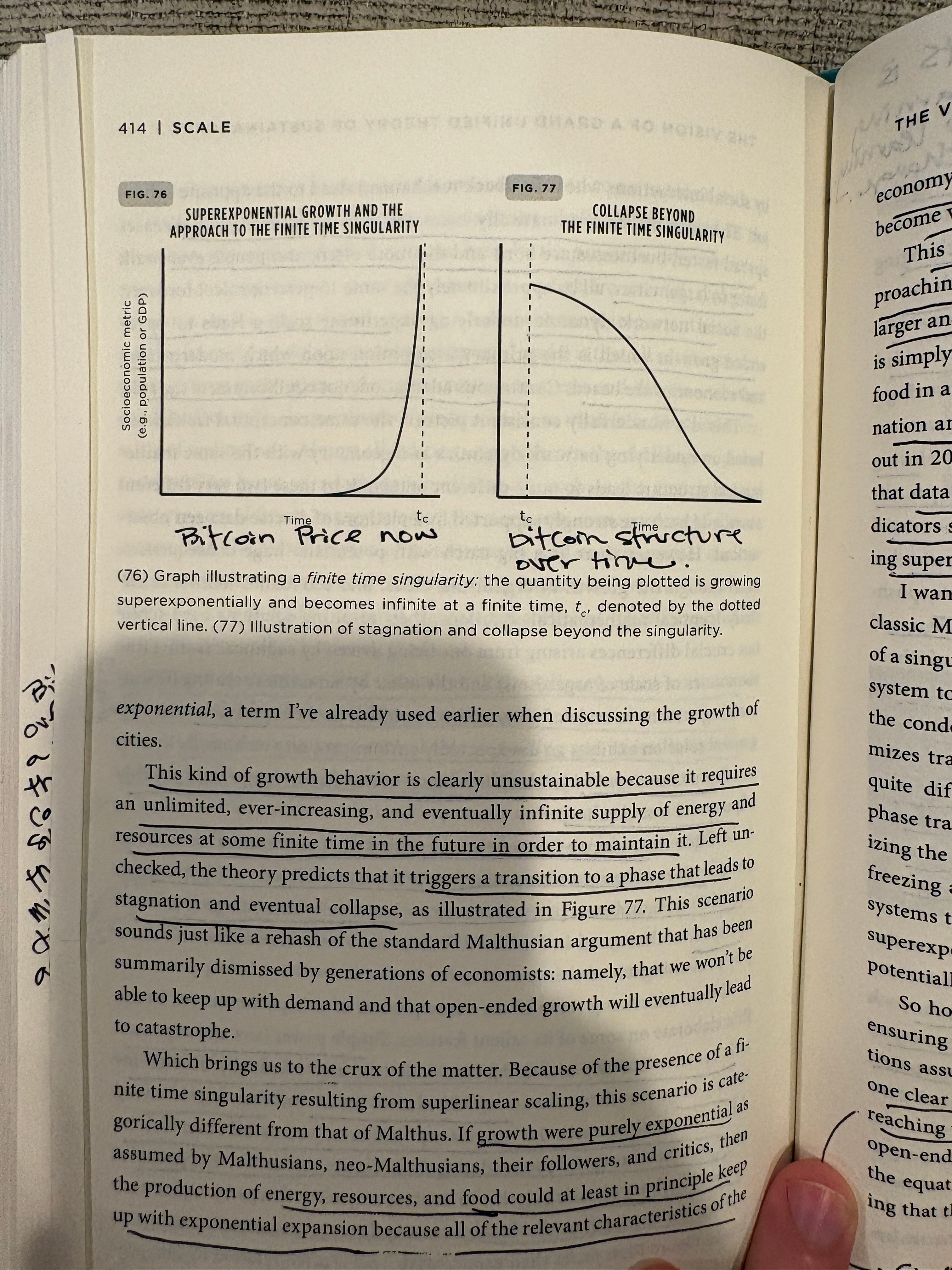
Another important point from Scale that aligns with Matthew’s 2041 timeframe is the idea of finite time singularity, which requires infinite growth and energy for system sustainability. Meaning that the system eventually kills itself off because of unsustainable resource needs. Both structures below look like Bitcoin on a linear scale (left) and Bitcoin’s decaying CAGR right.
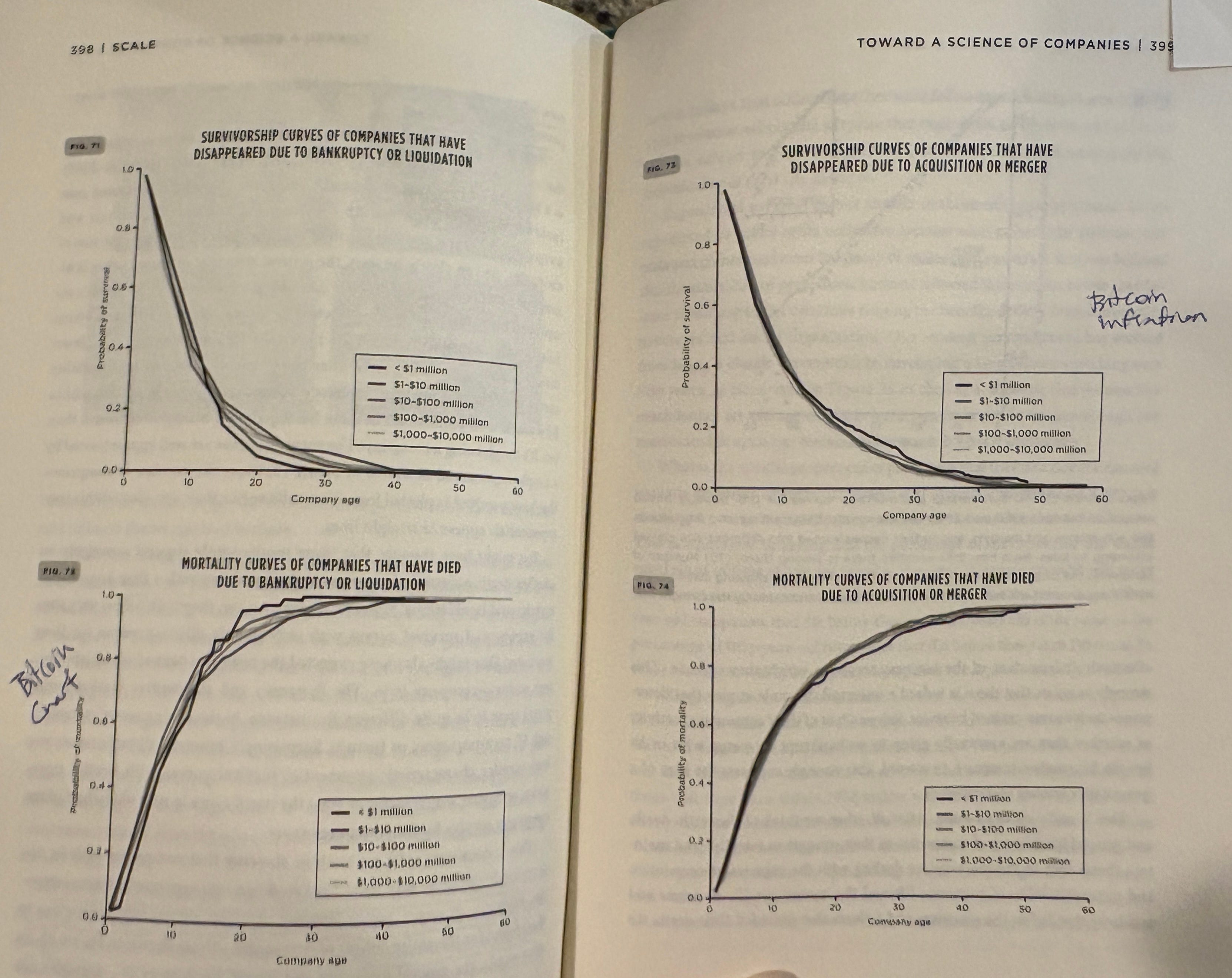
The page of company survivorship charts is quite interesting in the context of Bitcoin and technologies requiring faster treadmill innovations or scaling layers, at minimum, to survive. The chart in the upper right mimics Bitcoin’s inflation schedule/CAGR decline, and the one in the lower left its price chart in log form. Who knows what the future holds, but as noted, the 40-year time mark on these charts coincides with Matthew’s thoughts on a potential collision in 2041. 2009, the birth of Bitcoin + 40 = 2049. My question is, are all the current Treasury Company strategies that are monetizing Bitcoin’s Volatility speeding this natural decay up? Is that an issue?
Welcome to Navigating Bitcoin’s Noise, the show where we cut through the clutter and bring you the clearest insights on Bitcoin.
I’m your host, Kane McGukin, and today I’m joined by Matthew Mežinskis, widely known as @1basemoney. Matthew is one of the sharpest analysts on global liquidity, central bank balance sheets, and the role of base money in the evolving financial system.
In this conversation, we break down how money actually moves from gold to central bank reserves to a system now dominated by liquidity that most people can’t even access.
We get into why 2008 changed everything, how bank reserves quietly replaced real money, and why that shift may be pushing the system toward a breaking point. And we ask the question that matters: is Bitcoin just another asset, or is it the next base layer of the global monetary system?
If you’re tired of hype and want a first-principles breakdown of how the monetary system actually works, and where Bitcoin fits, this episode is for you. So sit back, relax, and let’s get started.
Kane McGukin
X: https://twitter.com/kanemcgukin
Substack: https://kanemcgukin.substack.com/
Matthew Mežinskis
X: https://x.com/1basemoney
Web: https://www.porkopolis.io/topmoney/
Comments
Nothing yet. Say the first thing.
Sign in to join the conversation.