
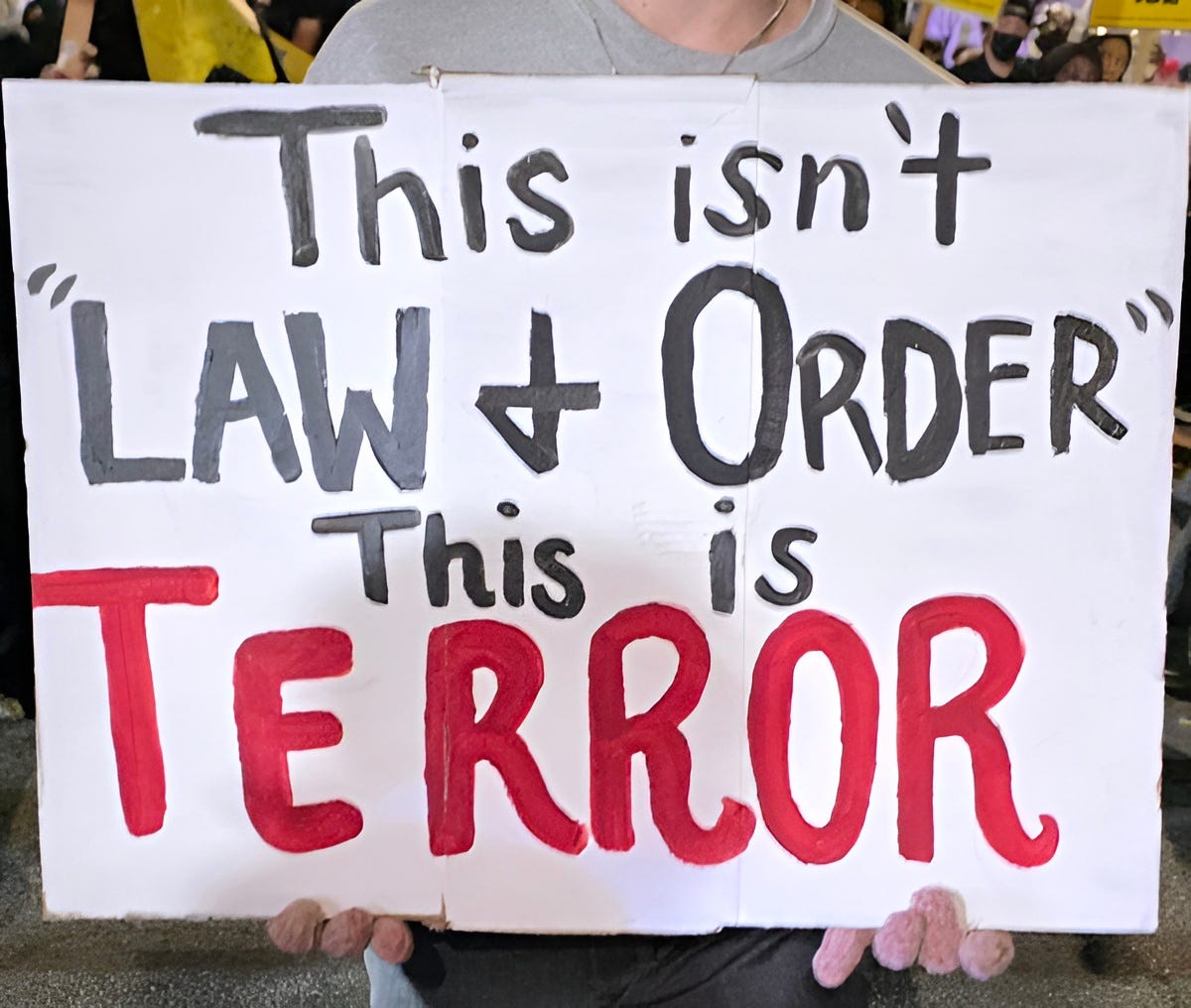
Several people have contacted me in regard to a recent protest I attended denouncing both ICE and the slow imposition of right-wing ultra-nationalist authoritarianism–via militarized crack downs on human beings–in the U.S. Each person I’ve spoken to has been well informed of our current climate and expressed strong disgust with this administration’s handling of citizens and non-citizens alike in their murderous attempt to reconfigure American society.
In one particularly fruitful conversation, I said that while I don’t think challenging ICE head-on can bring much good to a lone individual in the moment, we must still acknowledge that non-violent protest, which is what Renee Good and Alex Pretti were engaged in when they were killed, and which, despite their deaths, has been successful on multiple fronts, particularly in this country, is still worth pursuing even though it frequently becomes physically violent; that is to say, non-violent resistance will very often not be peaceful.
Non-violent demonstration, in spite of its pacifist premise, can attract violence because states, in their cowardice and paranoia, have historically been all too willing to use deadly force on individuals and groups they identify as problematic. In fact, if we look at U.S. protest footage from the 1960s and 70s, we see how non-violent resistance can metamorphose into a struggle for life and limb. This reality, however, does not destabilize the moral high ground upon which non-violent direct action rests.
Non-violent direct action is still the highest path to walk if we wish to create for our children a world where they can grow into powerfully empathetic beings accountable to themselves, each other, and their environment. And it is necessary to utilize non-violent approaches to political struggle if we are ever to explore, in peaceful coexistence, the dynamism of the human experience.
Yet again, in seeing this, we need to realize that in existential struggles for political supremacy and social authority, windows will be broken and supply chains disrupted; truncheons will fall, backs will be broken; and more, lives will be lost. And so, due to the gravitas the decision to engage in protest politics carries, I think it’s valuable to get clear about what protests are designed to do and what they are not.
First, protests exist to demonstrate to those in whom we (ironically) vest authority, that we aren’t going for their bull shit, and that if necessary, we are willing to mobilize in mass to oppose their chicanery. Used this way, protests become symbolic and a moral shield of political resistance against those in power.
Secondly, protests allow demonstrators, many for the first time, to experience the amplified resonance of solidarity that is only possible when large numbers of people are united behind, and committed to, undoing collectively perceived injustice.
Protests draw attention to these injustices, hopefully before they’ve metastasized, but certainly in the wake of their wide-spread ill effects on the public. Alone, they do little but allow demonstrators to blow off steam. The state knows this and so allows a certain amount of controlled unrest, believing people will lose either direction, intensity, or interest as time moves forward.
However, when mass demonstrations are sustained through collective action and plans are put into place that demand at all costs the will of the people against the machinations of the state, real change, in some meaningful manner, occurs.
Protests resemble the quarterback’s handoff to his running back with only inches to go for the first down: little movement, and small, but important gains. On the other hand, sustained collective pressure from the populace along with the implementation of extra-governmental forms of social organization are the long pass. Think QB to WR for the touchdown: greater movement and more permanent gains.
Protests give us a glimpse of what is possible when people are on one accord; however, they do not imply certain victory and they do not by themselves force change. Only when millions in a society decide to build and maintain structures that exist outside of government purview, and do so on their own authority, can the above mentioned effects of political protest be said to catalyze the direct action components of sustained peaceful political resistance.
With regard to Our predicament: right now, there are even principled nationalists who see that this president and his devilish administration are an anathema to any prospect of civilized coexistence in our future.
That is saying something.
Even these people see that the current methods being used to ‘make America great again’ border on the catastrophic. And just a cursory glance back into history tells us what happens when people who operate from a position of moral bankruptcy attain power. It never ends well; sorry for the spoiler.
Special about this moment is that average people — without knowledge of the historical tendency of governments to kill their own people in the name of sustaining and perpetuating their existence — are becoming aware of the deadly consequences of living as, for all intents and purposes, wards of the state;
And when millions of sane people come to understand that their very existence is at risk due to the imbecility of one person, as many Americans are beginning to realize, they begin to act in a way that mitigates the actions this individual takes. So it is only natural that millions of bodies are pouring into the streets at this very moment in support of ICE’s abolishment and, one would hope, DJT’s removal from office.
On the topic of his removal, it isn’t that his impeachment would remedy the country’s problems, although it would serve to cease having them exacerbated. No, instead, Trump’s deposition would be a symbolic recognition that even as all leaders are fallible, the choice we make to suffer for their mistakes–both unwitting and intentional–as weak helpless individuals, always rests with Us.
Further, his vacancy stands to inspire a collective realization that we don’t need leaders, but stewards. And more poignant, that the people are collective stewards of themselves. In this knowledge, the question, borne out of anxiety and self-absorption, that says, ‘how far am I willing to go for what I believe?’ is overpowered by the declarative statement, ‘together, we shall go far.’
Lastly, with regard to freedom, we believe we are free here because most of the time we can move around within the borders of this land mass without being assaulted by others (although recent events stand as a challenge to this thinking), and we have virtually limitless access to material pleasures of the flesh; but the freedom to engage in abject hedonism, which can be as devastating as it can exciting, is only a part of what it means to live as a “free being” on this earth.
Genuine freedom rests principally on our collective capability to coexist in civility and reverence for the Other. Ideally, we would do this by recognizing as valuable each participant in Our human project.
Sadly, it does not appear from my vantage point that those individuals and entities now remorselessly spewing untruths and vitriol from their public platforms and inciting such dissension on the planet desire to coexist with their human brothers and sisters.
Their actions leave the rest of us with a choice.
We can choose either to organize ourselves and build a new social project accountable to humanity, or else, continue to suffer in subservience to lesser minds.
No posts
Comments
Nothing yet. Say the first thing.
Sign in to join the conversation.