
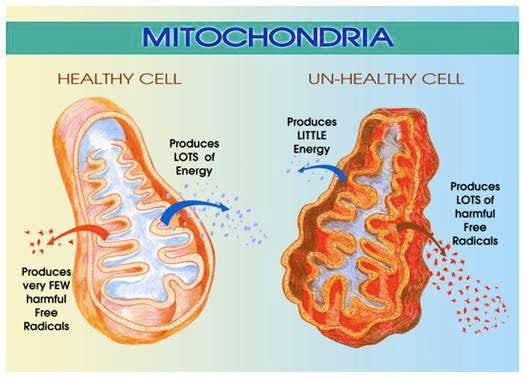
Recently, while listening to a podcast on the metabolic origins of cancer, a cancer scientist shared a fascinating perspective on cell biology: Cancer, at its root, can be understood as a result of dysfunctioning mitochondria—the organelles in our cells responsible for producing energy (ATP). Evolutionary scientists hypothesize that mitochondria were once independent, single-celled organisms that evolved over eons to become a critical component of larger, complex, multicellular organisms– like us humans.
In a healthy body, mitochondria operate with an astounding level of complexity—constantly signaling and communicating with one another to ensure the vitality and survival of the larger host. When mitochondria become damaged, however, they revert to a primitive, far less efficient way of producing energy called fermentation. Remarkably, cancer cells use this primitive method even when excess oxygen is available. They stop participating in the collective system and as a result, require more resources for their reproduction and survival.
It made me think of a striking parallel in Robin Wall Kimmerer’s Braiding Sweetgrass, where she describes the concept of “hungry ghosts”—entities so insatiable that they consume far more resources than they need, entirely severed from the web of mutual responsibility. In essence, a cancer cell is an organizational “hungry ghost.” It no longer operates with a sense of responsibility to the whole. It takes, isolates, and consumes, oblivious to the fact that it is destroying the very system that sustains it.
As leaders, educators, and systems thinkers, the parallels to human organizations are profound. When harm occurs within a school, organization, or community and goes unaddressed, a breakdown happens. We waste vast amounts of emotional energy simply managing the toxicity that results from a lack of honest communication. Individuals who experience unrepaired harm stop operating as collaborative partners. They retreat into survival mode—working in isolation, using inefficient approaches to navigate because they no longer feel safe or connected to the larger organism. Just like a damaged mitochondrion, a disengaged team member is often operating from a place of disconnection.
A healthy organization, much like a healthy body, is not one that never experiences damage. Friction, conflict, and missteps are inevitable whenever human beings build together over time. When leaders lack the tools, protocols, or courage to facilitate repair after harm occurs, the culture defaults to fragmentation. We end up with siloes, burnout, and “hungry ghosts”—individuals or departments competing for resources rather than collaborating for a shared purpose.
As leaders of our communities—regardless of their size—our most critical design challenge is ensuring we have the systems in place to heal the inevitable ruptures. When we build cultures grounded in intentional repair, we restore the lines of communication.
We ensure that every member of the system remains connected, energized, and clear on their responsibility to the whole.
Where in your organization might an unaddressed conflict be causing an “energy leak”?
What structural protocols do you have in place to make conflict repair a safe practice rather than a rare crisis response?
No posts
Comments
Nothing yet. Say the first thing.
Sign in to join the conversation.