
Apple in China is probably the highest rated business book on Goodreads.1 Go ahead and roll your eyes: Goodreads ratings reward the lowest common denominator, and most business books suck to begin with. The other top contenders are “how-to” books of varying quality, memoirs by famous CEOs, or salacious stories of companies like Theranos that went up in flames—not the most highbrow nonfiction.
But Patrick McGee’s work is much more ambitious than the rest. Apple in China has a novel take that contradicts conventional wisdom on what both named parties get out of their relationship. It’s supported by strong reporting, which pulls no punches but is reasonably upfront about whose side it’s telling. It’s remarkably clear, laying out the thesis in five clear prologue pages. And it doesn’t hurt to be a little lucky, such as when America’s president laid massive tariffs on China just a couple months after publication.
The central idea: “Apple wouldn’t be Apple today without China ... and China wouldn’t be China today without Apple.”
On Apple’s side: it’s well known that most Apple products are made in China, but conventional wisdom says that was just about lowering costs. In fact, Chinese manufacturers are uniquely able to adapt to new product requirements, scale up to meet massive demand, and respond to ruthless feedback on quality—allowing Apple to continually serve leading-edge products around the globe.
On China’s side: Apple obviously provides jobs for Chinese workers and products that its relatively affluent citizens enjoy. But the greatest benefit, McGee argues, is that Chinese manufacturers learned a lot by working with Apple that they wouldn’t have learned from other companies. This has made China the unquestioned leader in making tech products, allowing it to dominate other companies’ supply chains and increasingly develop its own consumer brands.
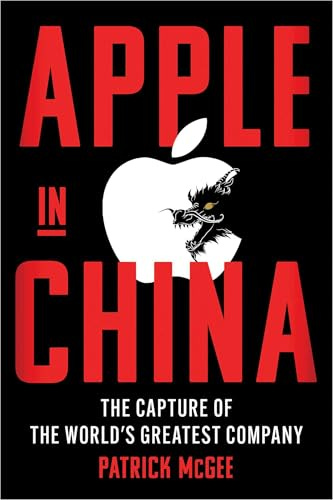
My only complaint about Apple in China is its subtitle: The capture of the world’s greatest company. This makes it sound like China was forward-thinking and cunning, setting a trap that Apple myopically stumbled into. The book’s reporting shows there was no such master plan: Apple itself practically had to say, “Hey China, you have us captured and it’s really good for you, please don’t force us to leave.”
And although Apple’s dependency is a problem worth highlighting at book length, it’s not obvious that it—or even America—would have been better off doing things differently.
Like many leading companies in complex industries like hardware, Apple doesn’t actually make its final products—it designs and sells them, but it works with third parties to do the manufacturing. So it needs to find reliable partners, ensure they have the right resources, teach them what to do, and test the final product quality. This is called supply chain management, and Apple is considered one of the world’s best at it.
That’s in part because Apple has mastered the generic MBA syllabus, such as: have multiple suppliers for everything, so you can play them against each other;2 make products only when you know you’re able to sell them, so you’re never stuck holding too much inventory; and use your power as a big and popular company to negotiate incredibly strict terms with vendors, making sure nobody can undercut you on price. (Apple once made a small company sign a contract without reading it, saying there wasn’t enough time.)
But what really makes Apple unique is how closely it works with suppliers to get exactly what it wants. All outsourcers send some oversight to the plants making their products (Tim Cook already worked with Chinese manufacturers while working at other computer companies before he was hired by Apple), but they generally expect partners to work independently to make a specified design. Because it sells high-end products, Apple can afford to invest lots more in helping its suppliers make better quality goods:
Apple sends a lot more employees overseas, who work a lot more closely with factory workers. For instance, when it realized that only one company (Lens Technology) could correctly shape glass for iPhones, it sent people to that companies’ rivals and trained them on the process, giving Apple more options and reducing Lens’ leverage.
When some manufacturers couldn’t afford enough equipment to meet Apple’s growing demands, it bought machinery itself and installed it at their plants. (This also helped Apple negotiate with them harder, because if the supplier didn’t keep its Apple contract then it would lose the equipment.)
Apple was unusually fanatical about testing its products—more than half its assembly lines were dedicated to testing, which was unheard of at the time, and it often tests every single product instead of just a representative sample.
In addition to quality, Apple’s supply chain is uniquely flexible, because it chooses suppliers who are willing to work collaboratively and pivot rapidly. This dates to the iMac days: Apple made the computer in five different colors and produced them on-demand without having to guess which colors would be more popular in advance (this way it wasn’t on the hook for losses when Tangerine flopped). And it’s become even more prominent for iPhones: Steve Jobs demanded that the screen be switched from plastic to glass only six weeks before the first version launched, and Apple’s suppliers delivered.
To find partners willing to give that much flexibility, Apple basically did everything in China—about 90% of its products are manufactured there—because:
Politically favored businesses could scale up quickly. Foxconn built a new iPod Nano factory from scratch in only nine months; later it used ample government infrastructure funding to double iPhone capacity on its own before Apple was willing to pay for it, becoming first in line when the demand came.
The business landscape was ripe for shaping. Since China was rapidly industrializing in the early 21st century, Apple could to set up clusters of suppliers in the same city, making it easier to change specifications quickly.
And with few labor rights protections, workers had no choice but to adapt to new demands. Per Haunted Empire, when Apple switched from plastic to glass screens, workers immediately started a 12-hour shift in the middle of the night “after being given just a cup of tea and a biscuit.”
Focusing exclusively on China wasn’t a deliberate strategy at first; it happened more gradually out of convenience. (Apple didn’t have a VP-level executive in China until 2017, and other senior leaders arrived only a few years earlier.) But it’s now stuck: its business model requires the scale and flexibility that only Chinese companies can provide today, and although it’s trying to move some production to other countries, it can’t anger China by doing so too quickly. At the same time, it has to manage tariff threats from a US government that’s concerned, for better or worse, about a massive trade deficit with China.3
Apple’s plight is an example of a phenomenon called Highly Optimized Tolerance: when systems are optimized against everyday risks, they may become more fragile to large, unplanned risks. Apple relentlessly mitigates the risks that suppliers will fail, input prices will rise, products will be faulty, and even that customer needs will change. But now it’s exposed to the big, weird risk of geopolitics.
Attracting all of Apple’s production was a coup for China, the book argues, but not for the reasons you may think. It created a lot of jobs, which is a plus, but those are hard jobs that workers often quit. It didn’t make Chinese factories wildly profitable, because Apple negotiates so aggressively that nothing is left over for suppliers (even though Foxconn’s revenue doubled in five years after it started making iPhones, its profits were basically flat).
Instead, what China gained was tacit knowledge—what experienced engineers know about how to create technologically advanced products well at scale. It’s hard to point to examples of tacit knowledge, but you can see its effects: the same companies that served Apple started winning contracts for other suppliers like Samsung and Nokia. Eventually, homegrown Chinese companies like Huawei took advantage of their local expertise to create their own products, removing foreign partners from the mix entirely (not Apple, but lower-end designers).
Believe it or not, an American tech reporter found it easier to get information from former Apple employees than from CCP members, so McGee doesn’t have nearly as much reporting on China’s perspective. But what he has demonstrates that the arrangement was hardly a master plan on China’s part. For one thing, the most effective operational model—rotating workers frequently from Apple projects (to get the training) to other companies (to put that to more profitable use elsewhere)—was pioneered by Foxconn, which produces a lot in China but is headquartered in Taiwan.
For another, Chinese policymakers didn’t seem to really understand what they were getting out of the relationship. Their mental model was that technical knowledge was acquired through “joint ventures”, in which an experienced foreign company works with a local partner to sell products in China. (In theory, the foreign company had contracts in place to protect its intellectual property, but in practice, you know...) Apple wasn’t in an industry where it had to follow this model, and the fiercely independent company wouldn’t have abided it anyway, preferring supplier relationships that could be cut off anytime.
By the mid-2010s, Apple’s full presence in China was being felt—not just as a producer, but as a seller of iPhones to the country’s rising middle class—and the government fired a few warning shots: it started enforcing arcane length-of-stay laws against Apple workers, nitpicked its lack of local partnerships, and claimed it owed taxes for underreporting sales. It was Apple that had to go to government officials and show them its impact: arguing it was “investing” more than $50 billion per year in the country, because that’s what it was spending on Chinese suppliers, which involved teaching skills that were helping them dominate global high-tech manufacturing. (Of course, Apple kept this story private, not wanting to broadcast to the US how much it was doing for a geopolitical rival.)
With some other signs of good faith—an unusually large investment in Chinese ridesharing company Didi, establishing R&D centers in the country that may or may not have been useful—Apple eventually convinced China’s leadership that its form of technology transfer was even better than the old joint venture model. China loosened its JV requirement for automakers in 2019, allowing Tesla to build its own factory there; the country was already a leader in electric vehicle production, but it’s since zoomed way beyond the rest of the world.
For Apple: The book doesn’t say this explicitly, but the subtext and cover clearly point to no: Apple stumbled into a situation where it has to do whatever China says and can’t really move production out of the country, which means trade barriers or geopolitical tensions could ruin its business at any moment.
But that minimizes just how much Apple has benefitted from the arrangement. Having practically its entire supply chain in China has allowed the company to build complex products at unfathomable scale: per The One Device, each iPhone took 24 hours of labor to produce (as of 2012), and Apple sells more than 200 million of them every year. It’s hard to know the counterfactual, but it’s possible that without going all-in on China, it’s not just that iPhones would be more expensive—we might not have them at all, and certainly they wouldn’t be as good or upgraded as frequently.
So the benefit was massive. Was the cost? This comes down to two questions:
1) How much leverage does Apple have over the governments that could give it trouble?
In China: Apple is vulnerable because all of its production is there, but it’s also well aware of the benefits it brings the country—not only the skill transfer, but the iPhones and other products that hundreds of millions of Chinese citizens love. China’s government has extracted some small concessions from Apple (giving a local partner access to data on Chinese users, removing VPN and certain news and messaging apps), but nothing that seriously hurt its business. Apple’s influence is by no means absolute—it wasn’t able to prevent controversial Covid-Zero lockdowns from disrupting iPhone production in late 2022—but so far it’s been able to prevent any serious repercussions.
In the U.S.: The biggest risk has been trade barriers—the Trump administration put a 25% tariff on imports from China in 2019, and then threatened a 145% levy on some goods in 2025. But Apple ultimately got an exemption each time. That’s in part because it’s become savvy at politics (McGee writes that Cook called Trump every few weeks during his first term to stay in good graces), but also because America needs Apple to succeed—everyone loves iPhones, and Apple is a major contributor to the health of the stock market and Silicon Valley.
2) To the extent that some existential risk remains, is it okay for Apple to bet the company on it?
Companies fail all the time. Usually it’s the small stuff that kills them: they’re not profitable enough, or another competitor beats them to the next big thing. Apple’s model has minimized those risks, and generated tons of value, at the cost of exposing itself to a very big tail risk. Is that a bad thing? Traditional corporate governance theory would say no; if anything, executives generally take too few risks. But that’s easy to say about a normal-sized public company; it feels harder to accept when the risk threatens a product as ubiquitous as the iPhone.
For China: By being a good place for Apple to do business, China is now a chokepoint of massive and strategically important manufacturing industries. That’s obviously good, right?
To Western readers, it sure seems so. But there are complications that are harder for us to see. For one thing, it’s been less obviously good for Chinese citizens: the government’s crackdowns on labor protections led to poor working conditions and lower wages, and its relentless investment in business infrastructure has meant more inequality and a weak social safety net. For another, serving Apple has meant making concessions toward becoming more Western and capitalist: however much influence you think the Chinese government has over Apple, it’s nowhere near the control it has over local producers or JV partners. That doesn’t seem like a cost to us, but to Chinese leaders it probably is; I’d love to read a version of this book from their perspective.
Finally, it’s just hard to predict what will shape geopolitical power. In the mid-2010s—when the important-in-retrospect Apple investment was taking place—all of the financial press was instead writing about China’s seemingly transformative Belt and Road program, which the country has now basically given up on.
For America: Even if you think the bargain continues to be good for Apple and China, there’s another interested party: the U.S. as a whole. McGee doesn’t actually talk about this angle, but it’s the real reason his book resonated so widely.
Apple helping improve Chinese electronics manufacturing is on its face a good thing for America; we get better partners to make us better and cheaper stuff. And though it helped China become a chokepoint for consumer electronics, it’s not an existential crisis if a rift interrupted our supply of iPhones. However, if you believe that “everything is computer“ now, China might be able to leverage dominance of consumer electronics into dominance of manufacturing basically everything. We’re already seeing this happen to some extent in cars—as more vehicles get electrified, China is gaining share through its expertise in battery manufacturing. Could energy infrastructure be next (via solar panels)? Industrial machinery (autonomous robots)? Military hardware (drones)? If China becomes a chokepoint in those industries, America’s power could be truly threatened.
That isn’t an immediate cost for Apple: as Lenin famously (and perhaps apocryphally) said, “The capitalists will sell us the rope with which we will hang them.” But it would be bad for America, and the effects would be bad for Apple as well.
That’s a worst-case scenario; China might not dominate all those industries, and even if so it might not use that status to threaten American power. It’s become unfashionable to say that economic integration causes peace, and it’s certainly not that simple, but it’s not wrong either. There’s a future in which both countries double down on their comparative advantage—China on manufacturing, America on innovation and design—and we’re all better off for it. (And in the meantime, having awesome and relatively cheap iPhones is pretty great too.)
Goodreads annoyingly doesn’t let you analyze aggregate ratings so this is hard to prove. This third-party site claims to rank business books as of early 2024, with the top one coming slightly below Apple in China‘s current 4.49 (although the “nonfiction” list shows Empire of Pain at 4.54, which is at least business-adjacent). I looked at more recent books from best-of lists and didn’t find anything higher.
The big exception is TSMC, which is the only supplier of iPhone semiconductors and is falling behind on chip supply. It’s unlike Apple to rely on a single company for such a key part, but TSMC is so much more technologically sophisticated than other chip makers that it’s a common choice (NVIDIA uses TSMC for all leading-edge GPUs). And the only other company that could plausibly make iPhone-caliber chips today (and through the iPhone 6 generation) is Samsung, which has its on competing smartphones.
No posts
Comments
Nothing yet. Say the first thing.
Sign in to join the conversation.