
Uganda’s tax landscape is undergoing a profound transformation as the Uganda Revenue Authority (URA) intensifies efforts to widen the tax base and ensure that more Ugandans who earn meaningful income contribute their fair share.
The latest move—expanding the EFRIS system to additional sectors—signals a new era of enforcement. Many businesses that previously operated informally or without strict invoicing requirements will now be required to issue tax‑compliant invoices.
This shift is backed by strong political support and clear commitment from the Ministry of Finance, reflecting Uganda’s broader ambition to grow its economy several‑fold. Taxes, especially those that have historically been under‑collected, are becoming central to this strategy.
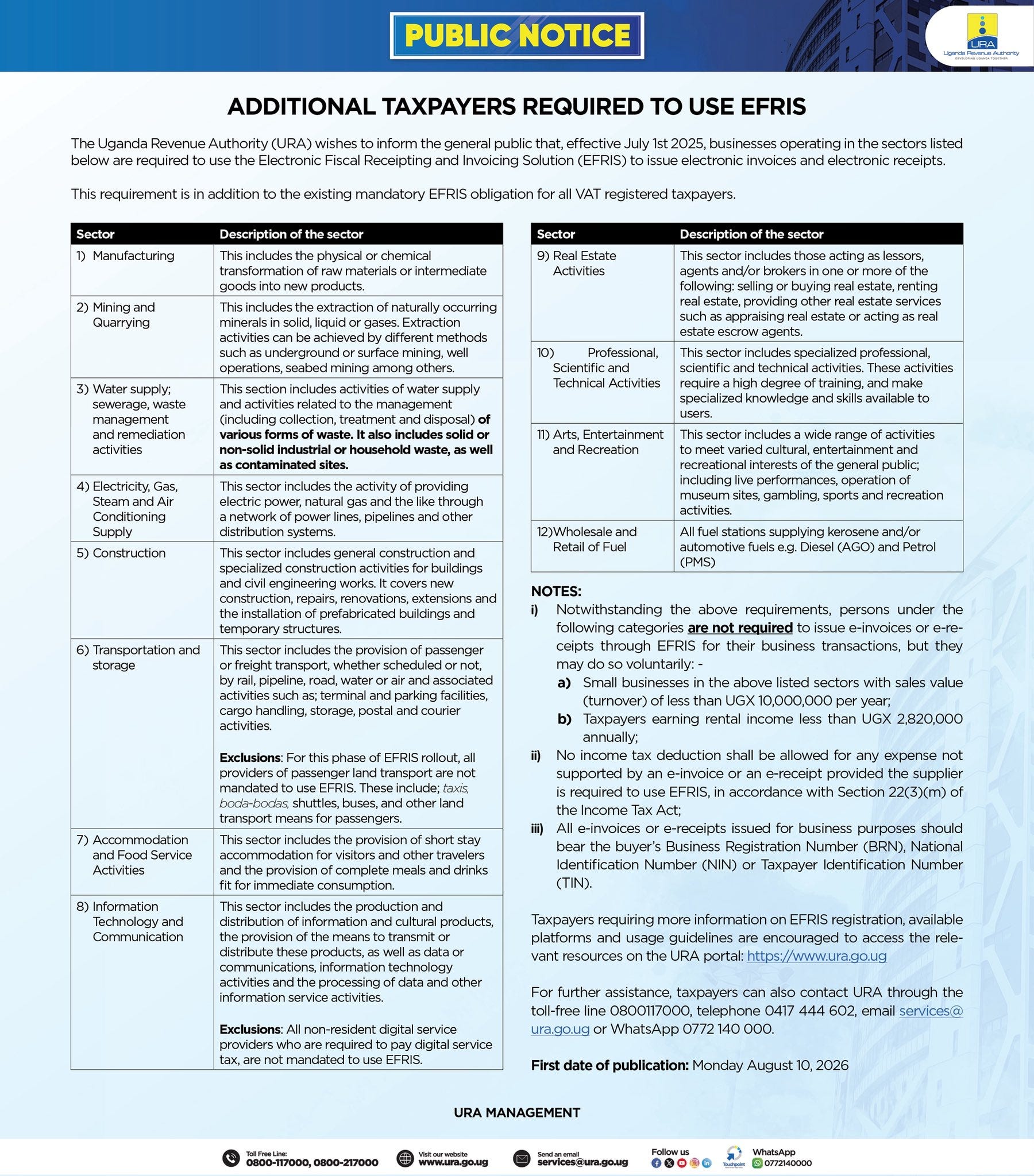
The new EFRIS notice covers a wide range of industries, including manufacturing, mining, water supply, construction, transport, accommodation, real estate, professional services, arts and entertainment, and the wholesale and retail of fuel.
While all these sectors matter, the implications for real estate are particularly significant because real estate is one of the most common investment choices for Ugandans. Whether someone buys land to hold for future value or constructs rental units—commercial or residential—real estate has long been seen as a reliable and straightforward investment. URA’s new communication, however, signals that the sector is entering a more regulated and closely monitored era.
URA defines real estate activities broadly, covering agents and brokers involved in selling or buying property, renting out real estate, and providing services such as appraisal or acting as intermediaries. This wide definition captures almost everyone participating in real estate transactions, from large developers to small landlords with only a few rental units.
The most critical categories for investors are the selling and buying of property and the renting of real estate, because these activities form the backbone of Uganda’s real estate market and are now firmly under the EFRIS mandate.
Rental income tax has become a major focus for URA since the amendments requiring every landlord to declare rental income and pay tax—12 percent for individuals and 30 percent for companies. Although the law has been clear for years, compliance has remained low. Many landlords simply do not declare rental income, even when they earn more than the UGX 2.8 million annual threshold that legally requires them to pay rental income tax.
The requirement that landlords must issue EFRIS invoices whenever they collect rent is designed to close this gap. Once rent payments are captured through EFRIS, URA can easily estimate how much rental income tax a landlord should pay at the end of the year. Some landlords may assume they can ignore the new rules, but the direction URA is taking suggests that non‑compliance will soon become extremely costly.
There are already discussions within industry circles that banks may eventually require individuals seeking loans secured by rental property to present a Tax Clearance Certificate, just as companies must do today. This would mean that before a bank accepts rentals as collateral, the landlord must undergo a tax audit and demonstrate full compliance. Once the financial sector adopts such measures, tax compliance will no longer be optional; it will become a prerequisite for accessing credit.
URA is also exploring the use of geospatial data from utility companies (UEDCL and UNWSC) to identify rental properties. In many cases, water meters and electricity meters are registered in the names of tenants or landlords, and the number of meters can reveal how many rental units exist on a property.
With modern data analytics and artificial intelligence, URA can map rental properties across the country and compare them with tax declarations. The leadership at URA is forward‑looking, and they have made it clear that they intend to use every available tool to bring landlords into the tax net.
For landlords, it is far better to begin complying now than to wait until URA conducts assessments that may include several years of unpaid taxes. The authority has set ambitious revenue targets for the coming years, and with strong political backing—as seen during the recent enforcement efforts involving traders downtown—it is clear that tax compliance will continue to tighten. Even though not everyone has fully embraced EFRIS, URA is investing heavily in tax education and enforcement to ensure that more Ugandans comply.
For investors, these developments carry two important messages. First, anyone planning to invest in real estate must reassess expected returns. Rental investments can no longer be evaluated using assumptions from 2015, when the sector operated with minimal oversight. If you plan to build a property worth UGX 300 million and expect annual gross rental income of UGX 25 million, you must now factor in rental income tax, repairs, and other costs.
After paying 12 percent tax and accounting for expenses, your net return may fall to around UGX 15 million, which translates to a net yield of about 5 percent. Investors must ask themselves whether such returns still justify the investment. Second, landlords who already own rental properties must evaluate the cost of non‑compliance.
If URA audits your property and determines that you owe rental income tax for the past three or four years, the financial burden could be severe. It is far wiser to register, update your tax records, and begin paying rental income tax now.
Happy Investing Everyone
Alex Kakande
Comments
Nothing yet. Say the first thing.
Sign in to join the conversation.