
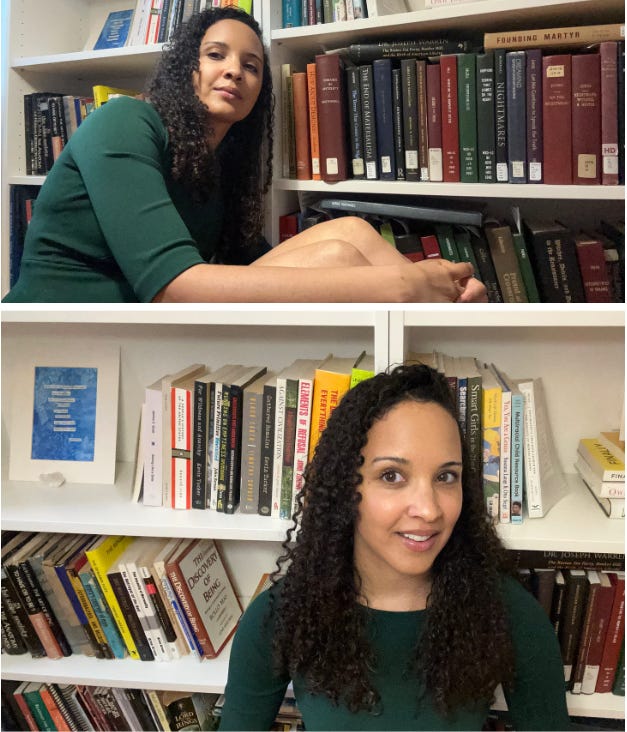
I’m writing to share that I’ve decided to change the name of this Substack from “Pandora’s Vox” to “The Heart of Knowledge.” Allow me to explain.
In the essay with which I began this Substack, I reflected upon the overwhelming need I felt at the time to “open vocal channels” I had largely kept closed during my initial years of doctoral study. There I commented that I was striving to create a space to house the types of expansive exploration that is both natural and vital to someone like me, but had been somewhat attenuated by the extreme demands on my time and mental real estate amid the disciplinary gauntlet that is PhD coursework and high-stakes oral examinations. In my department—the Department of History of Science at Harvard—these general examinations (often known as “comprehensive” or “qualifying” examinations elsewhere) require that the student reads hundreds of books and is prepared to answer questions that a panel of three faculty members poses in real time for a couple of hours straight. And if students do not perform well on this exam, they are generally asked to leave the PhD program. If students pass, they are permitted to begin teaching and working on their dissertations—or what will generally become their first scholarly book. Preparing for this exam was a yearlong process and by the time I reached the final weeks, I could think of nothing else as I studied and practiced nonstop from the car to the shower to the treadmill.
After this level of nonstop preparation over a period of months, realizing that the exam was over and that I had passed didn’t feel real at first. By contrast, it felt as though I had been unplugged from the Matrix or awakened from a years-long dream. I was pulled into a brief impromptu celebration in my department complete with champagne, and though I greatly appreciated this, I continued to feel off balance until I was alone and took deliberate action to feel like myself again.
This action was wandering over to the Cambridge Public Library to read books on any subject I wanted. In other words, not just the 200 or so books on the reading list that had largely circumscribed my activities for the year in which I prepared for the exam.
If you’re asking yourself what kind of unhinged person completes such a major milestone only to venture to the library moments later in search of more books, well, I am apparently that person and welcome to my corner of the internet. 👋🏽

The contents of the Cambridge Public Library and regional library system is one of the many reasons I’ve loved living in and adjacent to Cambridge for over a decade. The photo I took that day of the section of the public library devoted to texts on epistemology seems to suggest something about the intellectual climate and tax base that surround this library. But despite the practical implications of living in such a place (read: exorbitant rents and very high taxes), I’ve been happy to do so because living in a place where the general population values intellectual pursuits has helped to maintain my mental health.
Epistemology refers to the branch of philosophy concerned with how we know what we know and is of great interest to me. But the fact that this material sits alongside that concerning dreams and other subjects in texts written by academics and non-academics alike allows for a unique experience of discovery. I would only ever enter the stacks of Harvard’s vast Widener Library with the call numbers for my target books in hand as the volume of material on each subject and layout of the library do not encourage frivolous browsing. Nor does the organization and content of the library encourage swiftly bounding from one subject to another, or from work by an author with academic credentials to someone trained primarily in the school of hard knocks. By contrast, wandering the stacks of the Cambridge Public Library seems akin to perusing some of the greatest hits from an academic library alongside all kinds of other material—like cookbooks, travel guides, and movies—thrown in for good measure and all in close quarters to facilitate ease of discovery.
This victory lap around the public library felt like an inversion of something that critical theorist Jack Halberstam described in his landmark book—and one of my all-time favorite works of theory—The Queer Art of Failure. Quoting philosopher Walter Benjamin’s Selected Writings 1913-1926, vol. 1, Halberstam writes:
“Training of any kind…is a way of refusing a kind of Benjaminian relation to knowing, a stroll down uncharted streets in the ‘wrong’ direction (Benjamin 1996); it is precisely about staying in well-lit territories and about knowing exactly which way to go before you set out. Like many others before me, I propose that instead the goal is to lose one’s way” (p. 6).
For me, this stroll in the “wrong” direction à la Benjamin and Halberstam was a necessary act of celebration and personal rebellion—and one that brought unexpected gains.
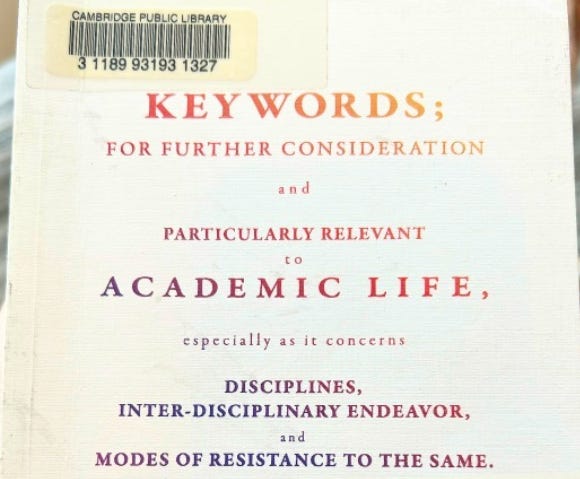
As I wandered the stacks of the Cambridge Public Library, I stumbled upon a short book I had not encountered before—Keywords; For Further Consideration and of Particular Relevance to Academic Life, &c. (2018)—that had been penned by a group of students and faculty associated with the Interdisciplinary Doctoral Program in the Humanities at Princeton.1
The text covers a lot of ground, but of greatest interest to me is the authors’ discussions of the relationships between love, knowledge, mastery, and disciplinarity in academic life. This discussion unfolds across distinct definitions they provide in this glossary-like book for the terms “expertise,” “amateurism,” and what they term “the amateurism of experts.”
They write the following of “expertise”:
“...The expert, as the ‘knower of,’ may find his/her inverse in the AMATEUR, or ‘lover of.’ It is characteristic of expertise that the expert has repressed his/her affection for a topic in order to acquire, sharpen, and demonstrate a mastery of it. Whether it is formally contradictory or merely unusual for knowledge and love to conciliate…remains a contested question” (p. 26).
They also write the following of what it means to be an “amateur”:
“The enthusiastic lover of some domain; hence, for practical purposes, the opposite of an expert… The expert is responsible to the protocols of a DISCIPLINE, wherein objects of study exist to realize methods for knowing them. The amateur is responsible to the object of study itself, if he/she is responsible at all” (p. 3).
Finally, they reflect upon an intermediate concept, “the amateurism of experts,” which they define as “inquiry by a trained mind in a field for which the mind is untrained” (p. 3). Though perhaps counter to the intent of the authors, I would extend this inquiry to the contents of one’s own field and underscore the role of love as a way of knowing.
Later that year, I was delighted to stumble upon the pedagogical scholarship of retired Amherst College professor Arthur Zajonc on this very topic. In Zajonc’s paper “Love and Knowledge: Recovering the Heart of Learning Through Contemplation,” he writes:
“[K]nowing itself remains partial and deformed if we do not develop and practice an epistemology of love instead of an epistemology of separation. Harvard’s motto is Veritas, or Truth. Knowing is, in this view, the central project of higher education. I maintain, however, that truth itself—veritas itself—eludes us if we bring to the world and to each other an epistemology of separation only. Our conventional epistemology hands us a dangerous counterfeit in truth’s place, one that may pass for truth but in fact is partial and impoverished… Although I am emphatically not calling for a rollback of science, I am calling for resituating it within a greater vision of what knowing and living are really all about… Such contemplative inquiry not only yields insight (veritas) but also transforms the knower through his or her intimate (one could say loving) participation in the subject of one’s own contemplative attention” (p. 1744).
Seen through this wider prism, the apparent contradiction of terms in “the amateurism of experts” offers an even richer provocation:
How does one become an expert who loves? That is to say, how does one become an expert who is prepared to be transformed by what they find within and without and, potentially, follow the resulting trail of breadcrumbs in the “wrong” direction? And can one remain available to this current of insight without allowing it to be extinguished or bastardized by our rituals of mastery and attempts to manufacture order?
Though I began engaging in various experiments propelled by these kinds of questions nearly 10 years ago, the question of how one does this as a professional academic and collegiate instructor had emerged as fresh challenges and open questions for me, and I was hungry for answers.
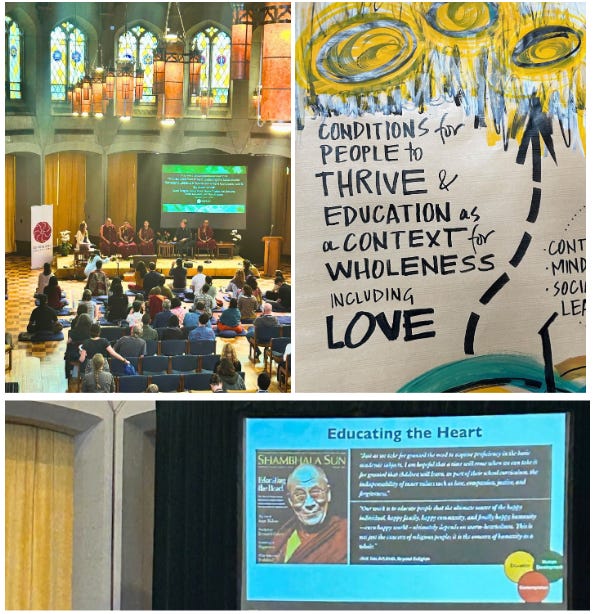
Months later as I was beginning to envision this Substack, I was thrilled to be selected to attend the Summer Research Institute of the Mind & Life Institute—an organization co-founded by the 14th Dalai Lama that is dedicated to promoting contemplative inquiry and where Zajonc previously served as president. I attended the event in hopes of meeting colleagues who share my concerns, learning about contemplative pedagogical approaches to higher education, and witnessing presentations that could enrich a scholarly article I anticipate publishing as an offshoot from my dissertation.
I enjoyed witnessing presentations by scholar-practitioners including Angel Acosta, Dr. Michelle C. Chatman, and Meena Srinivasan—the last of whom made a statement that has stayed with me since.
She said something to the effect of this: “the educator cannot give from wisdom they have not lived.”
Though this insight did not offer a concrete roadmap for reconciling the paradoxical demands of love and expertise, it reinforced my conviction that it’s my responsibility to begin sharing what I know and the spirit in which I know it, rather than waiting for approval or consensus.
In an effort to select a title for this Substack, I mentally referenced the mythological figure of Pandora due to her singular relationship to knowledge in its most expansive, forbidden, and feminine forms. Riffing on the well-known concept of “Pandora’s box” in which raising an unwelcome question is imagined to invite calamity, I selected the name “Pandora’s Vox” in reference to my desire to practice speaking in a voice (“vox”) that has recovered these elements as vital dimensions of knowing. As I articulated this agenda, I concluded with the sentiment that…
“to open Pandora’s vox is to practice speaking in the voice of the undisciplined adventurer, the expert who loves, and the lover who probes deeply.”
I remain committed to these principles, but have decided to change the name of my Substack and demote the mythological figure of Pandora from the organizing metaphor for my platform to more of an archetypal thought partner.
Why? Deciphering the meaning of the previous title requires considerable intellectual scaffolding, familiarity with the “dead” language that is Latin, and multiple creative leaps to divine its connection to the various concrete topics I discuss here. Though I very much like “Pandora’s Vox” as a concept and may use it for another purpose in the future, I’ve concluded that adopting a more accessible title for my Substack will ultimately help more of the people who may be interested in my work find and make use of it.
When I share stories like the one about my post-exam victory lap around the public library or even my decision to start this Substack, I often get questions like “what compels you to do such things and have you always been this way?”
My abiding interest in probing what I’m calling the heart of knowledge emerged from the convergence of my atypical levels of curiosity and persistent experiences of frustration in moments when I felt that expert knowledge simply rang false or, at the very least, hollow.
One manifestation of this began surfacing in high school when I visited doctors to complain of mysterious ailments that exceeded their limits of competence as practitioners. This statement is not meant to insult their intelligence, but only to observe that they were operating within a system and with training that had not equipped them to think or intervene at the level of the problem as it is experienced by a real person living in a body. In other words, they had been trained to ask questions, apprehend imbalances, and stage interventions bound only within particular organ systems and/or evidenced by certain types of empirical observation. Though these frameworks and their associated tools are valuable, any manifestations of illness or dysfunction that transcended a single organ system or was otherwise difficult to quantify effectively evaded the understanding (and even acknowledgement) of the average medical specialist. Their training had also not equipped them to recognize my testimony as a valuable source of data alongside other sources of data such as lab results, statistics, and the physician’s immediate observations of my body.2
In college, this area of concern expanded to include new dimensions—this time, related to the practice of education and the content of the knowledge that matters. Though I was extremely fortunate to attend Swarthmore College—an institution known for its intellectual intensity and attracting students who are equally dedicated to social action—I struggled with one widespread feature of higher ed pedagogy that I encountered there. By the final year of my studies, I had become deeply frustrated by the lack of integration of critical inquiry with introspection and attention to the deeper, formless wisdom that can only arise from experience. The persistent disjunction between thinking and feeling, external description and interior affectivity, had begun to take its toll on me personally, and I became deeply concerned with the broader social consequences of this widespread educational approach.3
I also suspect that my frustration with prevailing practices was amplified by comparison with my experience studying with my visionary high school teacher F. Christopher Reynolds. He and his collaborators have pioneered pedagogical approaches that reimagine education as a rite of passage, integrating depth psychological inquiries into purpose, identity, and creativity into coursework as central pedagogical goals.4 After having been so inspired by how multidimensional and depth-oriented education can be through this early experience, my frustration with mainstream approaches led to an existential reckoning with the function of my academic pursuits. This was followed by a deep foray into the philosophy of education and numerous “alternative” approaches to education before I resolved to try my hand at a path more explicitly oriented toward healing.
My frustration with surface-level inquiry in academe led me into the professional world of psychotherapy for a time where I hoped the tension between critique and the affective dimension would be easier for me to reconcile. In the course of my training and care work, however, I found this hope to be misplaced. This challenge had many dimensions but included the ways in which I became an object of inquiry and fascination in the course of my training in a manner that was inflected by racism, sexism, and neurnormativity. This was a context in which my knowledge and other features of my intellectual presentation became objects of ridicule for some of the people training me. I won’t reconstruct the whole story here, but a key takeaway was that the unfolding events revealed the enduring purchase of the notion that Black people cannot be highly intelligent, and that any Black person who shows up in this way must be engaging in a fraudulent performance indicative of mental illness.5
Though these events that unfolded over a few years were immensely damaging and entailed significant losses, they were also generative in that they cemented and expanded my longstanding interest in the meaning and politics of knowledge. Further, the events also helped to set the stage for my current doctoral research on the history of the field of Black Psychology and some of its many implications for the history of knowledge.
For nearly 10 years now, I have been engaged in experiments dedicated to freeing consciousness from various types of enclosures including mainstream sites of learning and healing, and prevailing ways of knowing that devalue bodily knowledge (and other extracognitive intelligences), disavow neurodiversity, and obscure our place as vital components of an intelligent, living world. My portfolio of projects past and present speak to these broad concerns in multiple registers and locations: on abstract and embodied levels, from the traditional classroom to the forest floor, and with audiences ranging from the general public to communities whose knowledge practices have been devalued and misrecognized.
Across the various conflicts and creative experiments described above, my life experience has continued to show me how urgent it is that we cultivate the emotional and intellectual muscles to welcome irruptions of mystery that destabilize the presumed order of things. This could be a physical symptom that confounds diagnostic frameworks, or a person whose seeming strangeness bespeaks a wilder, weirder world than one’s tidy worldview allows. And if—like me—you come to recognize yourself as one of these seemingly strange people, we can choose to become the irruptions of mystery that help to beckon the whole along another course.
This inner mandate has inspired me to approach my scholarship, writing, teaching, and other public-facing work in a manner that is not solely about the history of knowledge, but also the heart of knowledge. By this, I mean engagement with knowledge in a manner that invites awakening, demands integrity, clarifies purpose, elicits courage, deepens personal resources, and overshadows artifice through indivisible presence. It’s the vital core of knowledge that arises within and as us when we’re at our best.
I look forward to sharing more highlights from my journey into the heart of knowledge and hope that this renamed Substack will offer me a more robust container within which to share it. For the most up-to-date overview of the work I’m doing and the segments in which I’m covering them on this Substack, visit the About page.
Thank you for supporting my work and please let me know in the comments about an experience big or small that transformed the way you look at knowledge in your own life and/or the world around you!



The Heart of Knowledge is a user-supported publication. Please kindly consider becoming a free or paid subscriber to support my work:


ABOUT THE AUTHOR
Kaitlin Smith is a scholar, transformational educator, and consultant completing a Ph.D at Harvard in History of Science and African American Studies. She helps students, organizations, and everyday people transform through humanistic inquiry and introspection.
Notably, Harvard’s library system does not carry a copy of this book, though it was published by an academic press and was purchased by the library system at MIT.
One of the most resonant parallel stories I’ve encountered was penned by physicist Arthur Zajonc in The Heart of Higher Education: A Call to Renewal (2010). There he describes experiencing a similar existential crisis during his own undergraduate studies, questioning his relationship to these spaces of learning, and eventually teaching an interdisciplinary seminar that offered a model of more holistic inquiry titled “Eros and Insight.”
Comments
Nothing yet. Say the first thing.
Sign in to join the conversation.