
Chii migwetch for everyone’s response to the first post, for being here to listen and hold space. As I am sure many of us know, grief is not easy. It comes in so many shapes and sizes, and I tend to think of Grief as someone who comes to visit now and again.
When they knock on the door, we may as well answer.
I just want to touch on a few stories today, and we can thread our way through them together. Maybe it won't make sense, because it’s not linear, but time moves differently than we think.
So let’s lean in and see what the spirit of Story has to speak to us.
I led an event recently with another Indigenous woman, and we were sharing this knowing that as soon as the event ended and we went inside for a break, we’d get bombarded with questions that stem from the sentiment of I didn’t really know there were Native people around here followed by questions that deeply reflected that.
I was getting snacks at a table and in small talk fashion the woman turned to trauma as a point of conversation. Didn’t I hear the story on NPR? she asked. No, I said, but that kind of violence happened throughout history at boarding schools to Native children. Oh, but things are still happening today! she replied.
I found an excuse to walk away.
This is an interesting phenomenon, and I don’t know what to call it, so I’ll name its essence: it’s performative ally-ship, centering the non-Native person as being educated and caring about things happening to Indigenous people by bringing up something traumatic in conversation to impress us.
Except, it’s backfiring, because it’s not impressive. It’s traumatic.
Let me say it like this: when I look into the eyes of a stranger, of a new friend, of someone who wants to position themselves as an ally to Indigenous people, I want to be respected for the wisdom and history I hold in my body, culture and lineage, and then I want to ask how we can move forward together.
I do not want to have conversations about our trauma. We teach on it all the time. We live them constantly, flowing through our bloodstream, our consciousness. We share those stories all the time, and when we break from sharing those stories, we want peace.
I live only a few hours away from Carlisle, Pennsylvania, where the first Indian boarding school was created.
When we drive through Carlisle, we flip off signs. We turn the music up louder. We seethe.
And part of that seething is that people don’t know. They don’t know the history of boarding schools, how so many of our ancestors went there and, if they weren’t killed, were deeply severed from their cultures. This is the America we carry.
It started with Carlisle and spread to over 500 operated schools across the country, some still open, yes, still operating, but the trauma living, living, living in our families, in our bodies.
Some facts about Carlisle:
over 10,000 Indigenous kids forced to go there
around 200 died while attending, though, like many boarding schools, the number could be higher
created by that fucker Army Captain Richard Henry Pratt who coined the term “Kill the Indian Save the Man”
it is now a monument and army war college
Barding School Healing Coalition
We’ve been told the American Revolution was fought over taxes and representation. But the last complaint, the thing our founders were most angry about, goes like this.
He has endeavored to bring on the inhabitants of our frontiers, the merciless Indian savages.
He has endeavored to bring on the inhabitants of our frontiers, the merciless Indian savages.
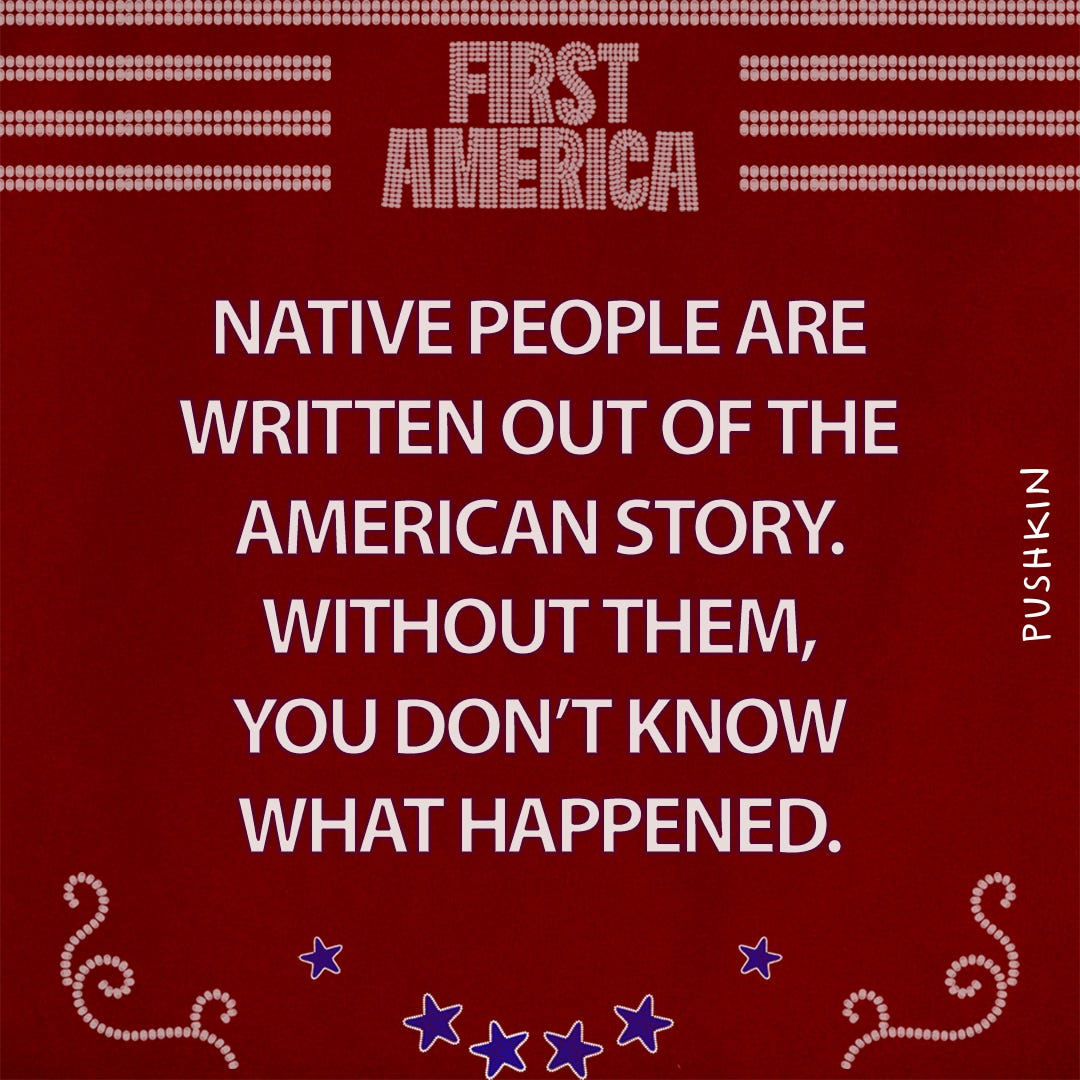
There’s a racial slur in the Declaration of Independence. Nativepeople are called savages. Alongside those lofty ideals, our founders included their deep hatred for Indigenous people.
Maggie Blackhawk (Fond du Lac Ojibwe), New York University
Ned Blackhawk (citizen of the Te-Moak Tribe of Western Shoshone), Yale University
Phil Deloria (descendant of the Standing Rock and Yankton Sioux tribes), Harvard University
Nick Estes (citizen of the Lower Brule Sioux Tribe), University of Minnesota
No posts
Comments
Nothing yet. Say the first thing.
Sign in to join the conversation.