
“There’s a fine line between madness and genius.
You know how it goes.”
—the author
“This thing is completely broken!” the surveyor of Camp Commie told me, exasperated. I was standing in the camp’s command tent, where all the official camp business was conducted. Leaning against a support pole was, to my dismay, one of those silver automatons that printed ticker tape from their fingers. It was printing now.
“Look at this!” the surveyor of Camp Commie said to me, and held up a strip of paper thirty feet long. “It’s been printing and printing and printing. 0 0 1 0 0. 0 0 0 1 1. It’s binary. But I’ve translated it, and it’s total gibberish!”
I took a look and, though not fluent in binary, had to agree.
“So have the guides agreed to take us up Mount Commie?” I asked him.
He was still staring at the ticker tape feed with hands on his hips. “What? Oh. Sure.” He fixed me with a beady eye. “Do either of you have any experience in mountaineering?” he asked.
“I don’t,” I said. “I don’t know about my boss.”
“Hmm,” he said, and waved a dismissive hand. “Don’t worry. You don’t need any. You’ll be following the path the whole way.”
“Path?” I said, relieved. “So there’s no climbing?”
“Well, no,” the surveyor said. “Just advanced hiking, if you like.”
“No problems, then,” I said, and clapped him on the back. “See you in the morning!”
* * *
In the morning, the guides met us over breakfast. “Anyone else coming with us?” I asked them, and they shook their heads. “Just you two,” they said.
They hoisted onto their backs heavy packs, stocked with clothes for themselves and for us on the cold mountain trail, along with hiking equipment and, mainly, food.
“How long is it going to take to get there?” I asked with trepidation.
“Not too long,” they assured us. “These supplies are for the hermit. A week’s worth.”
“Supplies for the hermit?” I said, surprised. “Nobody mentioned that.”
“Well, of course, someone has to feed him,” the surveyor of Camp Commie said, appearing at the flap of the command tent. “He’d die up there on his own!”
“Sometimes,” one of the guides added, “especially when nobody goes up there for a while, he gets bored and comes down here, to camp.”
“A fine time we have, those days!” the other said. “He’s a character.”
“Come in here a second,” the surveyor of Camp Commie said to me, beckoning. He looked enthusiastic about something. “I’ve figured it out,” he went on. “The puzzle, that is. It took me all night but I figured out what it means.”
“Really?” I said. “What does it mean?”
“Well, actually, I don’t know yet,” he admitted. “But look here.” He held up a length of ticker tape. “If I cut it every twelve inches, like so, and line them up on my desk over here like so, look at this, eh?” We looked. The zeroes and ones made a pattern that looked like a random doodle.
“And then, if I take every 100 lines and call that a ‘section’, and then I line up the sections side by side, left to right, eh, for twelve feet, eh, then what, eh?!”
“Then what?” I agreed.
“Don’t know yet,” he said. He tapped his own nose. “But I’m on to something. I can smell it.”
“Right,” I said. “Good luck, and see you soon.”
* * *
The guides got in one of the trucks belonging to the surveyor of Camp Commie and drove us to the base of the mountain. They talked the whole way, over cups of coffee and Joe’s syrupy pancakes.
“It’s not like we’re sherpas,” they explained, when I asked if they should walk to the base of the mountain if they were going to do it properly. “Those guys live on a different continent.”
“So how did you become a Mount Commie guide?” I asked him. We’d stopped and gotten out and were putting on our jackets and snow boots. He handed me a pair of hiking poles. “It doesn’t seem like the sort of job you hear about in the classifieds.”
“I fell into it,” he said, putting on a hat. “Literally fell into it. I was on vacation, climbing Mount Commie, and I fell and got stuck in a snowbank. Luckily the hermit found me, and when the guides before us came with the weekly supplies, they took me back to camp. I decided I liked it here so much I’d stay until the day I didn’t like it anymore.”
“So you like it a lot, huh,” I said.
“Oh yeah,” he said.
“And you?” I asked his companion. “Same story?”
“No. I was on a wildlife relocation mission, and I got my leg eaten by a lion,” he said. “I was using it as bait in a trap, you see, and I didn’t pull it out quick enough.”
“Sad times,” I said, and he nodded, and showed me his peg leg.
“What about you?” the first asked me. “What did you do before you worked for the Africa Kit Society?”
“Oh.” I paused to think about that.
“He was going to become the world yoyo champion,” Serena Mayfield cut in. She’d been unusually quiet since we left Marilyrilarilyn’s Safari, and spent the morning thus far in silence. She was already dressed for the snow.
“Well, how d’you do,” the second guide said.
“Everyone got their hiking poles?” the first guide said. He had stuffed all our unnecessary things in a big metal locker beside the trailhead. He hoisted his pack. “Let’s go!”
* * *
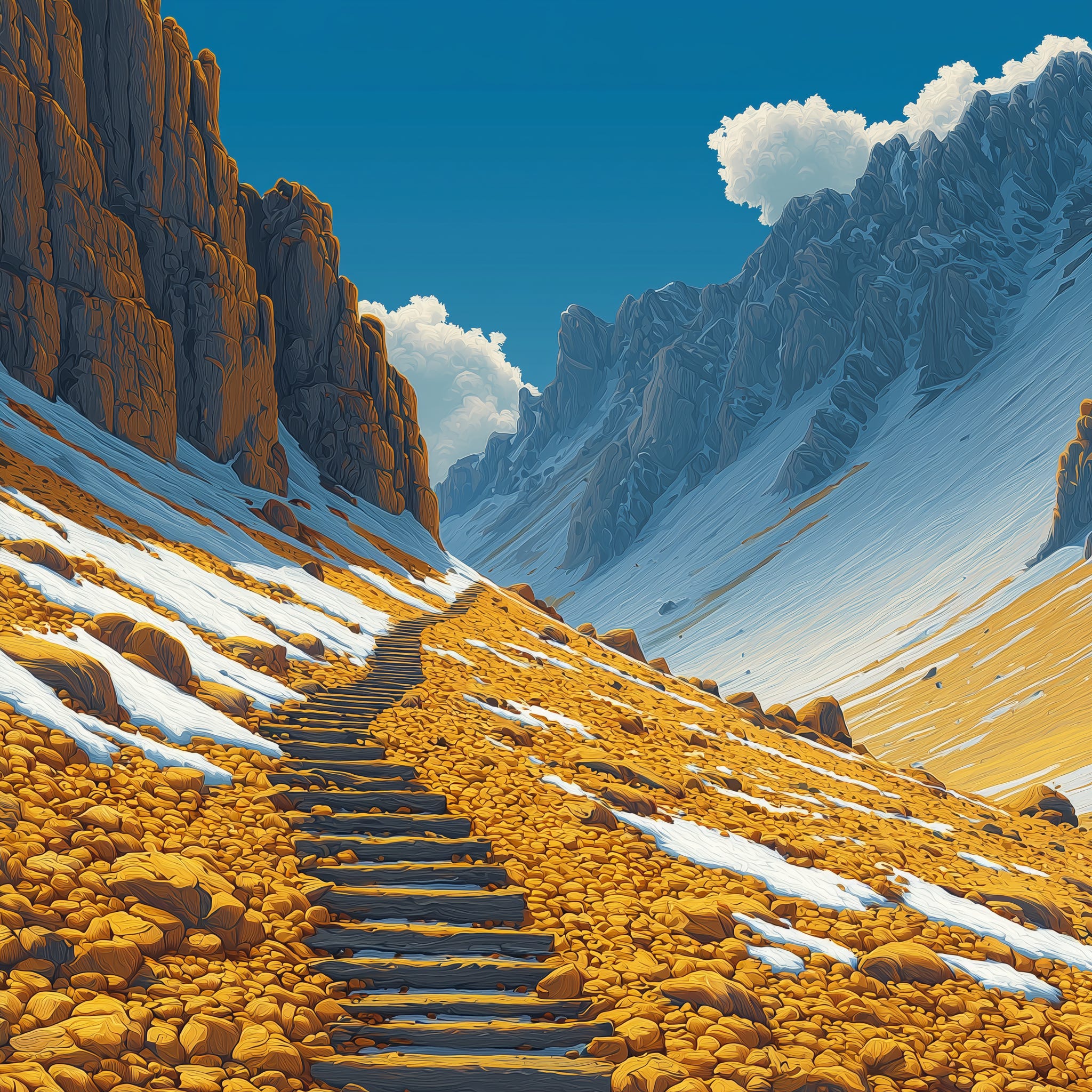
The trail up the mountain was about four feet wide and made of hard-packed dirt. Every hundred feet or so stood a pair of unlit torches: one to each side of the path. And when we reached the snowline, after a couple of hours, the torches became interspersed with colored flags.
“Red ones mean danger,” one of the guides explained. “Red means ‘go an alternate route’. Since there is no alternate route, we never put out red flags.”
“What if it’s dangerous?” I asked.
“We’re the only ones who go up here,” the other guide said. “So we’d already know.”
“And the hermit?” Serena Mayfield chipped in.
“Oh,” said both the guides at once. They half laughed, half snorted, and shrugged. “We never thought of that,” one admitted. “It’s a good thing you came along.”
“We’ll start putting the red flags out now,” the other said.
“Except he doesn’t know what they mean, since we’ve never used them before.”
They both stopped for a minute to think about that.
“Let’s have a coffee break,” the first suggested, so we stepped off the path at a relatively level spot. Serena Mayfield and I started to look for firewood, but the guides shook thermoses under our noses.
“Nothing like a proper cup of coffee,” the first said as we drank from our thermoses.
We looked down at the African savanna, an endless stretch of gold and brown dotted with crooked squiggles—trees. The clump of odd shapes straight ahead was Camp Commie, and just vanishing out of sight around the mountain to the east was a tiny grey and black snake—the Marilyrilarilyn Safari.
I tried to imagine how far out of sight Walm was, and how high I would have to go to see it, but in the end I gave up. I didn’t want to be there anyway. What did Walm have to offer me? Nothing, that was what, not even my old vending machine. Someone else was probably standing there now, in my spot on Public Works Way. In fact, it was probably Joey Brunoe, forced to take a job now that he didn’t have any friends to mooch beers off of. I tried to imagine him in a vending machine. Even in my imagination, he didn’t fit.
* * *
At the top of the mountain, which took all of the day to climb, we set down our packs to rest. We weren’t actually at the top—that was a long way to go, in point of fact, and there wasn’t a convenient path there, because we’d reached the spot where the hermit lived and no one had bothered climbing any higher.
The hermit lived in a cave, the entrance to which we now stood at, a deep recess in the rock. A guttering candle placed in a hollow of the wall was the only light.
The doorstep was a big flat slab of rock, which it looked like someone had swept recently. The snow bore telltale bristle marks, and I found a bristle.
“So the hermit,” the first guide said, “lives in there.”
“Do we need to make an appointment?” I asked. “Or can we just barge in?”
Serena Mayfield wasn’t going to wait for an answer to that question. I knew because she swept past me, took the guttering candle from the hollow of the rock, and disappeared into the dark.
“Should I… I ought to go after her,” I said hesitantly.
The guides shrugged and unloaded their supplies at the mouth of the cave, then tromped off around the corner to a storm-proofed hut they’d built for themselves and for the hermit, when the weather got so bad he couldn’t live in the cave anymore.
In a few seconds smoke drifted from the chimney, which was a stack of tin cans topped with a bent plate. They were probably making more proper coffee. I could use a coffee.
But Serena Mayfield, the most beautiful woman in the world, was in the cave.
I shook my head, displacing snowflakes, clenched my jaw, squared my shoulders, and plunged into the darkness after her.
* * *
She was waiting just inside, around a bend in the cave that had hidden the light of the candle.
“There you are,” she said, and gave the candle to me. “I wondered what you were doing.”
All along the walls of the cave, someone had carved out hollows in the rock, and in each hollow stood a candle, its flame burning steady and serene. The only wind to stir the flames and make our shadows dance was from our own passing.
“I like it already,” Serena Mayfield said. “I think we’re in for a surprise.”
The cave wound gently downward, curving like a corkscrew. The temperature rose the further we went, and near the bottom we both took our jackets off.
The cave leveled out at a potato-shaped room. In the center of the floor, growing through the solid stone, was a closed lotus, its petals six feet tall and brilliantly white. There were no lights in the room, but the flower gave off its own glow.
“I don’t think anyone’s here,” I said, making a complete circuit around the room without seeing anything.
“The hermit’s here,” Serena Mayfield said with certainty. “He must be in the lotus.”
“He might be meditating,” I said. “We shouldn’t…”
Serena Mayfield had other plans, though. She went straight to the nearest petal, grabbed hold of it at the top, and pulled it down, towards herself. It clattered when it hit the stone, like hard plastic.
“Are you going to help, or stand there like a human vending machine?” she asked me.
“It feels like vandalizing something sacred,” I said. “It doesn’t seem right.”
Reluctantly, I pulled on the nearest petal. It was plastic, and on closer look, the light it gave off came from an electric light in the ceiling.
I wrenched the petal from the fake lotus and tossed it on the ground. It was all fake.
“Why on earth would the hermit be in here?” I asked the room at large, after we’d been stripping lotus petals for half an hour.
“I have no idea,” Serena Mayfield said. “To make the quest seem more important, I suppose. So that it was really worth the effort.”
“I think I see something,” I said hopefully, and with an almighty tug the two of us removed the last lotus petal. All that remained was a teardrop-shaped shell, about three feet high.
I tapped it gently and the whole thing shattered.
“Good god!” I cried. Serena Mayfield’s mouth had dropped open, too.
Inside the shell was a man, a man sitting on his behind, cross-legged. He had his hands at his sides, the thumbs and forefingers pinched together. He had unnaturally bright frizzy orange hair and looked like he was about a hundred years old. He was humming.
His brow furrowed and he cracked one eye.
His lips burbled. “I wasn’t expecting you!” he said.
“It’s a surprise all round,” I assured him pleasantly.
“You’re the hermit?” Serena Mayfield asked him uncertainly.
“I suppose so,” the man said, equally uncertainly. “But that’s not all I am.”
He stood up and bowed to us, then took each of our hands in his and made a sandwich with them. He looked each of us in the eye.
“Welcome to the Cave of Serenity,” he said. “I’m Dayton Modwell.”
Comments
Nothing yet. Say the first thing.
Sign in to join the conversation.