
“CLASSIFIED: POTENTIAL VEINS.”
—classified guide to gold seams in the African region
“Mr. Joe, Mr. Joe,
you know he likes to eat them nice and slow.”
—famous song
In the morning over breakfast pancakes at Mr. Joe’s Extra-Syrupy Pancakes, Serena Mayfield told me a secret.
“I’m done with it,” she told me. “Completely done with it.”
“Done?!” I cried. “You don’t mean it!”
“I do,” she said.
“No!”
“Truly,” she said.
“Well, I’ll be damned.”
After that, we ate our pancakes in silence.
* * *
What she meant, of course, was that she was done with being the world’s most beautiful woman. Done with the fame and the fortune. She was giving it all up to stay in Africa. That was the real reason she’d come to Africa in the first place. She wanted to travel, and hoped to find a new calling in life.
“If that doesn’t work out, I can always go back,” she explained. “But I can’t. I couldn’t.”
I couldn’t wrap my head around the notion. She had everything—everything! Fame, fortune, power, beauty. And she didn’t want any of it, would give it all up.
And I? I was a homeless, friendless, penniless, volunteer charity worker on the run with her—wanted for kidnapping. All I had was my cardboard box, never opened, a bottle of Swamp du Vinegére, and a bag of my dead friend’s things. I couldn’t go back to the civilized world, even if I wanted to. Not in Africa, not anywhere in the world, not as long as she was in Africa. Not until she could step forward to clear my name.
What had started as an innocent hijacking had turned into a hornets’ nest and a spider’s tangled web. No longer were we merely making for Camp Commie, there to learn what her fake father had wanted us to know, thereafter to go our separate ways. No: I was stuck with her, now, for better or worse, until she changed her mind.
* * *
The surveyor of Camp Commie told us about the history of the area; about the various efforts made by various humanitarian causes to make improvements; about the Africa Kit Society; about Charity Food, which many local people suspected was just a front for a mining company; and about Camp Commie itself.
“And then there’s the Hermit,” he said, and Serena Mayfield’s eyes brightened.
“Hermit?” she asked.
“The Hermit of Mount Commie,” the surveyor said grandly, clasping his hands behind his back and beginning to pace.
“Can we see him?” Serena Mayfield asked.
“Anyone can see him,” the surveyor said. “Anyone, that is, who makes the climb up Mount Commie!”
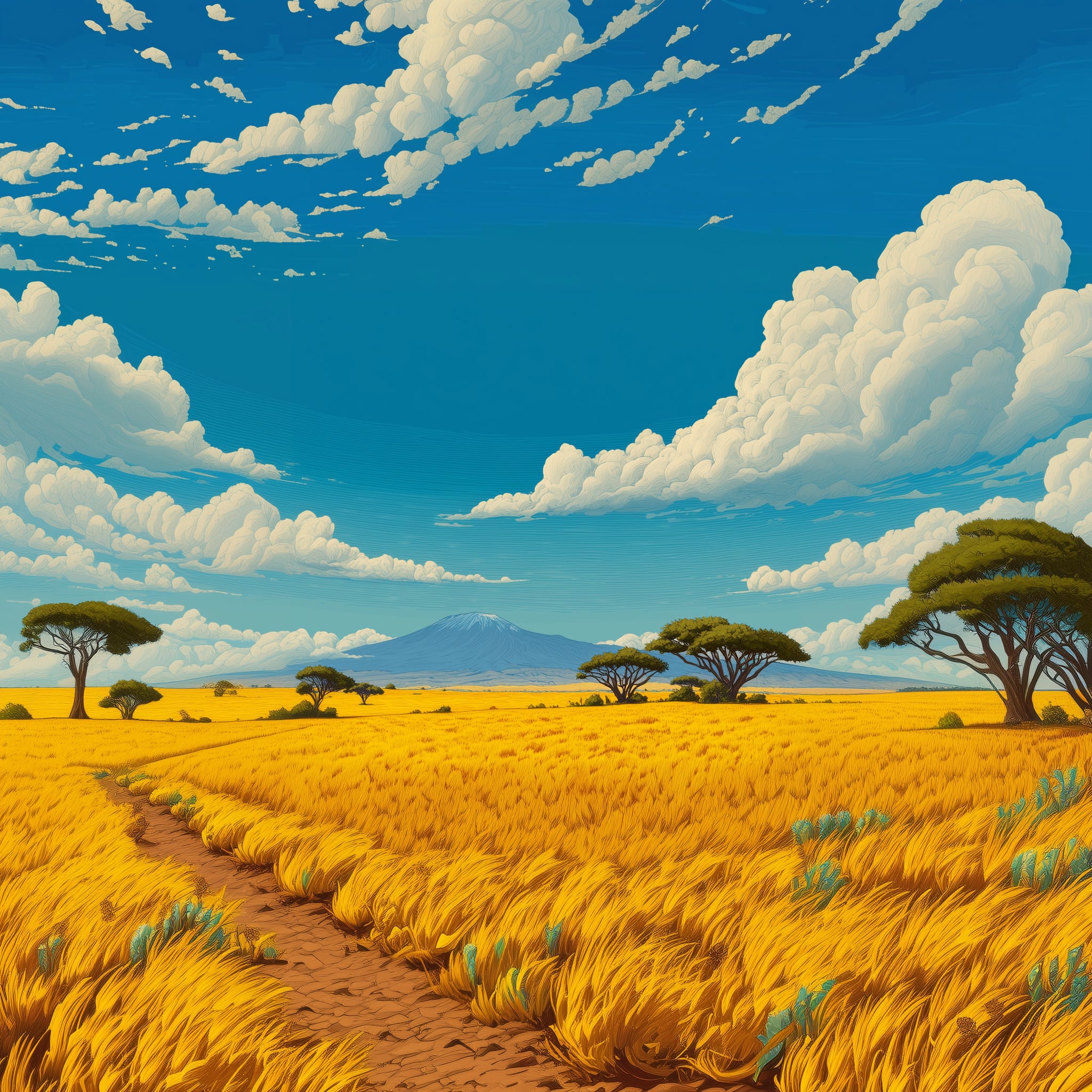
Our three heads turned as one to look at the snowcapped mountain. The wind picked up and lifted the snow like a blanket, making Mount Commie seem mysterious and forbidding.
“I don’t know about this,” I said.
“When can we set out?” Serena Mayfield asked.
“I’ll have to check with our guides,” the surveyor said. “They’re not in camp at the moment, but according to my log book, they’ll be down from the mountain this afternoon.”
“What are they doing up there?” I asked.
“Guiding tourists: climbers, magazine people, and various assorted folks such as yourselves,” the surveyor said. “I think there’s a couple of people from the Africa Kit Society up there with them, this time.”
“Great,” said Serena Mayfield. “Do you think they’d be willing to take us there tonight?”
“Heavens, no!” the surveyor said. “They always wait three days between climbs. I sometimes say to them, ‘Why don’t you take a week? Take five days, take four!’ and they always say to me, ‘No, no, we’ll take three days, just like we always do’. They’re stubborn people!”
“What can we do around here for three days?” Serena Mayfield asked.
“Well,” said the surveyor of Camp Commie, “there’s always…”
* * *
“The Marilyrilarilyn Safari!” I cried. “What’s that?”
“Don’t you follow the news?” Serena Mayfield asked. “It was all over the headlines just before I left.”
“I was risking my life on a banana run at the time,” I said, “so I might have missed it.”
“Oh,” she said apologetically. “It’s just that this is big news! Marilyrilarilyn is one of my favorite people. She’s one of the smartest people in the world. She’s certainly the smartest woman.”
“Aye,” the surveyor of Camp Commie agreed. He gave me a newspaper several months out of date. One of the columns in the paper was written by Marilyrilarilyn. I read it.
“Wow,” I said when I’d finished. Just, “Wow.”
“Exactly,” Serena Mayfield said. “There is no one like her. I had no idea the Marilyrilarilyn Safari was so close! Do they accept visitors?”
“They will if I send you,” the camp surveyor said. “I’m one of her biggest fans. Before I moved out here to Camp Commie, we used to correspond. Dear Marillie.” A wistful look came over his face, and it became clear to both of us that he was in love. He took the newspaper back from me and put it carefully in an ironbound chest he kept locked with a key that went in the inside pocket of his shirt—next to his heart. Then he wrote us a letter of introduction and told us to get in his truck.
He drove us east for a couple hours and stopped when the sun was directly overhead. “They’re down there,” he said, pointing.
A few miles distant, down a slight slope, was a train of elephants and six open-top Land Cruisers—one ahead of the elephants, one behind, and two to each side. On the ground with the elephants, little sticklike shapes darted this way and that—the handlers. On top of the biggest elephant, which had six tusks, sat the leader of the safari. He was scouting the land. On top of one of the other elephants, in a sedan chair mounted on the elephant’s saddle, sat Marilyrilarilyn.
We could tell it was her, even from here.
“You walk on down,” the surveyor of Camp Commie said. “And I’ll come pick you up in a couple of days.”
Serena Mayfield and I started down the hill at an easy pace. The safari wasn’t moving very quickly. Behind us, the surveyor started his vehicle and gave a toot of his horn, then turned round and disappeared.
Marilyrilarilyn appeared at the window of her sedan chair. A couple of the stick figures walking with the elephants darted between the Land Cruisers and started across the fields toward us.
We met them halfway.
“Stop, please!” one of them said with a heavy accent. The two of them, a man and woman, wore headbands of thread of gold and necklaces of animal teeth. They each held a spear.
“I am hoping you’ll tell us what you plan to do when you reach the safari,” the first one, the man, said, very politely.
“We’re here to see Marilyrilarilyn,” I said, and handed him the letter of introduction.
“I see,” he said, and handed it to the woman, who skimmed the lines quickly.
“I’ll take this to Marilyrilarilyn,” she said in her native language. I knew that’s what she said because the next second, she took off running with the letter and brought it to Marilyrilarilyn’s elephant. The whole safari had stopped by now.
In a few minutes she ran back.
“Marilyrilarilyn would be delighted to see you,” she said.
“How nice!” the man said. “Marilyrilarilyn is always so nice!”
“This is true,” said the woman.
“Please, come with us,” the man said, and we started to walk, with the two of them in the lead. “There is just one rule,” he went on.
“There are to be absolutely no questions,” the woman said, picking up for him.
“Absolutely none. No questions asked, no questions asked.”
“But wh…?” I began, and they both stopped, turned to face us, and held up their hands as if to ward off evil.
“I sense that you are about to ask me a question,” the man said.
“It is greatly distressing to Marilyrilarilyn to be asked questions,” the woman said. “Back in her home in the United States, she answers questions for a living.”
“So when she is on vacation,” the man said.
“There are to be no questions asked,” they both said.
“If you want to know something, you might say, ‘I am hoping you will tell me why it is you are doing that’ or ‘I wish to know what it is you are doing’, and so on.”
“Then she has the choice whether or not to explain. But it is not a question. It takes practice, patience and discipline,” said the woman.
“When my wife and I first came to Marilyrilarilyn’s safari, we asked questions all the time,” the man told us. “But now, we do not ever ask questions, not even amongst ourselves.”
“What happens if we— I mean,” I said, correcting myself, “I would like to know what happens if a question is asked.”
“It’s a good thing you would like to know,” said the woman. “Husband, I think you should tell them.”
“What will happen, is that Marilyrilarilyn will be upset,” said the man. “She will be very, very upset, and she will lock herself in her sedan chair and not leave the elephant for a week.”
“Won’t she die?” I asked.
“You mean, ‘I would like to know if she would die from doing that’,” the man corrected hastily.
“Yes, that’s what I meant,” I said. This no questions thing was going to be difficult.
“The answer is no, because she has lots of water in her sedan chair,” the woman said. “But we do not like to upset her.”
“And if someone were to ask more than one question, I wonder what would happen then,” I said. The husband and wife looked at each other with pained faces.
“That was too close to being a question for us,” the man said.
“I think you’ll find that, when you spend enough time without questions, they pain you, as well,” the woman said. “My husband and I feel it all the time now, don’t we.”
They both shuddered that time. “We’re learning bad habits already!” the husband said.
“Let’s just say that it could be very bad for Marilyrilarilyn,” the wife said to us. “And everyone else. We all feel the pain of questions.”
“Yes, we all feel the pain,” the husband agreed. “And here we are! Welcome to Marilyrilarilyn’s Safari!”
Comments
Nothing yet. Say the first thing.
Sign in to join the conversation.