
“No bananas, no help.”
—tribal saying
My new assignment—as given by the chief camp aide of Base Camp, following the death of Dan Denny—was refugees. They gave me an hour to shower and pack. I brought my unopened cardboard box, the bottle of Swamp du Vinegére, Dan Denny’s backpack, a replenished Africa Kit, and a pair of flip-flops someone had left behind. They all fit inside the backpack except the cardboard box. Then I said my last farewells to Dan Denny, and closed his eyes. Charity Food would ship his body back to his family in America.
An overland truck with the usual logos emblazoned on its sides awaited me, engine chugging away. I met the driver, a taciturn man with blond hair who didn’t speak English. He ignored my pleasantries and turned on the radio, a Russian station, until it was clear I wouldn’t try to talk again. Then we continued in silence.
After twelve hours, the landscape changed. Or rather, what dotted the landscape changed.
The scraggly trees of the savanna gave way to white tents, row after row after row of them. We drove for half an hour and never saw the end. When the truck stopped, I climbed up to the roof to look. Roads radiated from the truck like the spokes of a wheel, and between them, as far as the eye could see, the white tents stretched on and on and on…
…and on.
While Camp X had been a village of the impoverished at a subsistence level, my new assignment was something different: the displaced and destitute. These people had fled from war, persecution, and natural disaster, abandoning their homes, livelihoods, and sometimes their friends and families. They had crossed jungles, deserts, and savanna, climbed over mountains, waded through rivers, survived monsoons and droughts. They had braved dangers that I, a small town boy from Walm, could only timidly try to imagine. Their troubles made a surly driver, and even the loss of my only friend, Dan Denny, seem paltry and insignificant.
There was another difference, too: This wasn’t a village that a Charity Food camp ran supplies to. This was a camp purpose-built to house these unfortunates. It was called the Wheel. There were no bandits here.
At least, not any African bandits.
* * *
The camp director shook my hand. “Terrible stuff, that stuff that happened,” he said to me, equally supportive and vague. “Absolutely the worst. Still, good to have you here, very good.”
His desk, in the biggest tent in the very center of the Wheel, was littered with maps and charts and diagrams and lists. A report on the top of a stack read CLASSIFIED: POTENTIAL VEINS.
A silver automaton, like the one in the Charity Food recruiting office, glinted slyly at me with its reflective eyes. The blip-blip-blip screen was blank. I didn’t like this one any better than its cousin. It was as creepy as it was inanimate.
“You’ll be happy to hear we have an easy job for you,” the camp director was saying. He poured himself a brandy from a decanter on his desk and offered me one. “Yes, you know all about it, you do. Practically expert.”
“I’m looking forward to it,” I said, with as much enthusiasm as I thought Dan Denny would have had, had he been alive, though with less of the reckless abandon that had compelled me to sign up for this in the first place. “A camp like this, I feel like I can do some real good.”
“You can!” the camp director agreed. “Just the way you were before. You’ll be doing banana runs to the outlying camps. If you care to look at this map, the Wheel is just the largest of several refugee camps. You’ll make the rounds to all of them presently.”
My heart fell. Banana runs, again. And this time, no Dan Denny to do them with me.
“I realize the topic of a partner must be sore for you,” the camp director said.
“It is,” I said. “There was nobody like Dan Denny.”
“Yes, every one of us is irreplaceable,” the director agreed enthusiastically and empathetically in his vague way.
“But I’ll be all right. What’s a little suffering compared to theirs?”
“That’s the spirit,” the director said, and we clinked glasses.
“I’ll manage on my own,” I said.
“Oh, no no no no no,” the director tutted. “Kick that thought and kill it where it lies! Everyone must have a work partner. And yours will be…”
He went to the automaton and tapped it. It whirred to life, the screen blipped once, and a length of ticker tape ejected from its index finger.
“My lord!” the camp director said after he’d read it.
He handed me the paper, even though it clearly said: FOR THE EYES OF THE CAMP DIRECTOR OF THE WHEEL ALONE.
It also said: YOUR NEW PARTNER IS: SERENA MAYFIELD.
* * *
“She’s here as an ambassador for world harmony,” the camp director explained while I collected my jaw from the floor. “Some bureaucratic body in the high-ups thought it would be a brilliant idea to have the world’s most beautiful woman, and one of the richest, come to the land of the poor and—well—overall less fortunate. They’re right, too. It is a good idea. I wish we’d thought of it! Still, we’ll get a few photos with her,” the camp director went on. “Part of the deal, you know. Can’t hurt to have a bit of publicity. And she’s happy to do it, because all she has to do is nothing, and look pretty, and it looks good on her resume.”
“Serena Mayfield,” I mouthed, taking it all in.
“She’s not here yet,” the camp director added, looking at me under furrowed brows. “But she’ll be here tomorrow afternoon. Why don’t you have another brandy?”
* * *
To celebrate her arrival, Charity Food was throwing a special welcome party at the Hub—the center of the Wheel. After the party, Serena Mayfield would do a three-day tour of their camps, starting with the Wheel on the first day, and heading out to North Spoke on the second day, where she would spend the night, before heading to West Spoke on the third day to spend lunch there, with a quick ride back to the Wheel and a flight out in the evening. Some of Serena Mayfield’s sponsors were funding an extra delivery of supplies, nicknamed the “blitz”, to help make everyone look good. It was as neat and as full of surprises as a gift to yourself. Nothing could go wrong.
So naturally, it all did.
* * *
The elders of West Spoke writhed on the ground as they died from cyanide poisoning. The Charity Food Blitz organizers, meanwhile, were supplanted by a team of supervisors, script editors, make-up artists, hair stylists, photographers, and an enterprising journalist or two. They were all here for Serena Mayfield, and she, uncertain what to do now, let them do whatever they wanted.
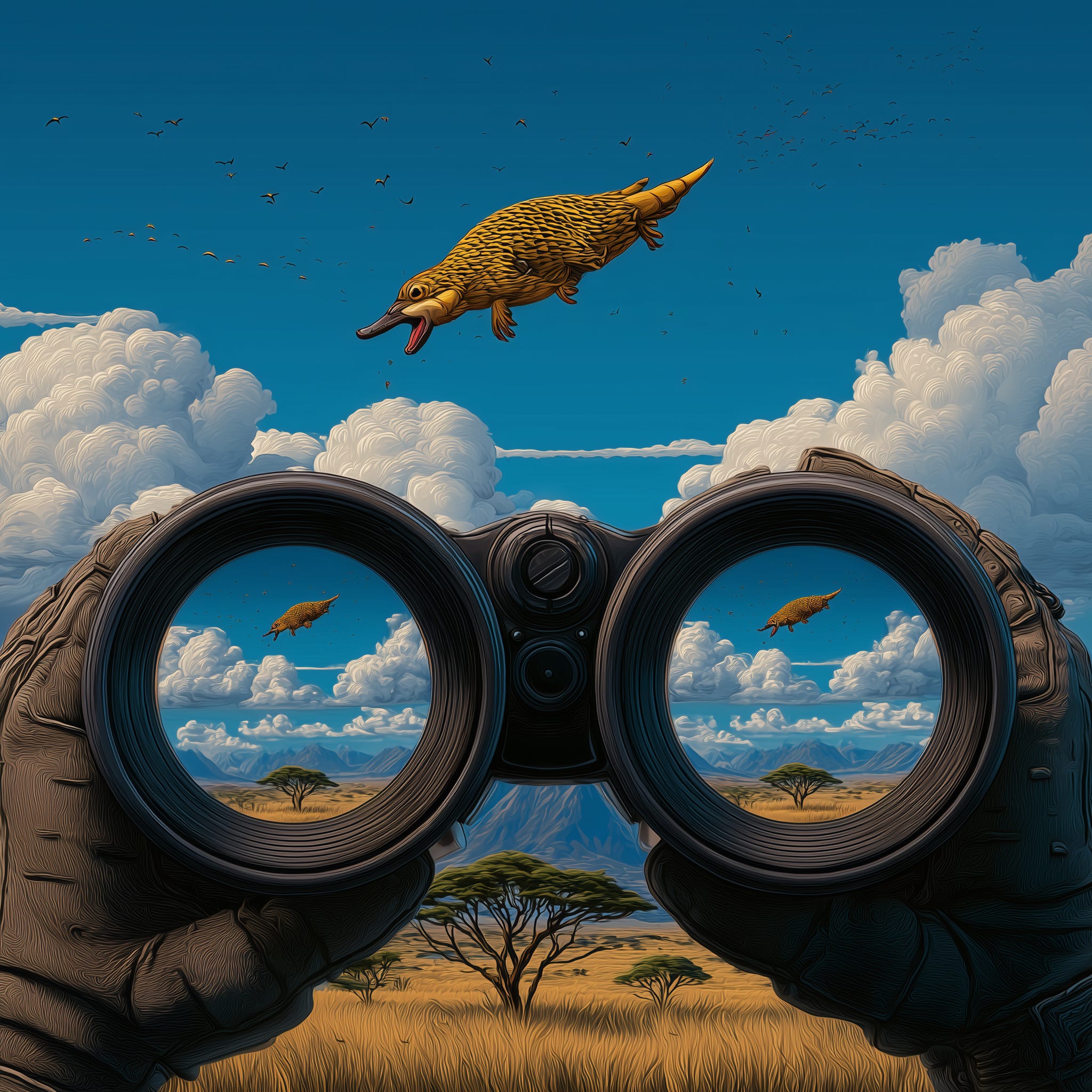
That’s when the people looking through binoculars called out, “A platypus! A platypus is falling from the sky!”
* * *
The platypus, as you may know, is an Australian creature, one of only five mammals to lay eggs. It has a duck’s bill, a beaver’s tale, and an otter’s feet. Like most Australian creatures, it is venomous.
What a platypus might be doing here, in Africa, was anyone’s guess, not to mention the unusuality of its appearance in the air.
The journalists and photographers had enough to sense to stop fawning over Serena Mayfield for a second and see for themselves.
“Got it!” one photographer said, brandishing a camera.
“I can already see the headlines,” one of the journalists said. “Not just Serena Mayfield, not just a flying Australian platypus in Africa, but Serena Mayfield AND a flying Australian platypus in Africa!”
“Serena Mayfield,” an elder who hadn’t died yet gasped.
The most beautiful woman in the world bent to her knees beside him, her dress dragging in the dirt.
“It’s a sign,” the elder said. “A sign from the gods. The end is coming!”
“What do we have to do?” Serena Mayfield asked.
He took her hand.
“Go to Mount Commie,” the elder said. “You will find the answers you seek!”
Serena Mayfield straightened and looked me straight in the eye. “Were you listening?”
“Yes.”
“Get me there.”
“But—”
“If you do this, you will have vindicated yourself,” the elder on the ground gasped. “Make amends for what you’ve done.”
“I didn’t make you take cyanide!” I protested.
Serena Mayfield’s eyes teared up. “Please,” she said. “For me.”
“But I…”
“Please,” she said, and clasped her hands. “He was my father.”
I looked at her, aghast, then to the elder, who with a last gurgle finally died. There was no resemblance at all.
“All right,” I said.
I could see a Land Cruiser—the one that was meant to pick her up and take her back to the Wheel—in the distance.
“Do you see that Land Cruiser?” I asked her, and pointed it out.
She nodded.
“When it gets here, I want you to distract the driver, and I’ll hijack it. Okay?”
“Okay,” she said.
The Land Cruiser pulled up at the edge of the camp. We two were the only ones still standing there, though; everyone else had gone to see the platypus when it landed.
“What happened here?” the driver asked, looking through the passenger window at all the dead elders.
“They took cyanide,” I said.
“Hey!” Serena Mayfield said from the driver’s side. “I know you’re supposed to take me back to the Wheel, but a platypus just fell out of the sky. You should probably go look at it.”
“A what?!” the driver cried.
“It’s true,” I added. “That’s where everybody’s gone.”
Something tugged at my sleeve. It was one of the refugee children. “Craisin?” he asked.
I shook my head. “No craisins.”
The driver hopped out of the Land Cruiser and sprinted off in the direction Serena Mayfield and I pointed.
“Now’s our chance!” Serena Mayfield said. “Come on, let’s go!”
“I can’t…” I said, for the refugee boy was holding onto my sleeve. “I’m stuck!”
“It’s just a child,” Serena Mayfield said. “Brush him off! Come on!”
I tried, but the boy had an iron grip. “Craisin,” he said. Just, “Craisin.”
“We’re wasting time,” Serena Mayfield said. “Look! The others are coming back!”
It was true. One of the camp aides carried the platypus—it really was a platypus, too—and the driver of the Land Cruiser was scratching his head, looking perplexed.
“He’ll have to come with us,” I said. The boy wouldn’t let go.
“No,” Serena Mayfield said.
“Then I have to stay,” I said. “You can take the Land Cruiser.”
“No!” Serena Mayfield said. “You heard that man. He said you had to come too, to atone for your mistakes.”
“But…”
“What’s more important?” Serena Mayfield demanded. “My father’s last request, and my request now, or a refugee child who doesn’t know the difference between a banana and a craisin?!”
“All right, but I’m not happy with this,” I said and, surprising everyone, I tore off the sleeve of my shirt and jumped in the Land Cruiser. Serena Mayfield jumped in on the driver’s side and slammed on the gas.
The Land Cruiser didn’t go anywhere. The engine was turned off.
The child, meanwhile, shouted, “CRAISIN!” at the top of his lungs, and grabbed at the vehicle’s frame, trying to stop us.
“Hey!” the driver of the Land Cruiser yelled. “That guy is trying to kidnap Serena Mayfield!”
A dozen photographer, journalist, make-up artist, hair stylist, naturalist, and camp aide heads turned in unison. Flashbulbs flashed. I was a front-page story.
“Let’s blow this popsicle stand!” I shouted, and Serena Mayfield, with the engine going this time, hit the gas again. The Land Cruiser swished past the shocked onlookers even as the photographers’ flashbulbs flashed again and again, and tore off across the savanna.
“Whoop, whoop!” I whooped. I wore the broadest grin of my life. It stretched from ear to ear.
“Now,” Serena Mayfield said, wiping a similar grin from her face with her sleeve, “which way to Mount Commie?”
Comments
Nothing yet. Say the first thing.
Sign in to join the conversation.