
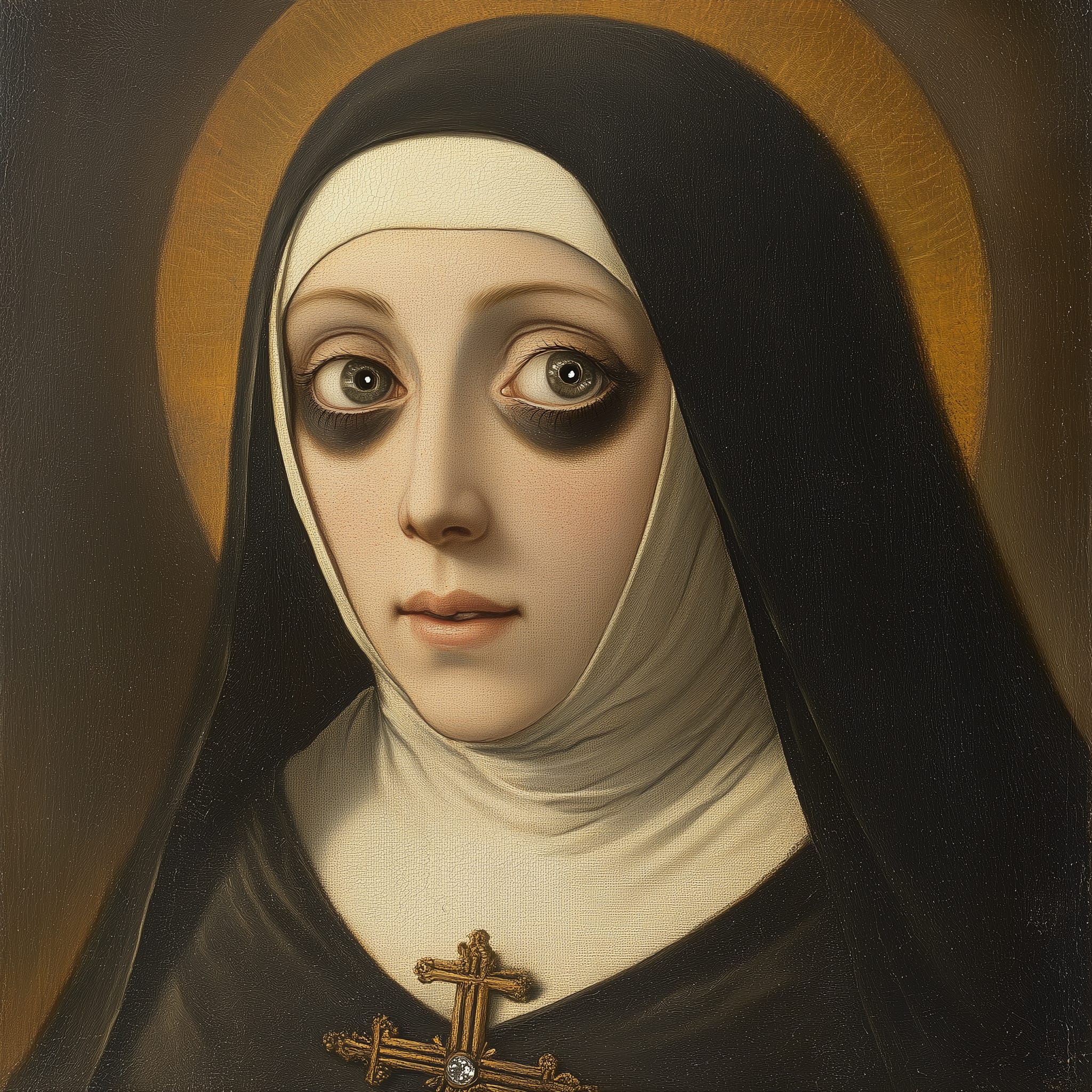
“Is Marilyrilarilyn present?”
—the camp director of the Wheel
We came to Camp Mercy just after first light, and even from a distance could see something was amiss. People were already up and about their morning chores—or rather, man-high crocodiles were.
“What are they?” Serena Mayfield whispered.
“Look!” I said, without answering.
A woman dressed in a nun’s habit staggered from one of the tents, a yoke on her shoulders.
“It must be the Sister of Mercy,” I said.
“It looks like she’s their prisoner,” Serena Mayfield said, as one of the crocodiles chased her back to the tent. It seemed like a reasonable supposition.
* * *
“You know, I don’t think they’re crocodiles after all,” Serena Mayfield said after we’d watched them for an hour. “I think they’re just wearing crocodile heads on their heads.”
In the growing light, I could see she was right. “That’s different, then,” I said. “We can just go up and talk to them.”
“Are you sure? I don’t want you to do anything too stupid.”
“Me? What about you?”
“I’ll wait here,” she said. “In case you get captured and need someone to rescue you.”
“Do you have any other ideas?” I said. “Because I’m open to suggestions.”
“No,” she said simply. “Let’s use yours.”
* * *
So I walked into camp alone. A sleepy guard stood on duty at the perimeter, waiting to be relieved. “Hey!” he cried, on seeing me. His shout drew the attention of the others, and quite quickly I’d attracted a crowd.
“What do you want?” the leader of them said. He wore a tank top and had been shaving. I could tell because he was still holding the razor, and he had shaving cream foam on his face. He wasn’t wearing a crocodile head on his head.
“I’m lost,” I said. “I got separated from my safari in the night.”
“What safari?” he demanded. “Nobody comes this close to Camp Mercy.”
“The Marilyrilarilyn Safari,” I said. “It’s just luck I found you. I walked all night, trying to get back to them. I really have no idea where I am.”
“Are you alone?”
“Yes,” I said. “I’m the only one stupid enough to lose a whole safari.”
“Hmm,” said the leader, and his beady eyes looked over my shoulder to scan the savanna. I hoped Serena Mayfield was still in hiding.
The leader nodded, and three of the crocodile-head-wearers grabbed me and tied my hands behind my back.
* * *
They carried me into their camp and set me down inside a tent, there to tie my rope handcuffs to the central tent pole. I wasn’t alone. A woman dressed in a nun’s habit sat on the floor, staring at the ground, a yoke on her shoulders. I wondered if she was the same Sister of Mercy I’d seen before, or a different one.
“Psst,” I whispered when the crocodile-headed men had gone. “Psst!”
She looked up.
“Are you one of the Sisters of Mercy of the Jungle?”
She looked down again.
“I’m looking for a Sister of Mercy,” I explained, wriggling in my bonds to face her better. “I’ve come a very long way. I need your help.”
She looked up.
“Where are the other Sisters?” I asked. “Are they in the other tents?”
She shook her head.
“Are they anywhere in camp?”
She shook her head again.
“So where are they?”
“Dead,” she said, the first word and the last I’d get out of her for some time.
“I’m sorry,” I said. “Look, I have friends who will be coming to get me. They’ll cut you out of the yoke and you can go on your way.”
She looked neither up nor down. She’d closed her eyes. I guessed she was praying.
Someone’s boots scuffed the dirt outside the tent, and I wriggled back to face the flap. One of the crocodile-head-wearers peered in. He had several days’ scruff and scars on his face.
“Food for the prisoner,” he said, and pushed a bowl of slop in my direction.
“Hello,” I said, calling after him as he lowered the flap. “Hello! I think there’s been a mistake. I’m not here to cause any trouble! I’m just lost.”
The footsteps marched steadily away, so I gave up and looked at the bowl of slop.
* * *
“Here,” I said, pushing it with the toe of my shoe toward the Sister of Mercy. “You’re probably hungrier than I am.”
She looked at me without blinking, then closed her eyes again.
“If you change your mind, eat it,” I said, as she could presumably still hear with her eyes closed. “I’m not taking it back.”
* * *
I must have nodded off, because when I woke, the light outside had changed and the noise of camp died down. I twisted my head to look over my shoulder at the Sister of Mercy. She was watching me silently, her hands playing a game of imaginary cat’s cradle. The bowl of slop had been cleaned dry.
“I’m glad you ate,” I said, although the truth was, now I was hungry, and I wasn’t glad at all.
She continued to stare impassively, but I’d swear she was feeling friendlier towards me now.
“Who are those men?” I asked in a low voice. I was starting to get a crick in my neck.
She sat in silence so long I thought she wasn’t going to answer. But then, the Sister of Mercy leaned forward slowly and whispered a single word: “Whackodiles.”
* * *
In normal circumstances, I would have laughed. Whackodiles were the sort of thing nobody really believed in, assuming they’d ever heard the word. I certainly hadn’t before I came to Africa, although now that she said it, I couldn’t help recalling that I’d read a description of them before. The question was, where?
It came to me: in Dayton Modwell’s book, Full Force: My Life as a Zebra Tamer.
This is what he had to say about them, on page 277, which happened to be the only page I’d read.
When I came to the Nile after sixty-five days in the desert, I made the sort of discovery that one always hopes to make, but one knows one has little chance of ever making; I, Daytoniano Modwelliano; yea, ’twas I, I who first gazéd upon the Nile and saw the creature that was to man as a pot of boiling water is to an egg: the Whackodile.
[…] These were men who were more than men: Crocodile Hunters Maximus Extreme, the sort of maniacs who pursued their goals with more than devotion, more than zeal, more than fanaticism. These were the men who lived and breathed the Nile, who, when they made a kill, skinned the crocodile alive and unbound, its jaws still snapping, then cut off its head and made it into a hat, and the skin into a suit of sharp and shimmery scales. They feasted on the meat, raw, and saved the tail for last, as it was the best.
[…] Thus were the two tiers of Whackodiles established: the first tier, those sans hat; and the second, those avec hat. There was no doubt as to which tier was preferred, the tier to which all aspired. Namely: that of tier two.
The Whackodiles of tier one—those without hats—were mostly young and untrained. Their fellow Whackodiles, particularly of tier two, would ne’er lift a finger to help them; thus they received their training at the hands of Mother Nature, and many of them did not survive it. But those who did progressed to tier two, and thereafter showed no shortage of strength, agility, and stamina—indeed, they seemed possessed as by Mother Nature herself, possessed not only with supernatural strength of arms, with longevity of life and with wicked endurance, but with fever to wrestle with the Nile crocodile in his own territory, where such a Whackodile would be out of his element and at his weakest.
Modwell went on at some length, but that was the gist of it. I couldn’t remember all that at the time, of course, but having since read my copy it was easy enough to research.
The main thing was: There was no way in hell I would be a match for these whackodiles. There was no way in hell Serena Mayfield would be a match for the whackodiles. There was no way in hell the two of us together would be a match for the whackodiles, supposing she did eventually show up to rescue me and end up in the same tent as the Sister of Mercy and myself.
A terrible thought struck me. What if she already had tried to rescue me, and had been caught and captured and put in a different tent? What if she’d been killed?
I had no way to know.
* * *
Dayton Modwell’s book, if I had read it at that time, would have offered me the following advice about whackodiles, based on experience, if not personal experience:
When the opportunity arises to engage with a Whackodile in civil discourse, do not take it. Whackodiles do not understand civil discourse. They will make you a prisoner and slave until you are weak and sickly at which time they will kill you.
When the opportunity arises to engage with a Whackodile in combat, do not take it. Whackodiles do not understand combat, either, but they always win.
When the opportunity arises to avoid Whackodiles altogether, take it. It’s the only outcome which is wholly beneficial to you.
He would have also offered this tidbit, on page 281:
Whackodiles are Nile creatures, as intimately bound up with the Nile crocodile as any animal can be with its home turf. They rarely stray from the Nile, and if by some odd chance they do, they are desperate, and nothing if not twice as dangerous.
* * *
Someone appeared at the tent flap: I could see their shadow. I hadn’t heard any boots.
Serena Mayfield slipped inside, holding a machete.
“Serena!” I cried, and lowered my voice at once. “How did you get past the guards?”
“Oh,” she said, bending to saw through my bonds with the machete. “They all went for a walk about twenty minutes ago. I saw you get captured,” she added. “So I took our supplies and hid them, and when I came back, everyone was just leaving.”
“Where were they going?” I asked.
She shrugged. “Does it matter? Let’s get you out of here.” Her eyes landed on the Sister of Mercy and their gazes locked.
Serena Mayfield dropped my bonds, two-thirds of the way cut through.
“Hey, what,” I began, and she shushed me without looking. I craned my neck to see what was going on.
“She knows something,” Serena Mayfield said, her voice breaking.
“If she does, she’s not telling us!” I said. “Believe me, I’ve been talking to her all day, and so far the only words she’s said are, ‘dead’ and ‘whackodiles’.”
“She knows something,” Serena Mayfield repeated, and she crouched a foot from the Sister of Mercy. “I can see it in her eyes.”
“Ask her about the whackodiles,” I suggested. “Maybe she will talk to you.”
Serena Mayfield and the Sister of Mercy stared at each other in a silence interrupted only by me, rubbing the frayed rope against the tent pole until the last strands snapped. I rubbed my wrists. I had rope burn.
“I promised her we’d set her free when you came,” I added, standing.
Serena Mayfield looked at me for the first time since she’d seen the Sister of Mercy. “And we will,” she agreed. “When she tells us what it is I know she knows.”
“How do you know she knows anything?” I said impatiently.
“Look in her eyes,” Serena Mayfield said, and I looked—closely.
Something deep in the dark blinked at me, something that was both white and all the colors of the rainbow, something that was its own prism.
Someone opened the tent flap behind us. I whirled, and a whackodile’s fist sent me flying. Serena Mayfield whirled, too, machete in hand, and without hesitation stabbed the whackodile in the chest.
She withdrew the blade triumphantly, looking a bit shocked at what she’d done, and then even more shocked when the whackodile grabbed her by her belt and tossed her to the ground, as he had me, like a ragdoll.
The Sister of Mercy staggered to her feet, now, and clobbered him with the yoke, once, twice, and again, until he fell over.
“I thought you said they all went for a walk!” I cried, pushing myself to my feet.
“I guess one of them stayed behind,” Serena Mayfield said impatiently.
But the whackodile wasn’t finished. He got back to his feet and grappled with the Sister of Mercy, both hands on her neck. Serena Mayfield picked up her machete and, while the two of them wrestled awkwardly, hacked at him again and again. With a final and almighty blow she chopped him in the neck, just below the protection of the crocodile head on his head, and the machete stuck in the bulging cords of his muscle.
She looked at me, I looked at her, then we both looked at the two of them. The whackodile fell on his face, on top of the Sister of Mercy, and she and the crocodile head on his head touched noses.
We pried his hands off the Sister of Mercy’s throat, still in a vice-like grip, and she gurgled. She was dying.
“What do you know?” Serena Mayfield asked her desperately. “Please, please, tell us!”
The Sister of Mercy’s eyes widened at something only she could see, and her mouth stuttered silently.
“Why are the whackodiles here?” I added, as I undid the yoke and lifted her head to remove it. “I’m sorry it turned out like this. We really had good intentions.”
Serena Mayfield began to wail, high and plaintive.
The Sister of Mercy’s lips formed a word, faltered, and formed it again.
“Bijous,” she whispered, and her eyes flashed before they closed.
I looked at Serena Mayfield and saw the same glint in her eyes. “Bijous,” she whispered. “Bijous, bijous.”
* * *
We dug up our supplies from where Serena Mayfield had hidden them, having already stolen a second machete and some other provisions from the whackodiles at Camp Mercy.
“Where do we go now?” I asked her presently.
“There,” she said with certainty, pointing at the dense jungle a few miles west of us.
I was about to protest that hacking at random through the jungle was most certainly a bad idea, but then we both saw something rather strange. A black and white bundle of cloth, vaguely resembling a human woman, was making a beeline for the jungle thicket.
“It can’t be the Sister of Mercy,” I said, equally doubtful and certain that it was. “She died!”
“There,” Serena Mayfield said again, with even more confidence.
* * *
“We didn’t actually see her die,” I reasoned as we trod carefully along the damp forest floor. The air smelled pungent in here, like rotting mushrooms. Above us, the leafy canopy blocked nearly all sunlight.
We’d agreed to take turns at bushwhacking duty, but thus far Serena Mayfield had taken the lead, and wouldn’t let me even when I asked to. So I had plenty of time to form explanations for the Sister of Mercy’s survival. “Maybe she was just really tired after all the excitement. Maybe she was just resting.”
“Uh-huh,” said Serena Mayfield.
“Do you still know where we’re going?” I double-checked, as a recently severed tree branch fell under Serena Mayfield’s machete chops and almost gave me a dent in the top of my head.
“Uh-huh,” she said without stopping.
I looked behind us at the way we’d come—and realized I had no idea where that might be. The jungle had already closed in. The bright savanna could be a mile in any direction—or a hundred miles.
I shivered at the thought, and couldn’t help feeling that we’d come to another fork in the road on that map of life, and we were going a very wrong way indeed.
* * *
We camped that night at a spot chosen at random. Serena Mayfield had bushwhacked all day, first with her right arm, then her left when her right became too exhausted, and then with both together. She wouldn’t let me have a go because, she said, “You don’t know where we’re going.”
She chose the camping spot, but let me gather the wood for a fire. It was all damp and took a long time to light, then smoked a little and went out.
“We don’t need a fire,” I said. “It’s humid enough in here to keep us warm.”
Serena Mayfield didn’t say anything.
“What shall we eat?” I asked her, and looked through our provisions. I found one of the takeaway boxes of Joe’s pancakes, soggy and looking disgusting. We ate those.
“Who’ll keep first watch?” I asked, but Serena Mayfield had already gone to sleep, sitting upright, so that duty fell to me. Without a fire, I couldn’t see anything.
Sometime in the middle of the night, I realized it was getting cold. My teeth chattered. I pulled on an extra shirt and stared determinedly into the dark, hoping the noises all around weren’t deadly creatures coming to kill us. Hoping that that crunch, as of a snapping branch, was not the boot of a whackodile pursuing us, here to strangle us in our sleep with his bare hands, the crocodile head on his head touching us with its nose.
At dawn, Serena Mayfield woke me, and we ate some white bread and lettuce from Camp Mercy.
“I feel like I’m going on a Marilyrilarilyn diet,” I joked.
Serena Mayfield smiled slightly. “I wonder what happened to her,” she said. “I hope they treated her all right. She really saved us.”
I didn’t tell her what had happened to the handlers, that I thought Marilyrilarilyn had probably met the same fate.
In fact, I was wrong, though it would take me more than twenty years to find out. Marilyrilarilyn had been spared the camp director’s wrath by the man from the Diplomatic Party for World Harmony; she’d flown back to America three days later, unharmed, and written a startling exposé on the goings on in Africa, published in conjunction with the Africa Kit Society. It ultimately brought down the entire Charity Food organization.
She’d also paid for a search party to find us, but they never did. They made it as far as Camp Mercy, where they were killed by the whackodiles.
But as I said, I didn’t know any of that at the time, so I didn’t have anything helpful to add.
* * *
I could never tell what time it was in the jungle. Apart from dusk, when the light dimmed, dawn, when it brightened, and night, when it disappeared completely and the only light came from the jungle itself, it was always half-light, and could have been any time of day. We ate less, which was a good thing, because we didn’t have very much food, and drank almost nothing. We seemed to get all the water we needed breathing the jungle air.
Serena Mayfield noticed the jungle light before I did. While I spent that first night groping in the dark and listening for the thwack, thwack, thwack, of her machete, she walked ahead confidently, like she’d learned to echolocate.
“Can’t you see it?” she asked me when I invariably fell behind.
“See what?” I asked her, frustrated. But from the second night onward, I could see it too, a faint but noticeable glow. It wasn’t enough to see far, just far enough for the next few steps, every branch and leaf outlined against the impenetrable black. I hoped it wasn’t a sign of bijou fever, and wished Dayton Modwell had told me more about it.
From then on, we bushwhacked even after dark and only slept a few hours. Some nights, I don’t think she slept at all.
On what could have been the fifth day or the tenth day or any other day, we suddenly exited the jungle and came into a clearing. The sun shone straight down on us, unimpeded by a leafy canopy; shone so bright, we both covered our eyes and peeped between our fingers until they adjusted.
We stood on a railway, one that, though in disrepair, someone obviously kept clear. It ran as far as the eye could see in either direction.
“Which way now?” I asked Serena Mayfield, praying the answer wasn’t going to be “straight ahead”, back into the jungle.
“To the right,” she said, hesitating only a moment.
So we turned right.
Comments
Nothing yet. Say the first thing.
Sign in to join the conversation.