
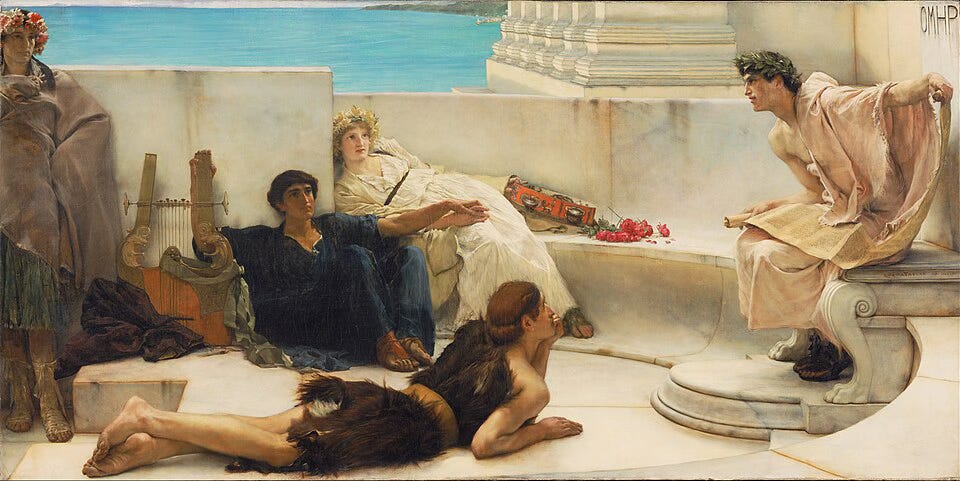
“We live in an age that demands apology from greatness. Great storytellers when they portray greatness, like Homer, celebrate it. We circle around it. We dance around it. We turn greatness into privileges and we demand apologies for it. That’s a fact of Hollywood. And I’m just wondering how you, as one of the greatest storytellers of our age, approach greatness? Is it still a story of apology that demands repentance and reflection and self-criticism?” This is a question from an interview of Chinese journalist and political philosophy lecturer and doctoral student Zhong Shu with Christopher Nolan about his new film Odyssey. The interview made rounds online because of its contents, so distinctly different from the usual dull cookie-cutter press tour interviews conducted in the West, which often carry the vibe of fans overwhelmed with enthusiasm meeting their idols without any chance of critical questions being asked. Questions asked by Zhong Shu were intelligent, informed and cut straight to many of the issues so passionately debated with regard to Odyssey and what many consider to be its failures — not necessarily as a movie, but certainly as an adaptation of the Odyssey, a literary work millennia old that conveys and immerses us in a world of very different morality and cosmology from the Western one. To this question Christopher Nolan answered without much ambiguity: “Are we going to treat greatness as an absolute or coming from a democratic, more idealized philosophical state that we live in today’s world where we want to view people as equal? Do we have to apologize for that greatness? And the answer is yes, we do, or the audience rejects the greatness.”
But the reactions to the interview encompassed not only a reverence for the level of sophistication the Chinese journalist presented, but also a certain sense of shame - the world, in this case represented by China as the main rival of the West for world predominance, can see that the king is naked so to speak, that we in the West have abandoned the great cultural heritage of our past and we feel the need to apologize for it and adjust it in order to justify its embrace in the current age. An article in the Spectator called “China Understands The Odyssey Better Than We Do” was published on the 4th of August, arguing that the West now reads classical antiquity mostly through the lens of its own current ideological battles — burdened by guilt and the compulsion to apologize for its own past. China, by contrast, having already violently uprooted its own tradition, can approach Homer more freely, without that baggage — so the inheritance of antiquity may end up passing to China rather than to a West that is making its own classical heritage increasingly inaccessible to itself. Do not worry, this won’t be another essay on Nolan’s film. What I find really intriguing about this subject is the big picture question that it asks, specifically: what really is Western civilization’s relationship to antiquity and its greatness?
This relationship has always struck me as quite paradoxical. On one hand, there is a deeply embedded sense of continuity with the world of antiquity, where some of the concepts our contemporary era holds almost dogmatically dear, such as democracy, are seen as having originated thousands of years ago in Athens, and the ancient inhabitants of Attica are often perceived as the first Westerners. This interpretation of Western history, very popular especially in America in the first half of the 20th century, was not so much a matter of overlooking inconvenient facts as of actively redefining history — selecting the ancestors that best justify the present. It emphasized precisely the enlightened and rational aspects of antiquity and built a strong connection between ancient Greece and the post-Enlightenment liberal West, at the expense of a competing and, in some ways, more historically grounded genealogy: the theory that modern Western liberty — parliamentary government, trial by jury, limits on the power of the ruler — descended not from Athenian democracy but from the tribal freedoms of the Germanic peoples, inherited through Anglo-Saxon England and the societies of Northern Europe.
This “Germanic freedoms” thesis was largely suppressed over the course of the 20th century — not on purely historical grounds, but because of the obvious dissonance it created once Germany itself became, twice over, the West’s authoritarian enemy. It was simply too uncomfortable to trace the roots of liberty back to a “Germanic” people when modern Germans were, at that very moment, being fought as the enemies of liberty itself. Yet this redefinition tended to overlook major aspects of the antique civilization that were sharply different and indeed would be directly contradictory to the humanist, optimistic and liberal aspects of the post-Enlightenment Western self-perception. It also tended to massively diminish the importance of the thousand-year-long history of the rise of the Christian West through the synthesis of Roman institutions, Christianity and Germanic tribes, which was perceived as a period of overtly religious and irrational backwardness, the proverbial dark age. Yet such a view is ahistorical, since the Middle Ages are simply the time when Western civilization as it is commonly understood was born.
It is beyond any doubt that the intellectual heritage of the Greek civilization has influenced immensely what followed - the Roman Empire and also the Christian West that came to replace the Roman civilization in Western Europe. In terms of raw intellectual output - philosophy, art, political thought, scientific concepts - ancient Greece was so incredibly productive it is beyond belief, and it is indisputably one of the high points of the endeavor of human spirit that we continue to draw from. Part of the connection is simply ethnic - Greeks and Romans were Europeans, and there is an understandable and more or less universal sense of perceiving past populations of the same ethnicity, and their achievements and history, as, to an extent, ours as well. Yet the notion that the Ancient Greeks were basically the first Westerners and that they constitute the beginning of Western civilization is much more problematic and, in my opinion, ultimately false. Oswald Spengler, the famous German polymath, was already going against the prevailing opinion of his time when he, roughly one hundred years ago, in his magnum opus The Decline of the West, claimed that the Antique civilization was simply a separate beast from the Christian Western civilization that came afterwards.
To describe all the countless ways in which the West differs from antiquity is not a subject that could be covered in one substack essay, more fitting would be a properly hefty book, nor is it within my capabilities. I would thus like to narrow the focus specifically on the anthropological differences between antiquity and the Christian West in the questions of family and relations between men and women. I am a big believer in the crucial importance of these questions when evaluating the nature of different human social orders. The family is the fundamental unit of any civilization, and the patterns of behavior, the role of each parent and the relationships between siblings are for any human being the archetypal point of reference for one’s perception of social life more broadly and what one considers just and right. And it is precisely in these areas where one can point out the profound differences between antiquity and the Christian West, and those differences cut so deep into the bone marrow of what constitutes the tenets of civilization that they can’t be overlooked.
Antiquity and the Christian West differ less in any single rule than in the underlying logic of basic perception of human life. One of the crucial anthropological differences between monotheistic religions and those outside of this framework, whether non-Western civilizations such as Hindu or East Asian cultures, or pre-Christian European ones such as that of antiquity, is the approach towards abortion, infanticide and, in the context of antiquity, also the practice called “exposure” of newborns - not killing the baby but leaving him somewhere where he possibly could be picked up by someone else - to be adopted but also possibly enslaved - which nevertheless often did not happen, and the end result was thus the same - death. The household head, the paterfamilias, held total legal power over the acceptance of the newborn into the family, which conferred upon the baby his position in the social and legal order. In other words - the baby, and any person in general, was not perceived to hold intrinsic value derived from a higher power - having a soul and being made in God’s image - but its legal personhood was conveyed by the paterfamilias. The Christian God loved His human creatures and wanted them to be saved. The Greek gods, by contrast, were mostly indifferent to the fate of human beings, whom they had not created. And this spiritual schism of course impacts countless other crucial aspects of civilization, most notably the view of slavery - the gradual forbidding of which was one of the tenets of Christian civilization. The whole notion of universal human rights is accepted as a sort of logical and obvious fact by most secular Westerners, even though there is nothing obvious or logical about it, and it is simply a secular version of the Christian belief in the intrinsic value of human beings made by God.
In Antiquity, it was the legal act of accepting the newborn by the paterfamilias - tollere liberos - that essentially endowed the baby with legal rights connected to his official belonging in the family. Without this act, the baby was, in a sense, res nullius, maybe comparable to a person without citizenship in our times. As for outright infanticide, we lack records of direct legal regulation, but it was certainly practiced and tolerated. The Roman historian Tacitus condemned the Jewish teaching that infanticide and abortion were sinful as a “sinister and revolting” doctrine. A first-century B.C. Egyptian wrote to his pregnant wife that if she should bear her child before he returned from his trip, then, “if it is a boy keep it, if a girl discard it.” How widespread it was, for example with deformed or unhealthy infants, and how sex-selective it was, are a matter of continuous debate among researchers.
In the literature, one often finds a figure of 140 males per 100 females for the sex ratio in ancient Rome; this figure traces back to J. C. Russell’s Late Ancient and Medieval Population (1958), which estimated sex ratios of 131:100 in the city of Rome and roughly 140:100 across Italy, Asia Minor, and North Africa. This figure was popularized in Rodney Stark’s The Rise of Christianity (1996), where it supports the argument that early Christianity’s rejection of female infant exposure gave the movement a demographic edge through a more balanced sex ratio and higher fertility. Such skewed sex ratios would be comparable to those observable in China, a culture with strong male offspring preference and a lack of a taboo regarding infanticide or abortion, during the height of the one-child policy in rural areas. It’s worth noting that more recent direct archaeological and DNA evidence complicates this picture: analysis of Romano-British infanticide victims found a ratio of roughly 7 girls to 5 boys, and a 2024 study of the Ashkelon remains found 14 males to 5 females. Some argue that such skewed sex ratios in premodern populations with massive death rates would be impossible and would lead to rapid depopulation, but even with all these caveats, the fact remains that, morally speaking, abortion, infanticide and exposure were just fair game, even though they sometimes might have been moderated by practical concerns.
But the changes of course affected multiple other areas regarding family life, such as divorce, incest, polygamy, infidelity and sexual morals more broadly. While male polygamy was almost always restricted in antiquity, this was a matter of practical questions of legal status and inheritance rather than a moral issue. Having sex with concubines, prostitutes or slaves while married was not somehow intrinsically bad, you just needed to decide which woman would be the legal wife whose children would carry on the legal kinship status, so the whole affair of inheritance isn’t overtly messy. Divorce was permitted. In questions of incest, relations between parents and children, and between siblings, those in very close genetic proximity with acute danger of genetic defects, were sacredly prohibited — yet when it comes to cousin-marriage, the approach was much more lenient.
The Athenian institution of the epiklēros is the clearest example: if a father died without a son, his daughter was required to marry her nearest paternal relative, often an uncle or cousin, specifically to keep the family property intact. This is of course a very common pattern throughout history and across different civilizations. It is especially pronounced close to the Middle Eastern core, where agriculture was first invented and the need to develop rules for passing on property, especially land, first arose. The daughters of Zelophehad in the Torah won the right to inherit their father’s property, but only on condition that they marry within his own clan, which in practice meant marrying their first cousins — so the land stays inside the family line, exactly as in Athens. A strong cultural preference for marrying paternal first cousins persisted across much of the Muslim world, layering the same lineage-preserving logic. Roman practice followed the same pattern, prohibiting the closest degrees under the Twelve Tables while leaving first-cousin marriage entirely legal until Justinian, even though it was not really practiced all that often. Later, the Church began pushing the boundary outward and made a real taboo out of it, prohibiting marriage between relatives going as far as sixth cousins.
There is continuous debate happening among historians about the direct causality of the processes; some, like Todd, argue that these changes preceded Christianity, while others see Christianity as the main kickstarter, but that can be explored some other time. What is important is that somewhere between late antiquity and the early Middle Ages, Europe underwent a true civilizational revolution — one so fundamental that it reshaped, and continues to reshape, virtually every question this essay has raised so far. Historian Kyle Harper describes it as a shift from an honor/shame-based culture to a sin, or alternatively guilt-based, culture. In matters of sexuality, Christianity was much more prudish than what came before. Ancient sexual ethics were organized around honor and status, not a universal moral standard — what was permitted depended on who you were and who she was (free/slave, man/woman, citizen/foreigner). A wife’s infidelity was a crime, while a husband’s use of slaves, prostitutes, or concubines was fully legal and carried no stigma. The Christian revolution consisted in the collapse of that double standard — the same fidelity standard applied to men and women, master and slave alike — shifting the operative question from “what is your status” to a universal concept of sin that applied regardless of social position.
Broad-based church pressure against cousin-marriages, arranged and forced marriages, and the increased freedom of the individual to decide about his inheritance, as opposed to the mandatory inheritance rules intended to keep the wealth within the clan, led to a massive diminishing of the importance of clans within Western European society and laid the grounds for the more individualistic, nuclear-family-based approach characteristic of the West. Once again, there are continuous debates about the precise causality: some, such as Joseph Henrich, claim that the Church essentially invented these concepts, while others, such as Emmanuel Todd, lean more towards the Church’s efforts finding fertile ground among the populations of north-western Europe, where many of these practices already existed and were merely universalized. But the end result was nevertheless the same. And of course, all of those changes massively increased the position of women within society - the emphasis on marital consent and the fight against arranged marriages gave women greater power and status, and the sexual mores being, at least formally, applied equally to men of all status, from peasant to king, increased the stability of marriage. Christian civilization became, without any doubt, the most “feminist” major world civilization in history.
Now, let’s get back to the beginning of this article and the appreciation of the Chinese for the classical works of antiquity such as Homer, which the modern (post)Christian West has an increasingly complicated relationship with - as Nolan said, if the movie approached Homeric greatness unapologetically, the audience would reject it. While many claimed he is wrong in his assessment of Western audiences, I would give the third most financially successful director of all time after Spielberg and Cameron the benefit of the doubt when it comes to assessing the taste of the audiences, I would even go “so far” as to claim he understands Western audiences better than online chuds. China is a civilization that have not considered abortion or infanticide morally wrong, the practice of infanticide was normal and even often socially desirable due to the emphasis on the responsibility of the individual towards the community, which should not be burdened with more people than it can feed. The strong male preference led to unbalanced sex ratios in China, since infanticide usually affected female newborns due to women being essentially given away to be part of the family they married into while the man continued the patrilineal line.
But even more importantly, it conveys the same lack of perception of human life as possessing intrinsic value conferred by some higher power in its own right, but being perceived in its value mostly relationally to one’s standing in the social order - defined by one’s relationships between father and son, ruler and the ruled, husband and wife and so on. Let us consider one of the most famous aspects of antiquity in popular imagination - the disposal of undesirable, weak, deformed children - and let’s put it in comparison with the one-child policy of China. In both cases, we can see the application of a remarkably similar underlying logic: the killing of unborn or newborn children is seen as justifiable and desirable from the point of view of broader social order and harmony - whether the more eugenic strengthening of the “biological” material in Greece or the (perceived) sustainable population size in China.
The position of women in Chinese society was indeed quite undesirable from a Western point of view. Both China and antiquity were patrilocal cultures, where the wife moves into the husband’s household and becomes legally a part of the male-defined kinship structure. Chinese society had the concept of a strict conceptual and spatial division between nei (inner, the female sphere) and wai (outer, the male sphere of public life, politics, and business). Women — especially married women from the upper classes — were largely confined to the inner quarters of the household, physically separated from the part of the house where the man conducted his social and business life. Structurally it’s nearly identical to the Greek concept of gynaikeion — a section of the house reserved for women, separated from the space where the man received guests. The concept of concubinage also has its strong parallels in old China, one legal wife plus a number of concubines — but with a far more elaborate formalized hierarchy defining the number of concubines by the man’s legal status and wealth. Divorce in China was permitted only from the male side - it is true that here Rome was different, since women could also initiate divorce, but the permissibility of divorce as such makes both civilizations different from the Christian West. In matters of cousin-marriages, both civilizations lacked the strict taboo of the Christian West, even though neither was really anthropologically based on the practice of cousin marriage such as the Islamic states of the Middle East. China permitted cross-cousin marriage (to the child of a paternal aunt, or a maternal uncle or aunt) — and it was even preferred, as a way of strengthening ties between families, but it strictly banned marriage between the children of two brothers — because they carried the same family name, and such a union was viewed as effectively incestuous, not as a union between two separate lineages.
Now, of course, one does not want to take these similarities between antiquity and classical China too far, since the differences are many and highly important. The point of this essay is not the claim that these civilizations are identical by any means. It is more in pointing out that classical civilizations differed from the Christian and post-Christian West in ways that are so fundamental as to make the notion of a truly common civilizational affiliation nonsensical. In matters of basic family life - which is a strong proxy for a broader outlook on life and social order in general - the average family of classical antiquity would find more in common with a family in classical China, and possibly other non-Western societies as well, rather than with that of the Christian West. And, taking this one step further, is it really so surprising that Chinese audiences might feel an almost more intimate sense of understanding of the Homeric works than modern Westerners? Isn’t the notion of the inherent value of every human life, secularized in the doctrine of human rights, precisely the spiritual schism that tends to make greatness, which almost inevitably encompasses a degree of violence, conquest and death, inherently prone to being perceived as morally problematic under the scrutiny of the Western mind?
There is of course a highly influential line of thinking on the Western right that reveres antiquity precisely because of the lack of Christian guilt-based morality and thus its propensity for greatness unabated by these considerations, represented most importantly by Nietzsche and the whole array of right-wing thought leaders drawing on the Nietzschean monumental legacy. I believe that the Nietzschean right understands antiquity better and more realistically than the sort of simplistic liberal grand narrative of enlightened democratic continuity. It creates a certain schism on the Western right. On one side there is a broad camp of cultural conservatives, who are drawn to the legacy of Christianity since that is the foundation of the Western cultural heritage they want to conserve, yet whose position is undermined by the fact that the current populations of the West are secularized and the moral dogmas are merely shadows of their former selves, emptied of their transcendent power. In the previously dogmatic matter of abortion or, alternatively, euthanasia, the West has been coming closer to pre-Christian morality. Yet it is also true that many of the anthropological foundations of the modern West’s monumental successes are, perhaps unintended, consequences of Christian civilization - lack of clannishness and connected nepotism, trust towards strangers, abstract analytical thinking, individualism, the Protestant striving towards universal literacy and so on.
On the other hand, there is the right that is not conservative in any sense, but revolts against the egalitarian sentiment of the left, correctly perceiving that many of the deep roots of this egalitarian sentiment are secularized variations of Christian ideas and what they see as the slave-based, feminized morality of the frail and weak. This tension is at the core of the fault line I outlined above - is the West more defined by its Indo-European heritage, the thread connecting all its previous incarnations from Greece to Rome — the honor culture, the martial spirit, the hierarchical and heroic worldview — or more by the Christian element? As Christianity’s social power continues to erode, what happens to the anthropological foundations — trust, individualism, the nuclear family, literacy, the suppression of clannishness? Do these foundations outlive the faith, suggesting that these traits were perhaps really more innate to Indo-Europeans? Or were they never truly independent of their theological root, and destined to erode along with it?
Perhaps the least satisfying and straightforward answer is the correct one. Neither element, it seems, was sufficient on its own. The Christian societies of the pre-Islamic Middle East and North Africa were not able to survive as such, despite being Christian. Yet it is also true that the pre-Christian pagan Northern European cultures, such as Viking Scandinavia — purely Indo-European, Germanic honor culture, martial and heroic — ultimately did not stand a chance against the rising Christian civilization and were incorporated within it. The history of northeastern Europe around 1000 AD is, to a large degree, a history of one pagan community after another being Christianized. The Christian West came to be as a synthesis of Christianity, the legacy of the Roman legal and imperial framework, and the warrior ethos of the Germanic tribes. This synthesis always carried a certain inner tension between these elements - the guilt-based morality of Christianity and the honor-based warrior culture of the Germanics. Yet for a long time, the strange combination was able to produce an unlikely yet highly functioning synthesis that was able to conquer the world and create the greatest civilization in human history while also being quite uniquely preoccupied with moral questions such as the unique voluntary inner-Western crusade to end slavery. It was the archetypal union of opposites.
A Christian of, say, 1700 believed just as fervently in the God-given soul of every human being, and yet felt no comparable compulsion to apologize for conquest, kingship, or war, because he mentally existed within a cosmology that sanctified a transcendent order and hierarchy alongside the equality of human souls. This cosmology held two kingdoms apart: the Kingdom of Heaven, where all souls stood equal before God, and the kingdom of this earth, a fallen and necessarily hierarchical realm where war, conquest, and rule by the sword were tragic but unavoidable features of a fallen world. Yet this Western synthesis ceased to be feasible, since secularized guilt-based morality on its own, without the expansive “crusading” warrior element, produces a paralysing neurosis, while the notion of a new morality unshackled by the old dogmas remains frightening to the Western mind for its implications. It is perhaps for this reason that, until this contradiction is resolved, the Chinese might appreciate some of the classics of the Western canon more than we do.
No posts
Comments
Nothing yet. Say the first thing.
Sign in to join the conversation.