

I remember when I was for the first time about to visit the United States of America. It was in 2019 and I was sitting on a plane from Vienna to Los Angeles LAX airport. I must admit my excitement was running high. For all of my life America has been, for better or for worse, the center of the proverbial universe — politically, economically, culturally. Because everyone from Europe, especially of the younger generations, consumes so much American mass culture, there is a strange and of course completely fraudulent feeling of being somewhat familiar with the country even though one has never been there. Even the names of American states or cities — such as California or Los Angeles — carry a certain almost mythologically sounding significance.
I was aware that Los Angeles is not really supposed to be some breathtaking city. I had spoken to a number of people who had been there and they were almost always disappointed. But I was still expecting it to be somewhat impressive. It is the second largest city in America, one of the wealthiest places on earth, maybe the most important cultural export hub on the planet. There must be something to it. Well, after spending a couple of days in the city before finally renting a car to go and see some of the national parks throughout the American West — and the American West might very well have the most breathtaking nature I have ever seen — I came to the conclusion that nope, the place is really kind of a shithole.
I knew that there were supposed to be homeless issues and whatnot, but this was before the sort of streetview California misery porn genre became so common on Youtube, so I was still taken aback by it. Since we were not renting a car until the day we were leaving the city, we took the bus from our accommodation in Pasadena to Venice, and one could immediately see that this is not like public transport in Europe, where it is full of — well, normal people going about their day. Everyone on the bus was clearly either homeless or visibly pretty poor. We were also the only white people on the bus. Since Los Angeles is sprawling and the bus had a lot of stops, the journey took forever. We decided to hop off, grab a McDonald’s, and wait for the next one.
We got off downtown, literally within visible distance of all the skyscrapers that constitute the skyline of every major American city. That was a mistake. In the next half an hour or so I experienced one of the less relaxed and pleasurable moments of my life. It was a weekend, so downtown was completely empty except for the people who do not go there for work but simply live there on the street. Only homeless tweaked-out maniacs were around us, and there were quite a lot of them — tents, needles and even barking dogs. Fortunately, they paid us almost no attention, except for one black woman pushing a shopping cart containing what was likely most of her worldly possessions, screaming something unintelligible in our direction. Nothing happened to us. We somehow got through it and arrived at Venice Beach, which was not really all that interesting but at least populated mostly by hipsters, guys smoking joints and riding longboards — not the crowd we had just come from. I am fairly sure I do not ever need to visit Los Angeles again.
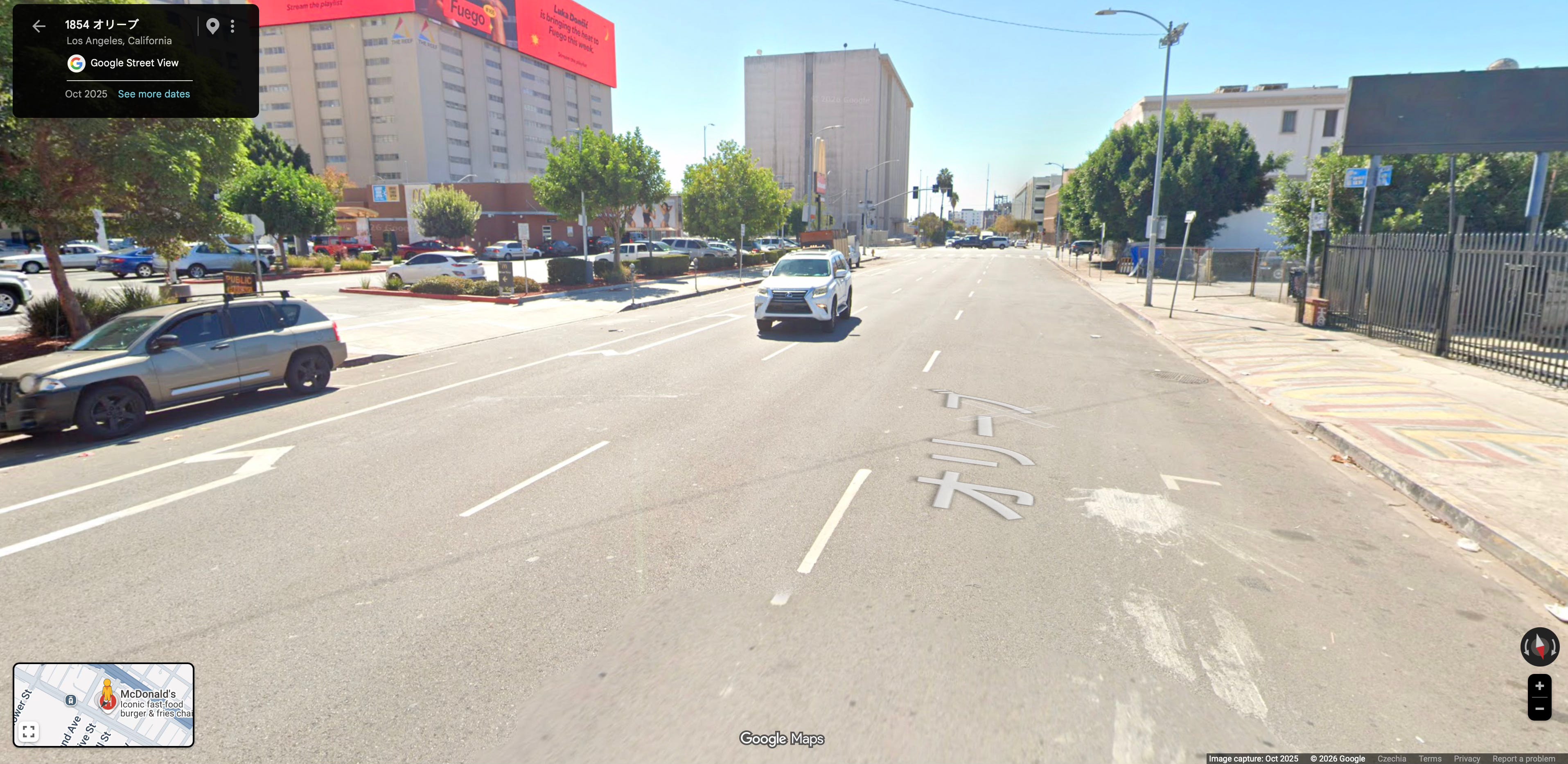
Nevertheless, this will not be another cookie-cutter Europoor essay where people try to explain to Americans why their life is so much better than theirs while making 2,700 USD net a month — because they can walk past an old building a few times a week, while their big salary does not really matter because they spend half their lives commuting from the suburbs to the office in their SUV to avoid getting stabbed on the street by a crackhead. What I immediately understood in Los Angeles is that this country simply works very differently than not only Europe, but probably most of the old world as well. The relationship between wealth and public and urban space just operates by different rules. I do not remember where I read it, but someone once described the US as best thought of as a super high-functioning wealthy Latin American country rather than some strange mutation of a European one. It is hyperbolic, but there might be something to it. Of course the United States is a massive, continent-spanning country and a diverse one at that, so there are substantial internal differences. The closer one gets to the American Northeast, the more European the overall feel — the mentality of the people, the architecture, the urban design. New York, which I visited a couple of years later, is a different beast altogether. Hell of a city.
If one tries to measure the wealth of a place in America by evaluating the quality, safety and pleasantness of its streets and downtown, one will often simply arrive at absurd conclusions. Because there are countless cities around the world that are not wealthy by any first world standard and yet are much, much more pleasant to spend time in than Los Angeles. In my personal experience, Sarajevo, the capital of Bosnia and Herzegovina, is far more pleasant than Los Angeles. It is definitely safer, there were very few homeless people, and there is a lot of very nice architecture — even though plenty of Yugoslav brutalism as well, which I happen to like. The average life expectancy in Sarajevo and Los Angeles is likely actually pretty similar — for Los Angeles it is 81, and while we do not have separate data for Sarajevo, the Bosnian average is 78, and since Sarajevo is the most developed part of the country, it will in all likelihood be a few years higher.
Is Sarajevo wealthier than Los Angeles though? Obviously not even close. Those 1.1 trillion dollars that the Los Angeles metropolitan area generates annually are real. Those Malibu and Beverly Hills mansions are real. But you are also far more likely to experience something deeply unpleasant or outright dangerous in Los Angeles than in Sarajevo — and in most major American cities for that matter — and the overall urban pleasantness of those cities is generally much lower. I know walkability has become something of an annoying buzzword, but being able to get around a city mostly on foot — or combining walking with public transport — is genuinely good for the body and therefore for the soul. Charles Dickens was an obsessive walker, covering up to 30 kilometres a day, and his night walks through London were a crucial part of his creative process. I have done something similar at various points in my own life, walking whenever time allowed. I not only lost weight but came to know my city in a more intimate way.
Now, I am not trying to claim that LA is representative of America as a whole. I am aware that most Americans do not particularly like that city either. But it is a useful case precisely because it is a city that is unambiguously very rich — it simply creates an enormous amount of valuable goods and services — and yet is not especially nice, safe or pleasant by any obvious measure one would use for cities elsewhere. Which brings me to why I am talking about this at all.
Recently, Substack has seen several continuations of the never-ending back and forth about the relative economic positions of America and Europe. And understanding this distinction — between wealth and everything else people tend to fold into it — is fairly important for navigating that debate. There were several interesting posts on this issue by Paul Krugman and also a broadly shared response to him by Silicon Continent. They all contain very interesting data and perspectives. I wrote a fairly lengthy post on the subject myself back in December, full of data. Yet in this one, I do not want to get into the data as much.
The general problem with these never-ending comparisons is that people — in this case especially Europeans — are constantly moving the goalposts, shifting from purely economic evaluation towards categories that are simply much harder or impossible to measure. Wealth is a quantitatively measurable category. We have tools to measure it. Sure, there is some room for interpretation — nominal GDP versus PPP, the influence of the dollar exchange rate, productivity and disposable income — but that will mostly only tell us whether America is wealthier than Europe or much wealthier than Europe. The conclusion is fairly clear to whoever looks at the data. Is America safer than Europe, healthier than Europe, does it have better urbanism or infrastructure, is the average American happier than the average European? Well, it is entirely possible that the answer to most of these questions is no — at least if we are talking about wealthy northwestern Europe, since people comparing Europe and America quite obviously do not have Moldova or Kosovo in mind. In 2024, American life expectancy hit a record high of 79 years — yet the average across wealthy European nations stands at 82.7, a gap of nearly four years - heart disease and drug overdoses are among the leading killers, and the wealthiest Americans in some cases survive no longer than the poorest citizens of Germany, France, or the Netherlands. Precisely why Americans lead less healthy lives than people in virtually any other wealthy country remains unclear — but the fact itself is beyond dispute. The massive gap in murder rates between the two continents is, of course, well-known — American homicide rates run four to six times higher than the European standard. But apart from health and safety statistics, which are fairly clear-cut, we are simply drifting away from measurable categories and into the territory of pure value judgement.
And even with life expectancy, it is not some fundamental law of nature that the person who lived 4.7 years longer necessarily lived a happier, more valuable or more fulfilled life simply because it was a bit longer. Is living until 95 somewhere on the Mediterranean coast — eating the healthy and tasty diet of that region, a bit of red wine and plenty of seafood, getting around on foot or by bike, spending time with friends — the idea of a good life? Is grinding hard in New York finance or Silicon Valley, earning a lot of money and building something big and valuable, and then possibly dying of a heart attack at 68 a worse life? Who lived the better life — the nomadic riders of the vast Eurasian steppe, who wreaked havoc and terror upon the sedentary farming civilizations on their borders, or the settled agriculturalist spending his life in fear of the eternal menace appearing on the flat horizon, hoofbeats rolling in like thunder on a hot summer day? Some say that what is best in life is to crush your enemies, see them driven before you, and hear the lamentation of their women. It sounds pretty damn rockstar-like. And yet in the end, the meek agriculturalists — toiling the land, doing what the warriors called women’s work — simply, decisively and completely won.

One might argue that the European model is simply not economically sustainable — with population rejecting the “hustle culture” in favour of “working to live rather than living to work”, the base of people paying enough into the system to sustain still-high-quality public services and infrastructure keeps narrowing, especially as populations age rapidly and are increasingly replenished by immigrants who often lack the human capital to fully replace retiring natives. In the case of America, the unsustainability may be of a more social nature — manifesting as a pervasive atmosphere of atomisation, mutual distrust and barely contained anger. It is up to anyone’s judgement. Answering such questions would ultimately require resolving a number of ethical and philosophical issues about what a good life is and how it should be lived. But that is not what economists are trying to measure when they talk about which continent is richer. Europeans tend to fall back on the “well, not everything is about money, you know” sort of rhetoric — like the Dude talking to the Big Lebowski. And they are completely correct. Not everything is about money. Except when measuring who is richer. Then it is about the money.
The reason Americans use the condescending term “Europoors” is not simply because Europeans are poorer than them — almost every country on the planet is poorer than America. It is because Europeans are poorer than Americans, quite notably so and with the gap growing, yet often refuse to acknowledge this while remaining remarkably smug and condescending about it. Of course Europe — and here I mean political Europe, not necessarily the entire continent — is not poor by any global metric, and it will not be anytime soon. It is and will remain the wealthiest bloc of nations outside North America. Europe is in a more or less similar position as the other “old” developed countries around the planet such as Canada or Japan. But there is a real problem with the lack of acknowledgment of Europe’s current economic position.
A piece by the Wall Street Journal titled “What Happens When Europeans Find Out How Poor They Are?” recently made the rounds online. For me the most interesting part of that article is not the economic disparity itself, but the data on the denial. Respondents to a poll were asked to guess how the British economy compares with the United States. On average, they thought that if the UK were an American state, it would rank seventh in per-capita GDP — somewhere behind New York and California. The reality is that Britain sits toward the bottom of the table, roughly on the level of Mississippi.
Now, I have always found the Mississippi comparison somewhat misleading — not because it is flattering to Britain, but because Mississippi is not a national economy. It is a regional unit within a much larger one, and as such its economy is inevitably propped up by fiscal transfers from wealthier states. Mississippi receives $2.73 back for every $1 it pays in federal taxes, roughly 45% of its entire state budget consists of federal dollars, and three quarters of its Medicaid costs are covered by the federal government. Strip that away and the comparison looks rather different. But that is somewhat beside the point. It is undeniably true that European countries would fare significantly less favorably than their inhabitants would guess when stacked up against American states.
If you do not want Americans using the term Europoor, then the next time you are confronted with that accusation, simply admit you are poorer. “Yes, our innovation in emerging tech fields certainly lags behind and it shows. But it is still a great place to live overall. Hopefully we will close some of that gap.” If non-financial factors are indeed so important for quality of life, it should not be particularly hard to admit to being notably poorer. And for the term “America is just a rich third world country” — which many Europeans love to deploy — to work, America must really be, well, rich. The claim that America is in many respects uniquely dysfunctional for its level of wealth — which in many ways is true — is poignant precisely because that level of wealth is so absolutely massive. One could even argue that America’s wealth is large enough that those who have it can buy their way around every broken public system individually, which removes the pressure to ever fix those systems collectively — the massive wealth of the country, combined with its sheer scale, may itself play a role in sustaining some of these dysfunctions.
The best way to see through this facade is to simply listen to what Europeans talk about among themselves when the conversation is not about America. You do not hear much about the incalculable value of strolling past historical monuments or the beauty of public transport and universal healthcare. You hear a great deal about rising costs of living, housing prices, taxes being too high and wages too low. When it comes to disposable income of the median household, America is simply much richer than Western Europe, often by a large margin. The difference in purchasing power between the US and countries like the UK, France or Italy sits at around 40% — in other words, America is roughly as much richer than Italy, France or the UK as those countries are richer than Turkey. Let that sink in.
But it is also important to acknowledge that Americans are mostly not as cool about all this as they tend to pretend. Americans engaging in this kind of debate online often give the impression that their biggest dilemma is whether to spend their massive salary on an extra air conditioning unit for one of their six bedrooms or fly to some Europoor city to marvel at the cathedral and laugh at how cheap everything is. And yet when one watches American society and politics, the nation does not seem all that content with its lot. If the economy is so strong, but American society still appears to be experiencing almost continuous social convulsion — there were three assassination attempts on Donald Trump — one can barely imagine how that society would react to a serious economic downturn. The feeling one gets is that America is now genuinely dependent on strong economic performance to maintain social peace. If a crisis of the magnitude of the Greek one after 2010 were to hit, I suspect the social fabric would struggle to hold.
To illustrate what I mean, let us look at what Greek society actually went through. Between 2009 and 2014, healthcare spending fell by more than 25%, average wages dropped by 20%, and unemployment surged from 9.6% to 26.5%. The share of the population at risk of poverty nearly tripled, from 16.4% to 42.7%. Between 2009 and 2011, Greece saw outbreaks of West Nile virus and the return of malaria, largely attributed to the collapse of public health infrastructure. There was a wave of suicides caused not by illness, but by economic conditions. With youth unemployment peaking at 50%, entire families came to depend on their grandparents’ pensions — which were themselves being cut — for survival. And yet Greek society, battered and tested as it was, got through it more or less intact, largely due to the strength of tight-knit family structures and a level of social cohesion that still exists in many — though not all — European societies. In moments of real hardship, the non-financial factors start to matter enormously. In other words — if some large economic shit hits the fan, I would not want to be in America, or more specifically in a large American metro area. I am sure rural Connecticut or Wyoming will be just fine.
This is mostly anecdotal, but from talking to a fair number of young American men, my impression is that social relations in the United States — family, friendships, men and women — are in significantly worse shape than in Europe, for reasons I cannot claim to fully understand. Relations between the sexes are noticeably more guarded, and the social lives of young people seem less rich. A lot of interactions tend to be transactional or business-like in character. Several people have told me that the gap between Europe and America in this regard has been widening over the past decade or so.
There seems to be quite a lot of projection going on in this debate. What you resent often reveals what you secretly wish you were, or what you genuinely fear. Much of what Europeans resent about America seems to betray what they actually envy. The wealth, the tech companies dominating European markets with no local contenders in sight, the often lavish lifestyle, the confidence and weight in international affairs, the ability to call the shots. Europe used to be all of that, and it is not anymore. Before 1914, the average citizen of a Western European country could look out at the world and reasonably observe a system of economic, cultural, political and military relations in which his part of the world was firmly on top. Today, Europe is simply an economically still significant yet broadly peripheral part of the American quasi-empire. It remains a prosperous and developed part of the world by any international standard, yet its days of centrality in global affairs are simply gone with the wind. The most competent and ambitious person many Europeans know will likely end up doing business in America and making billions there.
And yet Americans who are loudly preoccupied with the imminent social dissolution of European countries — violent ethnic fragmentation, civil war, crime, immigration and whatnot — may often be speaking more about their own fears than about any European reality. There was another interesting piece in the Wall Street Journal earlier this year, this time about a different dimension of the US-Europe relationship. Americans are leaving the United States in record numbers, many of them for Europe. Driven by healthcare costs, gun violence, political disenchantment and the rise of remote work, ordinary Americans — not just adventurers or retirees — are replanting themselves across the continent.
“You don’t face the prospect of your 5-year-old going into kindergarten and doing an active shooter drill. The wages are higher in the US but the quality of life is higher in Europe.” That is Chris Ford, 41, now raising his children in Berlin. A statement that must make the average anti-American Europoor shimmer with pleasure.
A few numbers worth sitting with. The American population in Portugal has surged over 500% since the pandemic, with Americans now accounting for 58% of all foreign property buyers there. Ireland issued 31,825 passports to Americans in 2024, rising to an estimated 40,000 last year. 40% of American women aged 15 to 44 say they would like to permanently move abroad — a higher share than the 37% of sub-Saharan Africans who express the same wish. It is certain that a significant part of this is purely performative, yet it is still quite remarkable. For the first time, there are now more natural-born Americans living in Norway than Norwegian-born residents in the United States, and more Americans migrated to Germany in 2024 than Germans to America.
Of course this will not lead to any meaningful depopulation of America — those numbers are still rounding errors against a growing population of 330 million. Yet it is significant that it is happening precisely as the economic gap between the US and Europe is widening in America’s favour. Counterintuitive, to say the least. American expats describe their motivations as a tangle of economic incentives connected to lower cost of living, lifestyle preferences and disenchantment with the trajectory of their country — citing violent crime and turbulent politics. When Gallup asked Americans during the 2008 recession how many wanted to leave the country, the answer was one in ten. Last year it was one in five — above the world average, and higher than in Southeast Asia.
There is a strong political element to this data. The share of young women expressing a desire to emigrate started rising sharply after 2016 — one wonders what might have happened that year — and there is a notable gap in emigration sentiment between those who approve of Trump’s leadership and those who do not. One might imagine many Americans being tempted to respond with “well, good riddance, enjoy it out there and don’t come back.” But that attitude does not bode particularly well for the social fabric of the country. Perhaps there is a deeper legacy at work here. The ancestors of virtually every American — well, with the exception of most Black Americans — were people willing to uproot themselves and leave when they did not like what they had. Perhaps this tendency is simply baked into the social fabric.
It is of course still entirely true that those Americans moving to Europe are usually able to enjoy European life precisely because they made their money in the US first. When you speak to many European businessmen, they will often tell you something simple: do business in America, live in Europe. I personally know a Czech who built a business in the States, lived there for several years, and came back when he had a child — he thought that the kind of childhood he wanted for his kid was simply not available in America. A pattern may be emerging. People from the broader West go to America the way ambitious young people go to the big city — to make it. Then many come back to enjoy the fruits of their labour somewhere more liveable.
The divorce of the US and Europe is an often declared wish, perhaps on both sides of the Atlantic. Yet beyond the political bickering, the two continents remain in many ways as deeply intertwined as ever. American companies hold roughly $6.8 trillion in outward foreign direct investment worldwide, with Europe alone accounting for around $4.0 trillion of that — well over half. On the other side, the EU’s total outward investment stock stands at roughly €9 trillion globally, with the United States absorbing somewhere between €2.4 and €2.7 trillion, making it by far Europe’s single largest destination. And as the migration statistics suggest, the social integration is not going anywhere either. The rise of remote work opens up possibilities in new modes of economic life that, while temporarily turbocharged during Covid, are still being explored and expanded. As Lee Kuan Yew once observed, globalisation is not primarily a political decision but a technological reality — and the internet and the airplane are not about to be uninvented.
Europe should come to terms with the fact that being essentially a premium lifestyle destination and digital nomad playground is not a path back to the first league — and in all likelihood, it probably will not get there. Americans, meanwhile, need to come to terms with the fact that for the absolutely massive amount of wealth their country produces, a substantial part of it perhaps really is a pretty unpleasant place to actually live in.
No posts
Comments
Nothing yet. Say the first thing.
Sign in to join the conversation.